Rethinking Animal Intelligence
The human brain contains roughly 86 billion neurons, a biological supercomputer responsible for everything from composing symphonies to remembering a grocery list. We often assume this kind of centralized processing is a requirement for any complex behavior. Yet, some of the planet’s most ancient survivors navigate their worlds with a quiet sophistication that completely bypasses the need for a brain.
This challenges our entire understanding of intelligence. How do creatures like jellyfish and starfish hunt, avoid danger, and find their way without a central command center? Their survival isn’t a fluke. It’s the result of a radically different, and highly effective, evolutionary strategy. Instead of a single brain, they rely on decentralized nervous systems that distribute the work of thinking and acting across their entire bodies. These are not primitive holdovers but masterclasses in efficiency.
The Jellyfish’s Distributed Nerve Network
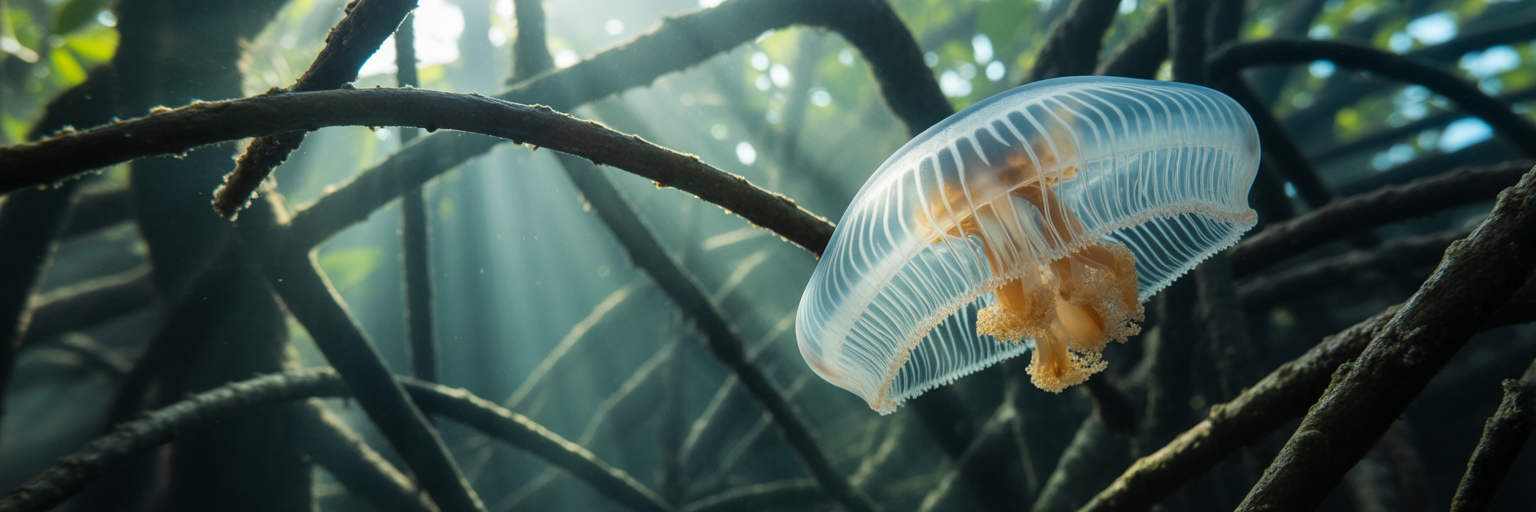
The jellyfish is a perfect example of this distributed intelligence. It moves with a ghostly grace, pulsing through the water, finding food, and dodging threats, all without a single, centralized brain. Its secret lies in a unique neural architecture that is both simple and profoundly effective.
The ‘Nerve Net’: A Brainless Command System
Instead of a brain, a jellyfish has a “nerve net,” a diffuse mesh of neurons spread throughout its body. Think of it less like a corporate headquarters and more like a city-wide sensor grid where information is processed locally. When one part of the jellyfish touches something, the nearby nerves react instantly without needing to send a signal all the way to a central processor and wait for instructions. This design allows for remarkably fast, reflexive responses to its immediate environment.
Rhopalia: The Jellyfish’s Sensory Hubs
While the nerve net handles reactions, specialized structures called rhopalia act as sensory hubs. These clusters of neurons, spaced around the edge of the jellyfish’s bell, are its version of eyes and ears. They are responsible for a surprising range of functions:
- Sensing light and dark, which helps with orientation
- Maintaining balance and controlling the pulsing rhythm
- Detecting chemical cues from prey or predators in the water
Learning Without a Brain: The Case of the Box Jellyfish
The question of how do jellyfish navigate becomes even more fascinating with the Caribbean box jellyfish. This creature uses its 24 eyes, grouped within its rhopalia, to perform incredible feats of box jellyfish obstacle avoidance as it maneuvers through tangled mangrove swamps. It’s not just bumping into things. As a 2023 study highlighted by Nature reported, these jellyfish demonstrate associative learning in invertebrates. They can learn to associate a visual cue, like the color of mangrove roots, with a physical obstacle and adjust their path accordingly. This form of memory was once thought impossible without a brain. It’s another reminder of their remarkable adaptations, much like the species that can reverse its aging process, a topic we explored in How One Tiny Jellyfish Learned to Reverse Its Own Aging.
Starfish Locomotion Through Local Control
Shifting from the jellyfish’s neural web, the starfish presents an entirely different solution to brainless navigation. Its movement isn’t driven by a network of nerves alone but by a brilliant piece of biological engineering: a hydraulic system that gives it a slow, deliberate grip on its world.
The Water Vascular System: A Hydraulic Engine
A starfish moves using its water vascular system, a network of canals filled with seawater. This system acts as a hydraulic engine, controlling hundreds of tiny tube feet on the underside of its arms. By changing the water pressure within these feet, the starfish can extend, retract, and grip surfaces with surprising force. It’s like operating a series of interconnected water pumps, each one contributing a small action that adds up to coordinated movement. This is the key to understanding starfish movement without a brain.
Decentralized Command in Every Arm
Imagine a starfish navigating the rugged, rocky coastline of the Pacific Northwest. There is no “leader” arm directing the others. Instead, each arm operates semi-independently, with its tube feet sensing and reacting to the surface directly beneath them. If one arm senses a better path or a stronger grip, the other arms gradually coordinate to follow its lead. Dominance shifts fluidly from one arm to another based on the goal. This coordinated motion is an emergent property, not a top-down command. It’s a stunning example of nature’s diverse solutions, much like the bizarre behaviors detailed in The Parasite That Turns Snails Into Zombies.
Emergent Behavior from Simple Rules

The abilities of jellyfish and starfish seem complex, but they arise from a simple principle: emergent behavior. This is when sophisticated, coordinated actions appear from many individual components following basic rules, all without a central director. You see it everywhere in nature. A flock of starlings moves as a single, flowing entity because each bird follows a few simple rules related to its neighbors. Traffic jams form from the individual decisions of thousands of drivers, not from a single command.
This is precisely what happens in these brainless animals. For the jellyfish, the simple rules governing its nerve net and sensory rhopalia lead to learned obstacle avoidance. For the starfish, the independent actions of hundreds of tube feet result in fluid locomotion across uneven terrain. These are two powerful decentralized nervous system examples, though one is neural and the other hydraulic. The resilience of this model is a major advantage. A starfish can lose an arm and continue moving, something a creature with a centralized control system could never do.
| Feature | Jellyfish (Nerve Net) | Starfish (Water Vascular System) |
|---|---|---|
| Primary Mechanism | Diffuse mesh of neurons | Hydraulic pressure in tube feet |
| Control Method | Local sensory-motor reflexes | Independent arm and foot action |
| Key Sensory Input | Light, balance, and chemical cues | Touch and chemical signals at feet |
| Resulting Behavior | Obstacle avoidance, hunting | Coordinated crawling on uneven terrain |
What This Means for the Evolution of Cognition
Studying these creatures forces us to abandon the conventional, linear view of evolution that places brained vertebrates at the top of an intelligence ladder. Decentralized architectures are not a mere stepping stone to a “better” brained existence. They are an incredibly successful and ancient evolutionary strategy that has allowed lineages like jellyfish and starfish to thrive for hundreds of millions of years. Intelligence, it turns out, is a wide spectrum of diverse solutions to environmental problems.
These animals that learn without a brain offer more than just biological curiosity. They provide blueprints for innovation. As explained by researchers on Phys.org, the starfish’s ability to coordinate hundreds of feet without central oversight is a masterclass in distributed intelligence, a model that inspires modern robotics. Engineers are designing decentralized networks to create more resilient and adaptable machines that can function even if parts of the system fail. This mirrors the incredible survival strategies found throughout nature, like The Frog That Freezes Solid and Thaws Back to Life, proving that there are many ways to solve the problem of survival.
A Different Kind of Smart
In the end, the jellyfish and starfish reveal a profound truth: intelligence is not synonymous with having a brain. One uses a distributed network of sensors and associative learning to navigate its world, while the other employs decentralized hydraulic control to crawl across the ocean floor. Both achieve complex, goal-oriented behavior from simple, distributed systems.
These creatures are not unintelligent. They are differently intelligent. Their existence encourages us to look closer at the “alien” minds operating all around us and appreciate the vast, creative diversity of life on Earth. To see more of nature’s most incredible phenomena, we invite you to explore our main blog, Nature Is Crazy.