Our bodies are remarkable at healing. A paper cut vanishes in days, and a broken bone can mend itself stronger than before. Yet, our abilities have firm limits. The loss of a limb is permanent. In the animal kingdom, however, such rules do not always apply. For some organisms, regeneration is not just about healing; it is a biological superpower that challenges our very definitions of life and survival. What if a catastrophic injury was merely a temporary inconvenience? This question is not science fiction. It is a reality for creatures like the sea slug that can decapitate itself and grow a new body, or the humble flatworm that can regrow from a tiny fragment. Their existence forces us to look at biology in a completely new light.
The Self-Decapitating Photosynthetic Sea Slug
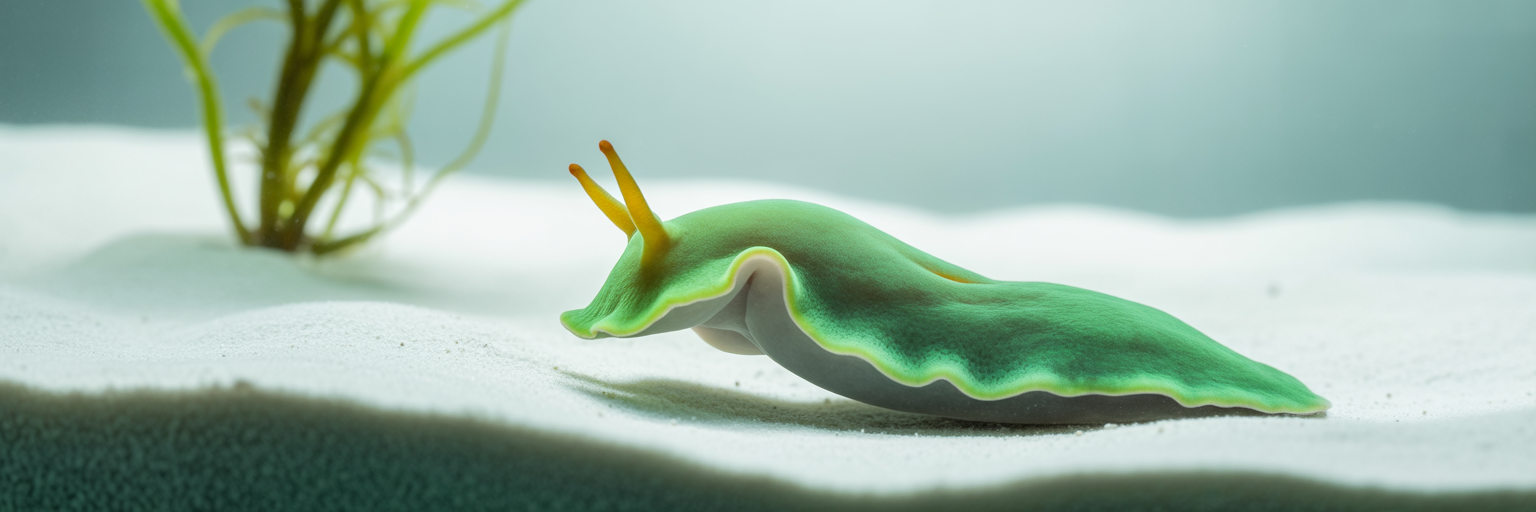
Among the most stunning examples of regeneration is the sea slug, Elysia cf. marginata. This small marine animal performs an act that seems impossible: it voluntarily severs its own head. This is not the result of an attack but a deliberate survival strategy known as autotomy. The abandoned body, complete with its heart and other organs, is left behind. The head, meanwhile, simply crawls away and carries on.
How does a disembodied head survive for weeks? The secret lies in something it stole. These slugs feed on algae, and instead of digesting everything, they incorporate the algae’s chloroplasts into their own tissues. This allows the severed head to perform photosynthesis, essentially becoming a solar-powered, mobile organism. As a recent study in Scientific American highlighted, this borrowed energy fuels an incredible feat. The process of how this sea slug regenerates body parts is astonishing:
- The sea slug intentionally severs its head from its body.
- The head continues to move and feed, surviving for weeks via photosynthesis.
- Over approximately three weeks, the head regenerates a complete, new body, heart included.
- The original, discarded body cannot regenerate a head and eventually perishes.
This process is so efficient that some slugs have been observed doing it more than once. However, there is a trade-off, as older slugs lose this ability, suggesting it requires immense energy. This slug’s strategy is one of nature’s most extreme survival tactics, rivaling even bizarre cases like the frog that freezes solid and thaws back to life.
Planarians: The Ultimate Masters of Replication
If the sea slug’s self-renewal is shocking, the planarian flatworm takes regeneration to an entirely different level. While the slug needs its head to regrow, a planarian can rebuild itself from almost any piece. This is the subject of a classic biology experiment: slice a planarian into several pieces, and within a week or two, each fragment will have grown into a complete, independent worm.
The foundation of this incredible ability is a massive population of adult stem cells called neoblasts. These cells are pluripotent, meaning they can become any type of cell the worm needs, from skin to neurons to digestive tissue. The planarian flatworm regeneration process is so robust that a fragment as small as 1/279th of the original organism can successfully form a new worm. It is a level of biological replication that feels almost alien, much like the parasite that turns snails into zombies with its mind-controlling abilities.
Perhaps the most baffling aspect is memory retention. Studies have shown that when a planarian is trained to navigate a maze, and then its head is removed, the new head that grows back seems to retain some of that training. This raises profound questions about where memories are stored. Is it purely in the brain, or is information somehow encoded throughout the body? The planarian suggests the answer is far more complex than we ever imagined.
A Spectrum of Regenerative Abilities
The abilities of sea slugs and planarians represent the extreme end of regeneration, but they are not alone. Nature showcases a wide spectrum of these powers, with each organism offering a different lesson. Among vertebrates, the axolotl stands out. This North American salamander is famous for its capacity for perfect axolotl limb regrowth. If it loses a leg, it does not just grow back a stump; it regenerates a flawless replacement, complete with bones, muscles, nerves, and skin, leaving no scar behind. Its abilities extend to regenerating parts of its jaw, spinal cord, and even sections of its brain.
At a simpler level, we find the hydra. This tiny freshwater polyp can regenerate from disorganized cells. If you were to break a hydra apart and mix its cells, they would re-aggregate and reorganize themselves into a new, complete organism. These varied regenerative biology examples show there is no single method for rebuilding a body. Instead, evolution has produced a toolkit of different strategies.
| Organism | Type of Regeneration | Key Mechanism | Notable Feature |
|---|---|---|---|
| Sea Slug (Elysia) | Whole-Body | Autotomy & Organogenesis | Survives via photosynthesis post-decapitation |
| Planarian | Whole-Body (from fragments) | Stem Cell-Based (Neoblasts) | Can regenerate from a tiny fraction of its body |
| Axolotl | Limb & Organ | Epimorphosis (Blastema formation) | Perfect, scar-free regrowth of complex structures |
| Hydra | Whole-Body | Morphallaxis (Tissue remodeling) | Can regenerate from dissociated cells |
This table illustrates the diverse strategies animals use for regeneration, from rebuilding entire bodies to perfectly replacing complex limbs. The mechanisms vary significantly, highlighting that regeneration is not a one-size-fits-all ability.
The Biological Blueprint for Rebuilding
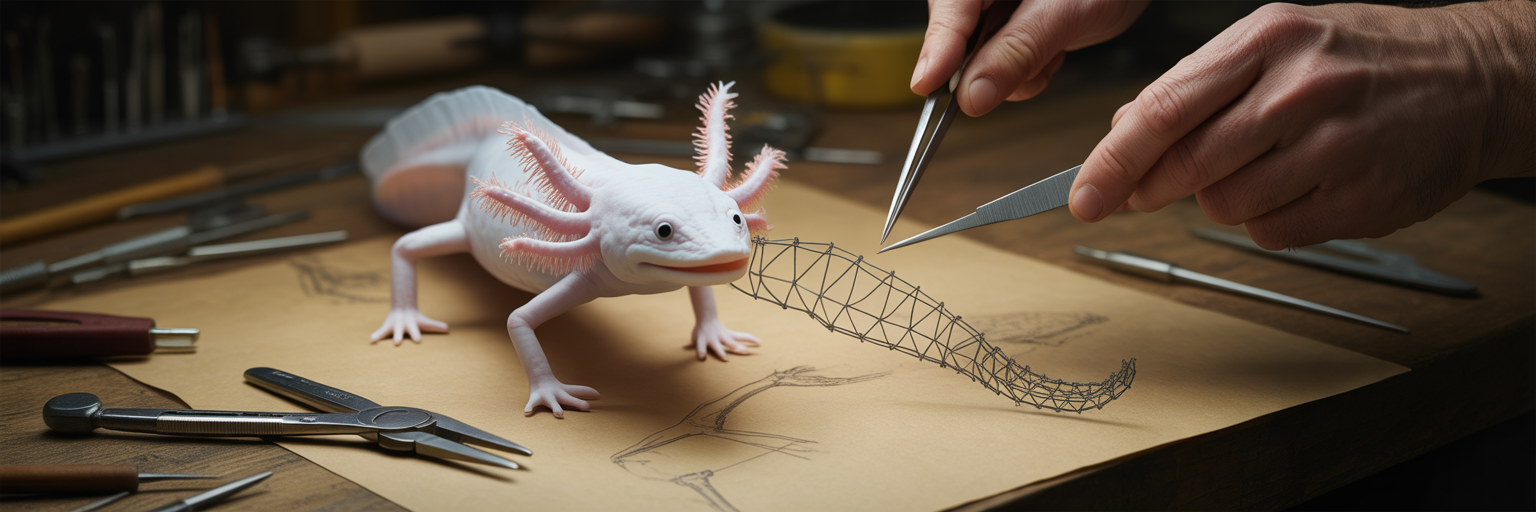
So, how do these animals accomplish such incredible feats? The animal regeneration process generally follows one of two main pathways, each with a distinct approach to rebuilding. As outlined in research published by ScienceDirect, these methods reveal the fundamental blueprints for creating life from existing parts.
Morphallaxis: Remodeling from Existing Parts
Think of morphallaxis as reshaping a single block of clay into a new sculpture. This process involves reorganizing existing tissues to recreate a complete organism, often without much new cell growth. The hydra is a prime example. When cut, its remaining cells shift and repattern themselves to form a smaller but complete version of the original. It is a masterpiece of cellular transformation, not unlike the process seen in the immortal jellyfish that can reverse its own aging.
Epimorphosis: Rebuilding from Scratch
Epimorphosis is more like building an extension on a house with new bricks. This process relies on growing new structures from the ground up. When an axolotl loses a limb, a special structure called a blastema forms at the wound site. This mass of undifferentiated cells, similar to stem cells, contains all the instructions needed to build a new limb from scratch. This method allows for the replacement of complex, multi-tissue structures.
- Morphallaxis: Repatterns existing tissue. There is little new growth, and the organism may shrink initially. This is seen in hydras.
- Epimorphosis: Involves new cell growth. It forms a blastema at the wound site and builds new structures. This is seen in salamanders.
Unlocking Regenerative Secrets for Human Health
Studying these incredible animals is more than just a scientific curiosity; it holds immense promise for human health. So why can’t we regenerate like an axolotl? When we suffer a major injury, our bodies prioritize closing the wound quickly to prevent infection. This results in the formation of scar tissue, which acts as a biological patch but lacks the function of the original tissue. Animals like salamanders, however, suppress this scarring response and activate genetic pathways for regeneration instead.
Researchers in regenerative medicine are studying these regenerative biology examples to create a biological roadmap for reactivating these dormant abilities in our own cells. The long-term goals are ambitious but grounded in real science: healing spinal cord injuries, repairing heart muscle after a heart attack, and perhaps one day, regrowing entire limbs. This is not a fantasy. It is a serious scientific pursuit backed by major institutions worldwide.
While the prospect of human regeneration remains a distant goal, the secrets are being unlocked one organism at a time. Each discovery brings us closer to a future where conditions once considered permanent might become treatable. To explore more of nature’s most fascinating stories, you can find further articles on our blog.