Life Beyond the Head
For humans and virtually all other vertebrates, decapitation is the absolute end. Our entire existence is managed by a single, centralized command center: the brain. Without it, all systems fail instantly. Yet, in the natural world, this certainty dissolves. A handful of organisms treat the loss of a head not as a final curtain, but as a temporary inconvenience. These are the animals that live without a head, challenging our most basic assumptions about life and death.
Creatures like cockroaches and certain sea slugs demonstrate that a body can persist, and in some cases, even thrive after such a catastrophic event. But how is this possible? Their survival isn’t magic; it’s the result of brilliant, and sometimes bizarre, biological engineering. This article explores the three core strategies that enable this phenomenon: decentralized nervous systems, profound regenerative abilities, and unique physiological adaptations that turn a fatal injury into a viable survival tactic.
The Decentralized Command Center
The cockroach is perhaps the most famous example of post-decapitation survival, and the reason lies in its fundamentally different body plan. Unlike humans, whose functions are micromanaged by the brain, cockroaches are classic decentralized nervous system animals. Their neural network is distributed throughout the body in clusters of nerve tissue called ganglia. Each body segment has its own local command center that manages basic reflexes and movement independently of the head.
This distributed system is why decapitation isn’t immediately fatal. As explained by entomologists in Scientific American, an insect’s body is not dependent on the brain for critical life-support functions. Several factors contribute to this resilience:
- Distributed Nerves: The body can still react to touch and move its legs without any signals from the brain. The ganglia in the thorax continue to operate, allowing the headless body to stand, react, and even walk.
- Open Circulatory System: Insects don’t have a high-pressure network of blood vessels like we do. When a cockroach loses its head, there is no catastrophic drop in blood pressure. The neck wound simply clots, preventing it from bleeding out.
- Breathing Without a Head: A cockroach breathes through small pores on its body segments called spiracles. Since respiration is not controlled by the brain or mouth, the body can continue to take in oxygen.
So, how do cockroaches live without a head? They don’t, not permanently. While the body can survive for weeks, it has no way to eat or drink. Eventually, it succumbs to starvation, dehydration, or infection. It’s a remarkable display of survival, but one with a definite time limit.
The Ultimate Power of Regeneration
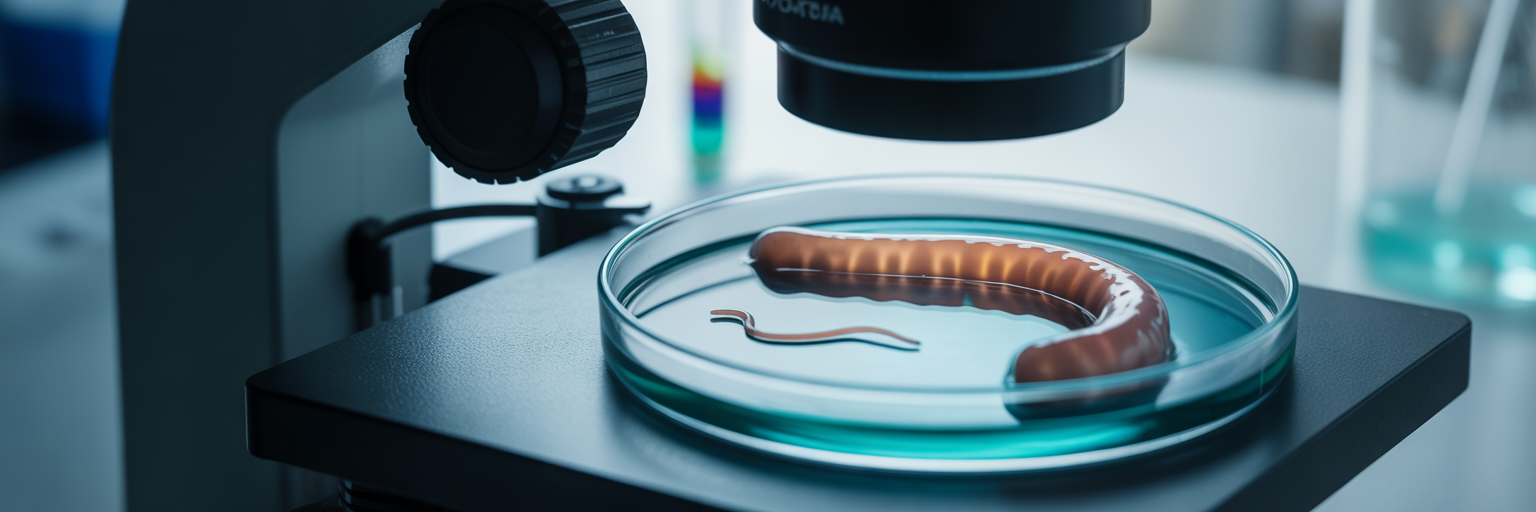
Surviving without a head is one thing, but growing a new one is another entirely. This is where the planarian flatworm enters the picture, demonstrating a mastery of the science of animal regeneration that seems almost mythical. If you cut a planarian into pieces, each fragment can regrow into a complete, fully functional worm. This includes regenerating a brand-new head with a new brain.
The secret to this incredible ability lies in cells called neoblasts. These are pluripotent stem cells, similar to the embryonic stem cells found in vertebrates, but with a key difference: they are distributed throughout the adult worm’s entire body. When the worm is injured, these neoblasts migrate to the wound site. There, they follow a genetic blueprint to differentiate into every type of cell needed to rebuild the missing parts, from skin and muscle to a complex nervous system.
This process stands in stark contrast to the limited regenerative capacity of humans and other vertebrates. While we can heal wounds, we cannot regrow entire limbs or organs from scratch. The planarian’s ability to reprogram its cells on demand is a biological marvel. This level of cellular reprogramming is a fascinating area of study, with scientists seeing similar wonders in other organisms like the unique jellyfish that can reverse its own aging process. For the planarian, regeneration isn’t just a healing mechanism; it’s a form of reproduction and the ultimate survival tool.
When a Head Regrows a Body
Just when it seems biology can’t get any stranger, we meet the sea slug *Elysia marginata*. This creature takes headless survival to an entirely new level. It doesn’t just survive decapitation; it can initiate it voluntarily. In a process known as autotomy, the slug can detach its own head from its body and simply crawl away.
What follows is astonishing. The severed head continues to move, feed on algae, and, over the course of a few weeks, regenerates an entirely new body, complete with a heart and all other internal organs. As covered in a report by Smithsonian Magazine, this discovery left researchers stunned. The old body, meanwhile, does not regrow a head and eventually decomposes.
Why would a sea slug regrow its body? The leading theory is that this is a radical strategy to eliminate internal parasites. If the body becomes too infested, the slug simply discards it and starts over. This feat is made possible by a remarkable ability called kleptoplasty. The slug steals chloroplasts, the photosynthetic machinery from the algae it eats, and incorporates them into its own skin. These stolen chloroplasts allow the detached head to sustain itself through photosynthesis, like a plant, providing the energy needed to perform the monumental task of regrowing a complete body. It’s a powerful reminder that parasites often drive extreme evolutionary adaptations, sometimes resulting in behaviors as strange as those seen in the parasite that turns snails into zombies.
The One-in-a-Million Anomaly

While the cockroach and sea slug have evolved repeatable strategies for headless survival, sometimes biology produces a complete fluke. The most famous example is the Mike the Headless Chicken story. In 1945, a farmer named Lloyd Olsen went to prepare a chicken for dinner, but his axe blow was imprecise. The blade missed the jugular vein, and, crucially, left the majority of the brainstem intact.
The result was Mike, a chicken who lived for 18 months without a head. This was not an evolved trait but a one-in-a-million accident. The brainstem, located at the base of the skull, controls essential autonomic functions. With his brainstem still functional, Mike’s body continued to manage his breathing, heart rate, and basic motor reflexes. He could still walk, albeit clumsily, and attempt to preen and crow.
However, Mike’s survival was entirely dependent on human care. Olsen fed him a mixture of milk and water with an eyedropper directly into his esophagus. He also had to regularly clear mucus from Mike’s throat to prevent him from choking. Mike’s story serves as a powerful illustration of the brainstem’s critical role in vertebrates. It also provides a sharp contrast to the self-sufficient survival of invertebrates, highlighting the difference between a biological accident and an evolved masterpiece of resilience. For more strange but true tales from the natural world, you can explore the articles on our blog.
What This Teaches Us About Life’s Resilience
From a cockroach’s distributed nerves to a flatworm’s cellular mastery, the strategies for headless survival are as diverse as they are fascinating. The article has shown three distinct paths: decentralized control allowing a body to function without a brain, total cellular regeneration to rebuild what was lost, and strategic self-decapitation to start anew. These mechanisms stand in stark opposition to our own biology. For humans, decapitation is instantly fatal due to our centralized nervous system, a catastrophic drop in blood pressure, and our brain’s absolute control over breathing.
These extreme examples push the boundaries of our biological understanding. They show that life can find a way to persist under conditions we consider impossible. The resilience seen in these creatures, much like the wood frog that can freeze solid and return to life, demonstrates that nature’s rulebook is far more flexible than we often imagine.
| Organism | Survival Strategy | Key Biological Feature |
|---|---|---|
| Cockroach | Surviving Decapitation | Decentralized nervous system (ganglia) and open circulatory system |
| Planarian Flatworm | Regrowing a Head | Pluripotent stem cells (neoblasts) distributed throughout the body |
| Elysia Sea Slug | Regrowing a Body | Autotomy (self-decapitation) and kleptoplasty (photosynthesis for energy) |
| Chicken (Mike) | Accidental Survival | Intact brainstem controlling autonomic functions (biological fluke) |
Note: This table compares the evolved, repeatable strategies of invertebrates with the accidental survival of a vertebrate to highlight the different biological principles at play.