Beyond Photosynthesis: A Plant’s Electrical Network
Long before humans developed sophisticated sensors, plants had already mastered the art of detecting environmental changes. We often see them as static, passive organisms, but this view overlooks a dynamic world of internal communication. The mechanism behind this activity is plant electrical signaling, a complex system that allows them to sense and react to their surroundings with surprising precision.
It is tempting to compare this to an animal’s nervous system, and while the analogy offers a starting point, the reality is far more unique. Plants operate a decentralized network without a central brain. Instead, every cell contributes to a collective awareness. This network processes a constant stream of information, responding to stimuli like a gentle touch, a shift in light, changes in soil chemistry, or a sudden drop in temperature.
While scientists have known about these electrical currents for decades, our ability to interpret them has been limited. Now, in 2026, the development of advanced bioelectronic technology for plants is finally allowing us to decode this hidden language. We are beginning to understand not just that plants are communicating, but what they are actually saying.
The Mechanics of Plant Bioelectricity

To understand how plants communicate electrically, we have to look inside their cells. Plant cell membranes are equipped with specialized ion channels that control the flow of charged particles like calcium, potassium, and chloride. When a plant is stimulated, these channels open or close, causing a rapid change in the electrical charge across the membrane. This sudden spike is known as an action potential, the same fundamental type of signal found in our own neurons.
From there, the signal doesn’t just stay in one cell. It travels through the plant’s vascular tissues, the phloem and xylem. We typically think of these as the plant’s plumbing system for water and nutrients, but they also function as its wiring, carrying electrical messages from one part of the plant to another. This creates a systemic signal, where a local event, like an insect bite on a single leaf, can trigger an electrical wave that puts the entire organism on high alert.
Of course, these signals are much slower than those in animals, traveling at speeds of centimeters per minute rather than meters per second. But speed isn’t the goal. This deliberate pace is perfectly adapted for coordinating whole-plant responses, such as activating defense compounds or adjusting growth patterns in response to environmental stress.
| Feature | Plant Signaling | Animal Signaling |
|---|---|---|
| Central Processor | None (Decentralized network) | Centralized brain and nervous system |
| Transmission Pathway | Phloem and xylem vascular tissues | Specialized nerve cells (neurons) |
| Signal Speed | Slower (cm/minute to cm/second) | Extremely fast (up to 100 m/second) |
| Primary Purpose | Coordinating defense, growth, and metabolic responses | Coordinating movement, sensation, and rapid reactions |
Sensing Touch and Imminent Threats
Some of the most dramatic examples of plant electrical signaling occur in response to direct physical contact. These are not slow, subtle adjustments but rapid, calculated actions that reveal a surprising level of sophistication. The most famous case is the Venus flytrap, which uses electricity to hunt.
The Calculated Trap of the Venus Flytrap
The trap of a Venus flytrap is lined with tiny trigger hairs. When an insect brushes against one, an action potential is generated, but nothing happens. The plant is waiting. If a second hair is touched within about 20 seconds, a second action potential is fired. The summation of these two Venus flytrap electrical signals triggers the trap to snap shut. This two-step verification system is a form of biological memory, preventing the plant from wasting energy on false alarms like a falling raindrop. It is a clear demonstration of a plant making a calculated decision. As a 2021 study in Scientific Reports confirmed, this movement is driven by measurable biomagnetic fields produced during its action potentials. A similar, though less predatory, response is seen in the Mimosa pudica, or sensitive plant, whose leaves fold inward instantly upon being touched as a defensive posture.
Defense Mechanisms Against Herbivores
The electrical response to being eaten is even more complex. When a caterpillar chews on a leaf, the specific damage creates a distinct electrical signature. This is not just a generic “ouch” signal. The message travels systemically through the plant’s vascular network to distant, untouched leaves. Upon receiving this warning, those leaves begin producing defensive chemical compounds, such as toxins or substances that make them less palatable. This coordinated, whole-plant defense system shows how plants communicate electrically to protect the entire organism from a localized threat. Even non-threatening physical stress, like persistent wind, triggers electrical signals that encourage the plant to grow stronger, more resilient stems.
A Broader Environmental Awareness
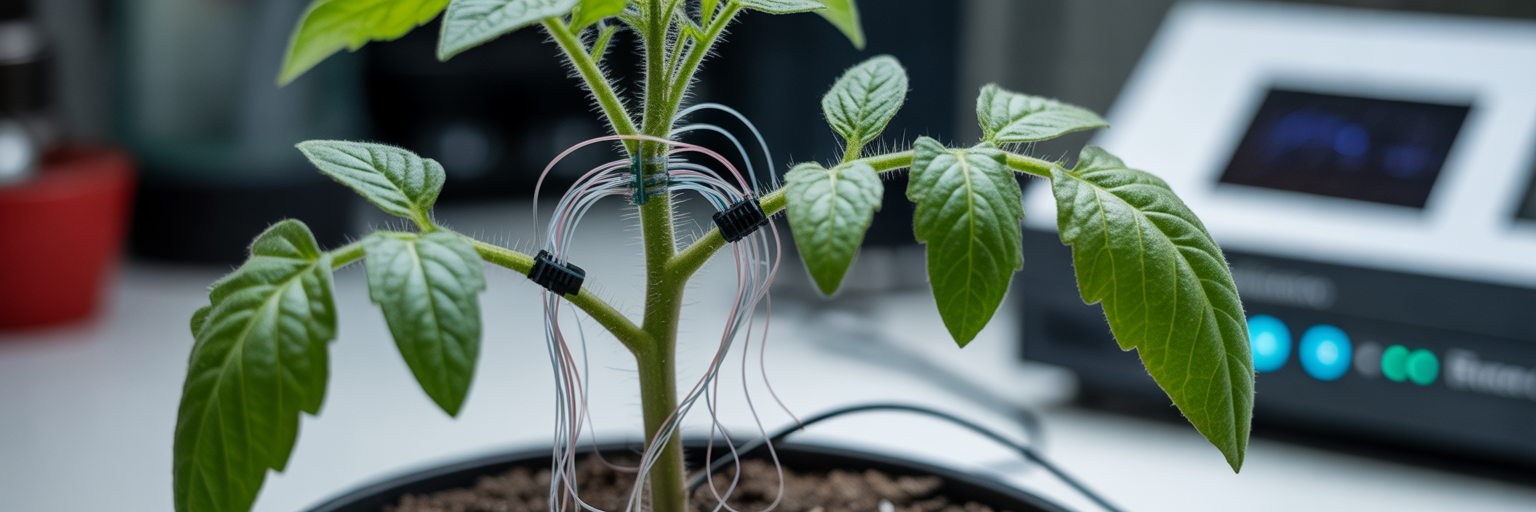
The latest plant intelligence research 2026 is pushing beyond obvious physical threats to explore how plants sense more subtle environmental cues. This work suggests a level of awareness that challenges our fundamental assumptions about the botanical world. Researchers are using machine learning and highly sensitive sensors to translate these complex signals.
Several frontiers are particularly exciting:
- Vibrational Acoustics: Studies are showing that plants can generate different electrical responses to different vibrations. They appear to distinguish between the harmless vibrations of wind and the specific frequencies produced by an insect’s wing beats, allowing them to prepare for a potential herbivore before it even lands.
- Decoding with AI: Machine learning algorithms are becoming our translators for the plant world. By analyzing vast datasets of electrical patterns, an AI can learn to differentiate the signal for “drought stress” from the signal for “pathogen attack.” This gives us an unprecedented, real-time window into a plant’s internal state.
- Bioelectric Fields: Some of the most forward-thinking research explores whether plants can sense the bioelectric fields of other nearby organisms. Early data suggests they may be able to distinguish the approach of different types of animals, though this remains a highly speculative area of study.
Recent explorations into this field, such as a 2024 paper highlighted by Frontiers for Young Minds, delve into how these electrical signals allow plants to act as early warning systems for environmental changes. While the data is compelling, it is important to maintain a balanced perspective. The interpretation of what plants truly “perceive” or “know” is a subject of intense scientific debate. We are listening to a conversation we are only just beginning to understand.
Applications in Future Farming and Conservation
So, what does this newfound understanding of plant communication mean for us? The practical applications, particularly in agriculture and environmental monitoring, are immense. By tapping into this natural information network, we can move from reacting to problems to anticipating them. The development of bioelectronic technology for plants is set to transform how we manage our natural resources.
Imagine a farm where growers receive real-time alerts directly from their crops. This is the promise of precision agriculture, guided by the plants themselves. The benefits are clear and direct:
- Water Stress Alerts: A plant could send a specific “thirsty” signal long before it shows visible signs of wilting. This would allow farmers to irrigate exactly when and where it is needed, dramatically conserving water.
- Nutrient Deficiency Alarms: A distinct electrical signal indicating a lack of nitrogen or phosphorus would enable targeted fertilization. This reduces chemical waste, prevents runoff into waterways, and lowers costs.
- Early Pest Warnings: By recognizing the electrical signature of a specific pest, a plant could alert a farmer to an infestation at its earliest stage, allowing for intervention with minimal or no pesticides.
Beyond the farm, this technology has powerful implications for conservation. Networks of native plants could become living environmental biosensors, monitoring forests and watersheds. They could transmit real-time data on air pollutants, soil contaminants, or changes in groundwater levels. Listening to the hidden language of plants is not just a scientific curiosity. It is a critical tool for building a more resilient and sustainable future in the face of global challenges like food security and climate change.