A Heartbeat Away from Solid Ice
On the forest floor, buried under a blanket of leaves and snow, lies what appears to be a small, frozen relic. It’s a wood frog, Rana sylvatica, and it is not merely cold. It is frozen solid. Its heart has stopped beating, its lungs no longer draw breath, and its blood has ceased to flow. To any observer, the creature is indistinguishable from a lifeless ice sculpture. This is the state in which the wood frog freezes solid, with up to 70% of the water in its body turned to ice. Yet, when spring arrives, this frozen frog will thaw, its heart will restart, and it will hop away as if waking from a long nap.
This remarkable feat of survival raises a fundamental question: how does a vertebrate endure a process that would be instantly fatal to almost any other animal? The answer lies in a sophisticated biological toolkit that allows the frog to control its own freezing and thawing. We will explore the precise science behind this natural marvel, its potential to inspire medical breakthroughs, and the boundaries of what we thought life could withstand.
The Science of Controlled Freezing
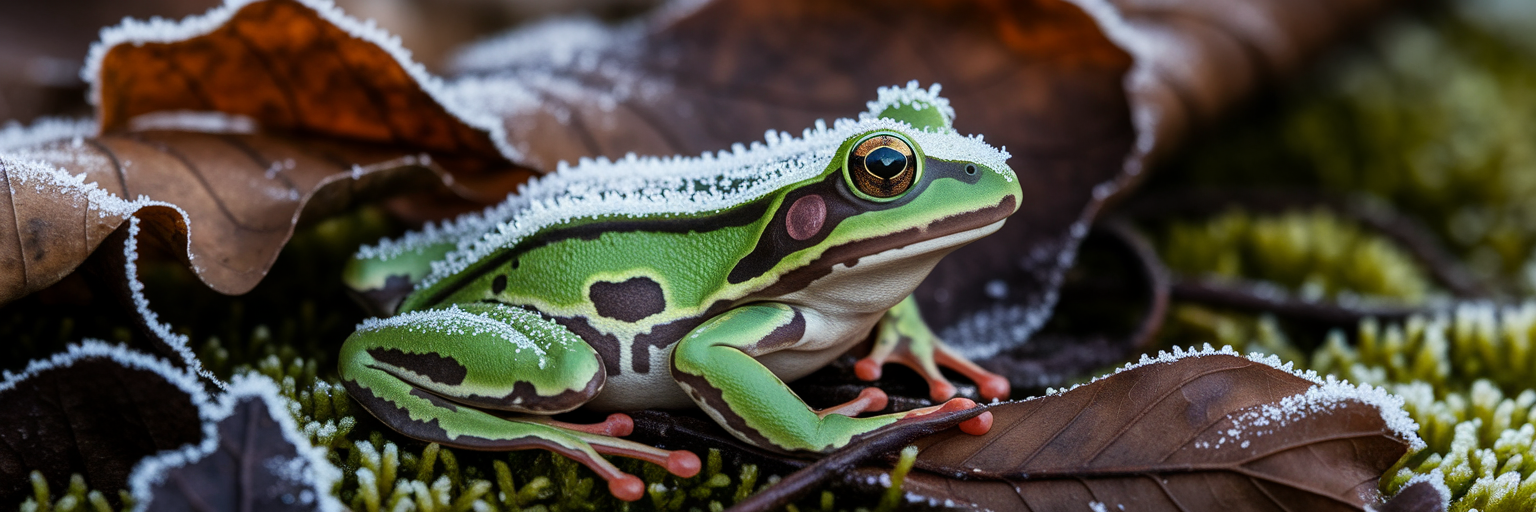
The wood frog’s survival is not a matter of luck but a highly orchestrated biological process. It doesn’t just endure the cold; it actively manages its descent into a frozen state. This careful management is the key to understanding how do frogs survive winter in such an extreme fashion. The process unfolds in a few critical steps:
- Initiating Ice Formation: As temperatures drop, the frog doesn’t fight the freeze. Instead, it initiates it. Special ice-nucleating proteins in its blood signal ice crystals to form first in extracellular spaces, like the abdominal cavity and under the skin. This is a crucial first move, as it directs the ice away from the delicate interior of its cells, where ice formation would be catastrophic.
- The Liver’s Emergency Response: The moment ice begins to form, the frog’s liver kicks into overdrive. It rapidly converts vast stores of glycogen into glucose. This surge of sugar is then pumped through the bloodstream, saturating every cell in the frog’s body. This isn’t a small adjustment; the frog’s blood glucose levels can skyrocket to concentrations hundreds of times higher than normal.
- Entering Suspended Animation: With its cells protected, the frog surrenders to the cold. Its heart stops, breathing ceases, and all metabolic activity grinds to a halt. It becomes clinically dead by any human standard, a solid block of frog and ice, waiting for the warmth of spring to return.
A Cellular Survival Strategy
While the controlled freezing process is impressive, the real secret to the wood frog’s survival lies at the cellular level. The frog’s body has engineered a defense system to protect its most vital components from the destructive power of ice. This strategy is far more complex than simply getting cold.
The Role of Natural Antifreeze
The massive amount of glucose pumped into the frog’s cells serves a critical purpose. It acts as a cryoprotectant, or a natural antifreeze. The high sugar concentration inside the cells prevents them from freezing solid. More importantly, it stops them from dehydrating. As ice forms in the spaces outside the cells, it naturally draws water out of them. Without the glucose, the cells would shrivel and die. Instead, the sugar holds onto the water, keeping the cells viable even as the world around them turns to ice.
A Secondary Safeguard
Glucose doesn’t work alone. The wood frog also accumulates high levels of urea in its tissues. While toxic to most animals in large quantities, urea works in concert with glucose to further lower the freezing point inside the cells. This combination creates a powerful cryoprotectant cocktail that stabilizes cellular structures and provides an additional layer of defense against ice damage.
Managing the Thaw
Surviving the freeze is only half the battle. The thawing process presents its own dangers, similar to the reperfusion injuries seen in human medicine when blood flow is restored to tissues after a period of ischemia. As the frog’s metabolism restarts, it can create a surge of damaging free radicals. To counter this, the frog has powerful antioxidant defenses ready to manage this oxidative stress, ensuring a safe return to life.
Inspiring a Revolution in Organ Preservation
The wood frog’s incredible ability is more than just a biological curiosity; it offers a potential blueprint for solving one of modern medicine’s most pressing challenges. According to research highlighted by Pfizer, donated organs like hearts and livers are currently viable for only a few hours on ice. This incredibly short window creates immense logistical hurdles, leading to organ wastage and a race against time for transplant recipients.
The frog’s methods could inspire a new generation of organ preservation technology. If scientists could replicate its strategy of using cryoprotectants to safely freeze and thaw complex tissues, it could transform organ transplantation. Imagine a future with long-term organ banking, where donated organs could be stored for months or even years. The impacts would be profound:
- Dramatically improved organ matching, as the extra time would allow for more precise compatibility testing.
- A significant reduction in the number of viable organs discarded due to logistical delays.
- A shift from frantic emergency operations to carefully planned, scheduled procedures.
Of course, applying this biology to large, complex human organs is a monumental scientific challenge. Yet, the potential for such tech innovations continues to drive research forward, offering hope for a future where no donated organ goes to waste.
Nature’s Other Extreme Survivors
The wood frog is not alone in its battle against the cold, but its method is unique. Nature has evolved two primary solutions for surviving subzero temperatures: freeze tolerance and freeze avoidance. The wood frog is a master of freeze tolerance, allowing its body to partially freeze. In contrast, other animals have perfected freeze avoidance, preventing ice from forming at all.
A classic example is the arctic fish, which lives in waters that are colder than the freezing point of its blood. These fish produce special antifreeze proteins (AFPs) that patrol their bloodstream. These proteins bind to any tiny ice crystals that begin to form, stopping them from growing and allowing the fish to remain active and liquid in a subzero environment. This comparison showcases the diversity of life waiting to be discovered when exploring the wild.
| Feature | Wood Frog (Freeze Tolerance) | Arctic Fish (Freeze Avoidance) |
|---|---|---|
| Primary Strategy | Allows body to partially freeze | Prevents body from freezing |
| Key Compound | Glucose and Urea (Cryoprotectants) | Antifreeze Proteins (AFPs) |
| Cellular State | Cells dehydrated but protected | Cellular fluid remains liquid |
| Outcome | Enters suspended animation | Remains active in subzero water |
The Scientific Hurdles in Cryobiology
While the wood frog provides an inspiring model, translating its abilities into practical cryobiology medical applications is filled with challenges. The two biggest hurdles are rewarming and scale. Safely thawing a frozen organ is arguably more difficult than freezing it. The risk of destructive ice crystals forming during rewarming, a process called devitrification, is immense. A perfectly preserved organ could be destroyed in minutes if thawed improperly.
Furthermore, the wood frog is small. Its size allows for relatively quick and uniform freezing and thawing. A large human organ, like a liver or kidney, is exponentially more difficult to cool and warm evenly. Cold spots and hot spots during the process could cause irreparable damage. Future breakthroughs will likely depend on developing novel technologies, perhaps using nanoparticles or electromagnetic fields, to achieve safe and uniform rewarming. The field remains an active and exciting area of research, and to stay informed on this and other scientific frontiers, you can explore more on Nature is Crazy.