A Gash in the Bark Reveals a Crimson Secret
Imagine striking a tree with a hatchet, only to watch a thick, dark red liquid ooze from the wound. It looks eerily like blood, and for a moment, the forest feels ancient and alive in a way you hadn’t considered. This unsettling scene is not a myth. There are real trees that bleed when cut, a natural phenomenon that has disturbed and fascinated people for centuries. The sight immediately brings questions to mind. Is the tree bleeding? Is it in pain?
The truth is far more interesting than any supernatural tale. This crimson ooze is not blood, but a highly specialized substance born from a remarkable evolutionary strategy. The explanation lies not in folklore, but in a biological adaptation that is, in many ways, stranger and more complex than the myths it inspired. What you are witnessing is one of nature’s most effective defense mechanisms in action.
The Chemistry of Nature’s ‘Blood’
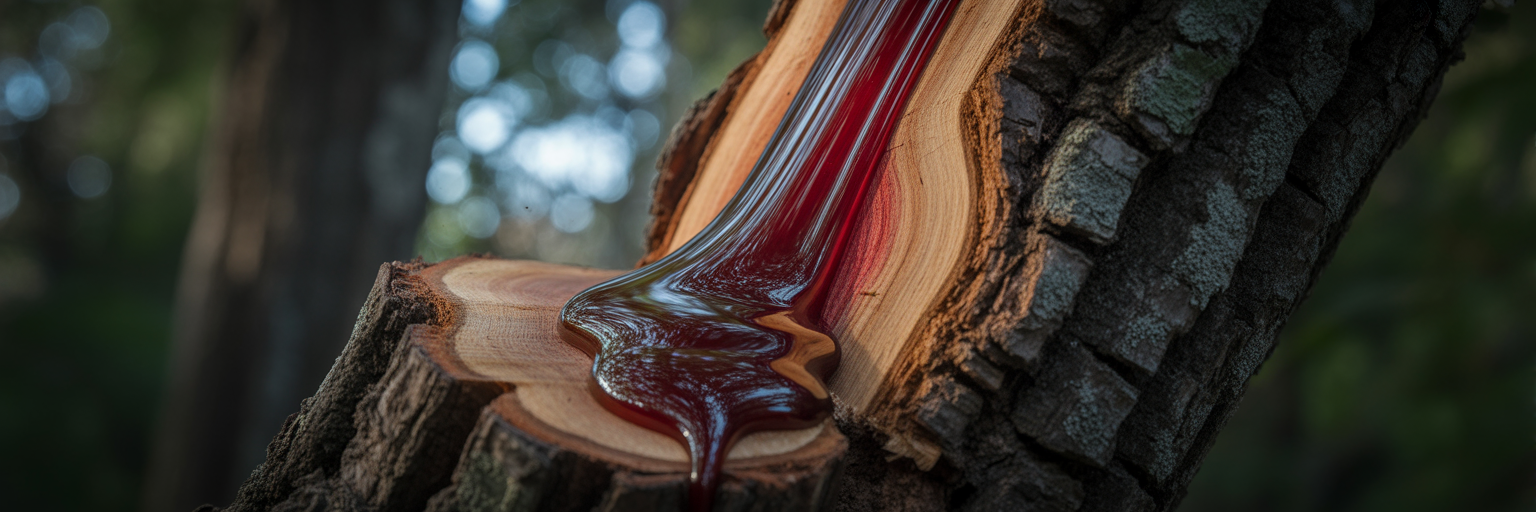
Let’s be clear: the substance leaking from these trees is not blood. Trees do not have a circulatory system with veins and arteries, nor do they have hemoglobin, the iron-rich protein that gives animal blood its red color. Instead, what you see is a specialized resin or latex. This red sap from trees is a complex cocktail of organic compounds, and its color comes from high concentrations of chemicals like flavonoids and tannins.
Think of this resin as a liquid shield, produced and stored in special cells and canals within the tree’s bark and wood. When the tree is injured, these canals are severed, and the resin flows out to the surface. It is a purely defensive response, a pre-packaged first aid kit that the tree deploys instantly upon being wounded. The production of this substance is a targeted biological process, designed to protect the organism from external threats, not an indicator of pain or suffering as we understand it.
Meet the Bleeding Trees of the World
This strange adaptation has evolved independently in various species across the globe, each with its own unique version of “blood.” While they share a common function, the appearance and composition of their resins differ.
The most famous is the Dragon Blood Tree (*Dracaena cinnabari*). With its bizarre, umbrella-like canopy, it looks like something from another world. Native to the Socotra archipelago off the coast of Yemen, its bright crimson Dracaena cinnabari sap is the source of the original “dragon’s blood” legend. This resin dries quickly into a hard, glassy substance.
Then there are the Bloodwood trees, a name given to several species in the *Pterocarpus* and *Brosimum* genera. The Kiaat tree (*Pterocarpus angolensis*) of southern Africa weeps a dark, sticky red sap that drips slowly, sealing wounds on its trunk. There are many fascinating bloodwood tree facts, but its ability to self-cauterize is its most notable. Similarly, the American Bloodwood (*Brosimum rubescens*) from South America produces a deep red latex. These natural chemical factories are a reminder of how nature often predates many of the innovations of modern science we study today.
| Common Name | Scientific Name | Native Region | Resin Characteristics |
|---|---|---|---|
| Dragon Blood Tree | Dracaena cinnabari | Socotra Archipelago (Yemen) | Bright crimson, thick, dries quickly |
| Kiaat / Muninga | Pterocarpus angolensis | Southern Africa | Dark red, sticky, drips slowly |
| American Bloodwood | Brosimum rubescens | South America | Deep red to orange, watery latex |
| Red Sandalwood | Pterocarpus santalinus | Southern India | Reddish sap that darkens upon exposure |
A Self-Sealing Wound and Potent Defense
So, why do trees have sap with such dramatic properties? The answer lies in survival. This resin is an incredibly effective, all-in-one defense system, especially for trees growing in harsh environments where any injury could be fatal. Its protective functions are twofold.
- Physical Barrier: The moment the resin is exposed to air, it begins to thicken and harden. It flows over the wound, creating a perfect seal that functions like a natural bandage. This barrier prevents moisture loss and physically blocks insects, fungi, and other pathogens from entering the vulnerable tissue.
- Chemical Warfare: The resin is not just a physical plug. It is loaded with antimicrobial and antifungal compounds that actively kill invading microbes. Its intensely bitter taste also deters herbivores, from insects to larger animals, that might try to feed on the tree.
This raw survival mechanism is a powerful lesson in adaptation. It demonstrates how organisms develop sophisticated solutions to environmental threats, a core principle for anyone interested in exploring the wild and its complex ecosystems.
Legends Written in Dragon’s Blood
It is no surprise that a phenomenon this visually striking has a rich history of myth and folklore. The name “dragon’s blood” itself comes from an ancient legend telling of a battle between a dragon and an elephant. The trees were said to have sprung from the ground where their blood was spilled. For centuries, people have sought to understand what is dragon’s blood resin and harness its perceived power.
Historically, it was a highly prized commodity. The vibrant red resin was used as a dye, a pigment for artists, and even as a protective varnish for Stradivarius violins. It was also a key ingredient in incense, alchemy, and traditional medicine across different cultures. As noted in research published by NCBI, the ecological significance of the resin is matched by its deep cultural roots. The resin’s ability to form a protective “skin” when dried likely reinforced its use in healing potions and rituals. This intersection of nature and human belief is a core part of our shared culture.
Modern Science Confronts Ancient Myths
While the legends are captivating, science offers a clear and equally fascinating explanation. The bleeding is a controlled, evolved defense mechanism, not a sign of suffering as an animal would experience it. The tree is not in pain; it is defending itself with remarkable efficiency.
Today, researchers are studying the very properties that made dragon’s blood famous in folklore. Its proven antimicrobial and anti-inflammatory compounds are being investigated for potential use in modern medicine, such as in advanced wound dressings. While its direct application is still largely experimental, the science validates the wisdom of ancient traditions. What was once seen as magic is now understood as brilliant biology, a reminder that the strangest phenomena in nature are often the most logical.