Nature’s Tiniest Nightmare Surgeon
In nature’s vast theater of survival, some of the most macabre dramas unfold at a scale too small for the naked eye. Here, monsters are real, and one of the most proficient is the phorid fly. This is not the common housefly you swat away from your lunch. It is a highly evolved parasitoid, a creature with a life strategy that makes it one of the forest floor’s most terrifying assassins.
It is important to understand the distinction here. A parasite lives on or in a host, often without killing it. A parasitoid, however, has a far more sinister agenda. Its larval stage develops inside a host, consuming it from within and ultimately killing it as a mandatory part of its life cycle. The phorid fly has perfected this grim art.
Often called “scuttle flies” for their strange, jerky way of running instead of flying, their other nickname is far more telling: decapitating flies. This name hints at the gruesome finale of their parasitic relationship. These flies are minuscule, some no bigger than a grain of salt, yet they possess the precision of a microscopic surgeon. Their size is a deceptive measure of their impact.
Imagine the bustling world of an ant colony, a superorganism built on order and efficiency. For the phorid fly, this is a hunting ground. It has evolved to target specific ant species with chilling accuracy. In the United States, its preferred victim is often the invasive fire ant, an aggressive species that has met its match in this tiny, airborne horror. The fly is the killer, the ant is the unwitting victim, and their interaction is a masterclass in biological warfare.
The High-Speed Aerial Ambush
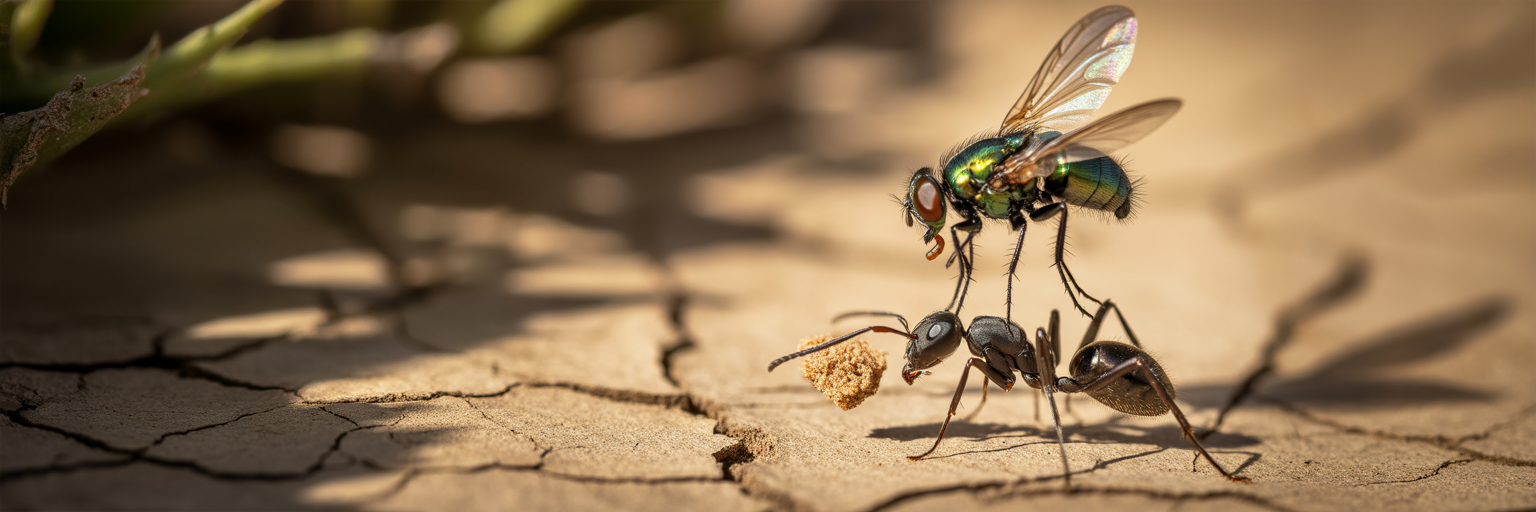
The attack begins not with a chase, but with patience. The female phorid fly is a master of aerial reconnaissance, and the hunt is a calculated, high-stakes maneuver that unfolds in fractions of a second. These specialized parasitic flies on ants have turned ambush into an art form.
Staking Out the Target
The drama starts with the female fly hovering like a tiny, malevolent drone over a busy ant trail. She is not looking for just any ant. She is observing, waiting, and selecting her victim with unnerving precision. She might target a forager of a specific size or one that is momentarily isolated from its nestmates. The entrance to the ant mound is a prime hunting spot, a bottleneck of potential hosts moving in and out, completely unaware of the danger lurking just above.
The Surgical Strike
Once a target is chosen, the attack is almost too fast for the eye to follow. The phorid fly dives from its hovering position in a blur of motion. In less than a second, she uses her sharp, hypodermic needle-like ovipositor to pierce the ant’s exoskeleton, typically in the softer tissues of the thorax. Through this tube, she injects a single, microscopic egg directly into the ant’s body. The entire maneuver is a feat of surgical accuracy, a high-speed injection performed on a moving target. The ant may flinch or stumble, but the deed is done before it can even register what happened.
A Walking, Unknowing Incubator
Here is where the true horror begins. The ant, having been violated by a nightmare surgeon, often just gets up, shakes itself off, and resumes its duties. It returns to the colony, forages for food, and tends to the queen, all while carrying the seed of its own destruction. It has become a walking, unknowing incubator. The colony has no idea that one of its own is now a Trojan horse, a mobile nursery for a creature that will eventually tear it apart from the inside out. This obliviousness is a key part of the parasite’s success, allowing its offspring to begin its development deep within the enemy’s camp.
The Parasite’s Journey to the Command Center
With the egg successfully planted, the scene of the crime shifts from the outside world to the ant’s internal landscape. The larva’s journey is a slow, deliberate infiltration of the host’s most vital area, turning the ant into a ticking time bomb.
The Hatching Within
A few days after the injection, the egg hatches inside the ant’s thorax. A tiny, featureless larva, or maggot, emerges into the ant’s body cavity. At this stage, it is a simple eating machine, but it does not begin its destructive feast just yet. First, it must travel.
How Flies Control Ants: The Slow Migration North
The larva’s primary objective is to reach the ant’s head capsule, the command center that houses the brain and controls all bodily functions. It begins a slow, methodical migration from the thorax, through the narrow neck, and into the head. This journey can take up to two weeks. During this time, the ant continues to behave almost normally. It is in a “zombie” phase, a living host that is not yet a puppet. It still forages, communicates, and serves the colony, all while the invader inches closer to its brain.
The Undetected Intruder
How does the larva survive for weeks inside a hostile body without being attacked by the ant’s immune system? The answer lies in sophisticated chemical camouflage. The larva produces molecules that mimic the ant’s own cellular signals, effectively making it invisible to the host’s internal defenses. It is an undetected intruder, growing safely while surrounded by an immune system that should be destroying it. The way the phorid fly larva manipulates its host from within is a chilling example of parasitic control, a phenomenon seen elsewhere in nature, such as in the relationship where a parasite compels its host to seek out its own demise, which you can read about in the story of what drives a snail to sacrifice itself for a parasite.
This table outlines the insidious, multi-week process of the phorid fly’s parasitic takeover. Note that the ant remains a seemingly functional member of its colony for a significant period, masking the fatal progression happening within.
| Stage of Infection | Approximate Duration | Larva’s Activity | Ant’s Outward Behavior |
|---|---|---|---|
| 1. Egg Injection | Less than 1 second | A single egg is deposited in the ant’s thorax. | Momentary disruption, then returns to normal activity. Appears completely unaware. |
| 2. Larval Hatching & Migration | 1-3 days post-injection | The larva hatches and begins its slow migration toward the head capsule. | No visible change. The ant continues foraging, feeding, and interacting with the colony. |
| 3. Internal Colonization | Up to 2 weeks | The larva settles in the head and begins to grow, feeding on hemolymph (ant blood). | Mostly normal, but may show subtle signs of sluggishness or slightly altered behavior. |
| 4. Host Manipulation Begins | ~2-3 weeks post-injection | The larva starts consuming non-vital tissues and influencing the ant’s brain chemistry. | The ant becomes disoriented, abandons its duties, and wanders away from the colony. |
Hollowing Out the Host from Within

Once the larva is safely lodged in the head capsule, the gruesome main event of the ant parasite life cycle begins. The parasite transitions from a quiet passenger to a voracious monster, systematically hollowing out its host while it is still alive. It is an act of biological puppetry at its most disturbing.
The larva starts to feed, but its consumption is strategic. It begins by devouring the ant’s mandibular muscles, rendering its powerful jaws useless. It then moves on to glands and other non-essential tissues within the head. The process is akin to someone carefully scooping out the insides of a pumpkin, except this pumpkin is alive, walking, and dimly aware that something is terribly wrong. The larva is literally eating the ant’s face from the inside.
The most unsettling part is that the ant remains alive and mobile throughout much of this process. The larva instinctively avoids consuming the most critical parts of the brain until the very end. By keeping the ant’s basic motor functions intact, the parasite ensures its host can still walk. The ant is no longer a member of its colony; it is a walking shell, a nutrient-rich vehicle being piloted by the creature devouring its mind.
Eventually, the larva’s influence over the host’s brain triggers a dramatic behavioral change. The infected ant, now in a confused daze, abandons its duties and wanders erratically away from the colony. This is not a random act. The parasite is manipulating the ant’s behavior, forcing it to find a cool, damp, and secluded spot. This location is ideal for the larva’s next stage of life, providing a safe haven away from the tidy, scavenger-filled environment of the ant colony. The ant is forced to deliver its own executioner to a safehouse. This level of deception and manipulation is a recurring theme in the insect world, where some species have evolved to become masters of infiltration, much like the caterpillar that tricks ant colonies into raising it as one of their own.
The Phorid Fly’s Grand Finale: A Headless Exit
The final act of this microscopic horror story is as brutal as it is brilliant. After weeks of internal sabotage, the phorid fly larva initiates its grand finale, a sequence of events that earns it the name “decapitating fly” and completes its grotesque transformation.
Once the zombified ant has reached a suitable location, the larva prepares to pupate. To do this, it releases a cocktail of enzymes that specifically target and dissolve the delicate connective tissues in the ant’s neck. The structural integrity of the joint fails, and the ant’s head cleanly detaches from its body. If you were listening closely with microscopic ears, you might even hear a faint “pop.” The headless body of the ant simply keels over, its service to the parasite now complete.
The severed head, however, has one final role to play. It becomes a protective pupal case for the developing fly. This is a morbidly ingenious piece of natural engineering. The hardened chitin of the ant’s head capsule provides a secure, armored chamber that shields the vulnerable pupa from predators, scavengers, and environmental hazards. The ant’s own head has become its killer’s cradle.
Inside this gruesome incubator, the larva transforms. After a few weeks, a fully formed adult phorid fly is ready to emerge. It breaks out of the head capsule, typically exiting through the ant’s mouthparts. The ant’s head has literally become a doorway for the next generation of its species’ tormentor. The new fly emerges, ready to begin the cycle anew.
The entire, horrifying life cycle is a model of brutal efficiency:
- The Ambush: A female fly injects an egg into an unsuspecting ant.
- The Invasion: The larva hatches and migrates to the ant’s head.
- The Possession: The larva consumes the ant’s head from within, turning it into a zombie.
- The Isolation: The parasite forces the ant to wander off and die in a safe place.
- The Decapitation: Enzymes are released, causing the head to fall off.
- The Emergence: The new adult fly exits through the mouth of the severed head.
Colony-Wide Chaos and Ecological Impact
While the fate of a single ant is a self-contained horror story, the true power of the phorid fly is its ability to terrorize an entire colony. The impact is not just about the number of ants killed, but about the psychological warfare it wages on the survivors.
The direct mortality rate from phorid fly attacks is often relatively low, sometimes affecting less than 4% of a colony’s foragers. However, their real impact is disruption. The mere presence of a few hovering phorid flies is enough to trigger widespread panic. Ants will abandon their foraging trails, drop precious food, and scramble for cover. This constant harassment creates a “reign of terror” that severely weakens the colony’s ability to gather resources, defend its territory, and grow.
This suppression has a ripple effect across the ecosystem. By keeping a dominant ant species in check, phorid flies can give a competitive advantage to rival ant species that are not their targets. This helps maintain biodiversity and prevents one aggressive species from completely taking over a habitat. The disruption caused by the phorid fly illustrates how a single species can influence an entire community’s behavior, a dynamic also seen in marine environments where the coral that can fight back like a living army defends its territory against intruders.
This natural dynamic has a practical application in fire ant biological control. In the United States, the invasive red imported fire ant has caused enormous ecological and economic damage. Scientists have turned to the phorid fly as a natural weapon. By introducing specific phorid fly species from the fire ants’ native South America, researchers are using nature’s own arms race to manage the invasive pest. This strategy of using a natural predator to manage a pest population is a cornerstone of modern biocontrol, and as detailed in FAQs from the University of Texas’s Fire Ant Research Project, phorid flies have been a key subject of study for controlling invasive fire ants in the southern U.S. In a strange twist, the ant’s microscopic nightmare has become our ally.