Beyond the Reach of the Sun
From the first day of biology class, we learn a fundamental rule: life on Earth is powered by the sun. Photosynthesis converts sunlight into energy, forming the base of nearly every food web we know. Yet, our planet harbors entire ecosystems that operate in complete, permanent darkness, miles below the surface or deep on the ocean floor. These hidden worlds are populated by extremophile organisms, life forms that flourish in conditions we would consider lethal, from crushing pressures and toxic chemistry to absolute cold.
These discoveries challenge our most basic assumptions about biology. If there is no sunlight, what energy source fuels these communities? What do these strange, resilient creatures reveal about the fundamental requirements for life itself? This exploration will take us to the bottom of the sea and deep into the Earth’s crust to understand chemosynthesis, the engine of life in darkness, and consider what it means for finding life beyond our own world.
The Engine of Life in Darkness: Chemosynthesis
The answer to how life survives without light lies in a process called chemosynthesis. While photosynthesis uses light energy, what is chemosynthesis is a biological pathway where microbes create energy from chemical reactions. According to NOAA, chemosynthesis is the process by which certain microbes use chemical energy to produce food, fundamentally replacing the role of the sun. Instead of capturing photons, these bacteria and archaea harness inorganic compounds like hydrogen sulfide or methane, which are abundant in these dark environments.
They oxidize these compounds, triggering a release of energy. This energy is then used to convert carbon, often from dissolved carbon dioxide, into the organic matter that forms the base of a food web. In essence, these microbes are the “producers” of their ecosystems, just as plants are on land. This process supports entire communities of life forms that don’t need sunlight or oxygen in some cases, rewriting the rules of where life can exist.
- Energy Source: Sunlight vs. Chemical Compounds (e.g., hydrogen sulfide, methane).
- Primary Producers: Plants and algae vs. Bacteria and Archaea.
- Location: Sunlit environments (land, upper ocean) vs. Dark environments (deep sea, Earth’s crust).
- Byproduct: Oxygen vs. Compounds like sulfur and water.
Ecosystems at the Deep-Sea Frontier
Nowhere is chemosynthesis more spectacularly on display than at the bottom of the ocean. The discovery of these ecosystems is a testament to the innovations of modern science, which allow us to explore these previously unreachable depths.
Hydrothermal Vents: Oases of Chemical Energy
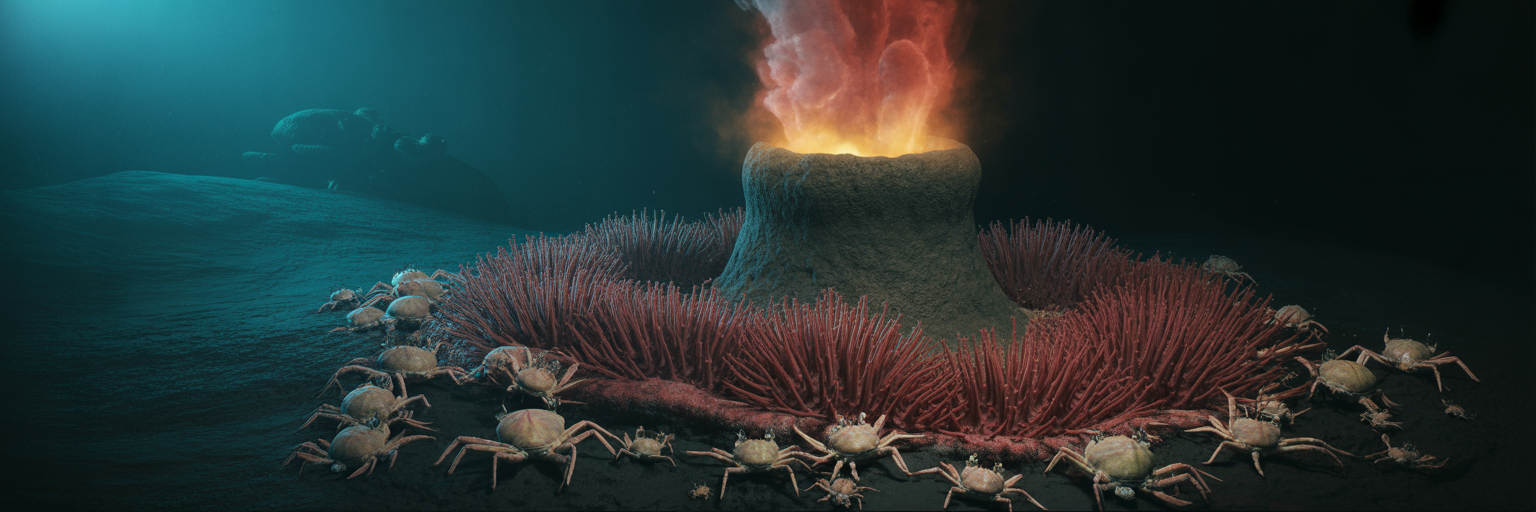
Imagine towering chimneys on the ocean floor, billowing black, superheated fluid into the frigid darkness. These are deep sea hydrothermal vents, fissures in the planet’s crust that release geothermally heated, mineral-rich water. The “smoke” is actually a brew of dissolved minerals, including hydrogen sulfide, the key ingredient for chemosynthesis. Around these vents, life doesn’t just survive; it thrives in dense, vibrant communities.
Life in Symbiosis
The food web here begins with chemosynthetic bacteria. These microbes form thick mats on the seafloor or live symbiotically inside other animals. The most iconic resident is the giant tube worm, Riftia pachyptila, which can grow several feet long. These worms have no mouth or digestive system. Instead, they house bacteria within their bodies, which process the toxic hydrogen sulfide from the vents and provide the worms with all the nutrients they need to live.
Cold Seeps: The Slow-Burning Alternative
Hydrothermal vents are not the only deep-sea oases. Cold seeps are less dramatic but equally important environments where methane and sulfides slowly leak from the seafloor sediments. Unlike the ephemeral, high-energy vents, cold seeps are stable and can persist for thousands of years. They support different, slower-growing communities, such as dense beds of mussels and clams that also rely on symbiotic chemosynthetic bacteria to survive.
| Feature | Hydrothermal Vents | Cold Seeps |
|---|---|---|
| Temperature | Extremely high (up to 400°C / 750°F) | Similar to surrounding seawater |
| Primary Chemical Source | Hydrogen sulfide from volcanic activity | Methane and sulfides from sediment decay |
| Geological Stability | Transient and short-lived (decades) | Stable and long-lived (centuries to millennia) |
| Dominant Organisms | Fast-growing species like giant tube worms | Slow-growing species like mussels and clams |
Life Within the Earth’s Crust
As incredible as deep-sea vents are, life exists in even more isolated places. Miles below the surface, within the solid rock of the Earth’s crust, scientists have discovered a “deep biosphere.” This subterranean world is home to microbes that derive energy directly from rock chemistry. A 2020 report from Quanta Magazine detailed how these microbes survive with absolutely no input from the sun.
One key process is serpentinization, where water reacts with minerals in the rock to produce hydrogen gas, a potent fuel source for these “lithoautotrophs,” or rock-eaters. These organisms live at an almost unimaginably slow pace. Their metabolism is so sluggish that cell division might occur only once every few hundred years. This hidden biomass, completely cut off from the sunlit world, is estimated to be so vast that it could rival the total mass of all life on the surface. These discoveries, which push the boundaries of what we thought possible, are the kind of stories we love to explore at Nature Is Crazy.
The Unexpected Link to the Surface
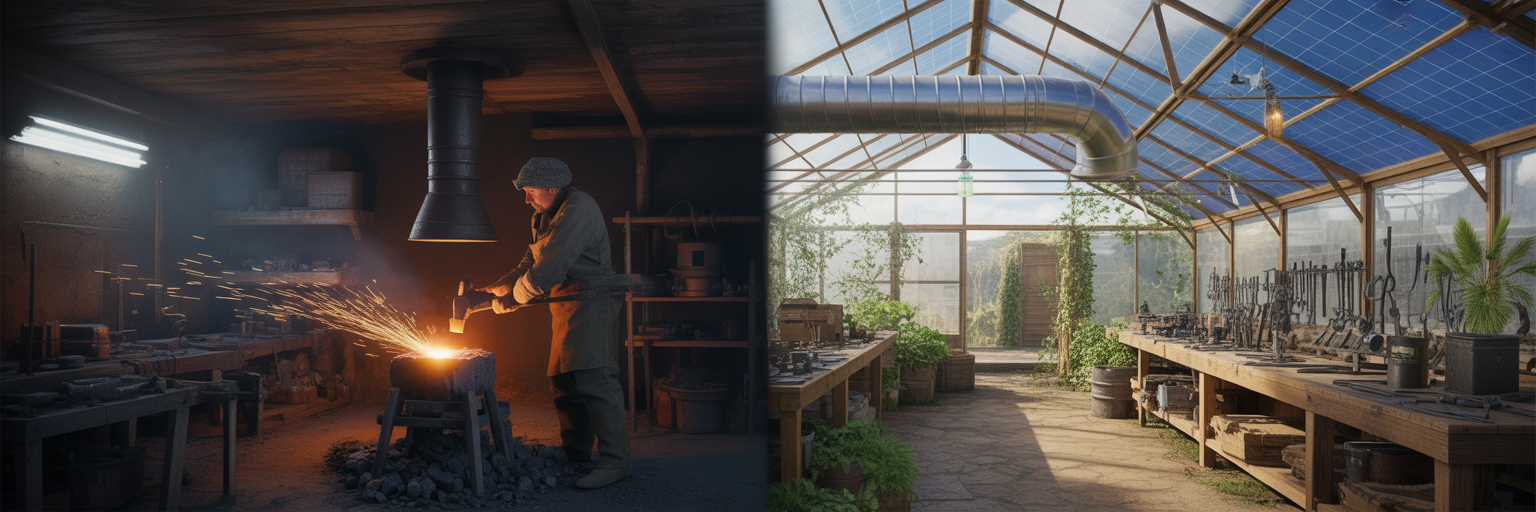
It’s tempting to think of these dark ecosystems as completely independent worlds. However, the reality is more complex. While they do not use sunlight for energy, many are not entirely disconnected from the sunlit surface. Many chemosynthetic microbes are aerobic, meaning they require oxygen to efficiently process chemicals like hydrogen sulfide. That oxygen is a direct byproduct of photosynthesis occurring thousands of miles away at the ocean’s surface.
Ocean currents act as a global circulatory system, transporting this oxygen-rich water down to the deep sea. This dependency doesn’t invalidate the miracle of chemosynthesis. Instead, it highlights the profound interconnectedness of Earth’s systems. It also helps us distinguish between these communities and truly anaerobic life forms, which thrive in completely oxygen-free zones deep within sediments or the Earth’s crust, representing the most extreme examples of life’s tenacity.
Redefining the Search for Alien Life
The discovery of chemosynthetic ecosystems has done more than just expand our understanding of life on Earth; it has fundamentally altered how scientists define a “habitable environment.” For decades, the search for life on other planets focused on the “Goldilocks zone,” the narrow orbital band around a star where temperatures allow for liquid water on a planet’s surface. We were looking for worlds like our own.
Now, the definition of habitability is much broader. The key ingredients may not be sunlight and a pleasant atmosphere, but simply liquid water, a chemical energy source, and a handful of essential elements. This shift in perspective turns our attention to some of the most intriguing locations in our solar system. The subsurface oceans of Jupiter’s moon Europa and Saturn’s moon Enceladus are now prime candidates. Hidden beneath miles of ice, these vast liquid water oceans are believed to host hydrothermal vents on their seafloors, powered by the gravitational pull of their parent planets. These vents could provide the exact chemical energy needed to support life, just as they do on Earth. The search for life, guided by these new principles, is one of the most exciting tech innovations shaping our future. Earth’s own dark biospheres have given us a compelling blueprint, urging us to look for life not in the light, but in the dark, chemical-rich corners of the cosmos.