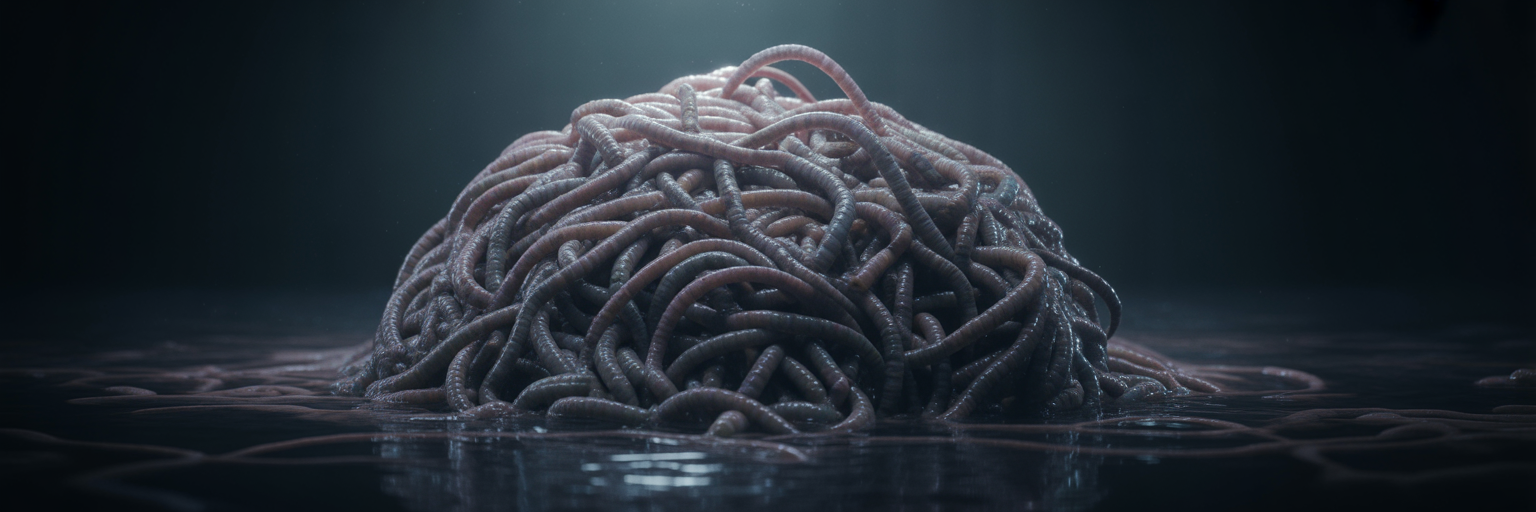
The image of a living, writhing knot is a staple of horror, a physical impossibility designed to unsettle. It suggests a creature so tangled it has lost its beginning and end, a chaotic mass of flesh moving with a single, unnatural purpose. But in the shallow ponds and marshes of North America, this nightmare is a daily reality for an organism that has mastered the art of the tangle.
Beyond Science Fiction: The Tangled World of Real Worms
We often look to fiction for creatures that defy the laws of physics, but nature frequently outpaces our imagination. The concept of a living knot seems like something born from a special effects studio. You can almost picture it, a pulsating ball of worms, hopelessly intertwined yet moving as one. It feels wrong, a biological paradox that should not exist. Yet, it does.
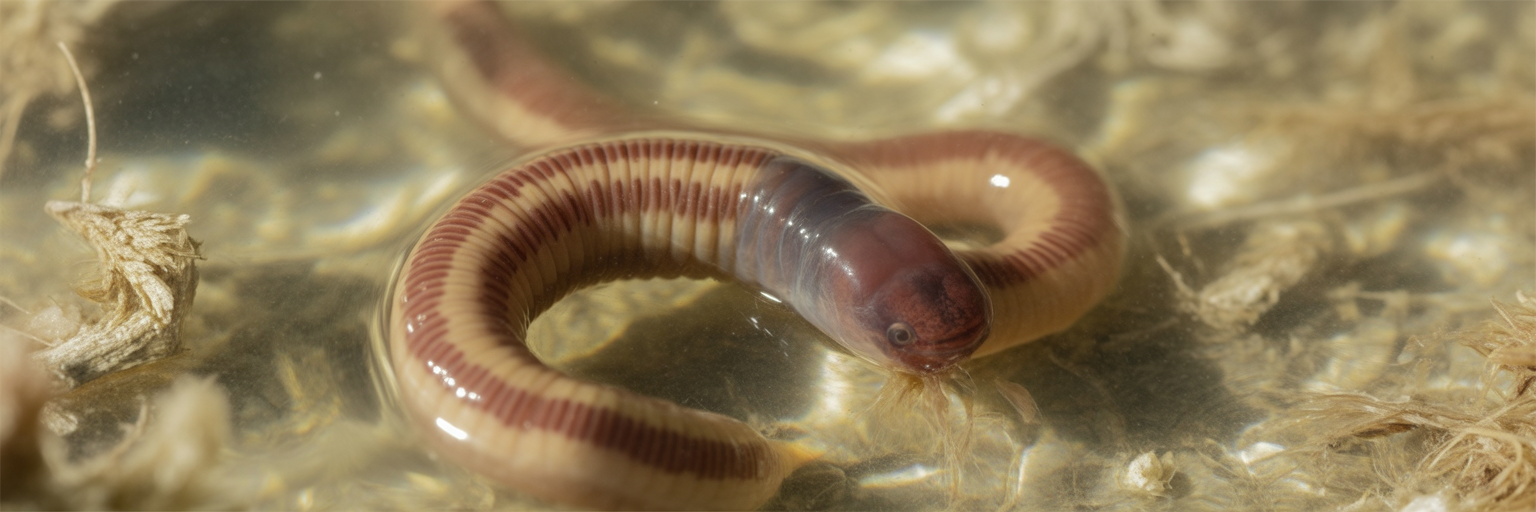
Meet Lumbriculus variegatus, a creature more commonly known as the California blackworm. At first glance, it is entirely unremarkable. It is a thin, reddish-brown aquatic worm, just a few centimeters long, spending its days sifting through mud at the bottom of quiet freshwater bodies. It looks like something you might see on a fishing hook, a simple organism leading a simple life. This humble appearance, however, conceals an extraordinary set of abilities that have captivated scientists.
These are the worms that tie themselves in knots, not as individuals, but as a collective. Thousands of them will slowly and deliberately weave themselves together into a dense, spherical mass often called a “worm blob.” This tangled ball acts as a single entity, a writhing sphere that seems to have a mind of its own. But the real mystery is not how they get into this mess. The true marvel is how they get out.
While the formation of the knot is a slow, almost passive process, its dissolution is anything but. When threatened, the entire tangled mass can explode, disentangling in a fraction of a second. A solid, cohesive blob dissolves into a flurry of individual worms, each making a rapid escape. This article explores the science behind this incredible feat, from the worm’s unique biology to the complex physics that makes the impossible possible.
An Introduction to the California Blackworm
To understand the worm’s bizarre behavior, we first need to understand the worm itself. Far from being just a biological curiosity, Lumbriculus variegatus is a well-studied organism that provides insights into regeneration, collective behavior, and survival. Its life is a testament to how evolution can produce highly sophisticated solutions from the simplest of building blocks.
Biological Profile and Habitat
The California blackworm is an oligochaete, placing it in the same group as the common earthworm. Its body is a chain of up to 200 segments, each capable of independent movement, which gives it its characteristic flexibility. Its reddish-brown color comes from the respiratory pigments in its blood, visible through its translucent skin. These worms are typically found in the shallow, silty bottoms of ponds, lakes, and marshes across North America and Europe, where they feed on decaying organic matter. As detritivores, they play a quiet but important role in their ecosystem, breaking down waste and recycling nutrients.
A Model Organism for Modern Science
Scientists are particularly interested in this worm for a few key reasons. One of the most significant Lumbriculus variegatus facts is its incredible regenerative ability. If the worm is cut into pieces, each fragment can regrow into a complete, functioning individual. This is its primary method of reproduction, known as fragmentation. A single worm can split into multiple new worms, allowing populations to grow dense very quickly. This regenerative prowess makes it a valuable model for studying tissue repair and regeneration, much like how nature is filled with examples of animals that can regrow skin stronger than before.
This rapid, asexual reproduction helps explain how the massive worm blobs form in the first place. A successful population can quickly number in the tens of thousands, all living in close proximity. This density is the crucial ingredient for the collective animal behavior that makes them famous. Without a crowd, there can be no knot.
The Art of the Knot: Why Worms Tangle Together
The formation of a “worm blob” is not an accident. It is a deliberate, if passive, survival strategy. This mass of intertwined bodies functions as a single superorganism, where the collective provides benefits that no single worm could achieve on its own. The knot is not a prison; it is a fortress built of living bodies.
The ‘Worm Blob’ as a Superorganism
When thousands of California blackworms gather, their slow, random movements cause them to passively intertwine. Over several minutes or even hours, they form a dense, spherical knot. This “worm blob” behaves like a single entity with emergent properties. The worms on the inside experience a different environment than those on the outside, and the entire structure can respond to environmental cues as a whole. It is a stunning example of how simple individuals, following simple rules, can create complex, organized structures.
Survival in a Tangled Mass
The primary reason for this behavior is survival. The tangled mass offers several key advantages that allow the worms to endure harsh environmental conditions:
- Moisture Retention: California blackworms are aquatic and require moisture to survive. If their pond or marsh begins to dry out, the blob acts as a collective shield. The worms on the outside of the ball may desiccate, but in doing so, they form a protective crust that traps moisture for the thousands of worms huddled inside. This allows the colony to survive periods of drought. This incredible adaptation is a powerful example of how organisms evolve extreme survival skills, similar to other life forms that can survive being completely dried out for years.
- Thermoregulation: Huddling together is a common strategy in the animal kingdom for maintaining body temperature. For the worms, the dense blob helps insulate the collective from extreme cold or heat, keeping the internal temperature of the mass stable even when the external environment fluctuates.
- Predator Defense: While the explosive escape is the main defense mechanism, the blob itself can be a deterrent. A single, small worm is an easy meal for a fish or bird. A large, writhing ball of thousands of worms may appear too large, confusing, or unappetizing for some predators to tackle.
–
The tangling process itself is driven by what scientists call the “slow gear.” It involves slow, random wiggling motions. As the worms move, they bump into and weave around their neighbors, gradually tightening the mass. It is a beautiful illustration of order emerging from chaos.
The Great Escape: Unknotting in Milliseconds
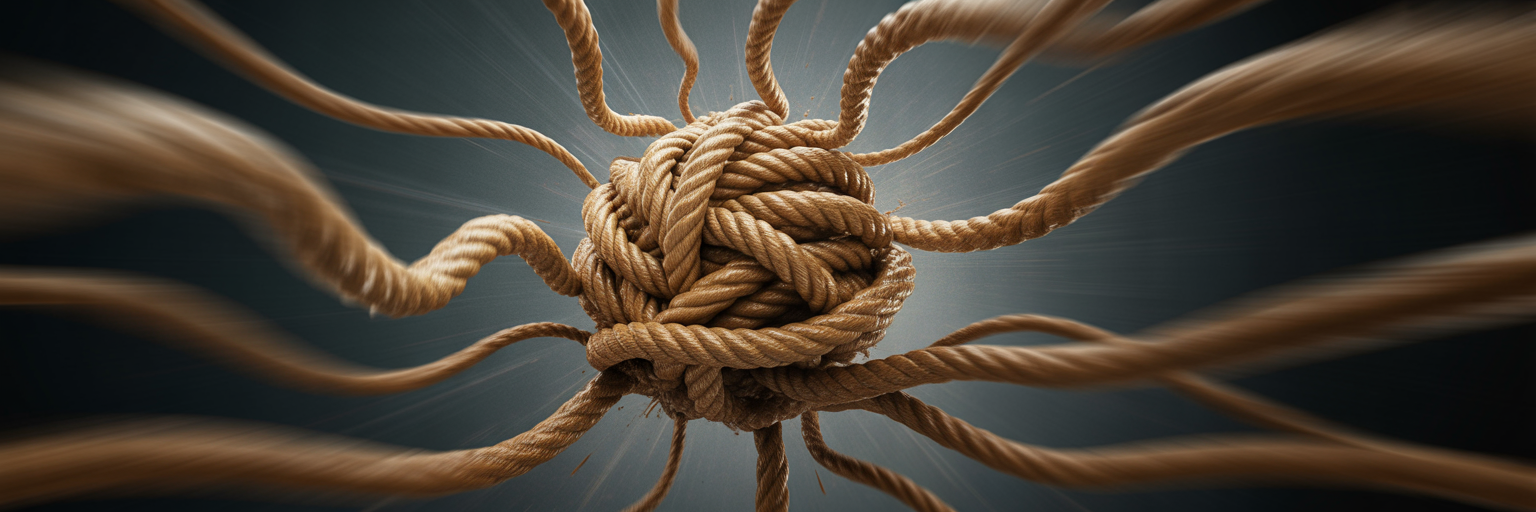
If the slow, deliberate formation of the worm blob is impressive, its explosive disentanglement is nothing short of astonishing. The ability to go from a hopelessly tangled knot to a cloud of free-swimming individuals in the blink of an eye is what makes this behavior so counterintuitive and scientifically fascinating.
The Explosive Disentanglement
Imagine a predator, perhaps a fish or a salamander, approaching the seemingly dormant worm blob. It detects a threat, maybe a sudden shadow passing overhead or a vibration in the water. In response, the solid-looking mass does not just move; it vanishes. The blob explodes outward in a flurry of motion, with thousands of individual worms scattering in all directions. As reported by research in the journal Science, this entire process of disentanglement can occur in just a few hundred milliseconds. This rapid escape is a remarkable survival tactic, reminiscent of other animals that can survive being swallowed and escape alive through sheer ingenuity.
The Mechanics of the ‘Fast Gear’
So, how do worms untangle themselves from such a complex knot so quickly? The answer lies in a second, distinct mode of movement known as the “fast gear.” When a threat is detected, every worm in the blob simultaneously triggers a specific, hard-wired reflex. They switch from slow, random wiggling to a rapid, helical wave motion. Each worm begins to move like a corkscrew.
This corkscrew shape is the key. If the worms simply tried to pull away from each other, they would only tighten the knot, a phenomenon known as jamming. Instead, the helical motion allows them to push their neighbors away. The corkscrew shape is physically incompatible with being in a tight knot, so as each worm starts to spin, it actively creates space around itself. This motion propagates through the blob like a wave, causing the entire structure to rapidly expand and fly apart. It is a synchronized, reflexive response that turns a tangled mass into an escape mechanism.
The Physics and Biology of an Impossible Feat
The California blackworm’s escape trick is not magic; it is a masterclass in physics and biology. It demonstrates how a simple reflex, when adopted by thousands of individuals at once, can produce a result that seems to defy physical laws. Understanding this feat required scientists to look beyond biology and into the world of mathematics and physics.
A Simple Reflex, A Complex Result
The California blackworm behavior is not a product of conscious thought or communication. There is no leader worm ordering the others to escape. Instead, each worm has a simple, built-in neural reflex. When it senses a threat, its nervous system automatically triggers the helical wave motion. Because all the worms share the same reflex, they all react in the same way at the same time. This synchronized action is what allows the collective to function so effectively. It is a decentralized system where a global, coordinated behavior emerges from local, individual actions.
The Physics of Active Matter
To truly understand the untangling, researchers turned to the principles of active matter physics. Active matter is a field of physics that studies systems made of individual agents that consume energy to move and exert forces on each other, like a flock of birds or a school of fish. The worm blob is a perfect biological example. As researchers at Georgia Tech discovered, the worms’ helical movements effectively change the topology of the knot. By modeling the worms as tiny, self-propelled springs, they showed how the corkscrew motion is the optimal way to create repulsive forces that drive the worms apart instead of pulling them together. You can read more about how they unraveled the mathematics behind this behavior, using physics to explain how the worms’ wiggly movements lead to such a rapid escape.
This research, highlighted in publications like the one from Georgia Tech, reveals that the worms have evolved a solution that is not just effective but mathematically elegant. They have harnessed physics to turn a tangled trap into an explosive escape pod.
| Factor | Slow Gear (Tangling) | Fast Gear (Untangling) |
|---|---|---|
| Primary Purpose | Survival (moisture, warmth) | Escape (predator avoidance) |
| Movement Type | Slow, random wiggling | Rapid, helical (corkscrew) wave |
| Coordination | Passive and emergent | Synchronized, reflexive response |
| Speed | Minutes to hours | Milliseconds (<0.1 seconds) |
| Energy Use | Low and sustained | High-burst and explosive |
| Trigger | Environmental cues (e.g., drying) | External threat (e.g., shadow, vibration) |
From Worms to Robots: Nature’s Blueprint for Technology
The study of the California blackworm is more than just an exercise in satisfying curiosity. It is a source of inspiration for engineers and roboticists. By understanding how these simple worms solve complex physical problems, we can develop new technologies that mimic nature’s ingenuity. This approach, known as biomimicry, looks to the natural world for solutions to human challenges.
The most direct application of this research is in the field of biomimicry in soft robotics. Scientists envision creating swarms of small, flexible robots that can operate as a collective. Like the worms, these robots could tangle themselves together to form a solid structure, perhaps to cross a gap or create a temporary barrier. Then, on command, they could trigger a rapid untangling mechanism to disperse and navigate through tight spaces or perform individual tasks. This idea of creating robots inspired by biological movement is part of a larger trend, similar to how scientists study plants that can detect touch without any nervous system to develop new types of sensors.
The principles learned from the worm blob could inspire a range of futuristic technologies:
- Self-Assembling Materials: Imagine fibers that could automatically weave themselves into a fabric or structure and then release on command. This could be used for everything from deployable shelters to smart textiles.
- Self-Healing Systems: A bundle of wires or tubes that, if severed, could re-tangle to restore a connection could lead to more resilient electronic or plumbing systems.
- Programmable Textiles: Fabrics that could change their density, stiffness, and shape by having their individual fibers knot and unknot could create clothing that adapts to the environment or medical braces that can be adjusted with precision.
The California blackworm reminds us that some of the most sophisticated engineering solutions are not found in a lab but in the mud of a quiet pond. By paying attention to these humble creatures, we can discover new ways to build, create, and solve problems.