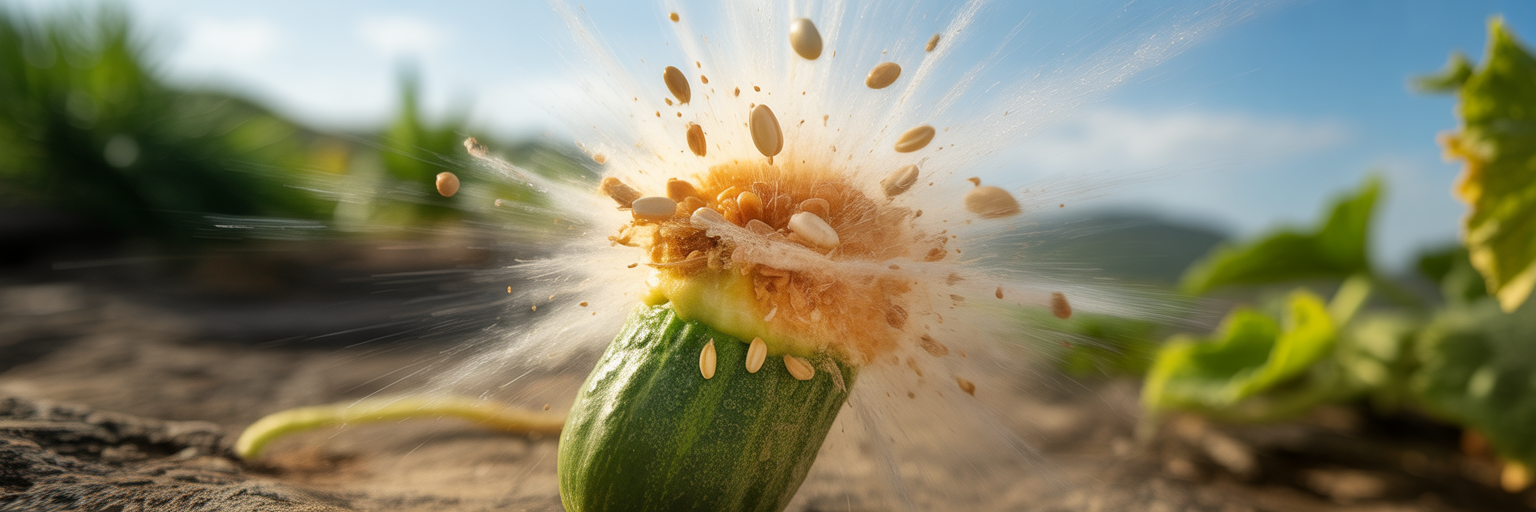
When Plants Get Violent
We tend to picture the plant kingdom as a serene, gentle world. It’s a place of slow, patient growth, where life unfolds at a pace you can’t really see. But beneath that calm, green surface, some plants have decided that patience is for suckers. They’ve chosen violence. Specifically, they’ve engineered themselves to explode.
This isn’t some botanical accident. It’s a deliberate, if unsettling, reproductive strategy. What would drive a quiet, leafy organism to develop its own biological cannon? The answer is survival. When you’re rooted to the spot, sending your kids off to find their own patch of sunlight requires a bit of dramatic flair. This aggressive strategy is just one of many of nature’s unsettling creations that defy belief.
This explosive method is known as ballistic seed dispersal, or ballistochory if you want to sound smart at parties. Think of it like a powerful, biological sneeze. The plant builds up incredible internal pressure until it can’t hold it in anymore, and then—ACHOO—it fires its seeds out in a sudden, forceful burst. Some plants use fluid pressure, while others use mechanical tension, but the goal is the same: to launch their offspring as far away as possible.
These exploding seed pods are nature’s way of saying, “Get off my lawn.” And the undisputed star of this botanical drama is a fuzzy little plant that looks harmless but packs a slimy, surprising punch. Meet the exploding cucumber, nature’s own green grenade, waiting for the slightest touch to go off.
Meet the Exploding Cucumber
The exploding cucumber plant, or Ecballium elaterium, is the poster child for aggressive botany. It’s a master of deception, lulling you into a false sense of security before it makes its move. To truly appreciate its bizarre talent, you have to understand the creature behind the explosion.
The Deceptively Calm Exterior
If you stumbled upon an exploding cucumber in its native Mediterranean habitat, you wouldn’t think twice. It’s a low-lying vine with large, fuzzy, heart-shaped leaves, looking perfectly ordinary. It produces small, yellow flowers that eventually grow into fuzzy, oblong fruits that resemble tiny, spiky gherkins. They just hang there, looking innocent. But inside these unassuming fruits, a high-stakes biological countdown is underway.
The Science of the Sneeze
The explosion is powered by turgor pressure. As the fruit ripens, it absorbs a massive amount of water, creating a soupy, seed-filled slime inside. This process builds up immense pressure, turning the fruit into a tightly-wound, high-pressure water balloon. The fruit hangs from a stalk that acts like a plug, holding all that pressurized goo inside. When the fruit is perfectly ripe, the connection to the stalk weakens. The slightest touch from a passing animal, a gust of wind, or a curious human is all it takes.
The moment the stalk detaches, it creates an opening. The built-up pressure has somewhere to go, and it erupts with astonishing force. The fruit launches itself backward off the stalk while simultaneously firing its slimy payload of seeds in the opposite direction. This isn’t just a gentle squirt; as reported by CNN, the seeds can be launched at speeds approaching 45 miles per hour and travel over 33 feet. It’s a messy, effective, and frankly hilarious feat of natural engineering.
An Unforgettable Encounter
So, what’s it like to be on the receiving end? Imagine walking through a field, you brush against a low-hanging plant, and suddenly you’re hit with a cold, slimy spray. You look down to see a weird, empty fruit husk twitching on the ground, having just shot its insides all over your leg. It’s a moment of pure, comical horror. The process is a masterclass in surprise:
- The Buildup: The fruit swells with water, becoming a taut, pressurized vessel of doom.
- The Trigger: A gentle touch is all it takes to break the seal between the fruit and its stalk.
- The Detachment: The stalk pops off like a cork from a champagne bottle.
- The Eruption: The fruit recoils violently, blasting its seed-laden slurry forward in a chaotic, slimy jet.
It’s a startling, slightly gross, and utterly unforgettable experience that proves plants are anything but boring.
The Biomechanics of a Botanical Blast

While the exploding cucumber relies on a high-pressure squirt gun, many other plants use a different, more mechanical method for ballistic seed dispersal. This approach is less about a slimy sneeze and more about a powerful, snapping explosion. It’s a strategy built on tension, drying, and a sudden, violent release.
The Drying-Tension Method
Many exploding seed pods work like a tightly coiled spring. The walls of the seed pod are constructed from layers of fibers, often oriented in different directions. When the pod is green and hydrated, everything is stable. But as the pod matures and dries out in the sun, these layers begin to shrink at different rates. This uneven shrinkage creates an incredible amount of stored tension. The pod twists and contorts, storing potential energy in its very structure. You can almost feel the strain building, waiting for the right moment to snap.
The Fracture Point
This stored energy continues to build until it reaches a critical breaking point. The pod is designed with built-in weak spots, or sutures, that act as a predetermined fracture line. When the tension becomes too much for the pod’s structure to handle, it fails along these lines. The result is a sudden, explosive snap. The two halves of the pod curl back violently, flinging the seeds out like a catapult. Recent research, such as a study in PNAS, has used high-speed cameras to reveal these explosions happen in fractions of a second, showcasing a highly optimized natural catapult system.
A Feat of Natural Engineering
This entire process is a stunning feat of natural engineering. The plant has perfectly evolved a structure that can slowly store energy over days or weeks and then release it in an instant. It’s a beautiful, violent conversion of potential energy into the kinetic energy of flying seeds. This intricate mechanical process is a reminder that plants are far from passive, with some plants that can detect touch without any nervous system, showcasing their complex adaptations. It’s a silent, deadly trap, set and sprung without a single muscle.
Nature’s Demolition Squad
The exploding cucumber may be the most famous, but it’s far from the only member of nature’s demolition squad. A surprising number of plants that shoot seeds have adopted this explosive strategy, each with its own unique style of botanical ballistics. Here are a few other members of the squad.
The Twisting Pods of the Orchid Tree
The Orchid Tree (*Bauhinia purpurea*) uses the drying-tension method with dramatic flair. It produces long, flat seed pods that can be up to a foot long. As these pods dry in the sun, they twist tighter and tighter until the tension becomes unbearable. Then, with an audible crack, they snap open, violently curling into a spiral. This explosive action flings the large, flat seeds nearly 50 feet away, ensuring they have plenty of room to grow.
The Popping Capsules of the California Lilac
A more common North American example is the California Lilac (*Ceanothus spp.*). This shrub produces small, three-lobed seed capsules. As they dry, pressure builds inside each lobe until the capsule bursts open with a distinct popping sound. While not as powerful as its more dramatic cousins, the force is still enough to send seeds flying several feet, helping the plant spread across hillsides and chaparral.
The Final Boss: The Sandbox Tree
If the exploding cucumber is a green grenade, the Sandbox Tree (*Hura crepitans*) is a botanical claymore mine. This tree is the undisputed champion of explosive dispersal, and it looks the part. Its trunk is covered in sharp, conical spikes, warning away anyone who gets too close. Its fruit is a pumpkin-shaped capsule that, when ripe and dry, unleashes one of the most violent explosions in the plant kingdom.
The Sandbox tree explosion is no joke. The capsule detonates with a sound like a gunshot, loud enough to startle anyone nearby. It shatters into sharp, woody segments that fly in all directions. The seeds themselves are ejected at speeds estimated to be over 150 miles per hour, traveling more than 150 feet. This isn’t just dispersal; it’s a declaration of war on the surrounding landscape.
| Plant Name | Common Name | Explosion Mechanism | Estimated Max Speed | Estimated Max Distance |
|---|---|---|---|---|
| Ecballium elaterium | Exploding Cucumber | Fluid Pressure Ejection | 45 mph (72 km/h) | 33 feet (10 m) |
| Bauhinia purpurea | Orchid Tree | Drying & Twisting Tension | Unknown | 50 feet (15 m) |
| Ceanothus spp. | California Lilac | Drying & Popping Capsule | Low | ~10 feet (3 m) |
| Hura crepitans | Sandbox Tree | Explosive Dehiscence (Drying) | 150+ mph (240+ km/h) | 150+ feet (45+ m) |
This table compares the dispersal methods and performance of several key plants known for ballistic seed dispersal. Data is based on botanical observations and scientific reports to illustrate the varying scales of these natural explosions.
Why All the Explosive Drama?

This all begs the question: why go through all the trouble? This kind of weird plant reproduction is incredibly energy-intensive. Building up that much pressure or tension requires a lot of resources. But for these plants, the evolutionary payoff is more than worth the dramatic effort.
Escaping the Parent’s Shadow
The primary driver is competition. A seedling that sprouts directly underneath its parent is doomed. It will be stuck in the parent’s shadow, fighting for the same limited sunlight, water, and soil nutrients. It’s a battle it will almost certainly lose. By blasting its seeds far away, the parent plant gives its offspring a fighting chance. It’s the botanical equivalent of kicking your kids out of the house so they can find their own way in the world. This explosive solution to parental competition is one of many tactics plants use to dominate their environment, with some plants that can control the growth of nearby roots to choke out rivals.
The Race to Colonize New Land
Explosive dispersal is also an excellent strategy for colonizing new territory. A sudden landslide, fire, or fallen tree can open up a new patch of bare ground. Plants that can get their seeds there first have a massive advantage. Ballistic dispersal allows them to rapidly move into these unoccupied areas, establishing new populations before competitors can arrive. It’s a land grab, executed with biological artillery.
A Self-Reliant Strategy
Finally, this method is wonderfully self-reliant. Many plants depend on external agents for seed dispersal. Some rely on the wind (anemochory), hoping a breeze will carry their seeds to a good spot. Others rely on animals (zoochory), hoping a bird or mammal will eat their fruit and deposit the seeds elsewhere. But these methods are unreliable. The wind might not blow, and animals might not show up. Explosive plants take matters into their own hands. They don’t need to wait for help. The key advantages are clear:
- Reduced Competition: Offspring are sent far from the parent plant.
- Rapid Colonization: Allows plants to quickly claim new, open habitats.
- Increased Reliability: The plant controls its own dispersal, free from dependence on wind or animals.
- Wider Distribution: Seeds are scattered over a large area, increasing the odds that some will land in a suitable location.
A Bizarre and Beautiful End
From the slimy, surprising shot of the exploding cucumber to the startling gunshot crack of the Sandbox Tree, the world of explosive plants is a perfect example of nature’s bizarre ingenuity. It’s a reminder that the plant kingdom is not a passive, peaceful backdrop to our world. It’s a dynamic, competitive arena where organisms have developed hilarious, terrifying, and brilliant solutions to the problems of survival.
Evolution doesn’t always follow a neat and tidy path. Sometimes, it produces a plant that decides the best way to ensure its legacy is to build a biological cannon and literally blow its own fruit to pieces. It’s weird, it’s a little creepy, but it’s undeniably effective.
So the next time you’re on a peaceful walk in the woods, listen closely. That sudden snap might not be a twig underfoot—it could just be a plant, armed and ready to fire. These explosive plants are just the beginning; the natural world is full of countless other strange and wonderful phenomena waiting to be discovered at Nature is Crazy.