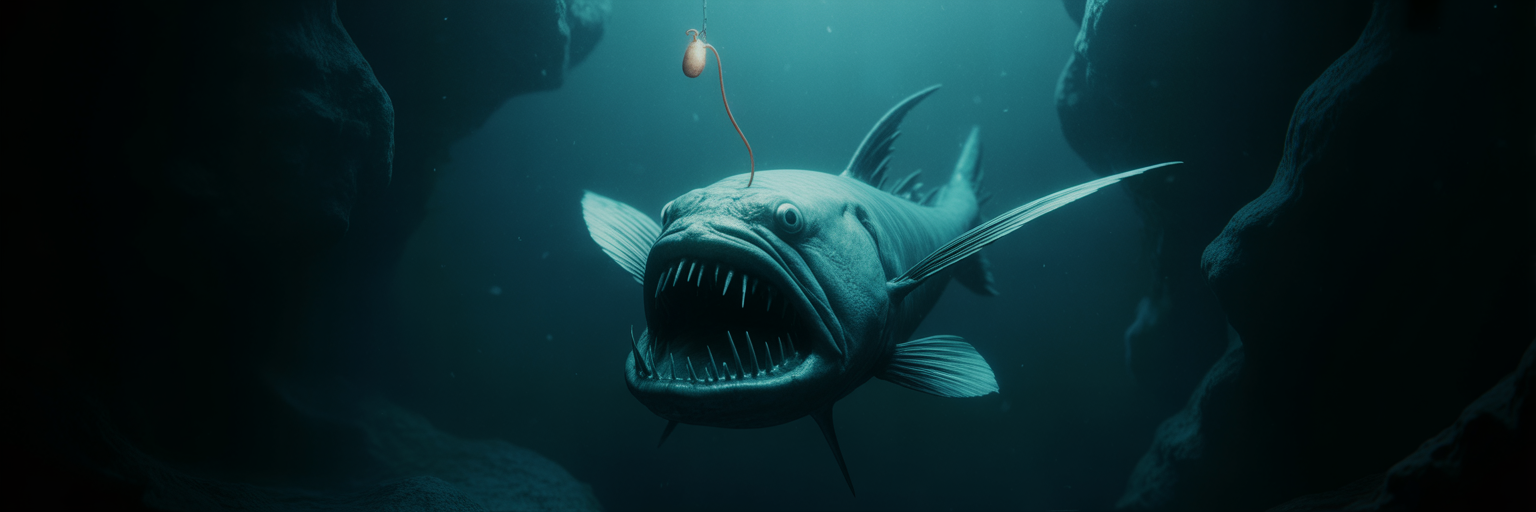
An Unsettling Invitation to an Inverted World
Let’s try a little experiment. Hang your head off the side of your bed. Feel that? The immediate, insistent rush of blood. The dull throb that starts behind your eyes and spreads across your temples. Your face feels heavy, swollen. A faint, queasy sensation begins to churn in your stomach as your organs, accustomed to a lifetime of downward pull, suddenly feel adrift. Stay there for a minute. The pressure builds. Your vision might start to speckle at the edges. It’s a deeply unpleasant, fundamentally wrong feeling. Now, get back up.
For you, that was a brief, voluntary moment of discomfort. A temporary horror you could end at will. But what if it wasn’t? What if that throbbing, disorienting state was your permanent reality? Imagine a world where the rules of gravity seem rewritten, a place so alien that our concept of “up” and “down” loses all meaning. This isn’t a hypothetical scenario from a science fiction novel. It’s a description of a real place on our own planet.
Picture an environment of absolute, eternal darkness, pierced only by fleeting sparks of living light. The pressure here is so immense it would crush a submarine like a soda can. There is no sky, no sun, no surface. There is only a cold, crushing, and silent abyss. In this seemingly impossible world, something lives. Something has not only adapted to this hostile void but has embraced an existence that would kill us in seconds. It has chosen to live its entire life inverted.
This isn’t just a party trick or a temporary maneuver. It is a constant state of being. The question isn’t just what this creature is, but how it manages such a feat. How has its body been re-engineered to defy the very sensations that just sent you scrambling upright? This article will explore the biology of these topsy-turvy animals, uncovering the stunning evolutionary logic behind their seemingly impossible existence. We are about to journey into some of nature’s most weird animal facts to understand the how and why behind a life lived upside down.
The Deep-Sea Daredevil: An Anglerfish’s Topsy-Turvy Tale
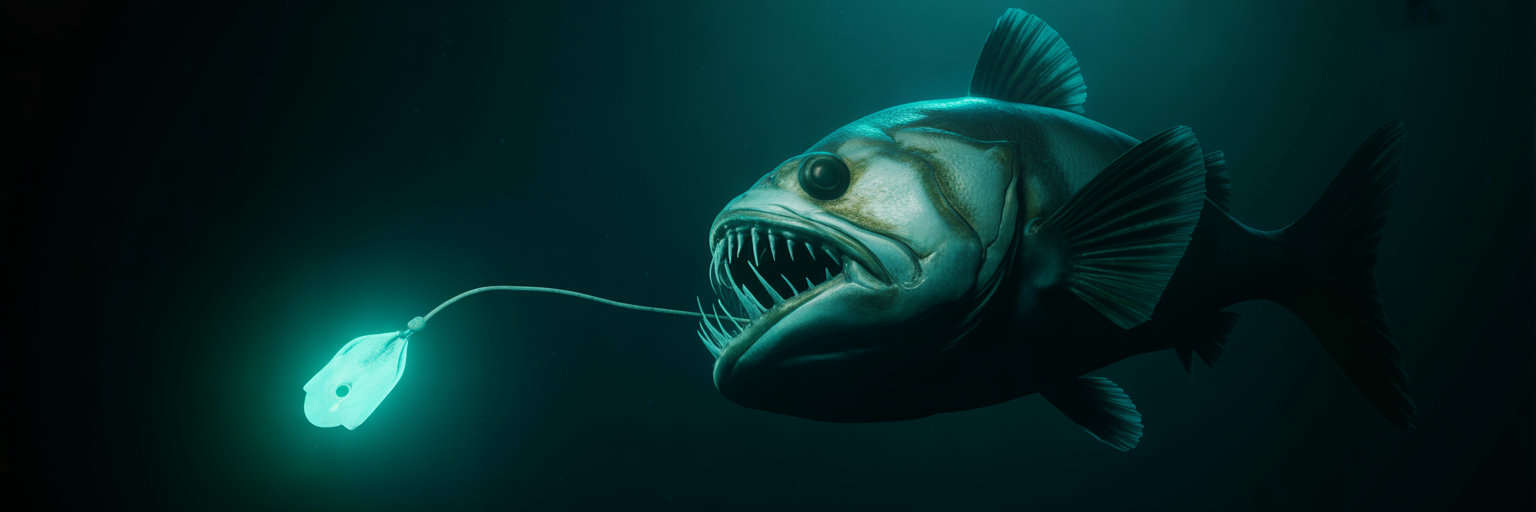
The grand reveal takes us thousands of feet below the ocean’s surface, into a realm of crushing pressure and profound blackness. Here, in the bathyal and abyssal zones, lives the only known vertebrate to spend its entire life swimming, hunting, and existing upside down: the whipnose anglerfish of the Gigantactis genus. This isn’t a recent evolutionary quirk. It’s a lifestyle perfected over millennia, yet it remained a secret hidden in the deep until very recently.
For a long time, scientists could only study specimens dragged to the surface, their bodies warped by the sudden change in pressure. Their true behavior was a mystery. It wasn’t until late 2023 that scientists using deep-sea submersibles could confirm this bizarre orientation. As highlighted by outlets like Phys.org, multiple species of whipnose anglerfish were observed swimming inverted for extended periods, a discovery that reshaped our understanding of life in the abyss.
Imagine the environment. The pressure is hundreds of times greater than at sea level. The water is near freezing. Light does not penetrate this far. It is a world of profound scarcity, where a single meal can mean the difference between survival and starvation. In this high-stakes game, the deep sea anglerfish upside down posture is not a strange flaw. It is a masterstroke of predatory engineering. The reason is all about the hunt.
Like other anglerfish, Gigantactis possesses a bioluminescent lure, a fleshy appendage called an esca that glows with an eerie light produced by symbiotic bacteria. But unlike its relatives, this anglerfish has an incredibly long fishing rod, sometimes four times the length of its own body. By swimming upside down, it can dangle this glowing lure far below it, like a fisherman casting a line into the dark water. Any unsuspecting fish, squid, or crustacean drawn to the light from below swims directly toward the anglerfish’s waiting, upturned mouth. It is a ruthlessly efficient trap.
This inverted posture is its default state. Footage shows it moving with a strange grace, its fins propelling it through the water with its belly facing the unseen “sky” of the sea surface miles above. This constant inversion allows for precise control of its lure, turning a simple anatomical feature into a sophisticated hunting tool. The anglerfish isn’t a freak of nature. It is a predator perfectly, and terrifyingly, engineered for a world where the only light is the one you make yourself, and the best way to hunt is from above.
The Anatomical Blueprint for an Inverted Life
Understanding why the anglerfish lives upside down is one thing. Understanding how is another. This bizarre lifestyle is made possible by a suite of incredible animal adaptations for gravity and pressure that defy our own biological limitations. Its entire body is an integrated system, a blueprint for a life lived in reverse.
Let’s start inside. While we don’t have a complete picture of its internal anatomy, scientists theorize that its organs and skeletal structure are arranged to function perfectly against a constant, inverted pull. Unlike our own loosely held organs, which would slump and press against the diaphragm, the anglerfish’s internal systems are likely secured in a way that prevents compression and maintains function. Its very skeleton may be structured to distribute weight and stress in this unusual orientation, ensuring that being upside down is its most stable and comfortable state.
Its movement is another piece of the puzzle. The placement and motion of its fins are optimized for efficient upside-down propulsion. It doesn’t flail or struggle. It glides. The fluid dynamics of its body shape allow it to move through the dense, cold water with minimal energy expenditure, a critical advantage in a low-food environment. It is a graceful, not a clumsy, swimmer in its inverted world.
Of course, the star of the show is the bioluminescent lure. The inverted posture gives the anglerfish superior control over the esca’s position. It can twitch it, wave it, and position it with precision to mimic the movements of smaller bioluminescent prey, creating an irresistible attraction. The symbiotic bacteria living within the esca are the power source, a tiny, living lantern that the anglerfish has harnessed for its own deadly purposes. This creature is a prime example of one of nature’s unsettling creations that defy belief, a living testament to evolution’s strange solutions.
Finally, consider its senses. In total darkness, vision is secondary. The anglerfish likely relies on a highly developed lateral line system, a series of pressure-sensitive organs running along its body. Tuned to detect vibrations from below, this system would act as a form of sonar, alerting the fish to the approach of potential prey drawn to its lure long before it comes into view. Every part of its biology, from its bones to its glowing bait, is a component in a machine designed for one purpose: to thrive in a world where down is up.
The Slow-Motion Acrobat: Why Sloths Hang Around
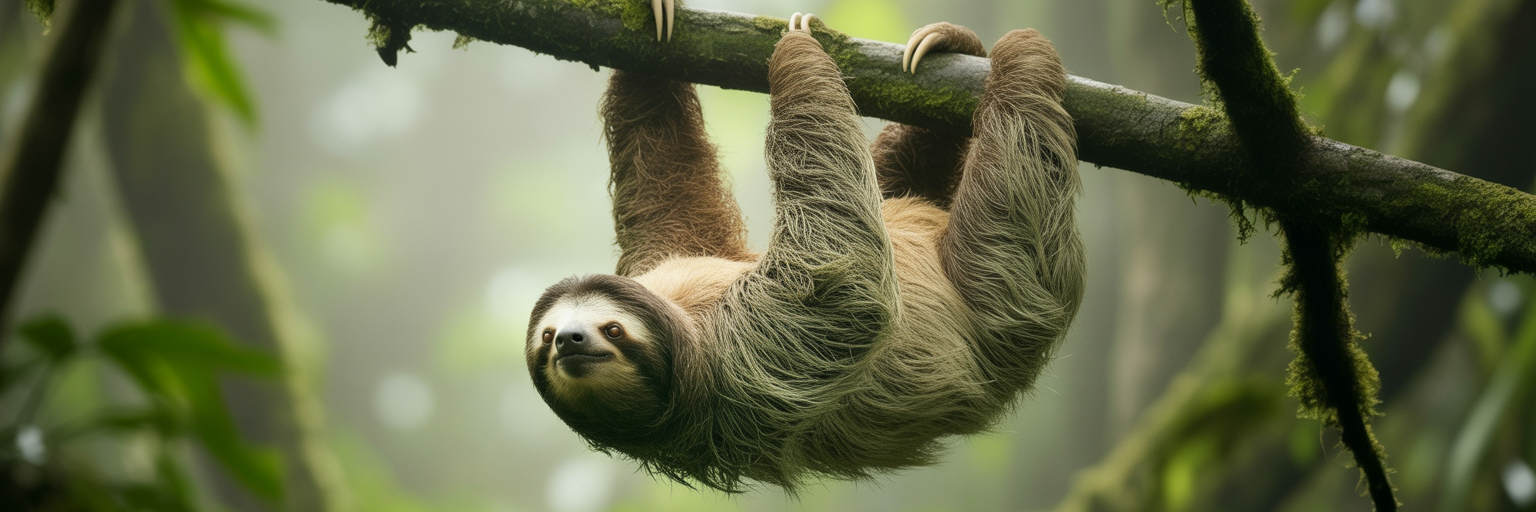
Leaving the crushing darkness of the abyss, we ascend into the sun-dappled canopy of Central and South American rainforests. Here we find a far more familiar, yet equally strange, inverted specialist: the sloth. While the anglerfish is a fast, dark predator, the sloth is its polar opposite. It is a slow, herbivorous creature living a life of passive suspension. Yet both have arrived at the same upside-down solution for entirely different reasons.
The central question is, why do sloths hang upside down? The answer lies in a single, overriding evolutionary pressure: extreme energy conservation. A sloth’s diet consists almost exclusively of leaves, which are low in calories and difficult to digest. To survive on such poor fuel, the sloth has become a master of efficiency, and hanging is far more efficient than standing. Its long, hook-like claws are not for gripping with muscle power. They are shaped to hang from branches with virtually no effort, allowing the sloth to doze for up to 15 hours a day without wasting precious energy.
But this presents a problem we felt in our head-hanging experiment: organ pressure. A sloth’s stomach can account for up to a third of its body weight when full of digesting leaves. If its organs were arranged like ours, their weight would constantly press down on its diaphragm, making every breath a struggle. So, how does it breathe so effortlessly? The sloth’s secret weapon is internal. It has evolved unique fibrous adhesions that anchor its stomach and liver to its lower ribs. According to a study highlighted by Science News, these internal tethers act like biological glue, preventing the heavy organs from crushing the lungs. This simple adaptation saves the sloth a significant amount of energy with every breath.
This internal rearrangement is a fascinating case of specialized evolution, much like how some animals can change their internal organs seasonally to adapt to different metabolic demands. However, this specialization comes with a trade-off. While perfectly suited for life in the trees, the sloth is incredibly vulnerable on the rare occasions it descends to the forest floor. Its body is simply not built for terrestrial movement. The sloth is not lazy. It is a finely tuned biological machine, a living testament to the idea that sometimes, survival is about perfecting the art of doing almost nothing at all.
Night’s Inverted Sentinels: The Bat’s Hanging Habit
Our final stop on this tour of inverted life takes us to caves, attics, and hollow trees around the world, home to our third upside-down specialist: the bat. Unlike the anglerfish, which hunts inverted, or the sloth, which conserves energy, the bat’s hanging habit is driven by two different needs: efficient rest and immediate flight readiness. This showcases yet another evolutionary path to the same peculiar posture.
First, let’s address the obvious question: how do bats sleep upside down without all the blood rushing to their heads? Their physiology has several clever solutions. Bats are small, so their blood volume is low, reducing the overall pressure. More importantly, their circulatory systems contain one-way valves in their arteries, not just their veins, which prevent the backflow of blood and stop it from pooling in the brain. It’s a simple but effective plumbing fix.
The primary advantage of hanging, however, is all about takeoff. A bat’s hind legs are not powerful enough for running or jumping to gain the necessary lift for flight. By hanging from a high perch, they can simply let go. Gravity becomes their ally, providing instant downward momentum that they convert into flight. It’s an incredibly energy-efficient way to get airborne. This ability to essentially turn off the effort required to grip is one of many incredible biological hacks, similar to how some creatures that can shut down pain signals at will have evolved to override normal physical responses.
The mechanism for this effortless grip is a marvel of biological engineering in their tendons. It works in four simple steps:
- The tendons in a bat’s legs connect their muscles directly to their claws.
- When the bat hangs, the weight of its own body pulls on these tendons.
- This tension automatically flexes the claws, causing them to clamp down and lock into a tight grip.
- This entire process requires zero muscular effort to maintain. A bat could hang this way even after it has died.
These three creatures—the anglerfish, the sloth, and the bat—provide a stunning example of convergent evolution, where different species independently evolve similar traits to solve different problems.
| Creature | Primary Reason for Inversion | Key Adaptation | Environment |
|---|---|---|---|
| Deep-Sea Anglerfish | Hunting Strategy | Inverted Body Plan & Lure Placement | Deep Ocean (Abyssal Zone) |
| Sloth | Energy Conservation | Internal Organ Adhesions | Rainforest Canopy |
| Bat | Takeoff Efficiency & Resting | Locking Foot Tendons & Circulatory Valves | Caves, Trees, Structures |
Why Humans Can’t Join the Upside-Down Club
Let’s return to where we started: you, with your head hanging off the bed, feeling that awful, throbbing pressure. Now we can understand exactly why that happens. Our circulatory system is a masterpiece designed to fight gravity, constantly working to pump blood up to our brain. When we invert ourselves, that system is overwhelmed. The one-way valves in our veins are not enough to stop blood from pooling in our heads, causing that dangerous spike in pressure.
Our anatomy is equally unsuited for the challenge. Our internal organs are held in place by little more than soft tissues and membranes. When we go upside down, our stomach, liver, and intestines slump down onto our diaphragm, the muscle that controls our breathing. This makes it difficult, and eventually impossible, to take a full breath. We are, from top to bottom, creatures built for an upright world.
This human frailty makes the creatures that live upside down even more extraordinary. The anglerfish’s re-engineered body, the sloth’s internal organ glue, and the bat’s clever circulatory tricks are not just oddities. They are profound solutions to fundamental biological problems. The existence of these inverted specialists is a powerful reminder that life will always find a way, whether it’s by learning to breathe metal instead of air or by deciding the sky is below you. They challenge our most basic assumptions about what is “normal,” proving that in the grand, strange theater of evolution, “up” is merely a point of view.