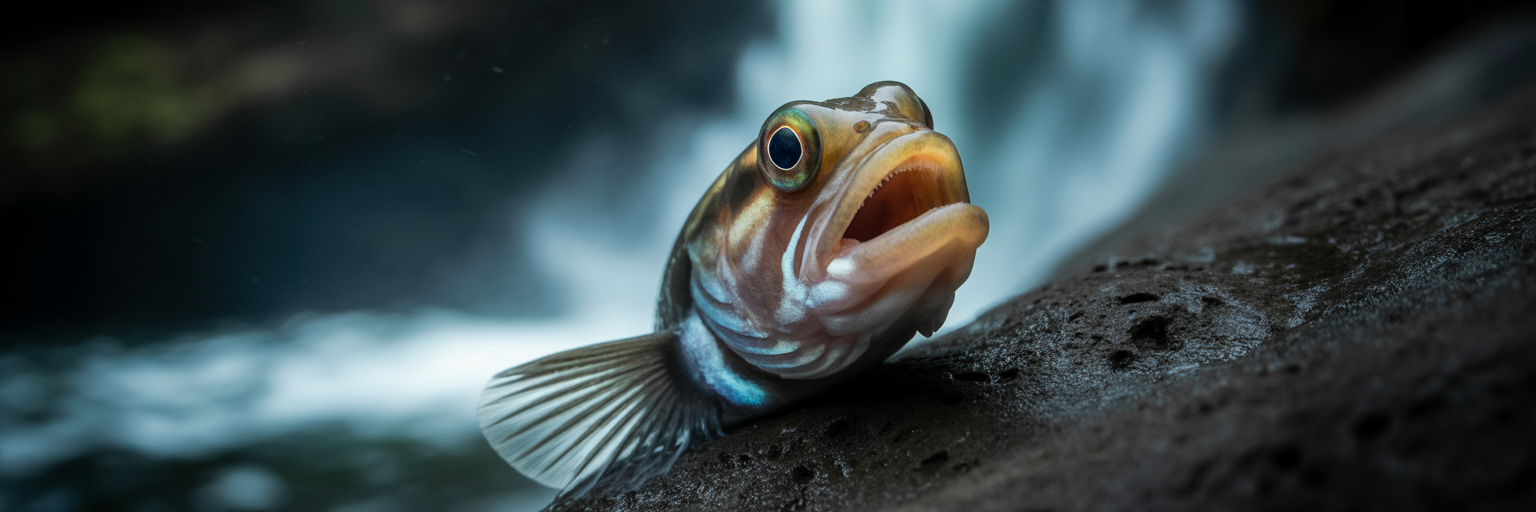
Hawaii’s Tiniest, Creepiest Overachiever
Picture a Hawaiian waterfall. You can almost hear it, can’t you? The gentle roar of water cascading over volcanic rock, misting the lush green ferns that cling to the cliffside. The air is thick with the smell of damp earth and tropical flowers. Below, a tranquil pool shimmers, a perfect postcard of paradise. Now, look closer at the rock face, right where the water crashes down with the force of a firehose. Something is moving. Something is moving up.
It’s a small, dark shape, no bigger than your finger, inching its way directly into the torrent. It’s not a bug. It’s not a lizard. It’s something that has no business being there, defying gravity and physics with a slow, deliberate rhythm. The sight is deeply unsettling, like watching a glitch in reality. This is the work of the Hawaiian goby, known locally as ‘o‘opu alamo‘o. Its scientific name is Sicyopterus stimpsoni, but you can just call it nature’s most stubborn overachiever.
This creature is a jarring contradiction. It possesses a superpower that would make a comic book hero jealous, yet it’s a tiny, almost pathetic-looking fish, just a few inches long. You could easily miss it, which makes its relentless, vertical climb all the more disturbing. This isn’t some graceful marvel of evolution. This is a weird, obsessive little monster from a B-horror movie, an inching, sucking thing driven by a single, terrifying purpose: get to the top. It’s one of nature’s unsettling creations that defy belief, a testament to how bizarre survival can get.
The existence of this fish forces two immediate, unnerving questions. First, how does a creature this small perform a feat that seems physically impossible? And second, what kind of brutal, unforgiving world produced a specialist this extreme? The answers are even stranger than the climb itself. Some of the most interesting Sicyopterus stimpsoni facts relate to how its body is a purpose-built climbing machine, a collection of biological tools honed for a single, nightmarish task.
The Unholy Physics of an Impossible Ascent
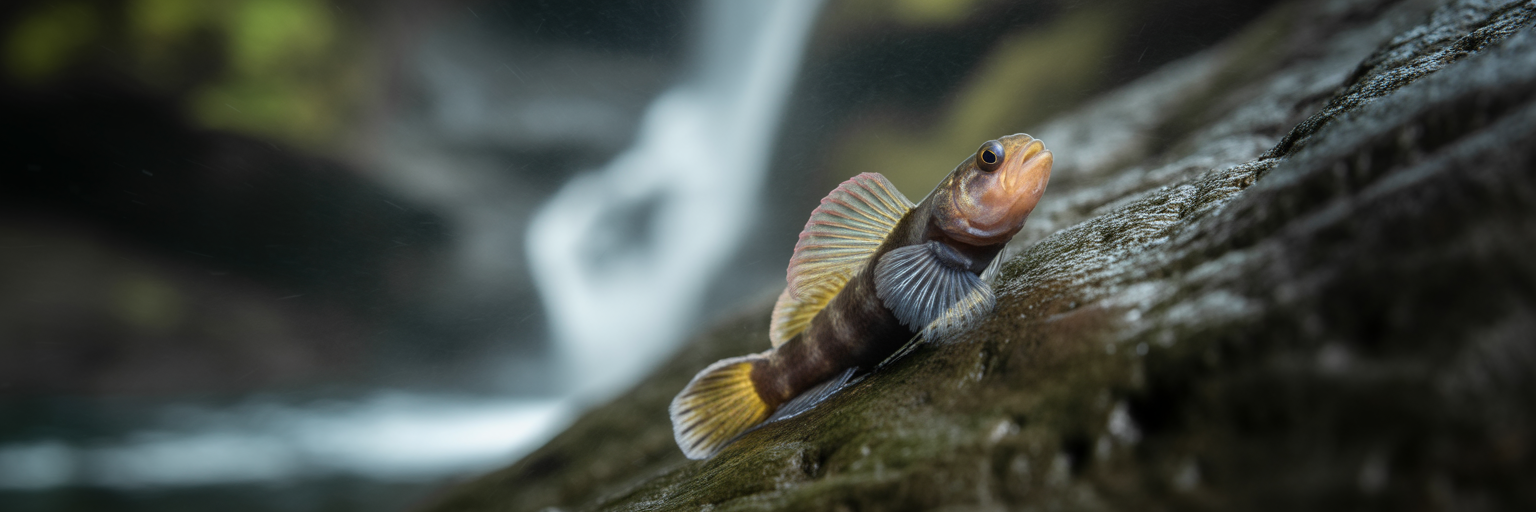
So, you want to know how do gobies climb? Forget everything you know about swimming. This isn’t about fins and fluid dynamics. This is a grotesque, brute-force assault on a vertical, slippery surface. The process is a two-part rhythm of suck and pull, a sequence so bizarre it feels like it was choreographed by a mad scientist. It’s less like climbing and more like a slow, wet, upward crawl.
Here is the grotesque manual for its impossible ascent:
- The Lunge: The climb begins with a violent forward thrust. The goby uses its body to lunge a short distance up the rock face, planting its face directly onto the slick, algae-covered stone. This isn’t a gentle placement. It’s a desperate, all-or-nothing slam against the wall.
- The Suction: The moment its mouth makes contact, the real horror begins. The waterfall climbing fish mouth isn’t just for eating. It’s a biological grappling hook. The fish flares its upper jaw, creating a powerful vacuum seal that locks it onto the rock with incredible force. You can almost hear the wet *schlop* as it attaches, a sound that promises it will not let go.
- The Pull: With its mouth firmly anchored, the goby engages its body muscles. You can see the strain in its tiny frame as it hauls its entire weight upward, inch by agonizing inch. It pulls its body toward its mouth, fighting against both gravity and the crushing weight of the water pouring over it.
- The Anchor: Just as it completes the pull, a secondary sucker on its belly, formed from fused pelvic fins, takes over. It clamps down, acting as a safety brake and holding the fish fast. This allows the goby to detach its mouth, take a “breath,” and prepare for the next lunge. This two-sucker system is the key to its continuous, inchworm-like movement.
This cycle repeats, over and over, for hours. Mouth-suck, body-pull, belly-suck, release. To truly grasp the absurdity of this feat, let’s put it in human terms. These fish can climb waterfalls over 300 feet high. As a report from National Geographic highlights, this is the biological equivalent of a person climbing a 30-story skyscraper using only their mouth and stomach to pull themselves up a wet, slippery surface. It’s a display of endurance and specialized function that borders on the supernatural.
Anatomy of a Biological Climbing Machine
The goby’s impossible climb isn’t magic. It’s the result of a body that has been ruthlessly optimized for one specific, horrifying task. Every part of this fish is a tool, modified and perfected for vertical ascent. It’s a living, breathing climbing machine, a collection of biological hardware that makes man-made suction cups look like children’s toys. Some animals have evolved incredible abilities, like those that can change their internal organs seasonally, but the goby’s entire external anatomy is a testament to extreme adaptation.
The Oral Sucker: A Biological Grappling Hook
The star of the show is the goby’s mouth. It’s not just for eating. The upper lip and jaw are specially modified to act as a high-performance suction cup. Unlike a rigid plastic cup that only works on smooth, flat surfaces, the goby’s mouth is soft and pliable. It can conform perfectly to the uneven, slimy, and unpredictable texture of a waterfall rock face, creating a flawless vacuum seal every single time. This oral sucker is the primary anchor, the tool that initiates the climb and bears the brunt of the pulling force.
The Pelvic Anchor: A Fused Fin Safety Brake
If the mouth is the grappling hook, the pelvic fins are the safety line. In most fish, these fins are used for steering and stability. In the goby, they are fused together into a second, smaller suction disc on its belly. This pelvic sucker is the unsung hero of the climb. While the mouth is detached and repositioning for the next pull, this secondary anchor holds the fish firmly in place, preventing it from being instantly swept away by the torrent. This dual-sucker system allows for a continuous, inchworm-like motion that would be impossible with a single point of adhesion.
The Engine Room: Disproportionate Muscle Power
A great set of tools is useless without a powerful motor. The goby’s body is packed with disproportionately powerful muscles, especially in its jaw and core. These aren’t the sleek, streamlined muscles of a fast swimmer. They are the dense, powerful muscles of a rock climber, built for generating immense pulling force. The entire body form is compact and rigid, designed to transfer the force generated by its mouth directly through its spine to its tail, allowing it to pull its full body weight upward without buckling under the strain.
| Body Part | Primary Biological Function | Specialized Climbing Role |
|---|---|---|
| Amphidromous Mouth | Scraping algae from rocks (feeding) | Primary suction anchor; generates initial grip and pulling force. |
| Fused Pelvic Fins | Stabilization in currents | Secondary suction anchor; holds the body in place while the mouth repositions. |
| Jaw Musculature | Chewing and scraping food | Generates immense, rapid suction force for adhesion. |
| Body Musculature | Swimming and maneuvering | Provides the power to pull the entire body weight upward against gravity and water flow. |
| Robust Body Form | Streamlining for aquatic life | Provides the rigid structure needed to transfer force from mouth to tail without buckling. |
Forged in the Crucible of Fire and Flood
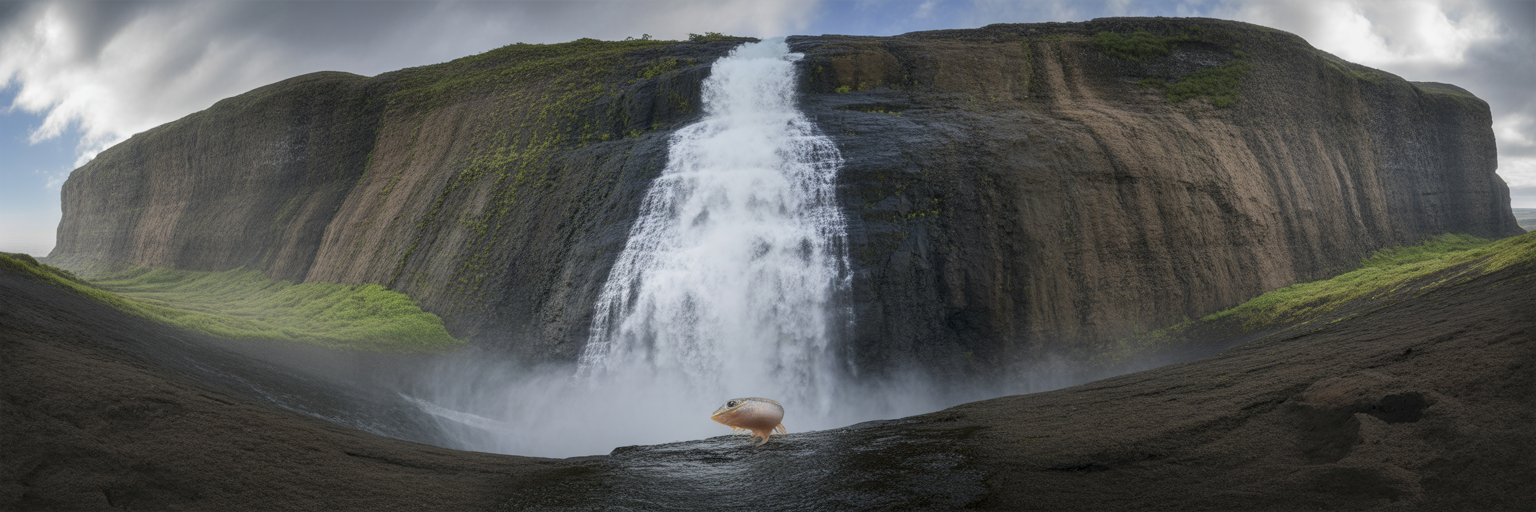
Why would any creature evolve such a bizarre and strenuous ability? The answer lies in the goby’s violent homeland. The Hawaiian Islands are geologically young, born from volcanic eruptions. This is an ecosystem in constant, violent flux. Flash floods can scour entire streams in minutes, washing everything out to sea. New lava flows can create towering, impassable waterfalls overnight. It’s a world of beautiful but brutal uncertainty.
In this chaotic environment, the waterfall becomes a gatekeeper. The habitats upstream are a sanctuary. They are safer, with fewer predators and less competition for food. But this paradise is locked away behind a vertical wall of rushing water. The ability to climb is the only key. For the goby, this climb isn’t a party trick. It’s a matter of life and death, a skill that separates survival from oblivion. This kind of extreme pressure produces some of nature’s most incredible survivors, including animals that can survive being swallowed and escape alive.
The goby’s life cycle makes this climb mandatory. It has what is known as an amphidromous life cycle. The larvae are born in the serene freshwater streams high in the mountains. Almost immediately, they are washed downstream, out into the vast, dangerous ocean. There, they grow into juveniles. But to complete their life and reproduce, they must return to the freshwater streams where they were born. This means undertaking a perilous migration back upstream, against the current.
The final stage of this journey is the Hawaiian goby climbing the waterfall. This is the ultimate test, a brutal filter that ensures only the absolute strongest, most determined, and best-equipped individuals make it back to the breeding grounds. Every goby you see in an upstream pool is a champion, a survivor of an impossible journey. Evolution didn’t just give them a neat trick. It armed them for a war against gravity, a war they must win to exist at all.
Evolution’s Genius for Repurposing Tools
Here’s where the story takes its final, weird twist. You might think this incredible climbing ability evolved from scratch, a brand-new invention for a brand-new problem. But nature is rarely that direct. It’s more of a creepy, resourceful tinkerer. It prefers to take something that already exists and repurpose it for a new, often bizarre, function. This concept is called exaptation, and it’s the secret behind the goby’s superpower.
Think of it like this: feathers likely first evolved on dinosaurs to keep them warm. Only much later were they repurposed for flight. Evolution upcycled an insulation tool into an aerodynamic one. The goby’s story is a perfect, and slightly disgusting, example of this principle in action. For years, scientists were baffled by the climb. Then, using high-speed video analysis, they made a stunning discovery.
As a study highlighted by Science.org revealed, the muscle movements the goby uses for climbing are nearly identical to the movements it uses for eating. The goby is an herbivore that feeds by scraping algae off rocks. To do this, it uses its sucker mouth to latch onto a rock and then uses its body to scrape its jaw across the surface. This “latch and scrape” motion is its normal way of having dinner. It’s a mundane, everyday behavior.
Evolution took this simple feeding motion and amplified it. It twisted the goby’s table manners into a bizarre method of locomotion. The “latch and scrape” became the “latch and pull.” The same muscles, the same neurological pathways, the same sucker mouth—all were repurposed for the climb. The goby’s world-class climbing ability didn’t appear out of thin air. It was hiding in its lunch break the whole time. This is the punchline to the goby’s story: its incredible, death-defying superpower is just an extreme, obsessive version of how it eats. It’s a chilling example of nature’s genius for finding horrifying new uses for old tools.
What This Freaky Fish Can Teach Humans
The story of this strange fish that climbs waterfalls is more than just a creepy biological curiosity. It’s a living blueprint for solving complex engineering problems. Scientists are now studying the goby in a field called biomimicry, which looks to nature for inspiration to create better technology. The goby’s mastery of adhesion in a wet, chaotic environment offers solutions to challenges that have stumped human engineers for decades.
The potential applications are as fascinating as the fish itself:
- Advanced Robotics: Imagine rescue robots that can climb wet, crumbling, and irregular surfaces in disaster zones. By mimicking the goby’s dual-sucker system and pliable mouth, engineers could design machines that can adhere to almost any surface, revolutionizing search and rescue operations.
- Industrial Inspection: The goby provides a model for miniature robots that could crawl inside wet, slippery pipes for inspection and repair. A goby-bot could navigate the interior of water mains, sewer systems, or industrial pipelines, identifying blockages or cracks without the need for costly and disruptive disassembly.
- Medical Technology: The suction-based movement could inspire tiny medical devices capable of navigating inside the human body. A microscopic device could inch its way through blood vessels or along organ walls to deliver drugs to a specific location or perform internal diagnostics with unprecedented precision.
Beyond specific inventions, the goby offers a masterclass in the physics of adhesion. By studying how it creates such a strong, yet instantly reversible, bond in a high-flow water environment, scientists can develop new adhesives that work in the most challenging conditions. The goby is a powerful, if slightly creepy, metaphor for resilience. It teaches us that sometimes the most extreme challenges are overcome not by inventing something entirely new, but by creatively and obsessively repurposing the tools we already have.
The Climber’s Fragile and Fleeting Kingdom
After its brutal, epic climb, the goby finally reaches its kingdom: the pristine, serene upstream pools. Here, it plays a crucial role in the ecosystem. As a primary herbivore, it grazes on algae, keeping the streams clean and healthy. It is a foundational species in the very sanctuary it fought so hard to reach. But here, the story takes a tragic turn. The ultimate survivor, a creature forged in fire and flood, is now facing threats it cannot climb its way out of.
The goby’s greatest strength—its specialization—is also its greatest vulnerability. Its entire life cycle depends on the ability to move between the ocean and the mountains. Man-made barriers are severing this connection. Dams, culverts, and water diversions create obstacles that are fundamentally different from natural waterfalls. Their smooth, concrete surfaces and uniform water flows offer no purchase for the goby’s suckers, effectively creating walls that are truly impassable. These structures cut off the breeding grounds, slowly strangling the goby populations upstream.
Even in the sanctuaries they do reach, new dangers await. Invasive species, like non-native fish introduced by humans, now inhabit these upper streams. They outcompete the gobies for food or, worse, prey on their young. The safe havens that drove the evolution of their incredible climbing ability are no longer safe.
The final irony is that this terrifyingly capable little monster is also a fragile, unique part of Hawaii’s natural heritage. Its survival no longer depends on its own strength, but on our intervention. Conservation efforts by scientists and local agencies in Hawaii are now focused on restoring stream connectivity, removing or modifying man-made barriers to give the goby a fighting chance. The tale of the waterfall-climbing fish is a weird, wonderful, and ultimately cautionary one. It reminds us that even the toughest survivors are vulnerable and that the strange and amazing creatures of our world are worth protecting. If this story has you hooked on the bizarre side of the animal kingdom, you can find more at Nature is Crazy.