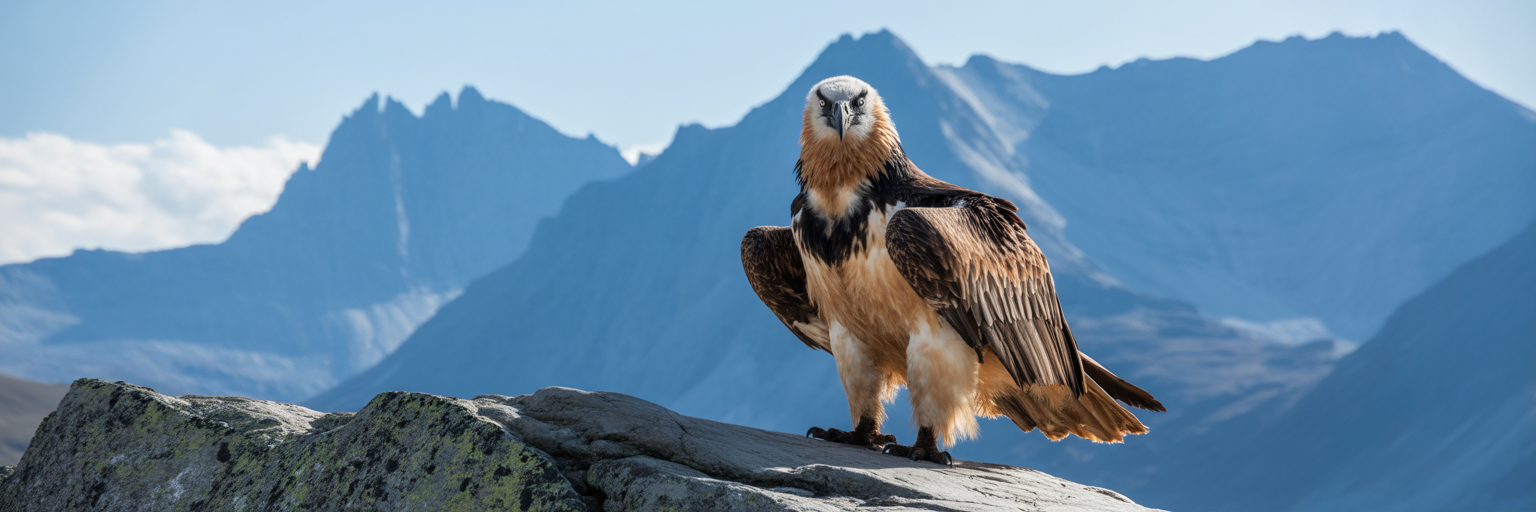
Meet Nature’s Most Metal Scavenger
Imagine a scene high in the mountains. The air is thin and cold. On a rocky ledge lies the aftermath of a feast, a skeleton picked clean by wolves and griffon vultures. The frenzy is over, the soft tissues gone. Most scavengers would move on, but this is not the end. This is just the beginning. A shadow glides overhead, patient and enormous, waiting for everyone else to finish. It has no interest in the meat. It’s here for the bones.
The Patient Diner at the End of the World
This creature is the bearded vulture, known scientifically as Gypaetus barbatus. It operates on a different timeline from its frantic cousins. While other birds squabble over scraps of flesh, the bearded vulture waits with an unnerving calm. It watches from a distance, a silent observer calculating the perfect moment to claim its prize. It understands that the real treasure, the nutrient-dense marrow locked inside the skeleton, is left untouched. It is a specialist, a connoisseur of the macabre, and its preferred meal is the very framework of life itself.
What’s in a Name? Bone-Breaker by Definition
Its names are as intimidating as its diet. For centuries, it was called the Lammergeier, a German term meaning “lamb-vulture.” This name came from the mistaken belief that it snatched lambs from shepherds’ flocks. While its talons are capable of carrying heavy loads, they are not built for killing. The more accurate name is its ancient Latin designation, Ossifrage, which literally translates to “bone-breaker.” No misinterpretation there. The name is a perfect summary of its life’s work and the core of its lammergeier feeding habits. It doesn’t just eat bones; it shatters them with calculated, terrifying precision.
A Vulture That Defies the Stereotype
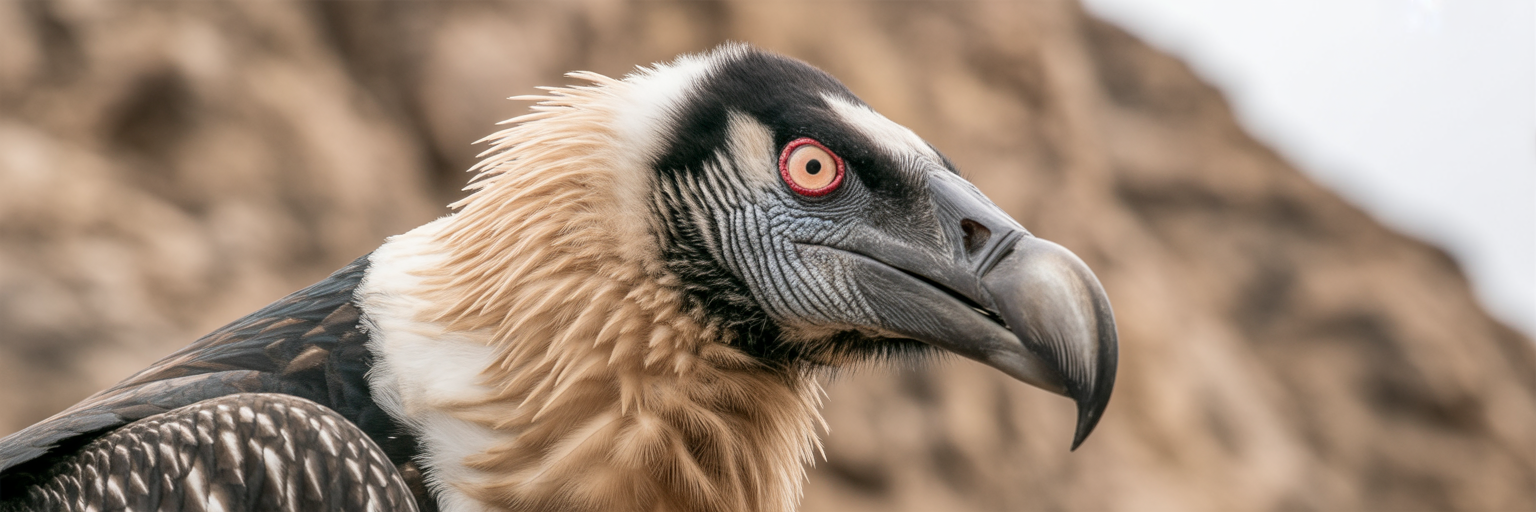
When you picture a vulture, you probably imagine a hunched, bald-headed creature. The bearded vulture is nothing like that. It’s a creature of gothic majesty. With a wingspan stretching up to nine feet, it commands the sky. Its head and neck are covered in creamy white feathers, a stark contrast to the dark, slate-grey of its wings. The most striking feature is its face. Piercing eyes are encircled by bright red rings that flare up when the bird is agitated or excited, giving it a look of perpetual, fiery intensity. And then there’s the “beard,” a tuft of black bristles hanging from its beak that completes its regal, almost vampiric, appearance. This is not the humble, dirty scavenger of cartoons. This is an avian aristocrat with a taste for skeletons.
The Bone-Dropping Buffet Ritual
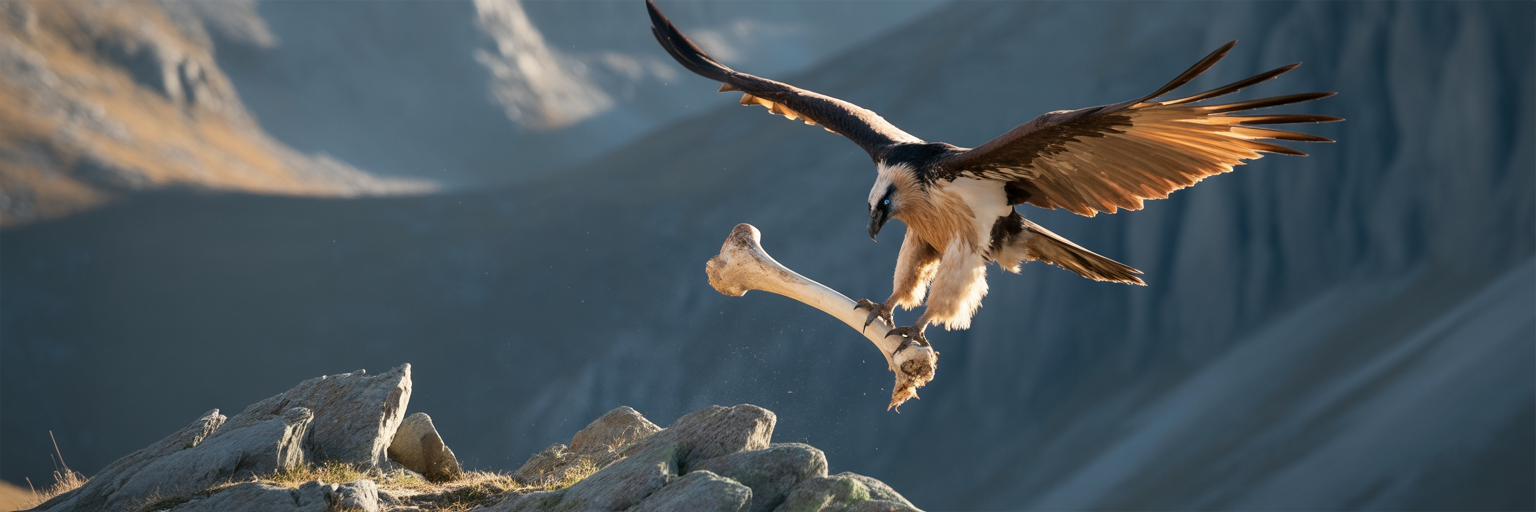
So, how does an animal actually live on a diet of bones? It’s not a matter of simply pecking at a skeleton. The bearded vulture has developed a feeding ritual that is part performance art, part brilliant engineering, and entirely horrifying. This isn’t just a meal; it’s a carefully orchestrated event that has been perfected over millennia. The process reveals an intelligence and foresight that is as impressive as it is unsettling, and it’s just one example of the many unsettling creations that defy belief which we’ve explored.
A Diet of Pure Skeleton
Let’s be clear: bones are not a side dish for this bird. The bearded vulture diet consists of 70 to 90 percent bone and bone marrow. This isn’t a desperate last resort when other food is scarce; it is the main course. Why? Because bones are an untapped nutritional goldmine. While other animals fight over perishable muscle and organs, the bearded vulture targets the skeleton, which is packed with fat and calories locked away inside the marrow. It’s a brilliant evolutionary strategy. By specializing in a food source that no one else can process, the bearded vulture has carved out a niche for itself, free from the chaos of competing scavengers.
The Aerial Art of Bone Shattering
The real spectacle begins when the vulture finds a bone too large to swallow. It can gulp down smaller pieces, but for a large femur or a section of spine, it employs its signature technique. The process is methodical and precise:
- The Selection: The vulture carefully inspects the skeleton, choosing a bone with the right size and weight. It might be a femur, a rib, or even a skull, sometimes weighing several pounds.
- The Ascent: Gripping the bone firmly in its talons, the bird labors into the sky. It spirals upward, climbing hundreds of feet, the bone dangling below like a macabre pendulum.
- The Ossuary: It doesn’t drop the bone just anywhere. The vulture flies to a specific, traditional patch of rock known as an “ossuary” or a bone-breaking site. These sites are used repeatedly, sometimes for generations, and are often littered with the shattered remains of past meals.
- The Drop: Hovering over the ossuary, the vulture positions itself with incredible accuracy. It releases the bone, sending it plummeting toward the rocks below.
- The Aftermath: The sound of a large bone cracking against stone echoes through the mountains. The vulture spirals down to inspect its work, landing among the sharp, jagged fragments. It then proceeds to swallow the pieces, some of which are large and sharp enough to look utterly lethal.
A Stomach That Laughs at Skeletons
Swallowing a ten-inch shard of bone is one thing. Digesting it is another. The bearded vulture’s digestive system is not just impressive; it’s a biological marvel that defies the rules of what should be possible. Inside this bird is a chemical processing plant so powerful it can liquefy the very building blocks of a skeleton. This is where the true magic, and the most horrifying science, happens.
The Most Acidic Stomach in the Animal Kingdom
If you’re wondering how do vultures digest bones, the answer is simple: extreme acid. The bearded vulture’s stomach has one of the highest concentrations of acid in the entire animal kingdom, with a pH level hovering around 1. For context, that’s nearly as strong as battery acid and powerful enough to dissolve steel. According to a 2024 study by Houston & Copsey in the Journal of Raptor Research, this incredible acidity is due to an unusually high density of acid-secreting cells in the stomach lining. This isn’t a mechanical grinding process. It’s pure, corrosive chemistry that breaks down solid bone into a digestible slurry.
A Biological Blast Furnace in Action
Think of the vulture’s stomach as a biological blast furnace. When a bone fragment enters, it’s immediately submerged in this potent acid bath. The acid goes to work, melting down the hard calcium phosphate matrix of the bone. This chemical assault liquefies the mineral components, releasing the nutritious fats and proteins from the marrow and collagen that were locked inside. The system is brutally efficient. The same research highlights that these vultures can process and absorb nutrients from about 50 percent of the bone they consume within just 24 hours. Their digestive tract is also surprisingly short, which confirms that the acid is doing all the heavy lifting. It’s a specialized system designed for one purpose: turning skeletons into energy with terrifying speed.
Anatomy of a Professional Bone-Eater
To thrive on such a dangerous diet, the bearded vulture needs more than just a strong stomach. Its entire body is a collection of specialized tools, a masterclass in evolutionary design. From its throat to its talons, every part of this bird has been shaped by its bone-eating lifestyle. It stands apart from other bone eating birds and vultures, with an anatomy perfectly suited for its role as nature’s ossuary specialist. This specialization is a powerful reminder of how some animals evolve to thrive in extreme niches, much like the incredible creatures that can change their internal organs seasonally to survive.
A Gullet Built for Daggers
The first challenge is simply swallowing the meal. The bearded vulture has an incredibly wide gape and a highly elastic throat. This allows it to gulp down sharp, jagged bone fragments up to 10 inches long and an inch thick without chewing. Its esophagus is tough and reinforced, able to withstand the passage of what are essentially bone daggers. There is no delicate nibbling here, only the swift and horrifying act of swallowing whole the shattered remnants of another creature’s skeleton.
Tools of the Trade: Beak, Talons, and Feathers
Every tool on this bird is adapted for its unique job. Its beak is strong but more slender than that of a flesh-tearing vulture, designed for gripping and manipulating bones rather than ripping through hide. Its talons are not particularly sharp or powerful, as they are not used for killing prey. Instead, they are adapted for carrying heavy, awkward loads over long distances. Perhaps the most telling adaptation is its head. Unlike other vultures that plunge their bald heads into messy carcasses, the bearded vulture eats clean bones. As a result, it never evolved a bald head, retaining its magnificent, fully feathered neck and face.
The Purpose of the Beard
Even its namesake feature, the “beard,” likely serves a purpose. Scientists have several theories about these black bristles. They may function as sensory tools, helping the bird manipulate bones near its beak with greater precision. Alternatively, the beard could be a visual signal used in social displays, indicating status, age, or health to other vultures. Whatever its function, it adds to the bird’s unique and intimidating profile.
| Feature | Bearded Vulture (The Specialist) | Griffon Vulture (The Generalist) |
|---|---|---|
| Head & Neck | Fully feathered, clean white/cream color | Bald or downy, adapted for messy feeding |
| Stomach Acidity | Extremely high (pH ~1) to dissolve bone | High (pH ~1.5-2), but primarily for killing bacteria |
| Beak | Strong and slender for gripping/manipulating bones | Powerful and hooked for tearing flesh and hide |
| Talons | Less sharp, adapted for carrying heavy bones | Stronger grip for anchoring on carcasses |
| Primary Diet | 70-90% bone and bone marrow | Almost exclusively soft tissue and viscera |
The Ecosystem’s Final Undertaker
The bearded vulture’s bizarre diet is more than just a biological curiosity; it’s a vital ecological service. In the harsh, unforgiving environments it calls home, this bird plays a role that no other creature can. It is the final, essential piece of the decomposition puzzle, ensuring that nothing goes to waste. By specializing in the leftovers of leftovers, it has become an indispensable part of its ecosystem, much like other organisms that have evolved to consume what others discard, such as the incredible life forms that can feed on plastic waste.
The Ultimate Niche Player
One of the most important bearded vulture facts is that its diet is a masterclass in avoiding competition. In high-altitude mountains, food can be scarce and unpredictable. By evolving to eat what every other carnivore and scavenger leaves behind, the bearded vulture has secured a reliable food source for itself. This is a perfect example of niche partitioning, where a species develops a unique specialty to thrive. Just as a business must find a unique strategy to secure essential resources, this vulture has ensured its survival by targeting an uncontested market.
Nature’s Cleanup Crew
The bearded vulture is the ecosystem’s final undertaker. By consuming entire skeletons, it performs a crucial cleanup service. This prevents the potential spread of diseases that could fester in old remains and ensures that valuable nutrients are recycled back into the environment. The calcium and phosphate locked away in bones are returned to the soil, supporting plant life and, in turn, the very herbivores whose bones the vulture will one day consume. It is the closing of a loop, a final, tidy act in the circle of life and death.
A Long-Lasting Food Source
Unlike flesh, which rots quickly, bones are incredibly durable. This provides the bearded vulture with a long-lasting food source that can be consumed weeks, months, or even years after an animal’s death. In an environment where fresh kills are few and far between, having access to a non-perishable food supply is a massive advantage. It allows the vulture to survive lean times and maintain a stable population in habitats that would be too challenging for other large scavengers.
The Vulture with a Gory Makeup Routine
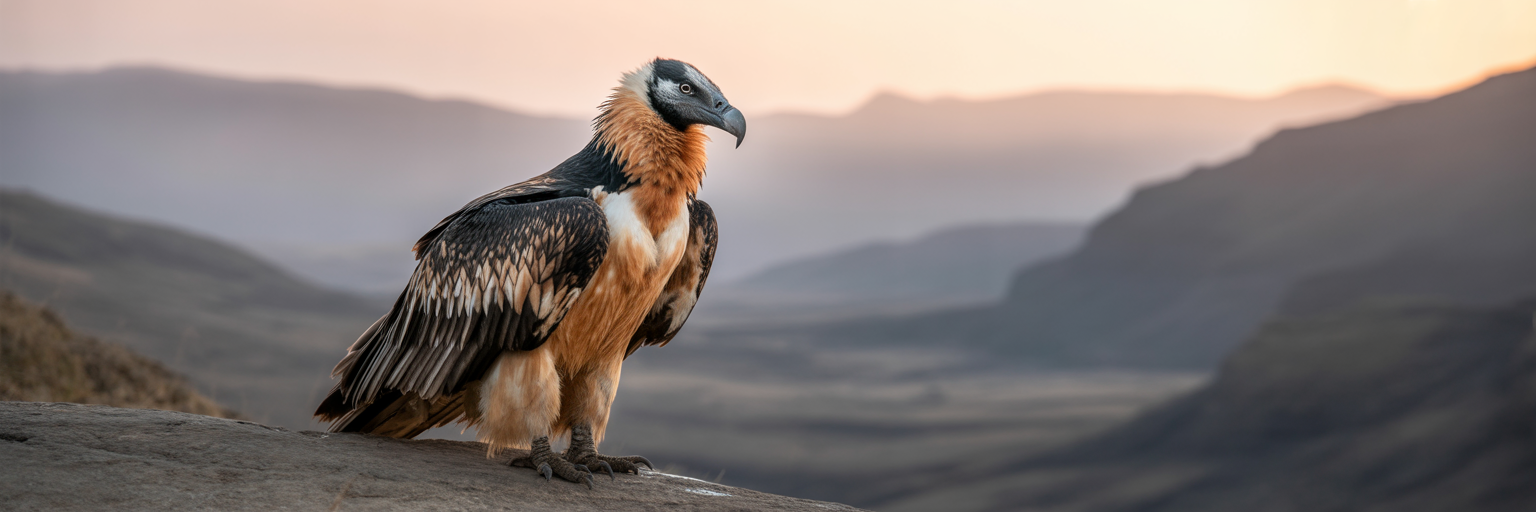
Just when you think the bearded vulture couldn’t get any stranger, it reveals another bizarre habit. This one has nothing to do with eating and everything to do with vanity. These birds, with their naturally white and cream-colored head and chest feathers, intentionally dye themselves a fiery, rust-orange color. This isn’t an accident; it’s a deliberate and fascinating behavior that adds another layer of mystery to this already captivating creature.
Bearded vultures seek out soil and water rich in iron oxides and take “baths” in them. They rub their heads, necks, and underbellies in the red mud, meticulously staining their feathers. This learned behavior transforms their appearance from pristine white to a dramatic shade of orange-red. But why go to all this trouble? Scientists have a few theories:
- A Status Symbol: The intensity of the color may be a signal of an individual’s dominance and health. A bird that has the time and energy to find good mud baths and maintain a vibrant color might be advertising its fitness to rivals and potential mates. The brighter the bird, the more powerful it is.
- A Form of Camouflage: The reddish hue could help the vulture blend in with the iron-stained cliffs and rocks of its mountainous home, providing camouflage while it nests or perches.
- An Antibacterial Agent: Some researchers believe the iron oxides may have antibacterial or anti-parasitic properties. By coating their feathers in it, the vultures could be performing a form of self-medication, protecting themselves from pathogens.
So, what animal eats bones and also wears makeup? The bearded vulture. From its bone-shattering rituals and acid-filled stomach to its gothic appearance and cosmetic habits, it is a perfect blend of horror and majesty. It is a testament to the strange and wonderful paths evolution can take, and a creature that truly earns its place among the most unique birds on the planet. To continue your journey into the wild and weird, explore the countless other stories from the natural world waiting for you at Nature is Crazy.