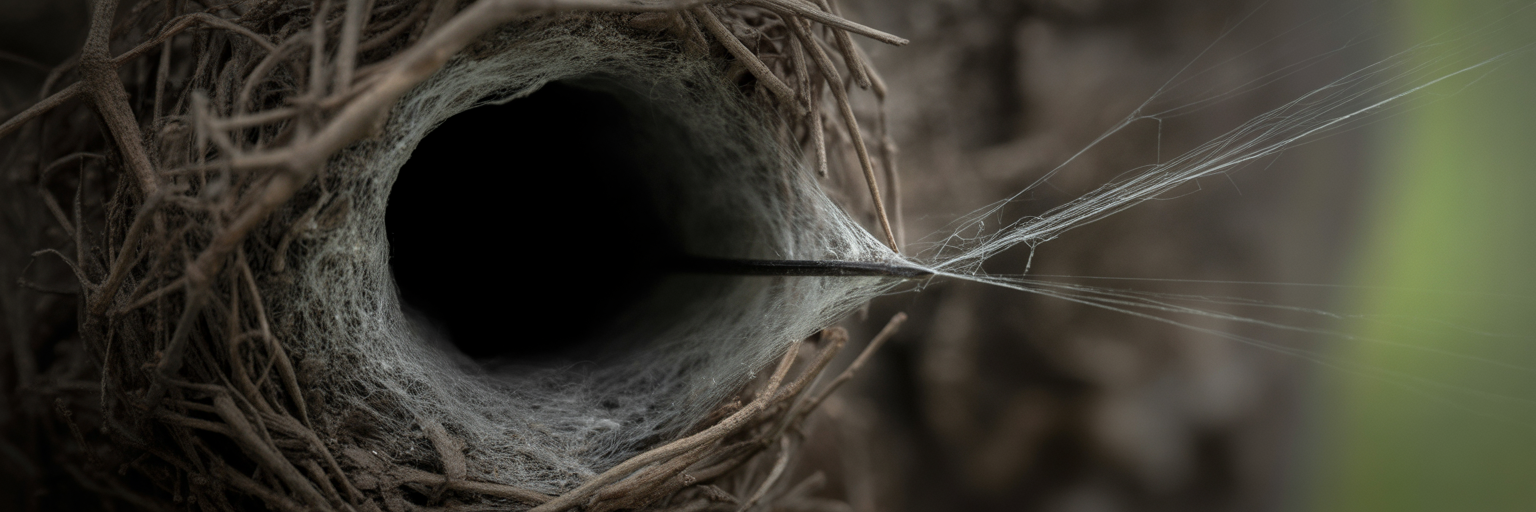
An Unsettling Intelligence in the Treetops
Imagine a quiet afternoon in the African savanna. Sunlight dapples through acacia leaves, casting shifting patterns on the dry earth. The air hums with the low buzz of insects, a sound so constant it becomes a form of silence. In this serene setting, a delicate, pear-shaped structure hangs from a thorny branch, swaying gently in the breeze. It looks like just another nest, a testament to the simple, instinctual drive of a bird to shelter its young. But if you look closer, something feels profoundly wrong.
This isn’t just a home. It’s a meticulously crafted lie. One of the entrances, the most obvious one, is a dead end. It’s a welcome mat laid out for a guest who will never be allowed inside. This structure was not built with the simple hope of being overlooked. It was designed with the active, chilling intention of being found. It is a booby trap, a piece of psychological warfare woven from grass and spiderwebs, built with what feels like malicious foresight.
The architect behind this creation operates with a level of cunning that feels out of place in the natural world. This isn’t just a physical barrier. It’s a mind game played against predators, a trap designed to exploit their most basic instincts and lead them to a frustrating, pointless conclusion. The builder seems to understand its enemy, anticipating its movements, its desires, and its eventual rage. It has constructed a puzzle that wastes a predator’s time and energy, leaving it exposed and defeated.
This level of planning makes you question the comfortable line we draw between animal instinct and conscious thought. The nest’s design suggests a deep understanding of cause and effect, of deception and misdirection. This is intelligent bird behavior that borders on the unsettling. It feels less like a product of evolution and more like the work of a tiny, feathered Hannibal Lecter. What kind of creature builds a house with a fake front door just to watch its enemies fail? We are about to be let in on a very dark secret, one that challenges our assumptions about the minds of the animals we share this planet with.
Meet the Mastermind: The African Penduline Tit
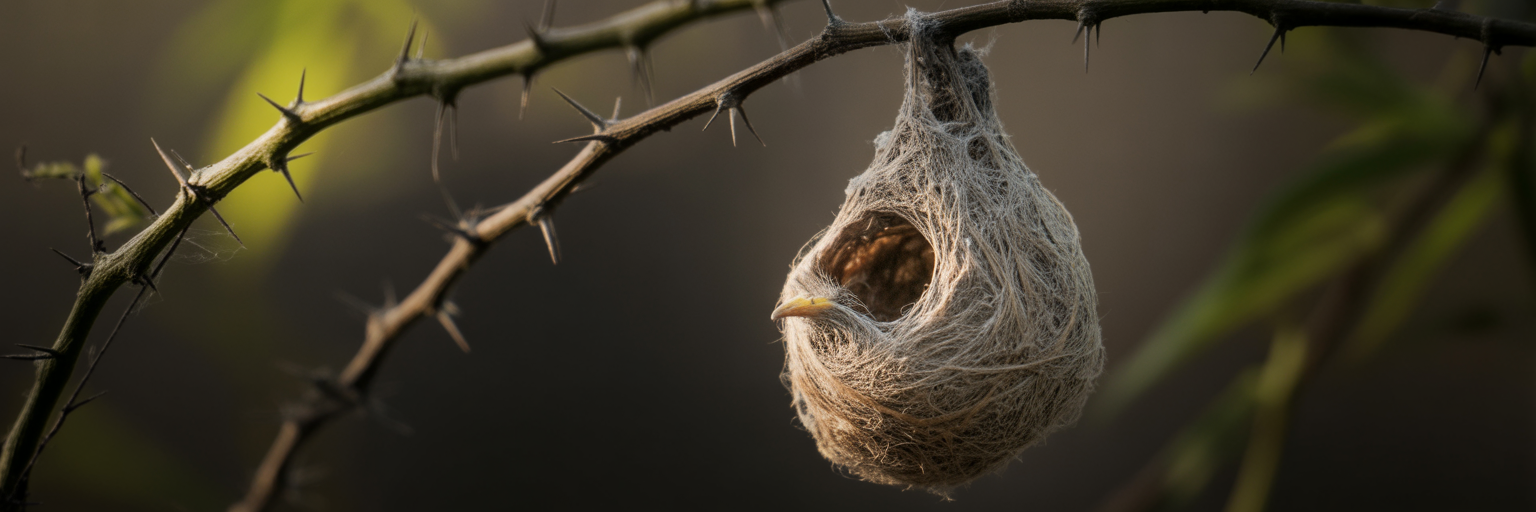
The creature responsible for this architectural deception is not a menacing hawk or a cunning corvid. The mastermind is the African penduline tit, a bird so small and fluffy it seems almost comical that it could harbor such a devious intellect. Its unassuming appearance is the perfect cover for its unsettlingly brilliant mind.
An Unassuming Architect
At a glance, the penduline tit is utterly harmless. It’s a tiny, sparrow-sized bird with soft, grayish-brown feathers and a sharp, conical beak. It flits through the savanna with a cheerful energy that belies the cold, calculating nature of its work. This contrast is what makes its creation so unnerving. You look at this tiny, innocent-looking bird and then at its nest, a fortress of lies, and the two things simply do not compute. It’s like discovering your sweet, elderly neighbor is a master spy. The disconnect is jarring, and it forces you to reconsider what’s really going on behind those tiny, black eyes.
Forged in a World of Threats
This bird’s genius wasn’t born from a desire to play games. It was forged in the brutal reality of the African savanna, a landscape teeming with predators that view nests as convenient, all-you-can-eat buffets. Tree-climbing snakes like the boomslang, predatory birds, and other nest-raiders are a constant threat. In such a high-stakes environment, a simple cup of twigs is a death sentence for your offspring. The penduline tit’s extreme defensive strategies are a direct response to this relentless pressure. Its nest isn’t a hobby. It’s a life-or-death necessity, a hardened shell of deception built to withstand a world of threats.
The Unsettling Building Blocks
The construction of the African penduline tit nest is a masterclass in material science. The bird weaves together soft plant fibers, grasses, and wool to create a felt-like pouch that is both durable and insulating. But the secret ingredient, the material that makes the whole trick possible, is spider silk. The tit obsessively collects strands of silk, not just for its strength, but for its unique properties of stickiness and elasticity. This isn’t just glue holding the nest together. It’s a crucial component of the trap mechanism itself, allowing the bird to build self-sealing doors and hidden passages. The use of such a sophisticated material is another layer of its unsettling intelligence, showing it understands the properties of its tools on a level that feels far beyond simple instinct. This is just one example of the kind of bizarre adaptations you can find in nature’s unsettling creations that defy belief.
The Architecture of Deception
The genius of the African penduline tit’s nest lies not in its strength, but in its lies. It is a structure built around a central, brilliant deception, a piece of deceptive animal architecture so effective it feels like it was designed by a military engineer. To understand it, you have to dissect its components and appreciate how each part contributes to the overall con.
The Welcome Mat to Nowhere
The most prominent feature of the nest is its false entrance. It’s a conspicuous, inviting tube-like opening near the top of the pouch, perfectly sized for a small bird. To a passing predator, it looks like the obvious way in. This is entirely by design. The bird wants this entrance to be found. It’s the welcome mat to nowhere, a deliberate lure designed to draw attention. As ornithologists have observed, these fake openings are specifically designed to mislead predators. A report highlighted by The Paper documents how predators like snakes are consistently fooled by these decoys. When a snake or other intruder pushes its way into this opening, it doesn’t find a chamber of juicy chicks. It finds a solid, sealed wall of felted plant matter. The doorway is a lie.
The Secret Passage
While the predator is busy wrestling with the fake door, the parent birds are using the real entrance. This one is almost impossible to see. It’s a thin, tightly sealed slit hidden somewhere else on the nest, often concealed under a small flap. This secret passage isn’t a permanent opening. It’s a functional door that the birds must actively operate. When a parent returns with food, it uses its beak to pry the slit open, slips inside, and the entrance seals shut behind it, vanishing completely. This requires a specific, learned technique, a cognitive step that separates the decoy from the functional door in the bird’s mind.
A Self-Sealing Marvel of Engineering
This is where the spider silk comes into play. The incredible elasticity of the silk gives the real entrance its self-sealing property. When the bird pushes its way through the slit, the spider-silk-infused fibers stretch to let it pass and then snap back into place, leaving no trace of an opening. This transforms the nest from a simple container with a hidden hole into a sophisticated piece of natural machinery. The bird has created a self-closing, automatically camouflaged door. The level of planning is staggering. It has to build a decoy, remember not to use it, and master the operation of a hidden, self-sealing entrance.
| Feature | The Fake Entrance (The Lure) | The Real Entrance (The Secret) |
|---|---|---|
| Visibility | Highly conspicuous and easy to spot | Camouflaged, often a seamless slit |
| Function | Leads to a sealed, empty chamber | Provides access to the actual brood chamber |
| Accessibility | Appears open but is a dead end | Sealed shut with spider silk, requires a specific action to open |
| Purpose | To misdirect and frustrate predators | To provide secure, hidden access for parent birds |
| Material Focus | Woven to look like a standard nest opening | Utilizes the elasticity and stickiness of spider silk for a self-sealing flap |
Note: This table highlights the deliberate design choices the African penduline tit makes to create a functional security system, separating the decoy elements from the true access point.
A Predator’s Worst Day
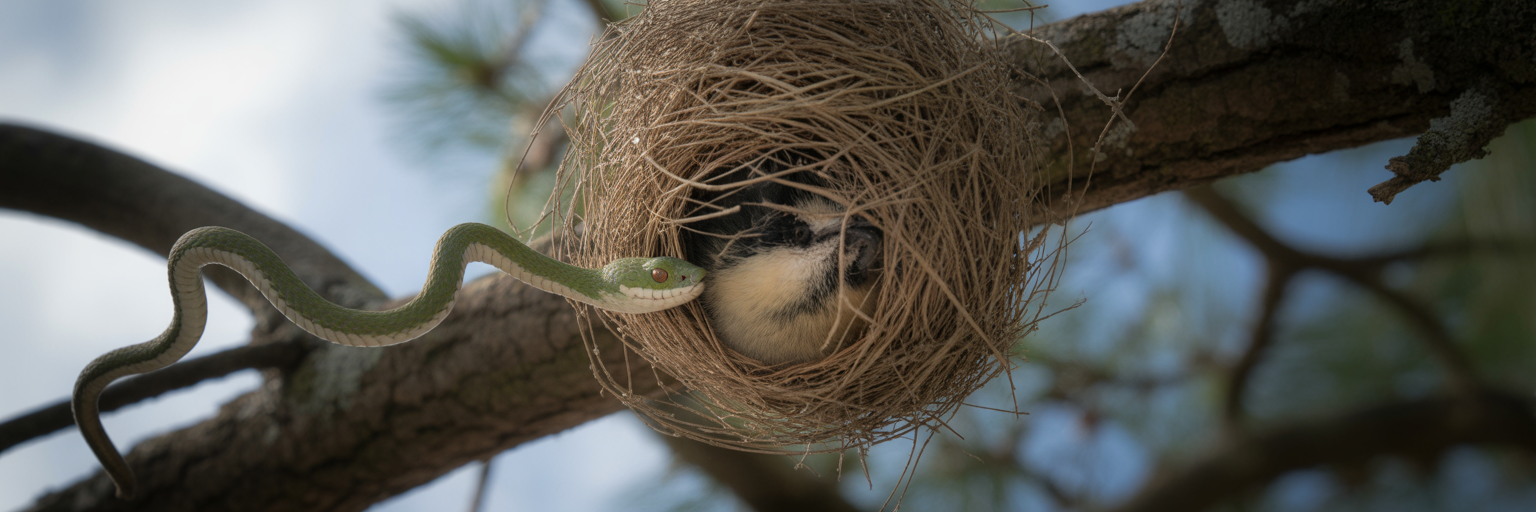
Now, let’s shift perspective. Imagine you are a boomslang, one of the most feared tree snakes in Africa. You move through the branches, senses on high alert, driven by the simple, ancient instinct to find food. Your eyes catch it: a penduline tit nest, hanging vulnerably from a branch. You see the entrance, a perfect, dark opening promising a meal of eggs or helpless chicks. It seems too easy. And it is.
You approach with confidence, sliding toward the entrance. You push your head inside, anticipating the soft warmth of a brood chamber. Instead, your snout hits a solid wall. Confusion sets in. This isn’t right. You push harder, twisting your body for leverage, but the wall doesn’t give. It’s a dead end. Frustration begins to build, turning into a primal rage. You attack the fake entrance, biting and tearing at it, but you are getting nowhere. All you are doing is wasting precious energy and, worse, making a huge commotion.
While you are locked in this pointless struggle, you are completely exposed. A passing eagle or hawk, your own predator, now sees you thrashing about, distracted and vulnerable. The hunter has become the hunted. This is the true genius of the nest. Its primary function is not just to be impenetrable, but to serve as one of the most effective predator confusion strategies in the animal kingdom. The goal is to turn a predator’s own instincts against it, transforming its confidence into a fatal liability.
Of course, the strategy has its limits. A large, determined predator might eventually tear the entire nest apart. But the goal isn’t to be indestructible. It’s to cause delay, frustration, and exposure. In the world of predator and prey, a few wasted minutes can be the difference between life and death. The penduline tit has engineered a system that usually provides more than enough time for its chicks to remain safe. It’s an incredible survival tactic, on par with some of the most extreme strategies in nature, like the rare animals that can survive being swallowed and escape alive. The snake slithers away, defeated, hungry, and thoroughly outsmarted by a creature a fraction of its size.
An Evolutionary Arms Race of Wits
This elaborate deception isn’t an isolated act of genius. It’s the result of a long and brutal evolutionary arms race. For millions of years, the ancestors of the penduline tit have been in a constant battle of wits with their predators. As snakes and other nest-raiders became better at finding nests, the birds had to develop more sophisticated ways to hide their young. This back-and-forth pressure, where prey develops cleverer defenses as predators become more perceptive, is what drives the creation of such complex behaviors.
The penduline tit’s strategy is a masterstroke in this arms race. It’s a perfect example of how birds protect their eggs by moving beyond simple camouflage and into the realm of active psychological manipulation. What’s fascinating to scientists is that this solution has appeared more than once. The concept of convergent evolution suggests that unrelated species, when faced with similar problems, often arrive at similar solutions. As outlets like Discover Wild Science have explored, various birds in predator-rich environments have independently developed decoy nests and fake doors. It’s such an effective strategy that evolution has produced it multiple times, in different parts of the world, among different species.
This behavior continues to fascinate researchers because it blurs the line between hardwired instinct and genuine problem-solving. The bird must execute a complex sequence of actions, ignore its own decoy, and remember how to operate a hidden mechanism. This suggests a level of cognitive flexibility that we are only just beginning to appreciate in birds. Ultimately, the birds that master this architectural deception are the ones that successfully raise their young and pass on their genes. In the ruthless calculus of evolution, the ability to build a convincing lie has become a highly successful trait.
This principle of thoughtful construction and strategic design isn’t confined to the animal kingdom. It mirrors the same kind of ingenuity that drives human innovation. We see it in the way we design our homes for security and convenience, and even in how we curate our digital lives, like when we apply principles of strategic design to our personal technology. The penduline tit is simply applying a timeless strategy in its own unique, and unsettling, way.
Nature’s Gallery of Tricksters
The African penduline tit may be a master of structural deceit, but it’s not alone. It belongs to a secret society of natural con artists, a gallery of tricksters who have turned deception into a fine art. The natural world is far more cunning than we often give it credit for, filled with creatures that lie, cheat, and misdirect to survive. The penduline tit’s approach is unique, but it’s part of a grand tradition of animal trickery.
Many species have developed strategies that rely on fooling their enemies. While some, like the penduline tit, are birds that build fake nests, others use performance art, mimicry, and statistical games to protect their young. Here are just a few members of this gallery of tricksters:
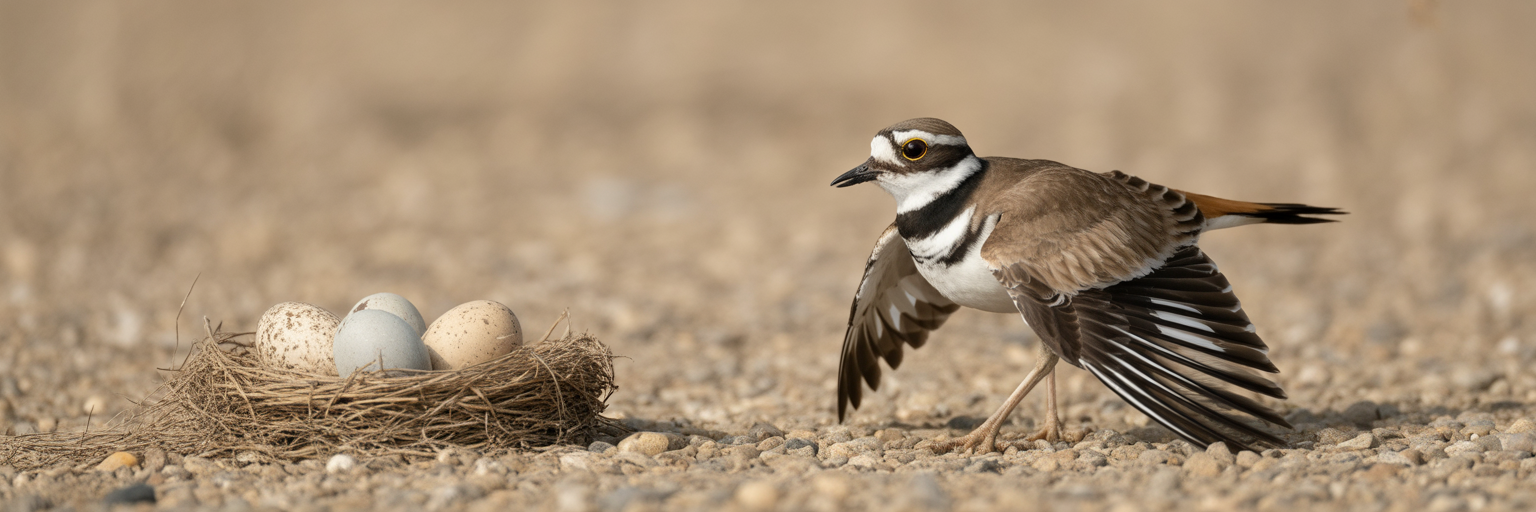
- The Killdeer’s Broken-Wing Act: This ground-nesting bird is a master of dramatic performance. When a predator approaches its vulnerable nest, the Killdeer will limp away, dragging one wing on the ground as if it’s fatally injured. It puts on a convincing show of being an easy meal, luring the predator further and further from its eggs. Once it has drawn the threat a safe distance away, the bird makes a miraculous recovery and flies off, leaving the predator confused and empty-handed.
- The Burrowing Owl’s Rattlesnake Impression: These owls nest in underground burrows, which makes them susceptible to predators like coyotes and badgers. To defend their homes, young burrowing owls have learned to mimic the sound of a deadly rattlesnake. When a predator sticks its nose into the burrow, it’s met with a chilling, rattling hiss. Most intruders aren’t willing to risk a fatal bite and will back off immediately, scared away by a threat that isn’t even there.
- The Widespread Use of Decoy Nests: Some bird species play a numbers game. They build multiple nests, sometimes five or six, but only lay their eggs in one. This simple strategy dramatically decreases the odds of a predator finding the right one. It’s a game of statistical probability, forcing the predator to waste time and energy checking empty nests while the real one remains safe.
While all these strategies are brilliant, the African penduline tit’s architectural approach remains a standout example of calculated, structural deceit. It doesn’t just distract or mimic. It builds a physical puzzle designed to frustrate and defeat its enemies. It is a testament to the unsettling depths of intelligence that can be found in the wild, a reminder that nature is not always what it seems. If you want to discover more about how truly strange and wild our world is, you can explore more stories on how crazy nature can be.
Related discovery: How Rattlesnakes Make Their Rattle Sound Closer