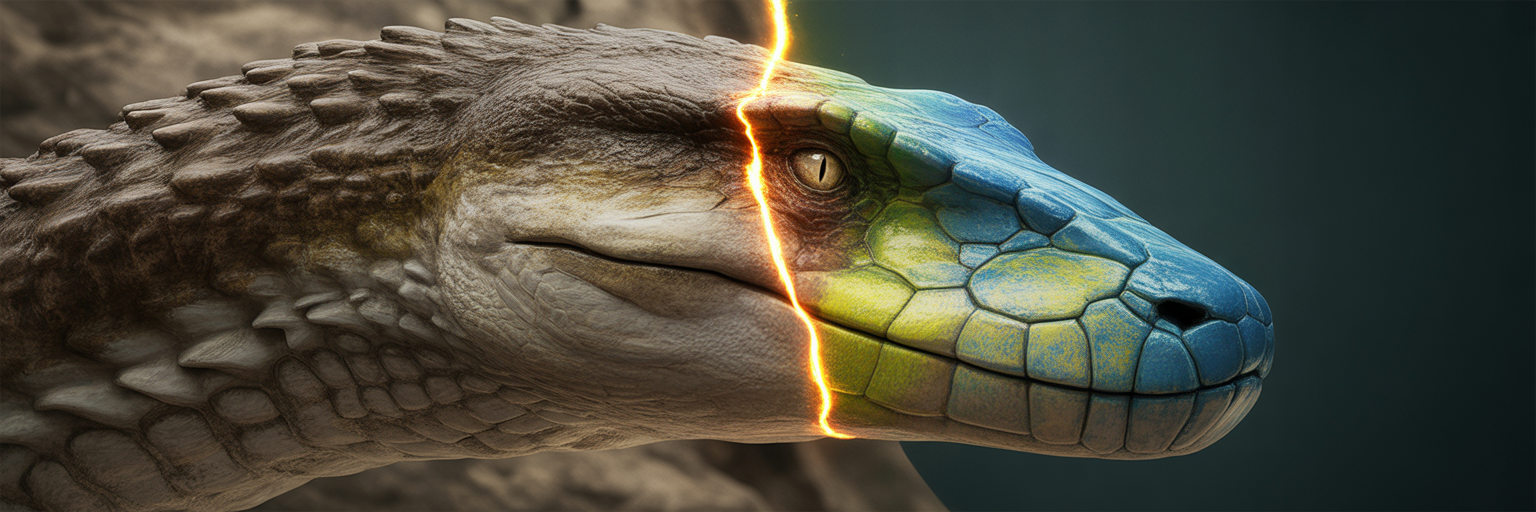
The Modern Masters of Biological Transformation
Watch an octopus for even a few moments, and you might witness something that feels like magic. In the blink of an eye, it can melt into a rocky crevice, mimic the texture of sand, or flash vibrant, pulsating colors. This isn’t an illusion; it’s one of nature’s most sophisticated engineering feats. To understand the possibility of extinct animal color change, we first have to look at the living masters of this biological art form: cephalopods like the octopus, squid, and cuttlefish.
Their ability to transform is so refined that it sets the benchmark for what is biologically possible. It’s a system built for speed, precision, and versatility, operating on principles that make other color-changing animals seem sluggish by comparison. By dissecting how these modern marvels work, we can build a framework for interpreting the clues left behind by creatures millions of years old.
The Mechanics of Chromatophores: Nature’s Pixels
The secret to a cephalopod’s rapid transformation lies in specialized cells called chromatophores. Imagine millions of tiny, pigment-filled balloons embedded in the skin. Each chromatophore is a sac containing a specific color—typically black, brown, red, or yellow. What makes this system extraordinary is that each individual sac is attached to a set of microscopic muscles, which are in turn wired directly to the brain.
When the brain sends a neural signal, these muscles contract. This pulls the pigment sac open, stretching it from a tiny dot into a wide, flat disk of color. The effect is almost instantaneous. When the muscles relax, the elastic sac shrinks back into a dot, and the color vanishes. By controlling thousands of these cells in coordinated groups, the animal can create complex patterns, adjust its brightness, and change its entire appearance. It’s like a flexible, living screen made of biological pixels, capable of refreshing its display in a fraction of a second. According to National Geographic, this neurally controlled adaptation makes them the fastest color-changers known to science.
A Multi-Tool for Survival and Communication
This incredible ability is far from a simple party trick. For cephalopods, dynamic color change is a multi-purpose tool essential for survival in a visually competitive marine world. Its functions are diverse and critical:
- Camouflage: The most obvious use is concealment. An octopus can perfectly match the color and texture of algae-covered rocks to ambush prey or disappear from a hunting shark. This isn’t just about matching a single color but recreating complex, mottled patterns with stunning accuracy. This is the essence of ancient cephalopod camouflage‘s modern equivalent.
- Communication: Cuttlefish are famous for their elaborate visual conversations. They use waves of color, stripes, and spots to signal intent during mating rituals, warn rivals in territorial disputes, or coordinate group movements. These messages are complex, specific, and broadcast in real-time.
- Deimatic Displays: When camouflage fails, a sudden, startling display can be a lifesaver. A cephalopod can instantly flash large, intimidating eye-spots or bright, disorienting patterns to frighten or confuse a predator, creating a critical moment to escape.
Neural vs. Hormonal Control: The Need for Speed
What truly separates cephalopods from other color-changing animals is the control system. Think of a chameleon. Its ability to change color is impressive, but it’s a slow, gradual process that can take many seconds or even minutes. This is because its chromatophores are controlled by hormones circulating in the bloodstream. The signal to change is a chemical message that travels relatively slowly throughout the body.
Cephalopods, on the other hand, use a direct neural system. The brain is wired straight to the muscles controlling the chromatophores. The signal is electrical, traveling along nerves at immense speeds. This is the difference between sending a letter and making a phone call. The result is a system that operates on the timescale of thought, allowing for instantaneous reactions to threats, prey, or potential mates. This distinction is vital, as it raises a fundamental question when we look to the past: if an ancient animal could change color, was its system fast and reactive like an octopus, or slow and deliberate like a chameleon?
Fossil Clues to Prehistoric Palettes
Transitioning from the vibrant, living world of cephalopods to the silent realm of deep time presents a formidable challenge. Paleontologists work with fragments of the past, and some fragments are far rarer than others. While bones and teeth can survive for hundreds of millions of years, soft tissues like skin, muscle, and nerves almost always decay before they can be preserved. This makes color one of the most elusive traits to study in prehistoric life. We can infer the shape of a dinosaur, but what did it truly look like? Was it drab and gray, or did it possess a vibrant, dynamic palette?
For this reason, any discovery that offers a glimpse into the coloration of an ancient animal is exceptionally significant. It’s like finding a single frame from a long-lost movie, providing a rare window into the visual world of the past. The discovery of fossilized chromatophores evidence is not just about finding color; it’s about finding the machinery that produced it.
The Challenge of Preserving the Ephemeral
For skin to fossilize, a near-perfect sequence of events must occur. The animal’s body must be buried rapidly in an environment with very little oxygen, such as the bottom of a stagnant lake or a deep marine basin. This anoxic setting stalls the bacteria that drive decomposition, giving minerals time to slowly replace the organic molecules of the skin. It’s an incredibly rare process. The fact that any soft tissue survives is a testament to nature’s ability to endure, much like the life forms that can survive being completely dried out for years, which you can read about in our article on biological resilience.
Even when skin is preserved, the delicate cellular structures responsible for color are often the first to degrade. Pigment molecules break down, and the microscopic architecture that creates iridescent sheens collapses. Finding not just fossilized skin, but the color-producing cells within it, is a paleontological jackpot.
A 10-Million-Year-Old Snapshot
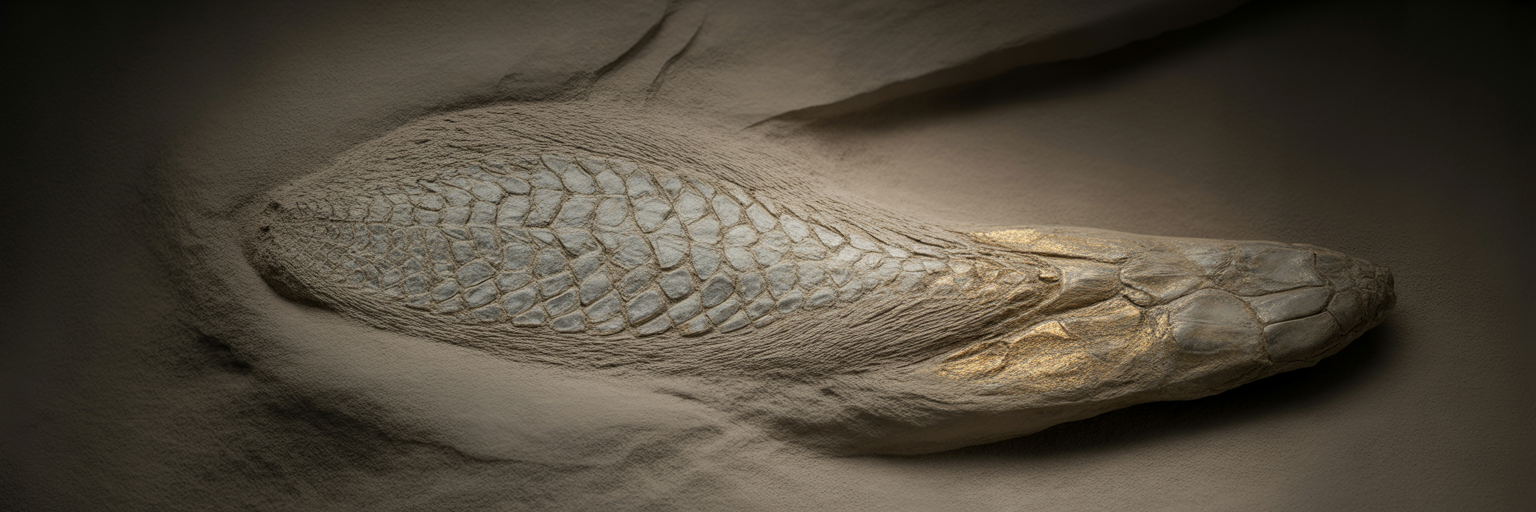
The central piece of evidence in this story is a stunningly preserved fossil of a snake skin from the Miocene epoch, roughly 10 million years ago. Found in an ancient lakebed in Spain, the fossil captured not just the pattern of the scales but also the microscopic cells within them. A study published in Current Biology, and detailed in University College Cork’s CORA repository, revealed that this was no ordinary fossil. It contained a complete toolkit of color-producing cells, a discovery that fundamentally changed our understanding of prehistoric reptiles.
The analysis identified three distinct types of chromatophores, preserved in exquisite detail:
- Xanthophores: These cells were found to contain carotenoid pigments, responsible for producing yellow and red hues.
- Iridophores: These cells didn’t contain pigment but instead housed guanine crystals. These microscopic, plate-like structures would have manipulated light to create an iridescent, metallic sheen, similar to the shimmer on a modern starling’s feather.
- Melanophores: Packed with melanin, these cells would have produced dark brown and black colors, providing a foundation for patterns and shading.
Finding just one of these cell types would have been remarkable. Finding all three together in a single specimen was groundbreaking. It suggested this animal had the potential for more than just a static, colorful pattern. It had the full suite of components needed for a complex and possibly dynamic visual display.
Decoding the Fossilized Color Toolkit
Identifying these ancient cells required a combination of powerful imaging and analytical techniques. Scientists used scanning electron microscopy (SEM) to examine the fossil at magnifications of thousands of times. This revealed the physical shapes and arrangements of the preserved cells, allowing them to be compared directly with the chromatophores of modern reptiles and amphibians.
But they didn’t stop at just looking at the shapes. Using sophisticated chemical analysis, they were able to detect the faint molecular ghosts of the original pigments and structures. The calcium phosphate that replaced the organic tissue had trapped traces of the original chemistry. By analyzing how these preserved minerals interacted with different wavelengths of light, researchers could confirm the presence of melanin and infer the light-scattering properties of the iridophores. This rigorous, multi-faceted approach moved the discovery from speculation to scientific fact, providing the first concrete evidence of such a complex color system in a fossil reptile.
Reconstructing an Ancient Camouflage System
With the physical evidence in hand, the next step is interpretation. The fossilized cells are like finding the components of an ancient machine. We have the gears, the wires, and the housing, but how did it all work together? Reconstructing the function of this system requires us to move from observation to hypothesis, using our knowledge of modern biology to fill in the gaps left by the fossil record. This is where we begin to explore how ancient animals changed color, blending hard evidence with educated inference.
The presence of a full suite of chromatophores strongly suggests this snake was capable of more than just having a fixed pattern. It had the hardware for a dynamic appearance, but the question of the “software” that controlled it remains the most tantalizing mystery.
Pigment vs. Structure: The Building Blocks of Color
The fossil revealed two fundamental methods of producing color, both of which are common in nature today. The first is pigmentary color, created by the xanthophores (yellows/reds) and melanophores (blacks/browns). These cells generate color by absorbing certain wavelengths of light and reflecting others. It’s a direct, chemical-based system.
The second is structural color, produced by the iridophores. These cells don’t use pigments. Instead, their precisely arranged guanine crystals act like tiny prisms, scattering and reflecting light to create shimmering, iridescent effects. The color you see can change depending on the viewing angle. By combining these two systems, the snake could have produced an immense range of appearances. It could have used its melanophores to darken or lighten its overall tone, blended yellows and browns for earthy camouflage, and activated its iridophores to create a dazzling, metallic sheen. This combination is a hallmark of animals with highly sophisticated visual displays, and finding it in a 10-million-year-old reptile was a revelation, ranking among nature’s unsettling creations that defy belief.
The Mystery of the Control System
While the fossil gives us the “what” (the cells), it cannot give us the “how” (the control system). Nerves and hormone-producing glands are among the softest of tissues and stand virtually no chance of fossilizing. This leaves us with a critical unknown. Did this snake have the slow, hormonally-driven system of a chameleon, or was it closer to the rapid, neurally-controlled system of a cuttlefish?
The evidence points toward something potentially in between. The cellular machinery itself is more complex than that of a typical chameleon, suggesting a need for more refined control. However, the anatomy of a vertebrate is fundamentally different from that of a cephalopod. It is unlikely it possessed the same direct brain-to-cell wiring. This leads to a fascinating comparison.
| Feature | Modern Cephalopods (e.g., Octopus) | Hypothesized Extinct Snake |
|---|---|---|
| Primary Control System | Direct Neural Control | Unknown; likely a mix of neural and hormonal signals |
| Speed of Change | Instantaneous (milliseconds) | Likely rapid, but possibly slower than cephalopods |
| Pattern Complexity | Extremely high; can create moving patterns | Potentially complex patterns, but dynamic movement unconfirmed |
| Cell Types | Chromatophores, Iridophores, Leucophores | Evidence of Melanophores, Xanthophores, Iridophores |
| Direct Evidence | Observable in living animals | Inferred from fossilized cellular structures |
An Evolutionary Stepping Stone?
The most compelling hypothesis is that this extinct snake represents an evolutionary intermediate. It may have possessed a system more advanced than the purely hormonal control seen in many modern reptiles, perhaps using a combination of slower hormonal signals for general background matching and more rapid neural inputs for subtle, faster adjustments or flashes of iridescence.
This would make it a crucial stepping stone in the evolution of skin coloration among vertebrates. It wasn’t just a passively colored animal; it was an active participant in its visual environment. It may not have had the god-like abilities of an octopus, but it was likely far more visually dynamic than we ever imagined a prehistoric snake could be. This discovery forces us to reconsider the capabilities of ancient reptiles, suggesting a world where the game of seeing and being seen was played at a much higher level than previously thought.
Life in a High-Stakes Visual World
An adaptation as complex as dynamic color change doesn’t evolve in a vacuum. It arises in response to intense environmental pressures. To understand why this ancient snake developed such a sophisticated visual toolkit, we must place it back into its world: the Miocene epoch, a time of significant ecological change and diversification. This was a world teeming with new forms of predators and prey, where the ability to control one’s appearance could mean the difference between eating and being eaten.
The story of this extinct animal color change is not just about cellular mechanics; it’s about survival in a high-stakes visual landscape. Every flash of color, every subtle shift in pattern, was part of a life-or-death drama played out over millions of years.
The Miocene Ecosystem: A World of Seeing and Being Seen
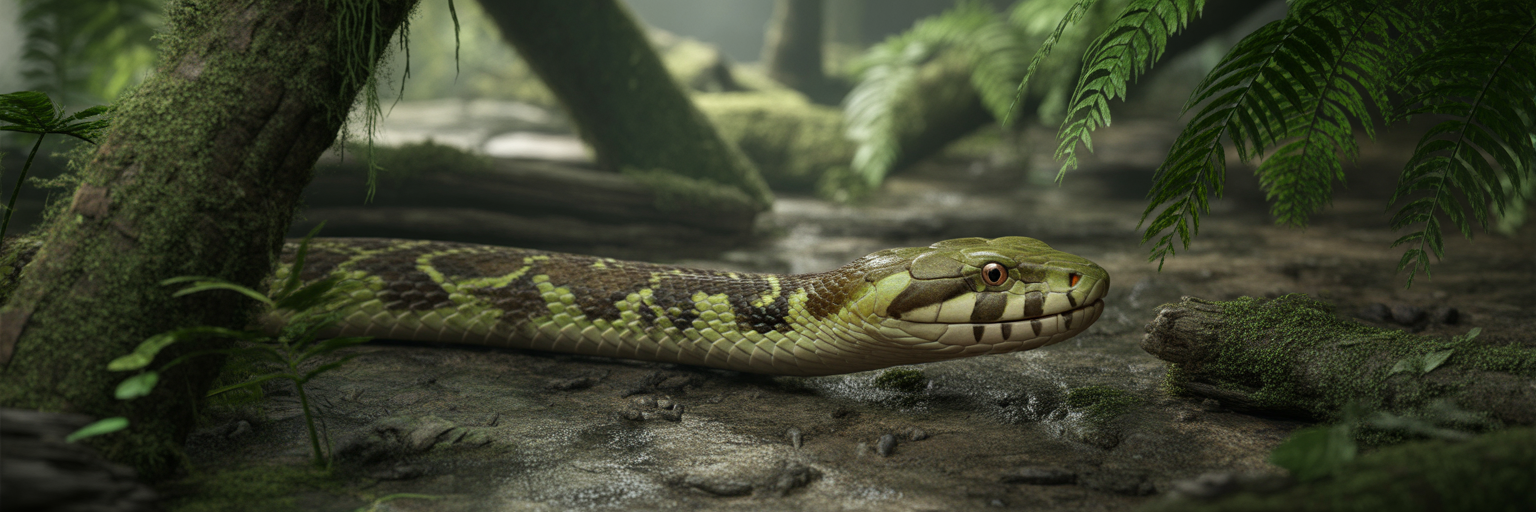
Ten million years ago, the world was in a state of flux. Grasslands were expanding, forests were changing, and mammals and birds were diversifying into many of the forms we recognize today. The snake’s environment was likely a mosaic of forests, woodlands, and open spaces, filled with a rich variety of life. Its prey would have included early rodents, lizards, and amphibians. Its predators would have been a formidable cast of characters, including keen-eyed predatory birds, similar to modern hawks and eagles, and early carnivorous mammals.
In such an ecosystem, vision was a primary sense for both hunters and the hunted. Predators relied on sharp eyesight to spot movement and break camouflage, while prey needed to remain invisible or have a last-ditch trick to escape a watchful eye. It was in this crucible of seeing and being seen that the snake’s remarkable skin evolved.
The Advantage of Ambush
For a predator like a snake, the primary advantage of color change is ambush. Instead of being restricted to a single type of environment, this snake could have actively tailored its appearance to its surroundings. Imagine it hunting in a sun-dappled forest. It could have used its melanophores and xanthophores to create a mottled pattern of brown and yellow, perfectly mimicking the leaf litter on the forest floor. If it moved to a rocky outcrop, it could adjust its tones to blend with the grays and browns of the stone.
This dynamic camouflage would have made it a far more effective and versatile hunter. It wouldn’t have to wait for prey to stumble into its specific hiding spot; it could create a hiding spot wherever it went. This ability to become one with the background would have allowed it to get dangerously close to its unsuspecting meals, striking with lethal precision.
A Fleeting Glimpse: Defense Against Keen-Eyed Predators
The same system that made it a great hunter also made it a resilient survivor. When confronted by a predator, a static camouflage pattern is only useful until you are spotted. A dynamic system offers more options. If a predatory bird swooped down, the snake could have performed a “flash-and-disappear” maneuver. By rapidly contracting its melanophores to reveal bright yellows or iridescent sheens, it could create a sudden, startling flash of color. This deimatic display could confuse the predator for a split second, just long enough for the snake to slither into the undergrowth.
Once in a new location, it could instantly change its pattern to match the new background, effectively vanishing. This ability to deploy multiple defense strategies is a significant advantage. It’s a level of tactical survival that echoes the incredible tactics seen in modern animals, including those that can survive being swallowed and escape alive, a topic we explore in our feature on extreme survival. Furthermore, it’s possible these patterns were used for communication with other snakes, signaling territorial claims or readiness to mate, adding another layer of complexity to its life.
The Evolutionary Arms Race of Sight and Deception
The discovery of such an advanced color-changing system in a 10-million-year-old snake is more than just a fascinating curiosity. It provides a powerful illustration of fundamental evolutionary principles at work. It speaks to a world where survival was driven by a constant, escalating battle between perception and deception. This single fossil offers a snapshot of a broader phenomenon: the co-evolution of sight and camouflage, and the remarkable ways in which different lineages can arrive at similar solutions to life’s challenges.
Understanding the evolution of skin coloration requires looking at it not as a single trait, but as one side of a biological arms race that has been raging for hundreds of millions of years. This snake was a highly advanced soldier in that ancient war.
Co-evolution of Predator Vision and Prey Camouflage
Evolution is often described as an “arms race” between interacting species. When predators develop sharper vision, it puts immense selective pressure on prey to develop better camouflage. In turn, as prey become harder to see, there is pressure on predators to evolve even more acute senses. This back-and-forth dynamic drives the evolution of increasingly sophisticated adaptations on both sides.
The snake’s dynamic skin was likely a product of this race. As the eyes of birds and mammals in the Miocene became more capable of detecting color, texture, and movement, a simple, static pattern was no longer enough. The ability to change color, to adapt to different backgrounds, and to produce a startling flash of light would have been a game-changing countermeasure. This animal wasn’t just hiding; it was actively managing its visibility in a world of expert observers.
Convergent Evolution: Different Paths, Similar Solutions
Perhaps the most profound insight from this discovery comes from comparing this extinct snake to modern cephalopods. Here we have two vastly different animals: a vertebrate reptile and an invertebrate mollusk. Their last common ancestor lived over 500 million years ago and was likely a simple, worm-like creature. They are on completely separate branches of the tree of life. And yet, both evolved the ability to change their skin color rapidly and create complex patterns.
This is a classic example of convergent evolution: the independent evolution of similar traits in unrelated lineages to solve similar problems. The snake and the octopus both faced the challenge of surviving in a world dominated by visual predators. Both arrived at a similar solution—a skin filled with controllable, color-producing cells. However, they built their systems from different parts. The cephalopod’s system is based on its unique molluskan anatomy, with direct neural control. The snake’s system was built upon a vertebrate blueprint, likely involving a mix of nerves and hormones. They took different evolutionary paths but arrived at the same functional destination. This demonstrates that dynamic camouflage is such a powerful advantage that evolution has invented it more than once.
The Adaptive Power of a Dynamic Appearance
Ultimately, the ability to change one’s appearance is a powerful adaptive tool because it is so versatile. It isn’t just for one thing. For this ancient snake, it was a key that unlocked multiple advantages. It improved its ability to hunt, enhancing its effectiveness as a predator. It provided multiple layers of defense against its own predators, from concealment to confusion. It may have even played a role in its social and reproductive life.
An adaptation that influences feeding, defense, and mating all at once is an incredibly potent engine for evolutionary success. It touches every critical aspect of an animal’s life. The discovery of this capability in a prehistoric reptile shows that this powerful evolutionary strategy is far more ancient and widespread than we ever knew.
Redrawing Our Picture of the Prehistoric World
For decades, our image of the prehistoric world has been shaped by what preserves best: bones. This has often led to a perception of the past as a world of grays and browns, a drab and muted landscape inhabited by creatures whose true appearance was a mystery. But discoveries like the 10-million-year-old color-changing snake are forcing us to redraw that picture. They reveal a past that was likely just as vibrant, colorful, and visually complex as the world we see today.
This shift in understanding is not just about adding color to old fossils. It’s about recognizing the depth and sophistication of ancient ecosystems and the remarkable creatures that inhabited them. It challenges us to think beyond skeletons and imagine the intricate biological systems that made these animals tick.
Beyond Bones: A More Vibrant Past
The evidence for a colorful past is growing. We now know that many dinosaurs had feathers, some of which were iridescent. We have found traces of red pigment in the fur of ancient mammals. And now, we have evidence of a reptile that could change its color on demand. Each of these discoveries adds a new layer of richness to our understanding. The prehistoric world was not a silent, monochrome film. It was a full-color, high-definition spectacle.
This particular extinct animal color change discovery is especially important because it implies behavior and dynamism. This snake wasn’t just colored; it was actively using color. It was interacting with its environment in a visually sophisticated way that we previously thought was reserved for a few modern animals. This suggests that the complex interplay of sight, camouflage, and communication has been a major driver of evolution for a very long time.
Technology Unlocking Ancient Secrets
Our ability to uncover this vibrant past is a direct result of technological advancement. The field of paleontology is no longer just about picks and shovels. Today, scientists use a powerful array of tools to wring every last secret from a fossil. Synchrotron-based X-ray fluorescence can map the chemical elements within a fossil, revealing the faint ghosts of ancient pigments. Advanced forms of electron microscopy allow us to see the preserved shapes of individual cells that are thousands of times smaller than a grain of sand.
These technologies allow us to answer questions that were once thought to be permanently beyond our reach. They provide the hard evidence needed to move beyond speculation and reconstruct the appearance and biology of extinct animals with unprecedented confidence. It is this marriage of traditional fieldwork and cutting-edge lab work that is bringing the prehistoric world to life in stunning new detail.
The Future of Paleocolor
This discovery opens up a universe of new questions. If a snake from 10 million years ago had this ability, who else did? Could some dinosaurs have changed color? What about the giant marine reptiles that ruled the Mesozoic seas? As technology continues to improve, we may one day be able to answer these questions. The study of “paleocolor” is a rapidly advancing field, and each new fossil preserved in the right way could hold another piece of the puzzle.
The machinery for rapid, dynamic camouflage is an ancient innovation, a testament to the power of evolution to produce sophisticated solutions to the timeless problem of survival. It fundamentally alters our view of prehistoric life, replacing a drab world of bones with one of vibrant, shimmering, and ever-changing color. As we continue to explore, we are reminded that nature’s capacity for invention is truly vast, a theme we celebrate across all the stories you can find on our homepage.