
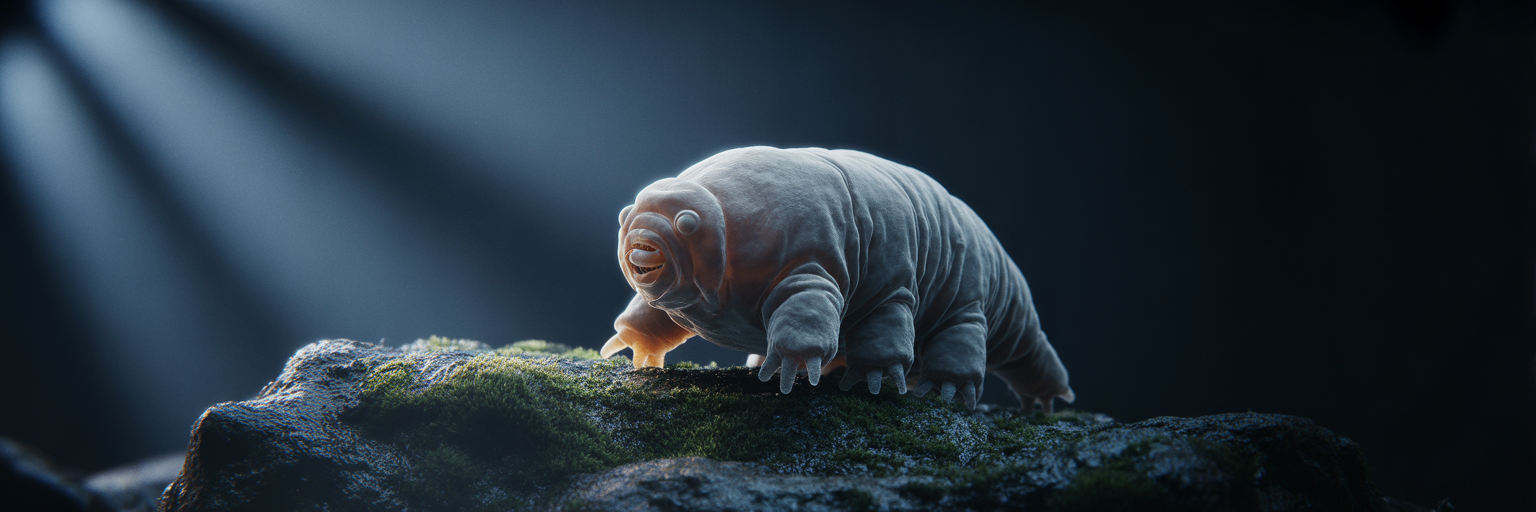
Nature’s Unfair Little Monster
Imagine the worst day ever. Not a “spilled coffee on your shirt” kind of bad day, but a truly apocalyptic one. A solar flare boils the oceans. A nearby supernova bathes the planet in gamma rays. An asteroid impact turns the continents to glass. In this scene of absolute cosmic annihilation, where everything you know has been vaporized, one creature would simply shrug, wait for things to cool down, and go about its business. It’s a level of resilience that feels less like evolution and more like a cosmic cheat code.
This creature is the tardigrade. Scientists call it that, but its nicknames are far more fitting for the universe’s most deadpan joke: the “water bear” or “moss piglet.” The name conjures images of a squishy, adorable friend. The reality is a microscopic monster that looks like a gummy bear but has the durability of a bunker-busting bomb. It’s as if nature designed the most indestructible animal on earth and then, as a final, unsettling punchline, made it look like a clumsy, eight-legged beanbag.
The existence of the moss piglet forces us to ask some uncomfortable questions. What are the absolute limits of life? And what does it mean for one animal to so casually ignore them? Its survival isn’t about being strong or fast. It’s about having a biological off-switch that allows it to treat planet-sterilizing events as minor inconveniences. While we build shelters and devise escape plans, the tardigrade just waits. And that might be the creepiest thing of all.
Meet the Indestructible Moss Piglet
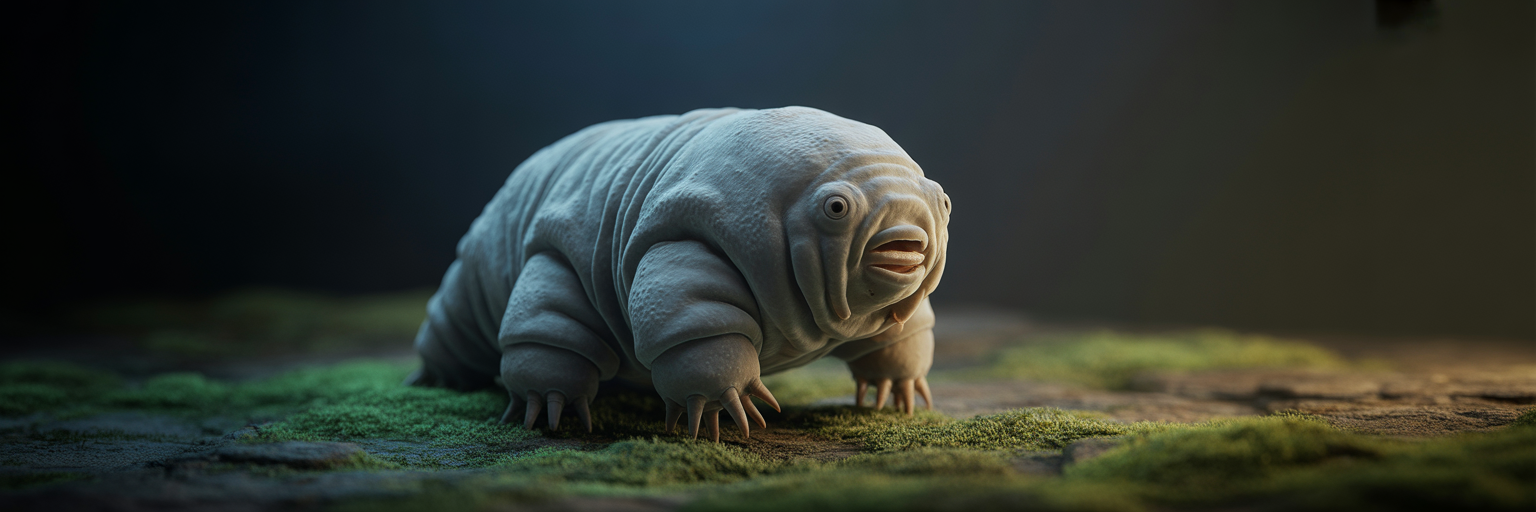
So, what exactly is this tiny horror? The tardigrade is a micro-animal, not a bacterium, usually measuring around half a millimeter long. To see one, you need a microscope. Its appearance is something out of a fever dream. Imagine an eight-legged microscopic bean bag chair with something that looks disturbingly like Wolverine claws at the end of each stubby leg. It moves with a slow, lumbering gait that earned it the “bear” part of its name, shuffling along like a clumsy, sentient vacuum cleaner bag searching for its next meal.
While the tardigrade looks like something from a sci-fi movie, it’s just one of many of nature’s unsettling creations that defy belief. The most bizarre part isn’t its otherworldly appearance, but its mundane address. These ultimate survivors aren’t hiding in some uncharted volcanic vent. They are everywhere. You can find them in the damp moss in a suburban Ohio backyard, in the sediment at the bottom of the Great Lakes, and on mountaintops across the United States. They are your neighbors, and they have been here for a very, very long time.
This ancient lineage has outlasted dinosaurs, ice ages, and countless extinction events that wiped out nearly all other life. They have watched species rise and fall, all while trundling through droplets of water, completely unbothered. The juxtaposition is what makes them so fascinating. They possess abilities that defy physics, yet they live in the puddle in your driveway. They are a constant, quiet reminder that the most extreme life forms are often hidden in the most ordinary places.
The Art of Playing Dead for a Century
The secret to the tardigrade’s absurd toughness isn’t strength, but a profound act of surrender. It’s a state called cryptobiosis, and it’s nothing like hibernation. Hibernation is a deep sleep. Cryptobiosis is a state so total it blurs the line between life and death. When the environment becomes hostile, the tardigrade doesn’t fight it. It simply opts out of being alive for a while. The most common form of this is anhydrobiosis, its defense against dehydration.
The process is both elegant and grotesque. The tardigrade expels up to 97% of the water in its body, retracts its legs, and curls into a desiccated, lifeless ball called a “tun.” In this state, its metabolism slows to less than 0.01% of normal. It becomes a biological speck of dust, a freeze-dried astronaut meal just waiting for a splash of water to become dinner again. This isn’t a conscious choice. It’s an automatic, biological failsafe triggered by threats like extreme dryness or freezing temperatures. It is the core mechanism behind water bear cryptobiosis.
The truly unsettling part is the reanimation. Imagine a piece of dust that has been sitting in a museum drawer for decades. You add a drop of water, and within minutes, it begins to unfurl. Its eight legs emerge, it stretches, and it crawls away as if it just woke from a short nap. Scientists have documented cases of tardigrades being revived after 30 years in this suspended state, completely unharmed. While the tardigrade is the undisputed champion, it’s not the only organism with this ability; you can explore other life forms that can survive being completely dried out for years to see how nature has solved this problem in different ways.
Surviving a Solar Grilling
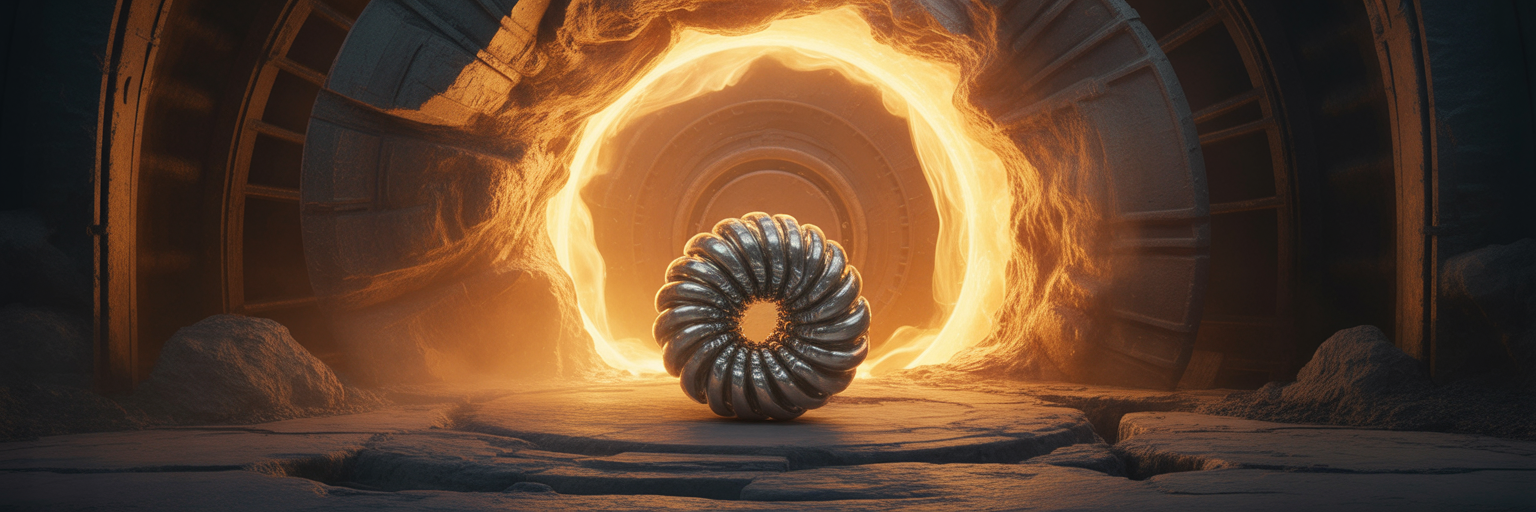
Now we get to the heart of the matter: the tardigrade’s casual defiance of heat. While humans struggle with a mild fever, a tardigrade in its tun state can withstand temperatures well over 300°F (150°C), far hotter than boiling water. On the other end of the spectrum, it can survive being chilled to just above absolute zero, at -458°F (-272°C). So, how do tardigrades survive heat and cold that would instantly destroy almost any other known animal?
The answer lies in the cryptobiosis we just discussed. By removing nearly all the water from its cells, the tardigrade eliminates the very substance that would boil and rupture its cellular structures when heated. Its body effectively becomes a heat-resistant bioglass. This doesn’t mean a tardigrade could sunbathe on the surface of Mercury, but it can handle bursts of extreme heat and radiation that are analogous to what it might face from solar exposure on Earth or even in the vacuum of space.
This resilience is so profound that it caught the attention of astrophysicists. According to a 2017 study published in Scientific Reports and covered by outlets like New Atlas, the tardigrade is so resilient it will likely survive until the Sun itself dies. The study modeled that as our star expands into a red giant and boils Earth’s oceans, tardigrades could be the last complex life form remaining. It’s the ultimate proof of their unfair advantage, a biological get-out-of-apocalypse-free card.
| Extreme Condition | Tardigrade Limit (in Cryptobiosis) | Human Limit |
|---|---|---|
| High Temperature | Up to 304°F (151°C) for minutes | ~105°F (40.5°C) internal temp is fatal |
| Low Temperature | -458°F (-272°C) for minutes | ~70°F (21°C) internal temp is fatal |
| Radiation (Gamma-Rays) | ~5,000-6,200 Gy | ~5-10 Gy is a lethal dose |
| Pressure | ~600 MPa (6,000x atmospheric pressure) | ~3-4x atmospheric pressure (can cause barotrauma) |
| Vacuum | Can survive for days in the vacuum of space | Unconsciousness in ~15 seconds, death in minutes |
Note: This table compares the documented survival limits of tardigrades in their protective ‘tun’ state to the general physiological limits for an unprotected human. The data highlights the vast difference in resilience and contextualizes the tardigrade’s ‘superpowers.’
The Molecular Armor Plating
The tardigrade’s survival isn’t just a parlor trick. It’s the result of a sophisticated molecular toolkit that seems almost intelligently designed. These internal mechanisms are the cheat codes that allow it to endure conditions that would shred other life forms. Here are a few key tardigrade survival facts that explain how it pulls off these impossible feats.
The Sugar-Glass Shield
When a tardigrade enters its tun state and expels its water, something has to take its place to prevent its cells from collapsing. That something is a sugar called trehalose. As water leaves, trehalose floods the cells and forms a glass-like matrix in a process called vitrification. This glassy substance acts like biological bubble wrap for its delicate proteins and membranes. It physically prevents them from shattering, deforming, or fusing together during the stresses of dehydration, extreme heat, or deep freezes. When water returns, the trehalose dissolves, and the cellular machinery goes back to work as if nothing happened.
The DNA Force Field
Perhaps the most incredible tool in the tardigrade’s arsenal is a unique set of proteins that protect its DNA. Radiation, whether from the sun or a cosmic source, is deadly because it shreds genetic material. The tardigrade, however, produces a special intrinsically disordered protein (IDP) known as the Damage Suppressor Protein, or Dsup. In simple terms, Dsup forms a protective cloud around the tardigrade’s DNA. This protein shield physically blocks radiation from reaching the delicate double helix, absorbing the damage and keeping the genetic code intact. It’s a personal force field at the molecular level, and it’s a key reason tardigrades can withstand radiation doses that are hundreds of times higher than what would be lethal for a human.
Because Surviving Fire Wasn’t Enough
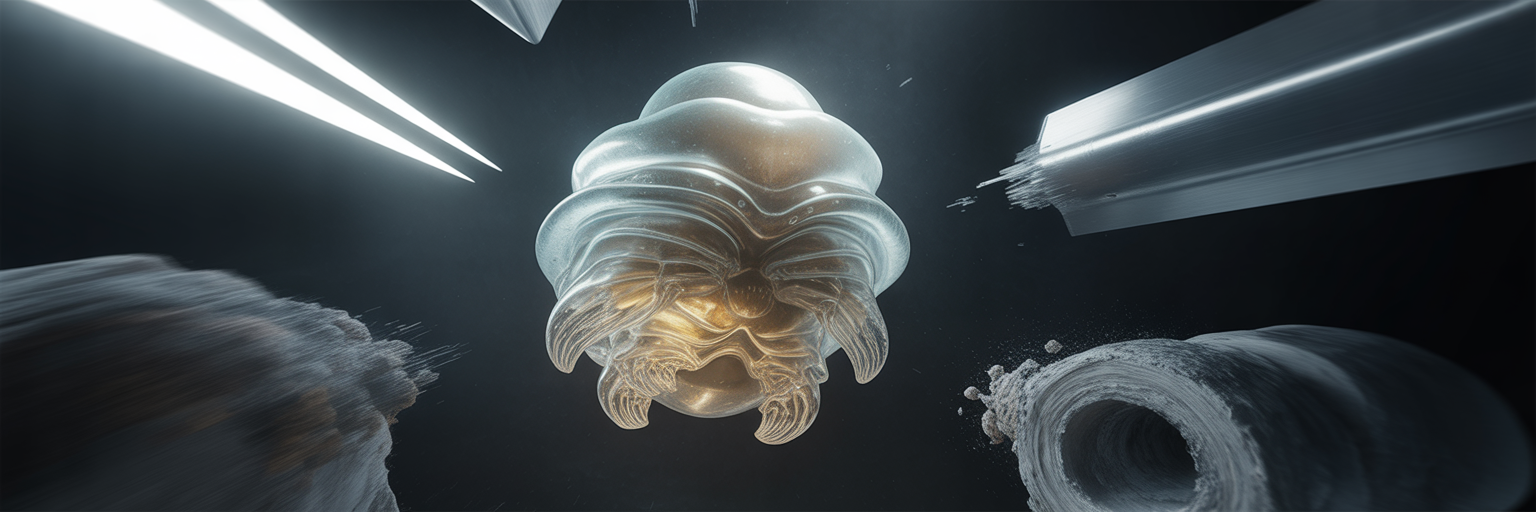
Just when you think you’ve wrapped your head around the tardigrade’s abilities, you discover it has more. As if being immune to boiling and freezing wasn’t enough, nature decided to give this microscopic creature a list of other superpowers that read like the features of an overpowered video game character. It’s a level of resilience that borders on the absurd, making them the ultimate example of animals that survive extreme conditions.
- Extreme Pressure: A tardigrade can withstand pressures of up to 600 megapascals (MPa). That’s about six times the pressure found in the Mariana Trench, the deepest part of the ocean. A military submarine would be crushed into a tin can long before reaching those depths. The tardigrade just shrugs it off. While its pressure resistance is legendary, it’s not the only creature with a wild escape plan; some animals can survive being swallowed and escape alive.
- Vacuum of Space: This is where we answer the question, what animal can survive in space? In 2007, the European Space Agency’s FOTON-M3 mission strapped some tardigrades to the outside of a satellite and exposed them to the hard vacuum and unfiltered solar radiation of open space. When they returned to Earth, many not only survived but went on to successfully reproduce.
- Lethal Radiation: As mentioned, the tardigrade’s Dsup protein makes it incredibly resistant to radiation. It can withstand a dose of gamma rays up to 6,200 Grays (Gy). For context, a dose of just 5-10 Gy is fatal to humans. This internal armor works against multiple threats, making the tardigrade a master of surviving the universe’s most hostile environments.
An Exoskeleton That’s More Like a Spacesuit
While cryptobiosis is the tardigrade’s ultimate survival strategy, it has a first line of defense that is equally impressive: its cuticle. This isn’t just skin. It’s a flexible, multi-layered, non-cellular suit of armor made primarily of chitin, the same material found in the exoskeletons of insects and crustaceans. But unlike the rigid shell of a crab, the tardigrade’s cuticle is pliable, allowing it to move efficiently and, crucially, curl into its protective tun state.
This outer layer serves multiple functions. It provides a tough physical barrier against predators and environmental abrasions. It also plays a vital role in slowing water loss as the tardigrade begins the process of dehydration, giving it precious time to prepare for cryptobiosis. The cuticle even offers a degree of shielding against UV radiation, protecting the delicate tissues within.
Like a knight upgrading his armor, the tardigrade periodically sheds this cuticle in a process called molting. It grows a new, larger suit underneath the old one and then wriggles out, leaving its old “spacesuit” behind. This process is so thorough that it even sheds and regrows the chitinous linings of its foregut and hindgut, along with its sharp stylets used for feeding. The cuticle is the perfect complement to its internal defenses, a durable yet flexible exterior that makes this tiny animal a self-contained survival machine.
Stealing Secrets from a Microscopic Overlord

Studying the tardigrade isn’t just an exercise in morbid curiosity. Scientists are actively trying to reverse-engineer its biological solutions to solve some of humanity’s most pressing challenges. The tardigrade is a masterclass in survival engineering, and its secrets could have profound implications for our own future.
- Medical Revolutions: Understanding how trehalose creates a state of vitrification could change modern medicine. Imagine being able to preserve organs for transplant for weeks or months instead of hours, eliminating frantic races against time. We could create vaccines, blood products, and other medicines that are shelf-stable without refrigeration, making them accessible to remote parts of the world.
- Biotechnology and Space Travel: The Dsup protein is a prime target for genetic engineering. Scientists have already shown that human cells grown in a lab can become more radiation-resistant when engineered to produce Dsup. This has immediate applications for protecting the healthy tissues of cancer patients undergoing radiation therapy. In the future, it could be used to shield astronauts from cosmic radiation on long-duration missions to Mars.
- The Future of Biomimicry: The tardigrade’s abilities are a roadmap for innovation. By studying these mechanisms, we might one day replicate what other biological marvels, like creatures that can shut down pain signals at will, already do naturally. The tardigrade teaches us that survival isn’t always about fighting the environment, but about having the right tools to wait it out.
They Will Have the Last Laugh
So there you have it. An animal that can be boiled, frozen to absolute zero, crushed, irradiated, and jettisoned into the vacuum of space, only to come back for more. The tardigrade’s existence is a testament to life’s tenacity, but it’s also a deeply unsettling thought. It’s unfair. While humanity builds bunkers, launches probes, and frantically searches for ways to survive the next catastrophe, the moss piglet has a much simpler plan: it just dries out and waits for the apocalypse to blow over.
It’s easy to picture the final scene. Long after our cities have crumbled to dust and the sun itself is a dying ember, a single drop of water from a passing comet lands on a speck of ancient debris. A tiny, eight-legged monster uncurls, stretches its claws, and lumbers off to find a snack, the sole, silent inheritor of a silent Earth. And in that moment, it will have the last laugh.