
The Myth of Endless Rejuvenation
For centuries, humanity has been captivated by the idea of cheating death. Alchemists searched for the elixir of life, and explorers sought a mythical fountain of youth. This deep-seated desire to turn back the clock has always felt like the stuff of legend. Yet, in the quiet depths of our oceans, a real form of aging reversal in nature exists, though it comes with a surprising catch.
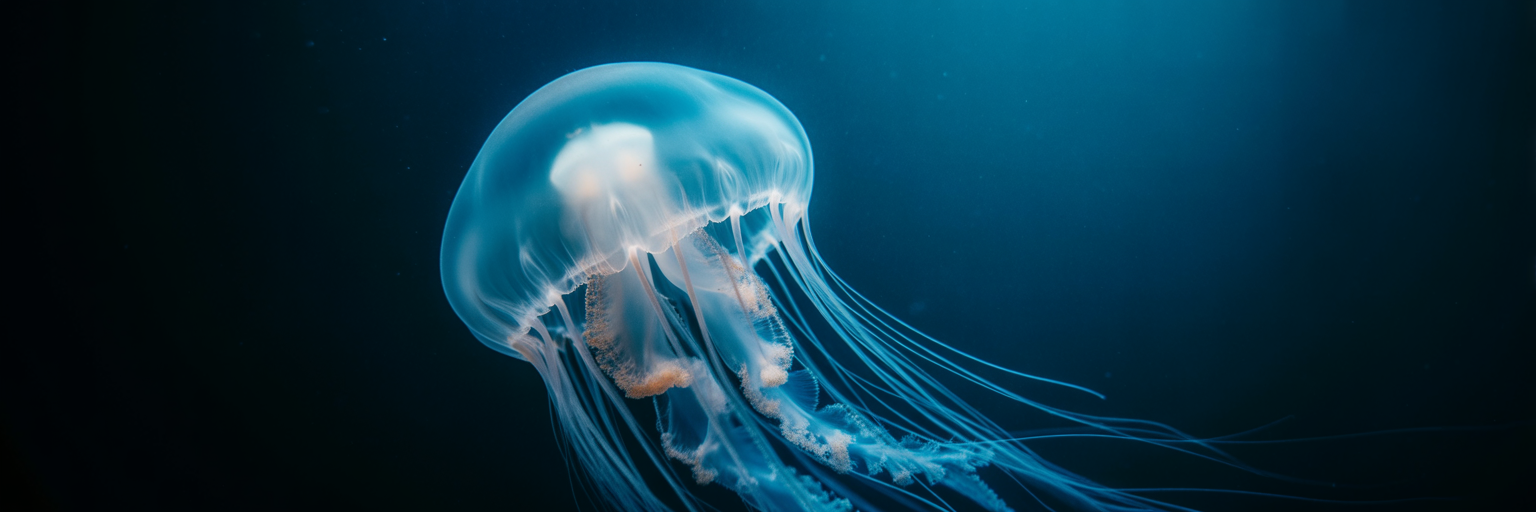
Meet Turritopsis dohrnii, a tiny creature often called the “immortal jellyfish.” This organism possesses an almost unbelievable ability to revert to its earliest stage of life when faced with extreme stress. It doesn’t just heal, it rewinds its own biological clock. But here is the central paradox: this incredible power appears to be a single-use ticket. It’s a biological reset button that can only be pressed once.
This isn’t magic, but a complex biological process that challenges our understanding of life and death. It forces us to ask a fundamental question. Why would evolution produce such a remarkable survival tool, only to impose a strict one-time limit on its use?
The Curious Case of the Immortal Jellyfish
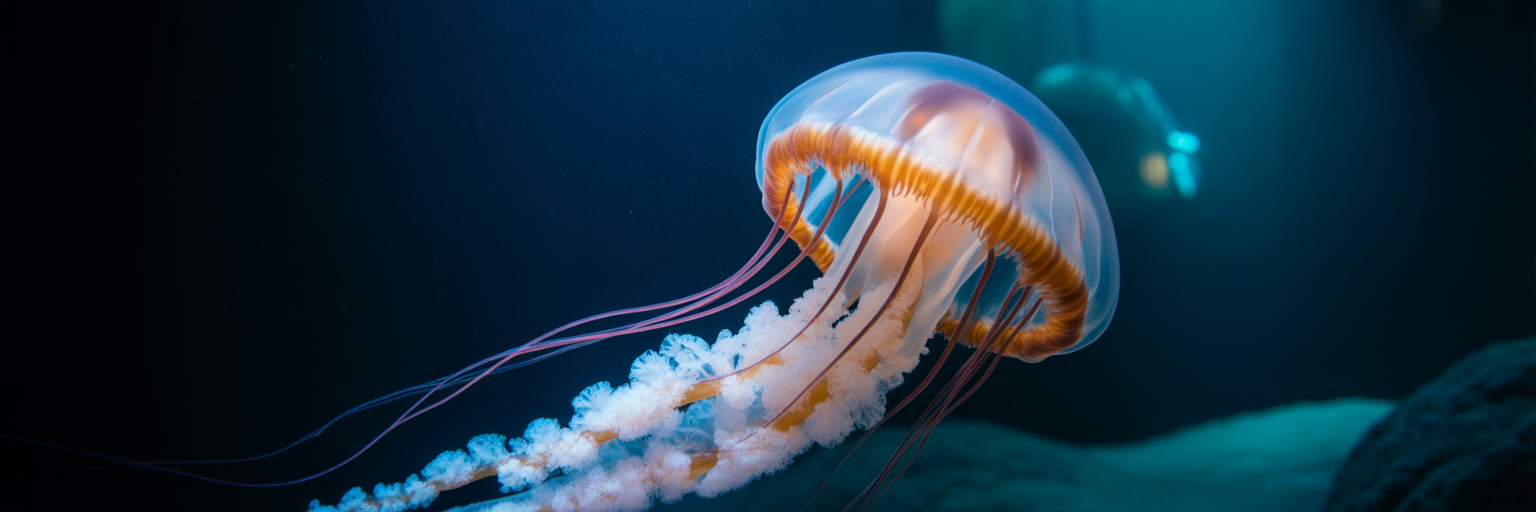
To understand this creature’s unique gift, we first need to look at its ordinary existence. The Turritopsis dohrnii life cycle is typical for many jellyfish, unfolding in a few distinct stages. This journey from a simple larva to a complex adult is the backdrop for its extraordinary transformation.
- It begins as a free-swimming larva called a planula, drifting through the ocean currents.
- The planula eventually settles on the seafloor, attaching itself to a surface to become a stationary polyp colony, resembling a tiny sea anemone.
- This colony then buds off genetically identical, free-swimming medusae. This is the classic jellyfish form we recognize, complete with a bell and tentacles.
Under normal conditions, the medusa lives, reproduces, and dies. However, when faced with severe stress like starvation, physical damage, or abrupt temperature changes, it can initiate its age reversal. This is not a graceful process but a desperate act of survival. The adult medusa’s bell and tentacles retract, and it sinks to the ocean floor. Its cells then completely reorganize, transforming it back into a new polyp. As documented by researchers and institutions like the Natural History Museum, this reversion is a complete cellular reprogramming event, not simple regeneration.
From this new polyp, a new life cycle begins. But here lies the crucial limitation. Current observations suggest this spectacular reset happens only once. The new medusae that eventually bud from this reborn polyp will live out a standard life, ending in a final death. This is one of the most fascinating immortal jellyfish facts: its “immortality” is actually a second chance at life, not an endless one.
Unpacking Cellular Transdifferentiation
The scientific mechanism behind the jellyfish’s reversal is a rare and fascinating process called cellular transdifferentiation. For a long time, biologists believed that once a cell specialized—becoming a muscle cell, a skin cell, or a nerve cell—its fate was sealed. Transdifferentiation turns that idea on its head. It is the remarkable ability of a mature, specialized cell to transform directly into another type of specialized cell.
Think of it this way: imagine a brick in a wall (a muscle cell) deciding to re-form itself into a roof tile (a nerve cell) without first being ground back down into raw clay (a stem cell). This direct conversion is what makes the process so efficient and profound. This process of cellular reprogramming, as highlighted in articles from publications like The Scientist, offers deep clues into biological aging and cellular potential. Scientists are studying how specific genes are activated or silenced to orchestrate this incredible cellular makeover. The concept of cellular transdifferentiation explained this way shows it is fundamentally different from other biological changes we are more familiar with.
| Process | Starting Cell State | Mechanism | Outcome |
|---|---|---|---|
| Transdifferentiation | Mature, specialized cell (e.g., muscle) | Direct conversion from one cell type to another | A different mature, specialized cell (e.g., nerve) |
| Stem Cell Differentiation | Undifferentiated stem cell (‘blank slate’) | Develops into a specialized cell type | A mature, specialized cell (e.g., blood, skin) |
| Regeneration | Varies; often involves stem cells or cell division | Replacement of lost or damaged tissue | New tissue of the same type as what was lost |
This table clarifies the unique nature of transdifferentiation by comparing it to the more commonly understood processes of stem cell differentiation and tissue regeneration, highlighting the direct cell-to-cell conversion that makes the jellyfish’s ability so remarkable.
The Limits of Biological Reversal

This brings us back to the central mystery: if an organism can reverse its age, why do it only once? The answer likely lies in a series of evolutionary checks and balances. Scientists have several leading hypotheses that help explain the biological immortality limits observed in Turritopsis dohrnii.
- Immense Energetic Cost: A full-body cellular transformation is an incredibly resource-intensive process. It demands a colossal amount of energy to deconstruct and rebuild an entire organism. It is plausible that a creature can only accumulate enough resources to perform this feat once in its lifetime. The second attempt might simply be too costly.
- Genetic Safeguards: Complex cellular reprogramming is a high-stakes game. Each time cells undergo such a radical change, there is a risk of introducing errors. These mistakes could lead to harmful mutations or uncontrolled growth, similar to cancer. A single-use system acts as a powerful evolutionary control mechanism, minimizing this risk while still providing a powerful survival advantage.
- Evolutionary Trade-Off: Perhaps we are looking at it the wrong way. The ability might not be about achieving individual immortality but about ensuring genetic propagation. If an adult medusa is injured or starving before it can reproduce, the reversal gives its genes a second chance to be passed on. The goal is the survival of the genetic line, not the endless life of the individual.
Even with this remarkable ability, the jellyfish is far from invincible. It remains vulnerable to predation and disease at every stage of its life. Its “immortality” is a specific biological trick, not a shield against the dangers of the ocean.
What Jellyfish Teach Us About Longevity
While we are unlikely to ever replicate the jellyfish’s full-body reset, studying how animals reverse aging provides invaluable insights for human health. The real prize is not eternal life, but the knowledge to develop new therapies for regenerative medicine. Understanding how nature coaxes cells to change their function could one day help us repair damaged organs, heal spinal cord injuries, or reverse the effects of degenerative diseases.
In laboratories, scientists are already working on something similar with induced pluripotent stem cells (iPSCs), where they reprogram adult human cells back to a stem-like state. This is a powerful technique inspired by the same principles we see in the jellyfish, though it is a carefully controlled laboratory process, not a natural one.
Ultimately, the immortal jellyfish reminds us that biology is full of elegant and surprising solutions. We may never find a literal fountain of youth, but by studying these natural wonders, we move closer to extending our “healthspan.” The goal is not just to live longer, but to live better, with a higher quality of life for as long as possible.