Beyond Communication: Sound as a Predatory Tool
In the animal kingdom, sound is the universal language. It’s used for everything from a bird’s morning song to a wolf’s territorial howl. Some animals, like bats and dolphins, take it a step further, using echolocation to paint a picture of their world with sound waves, helping them navigate and find food. But what if the sound itself was the weapon? What if an animal could produce a noise so violent it could physically harm its prey?
This isn’t science fiction. While many have heard tales of whales stunning their prey with sound, the truth is far stranger and belongs to a much smaller creature. The ability to weaponize sound is a rare and fascinating adaptation. This is just one of many surprising adaptations, and our blog features countless other examples of nature’s ingenuity. Forget what you think you know about sonic power; the real story is more explosive.
Debunking the Whale’s Sonic Stun Myth
The idea of a sperm whale disabling a giant squid with a blast of sound is a compelling image. It’s a popular theory that has circulated for decades, suggesting the whale’s powerful clicks are used for “acoustic stunning.” However, as scientists have learned more about how do sperm whales hunt, this theory has fallen apart. The evidence simply isn’t there. The whale’s clicks are incredibly loud, but their primary function is long-range sonar, allowing them to detect prey from miles away in the deep, dark ocean.
As a whale closes in on its target, its vocalizations change. It emits a rapid series of clicks known as a “terminal buzz.” For a long time, observers wondered if this was the stunning blow. But a detailed analysis of predator-prey interactions published in Scientific Reports revealed that these sounds lack the energy required for acoustic stunning. Instead, the buzz functions as a high-resolution biosonar, giving the whale a precise, real-time update on the prey’s exact location. This allows it to perfectly time its final move: opening its massive jaw and using suction to inhale its meal.
So, while their sounds are immense, they are tools of perception, not concussion. The sperm whale’s hunt is a masterpiece of tracking and precision, not brute sonic force. Just as the sperm whale has perfected its hunting strategy, other creatures have evolved equally bizarre ways to survive, such as the frog that freezes solid and thaws back to life.
The Pistol Shrimp’s Shockwave Claw
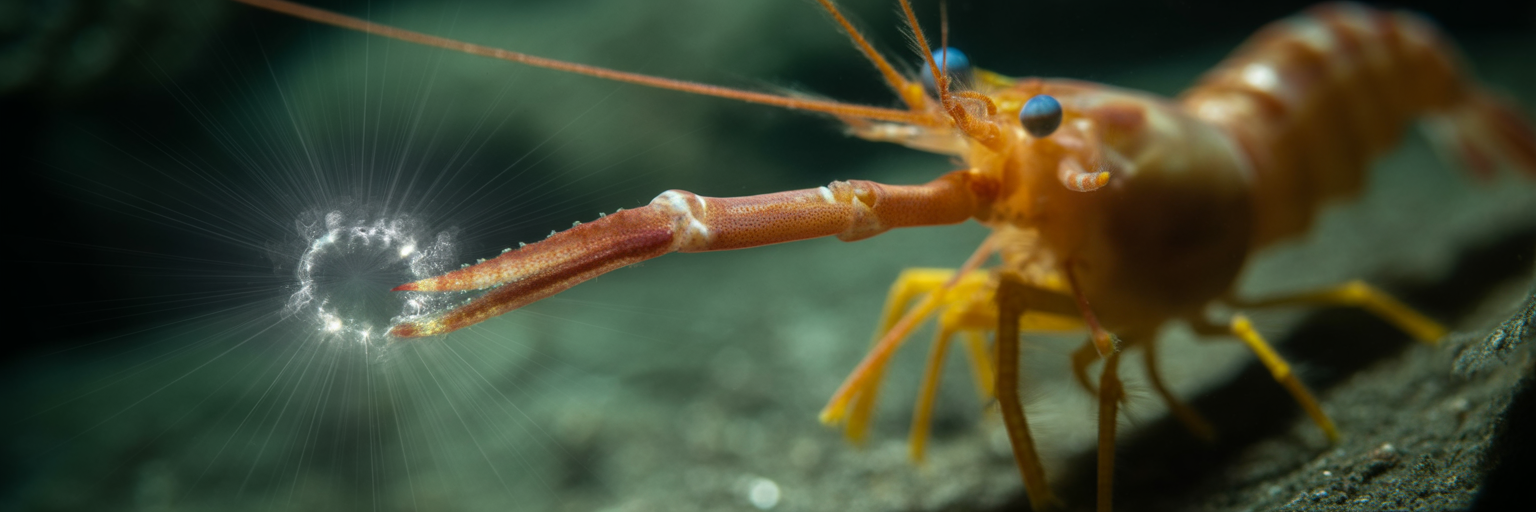
The true champion of sonic hunting is a tiny crustacean: the pistol shrimp. This animal is the definitive answer to the question of which animals that use sound to hunt with physical force. It wields a specialized, oversized claw that acts not as a pincher, but as a biological firearm. The pistol shrimp sound weapon is one of the most extreme adaptations in the animal kingdom, and its mechanics are astonishing.
The process happens in a fraction of a second:
- The shrimp cocks its large claw, and a small plunger snaps into a socket. When it releases the muscle, the plunger part of the claw snaps shut at speeds over 60 miles per hour.
- This incredible speed shoots a jet of water forward at an extreme velocity.
- The water jet moves so fast that the pressure behind it drops, forming a tiny, low-pressure vacuum pocket. This is known as a cavitation bubble.
- Within microseconds, the surrounding water pressure violently collapses this bubble.
It is the bubble’s collapse, not the snap itself, that creates the weapon. This implosion generates a shockwave that has been measured at 218 decibels, louder than a gunshot. For a brief moment, the collapse also produces a flash of light and temperatures reaching over 8,000°F, nearly as hot as the surface of the sun. This incredible ability, where noise itself becomes a physical weapon to stun prey, is a well-documented biological strategy, as highlighted by resources like Asknature.org. The shockwave from this cavitation bubble hunting technique is powerful enough to stun or kill small fish, crabs, and other shrimp instantly, allowing the pistol shrimp to collect its meal with ease.
Exploring Other Potential Sonic Hunters
While the pistol shrimp is the most famous and well-documented example, it may not be entirely alone. The world of acoustic stunning in animals is a small but fascinating field of study. Researchers believe that certain other marine creatures might employ similar tactics, though the evidence is often less conclusive. Some species of mantis shrimp, known for their powerful punches, may also generate cavitation bubbles with their strikes, adding a secondary sonic stun to their physical attacks.
A common pattern emerges when looking at these potential sonic hunters: they are almost always small. The physics of generating such a powerful, localized blast of energy is more feasible on a smaller scale. Creating a cavitation bubble requires an incredibly fast movement, and it’s easier for a tiny appendage to achieve that speed than a large one. This suggests that weaponized sound is a niche strategy, a case of convergent evolution where different, unrelated species independently arrived at a similar solution for capturing prey in an aquatic environment.
This evolutionary path is as fascinating as that of the lyrebird, which has learned to mimic complex sounds from its environment, from camera shutters to chainsaws, showcasing how different pressures lead to unique sonic abilities.
The Physics of an Underwater Weapon
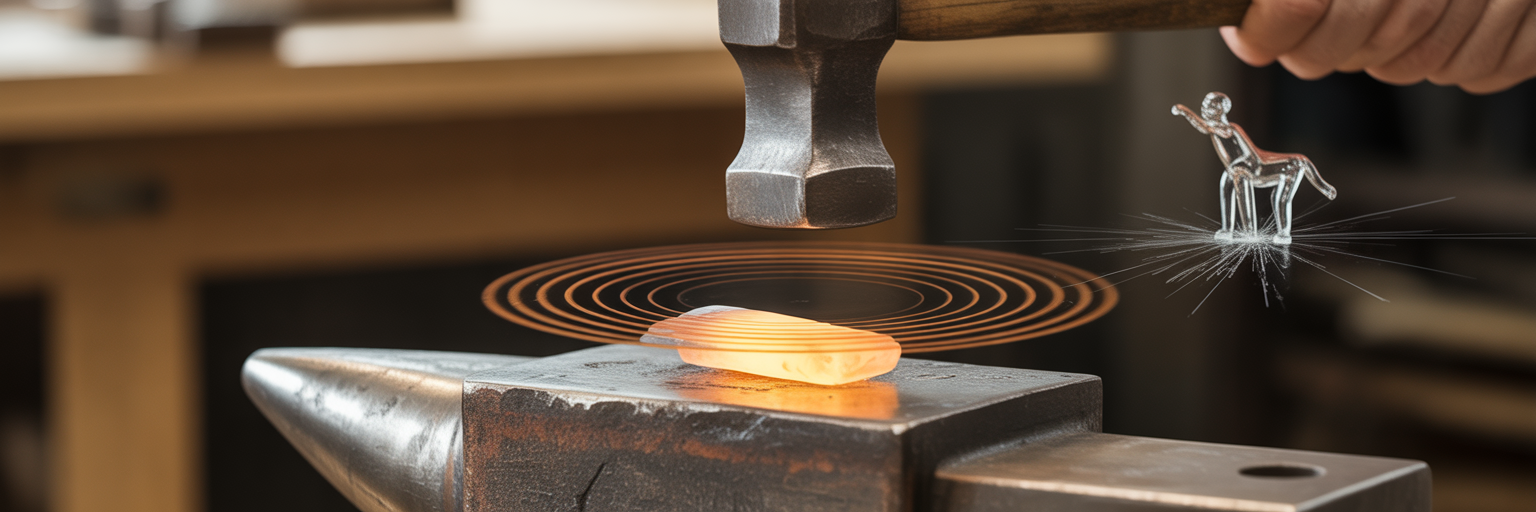
Why does this strategy only work underwater? The answer lies in the fundamental properties of water. Water is nearly 800 times denser than air, which allows pressure waves to travel farther and with significantly more force. A sound made in water retains its energy far more effectively than a sound made on land. This is why whale songs can travel across entire oceans.
A shockwave is essentially a pressure wave moving faster than the local speed of sound, creating an abrupt and violent change in pressure. When the pistol shrimp’s cavitation bubble collapses, it generates exactly this. Think of the force of a snapping towel, but concentrated into a microscopic point that implodes with incredible power. For a small fish or crab caught in the blast zone, being hit by this shockwave is not like hearing a loud noise; it is like being struck by a physical hammer.
| Property | In Air | In Water |
|---|---|---|
| Density | Approx. 1.2 kg/m³ | Approx. 1000 kg/m³ |
| Speed of Sound | Approx. 767 mph (343 m/s) | Approx. 3,355 mph (1,500 m/s) |
| Energy Transmission | Low efficiency, disperses quickly | High efficiency, travels farther with more force |
This table compares the physical properties of air and water at standard temperature and pressure to illustrate why sound-based weapons are a uniquely aquatic phenomenon.
Evolutionary Trade-Offs of Sonic Hunting
The existence of sonic hunting raises a question: if it’s so effective, why isn’t it more common? The answer lies in evolutionary trade-offs. The pistol shrimp’s brute-force approach is a stark contrast to the sperm whale’s informational use of sound. Each strategy comes with its own set of costs and benefits.
For the pistol shrimp, the pistol shrimp sound weapon is a powerful tool, but it comes with significant limitations that explain its rarity:
- High Energy Cost: Each snap of the claw requires a substantial amount of metabolic energy, making it a costly way to hunt.
- Extremely Limited Range: The lethal shockwave is only effective within a few centimeters of the claw. It is a close-quarters weapon only.
- Anatomical Specialization: The massive claw is so specialized for snapping that it is not useful for other tasks, like grasping or manipulating objects.
- Environmental Dependence: The entire strategy relies on the physics of cavitation, which only works in a liquid medium like water.
The fact that there are any animals that use sound to hunt this way is a testament to evolution’s creativity. The pistol shrimp’s sonic weapon is a testament to evolution’s creativity, much like the parasite that turns snails into zombies to complete its life cycle. It’s a powerful reminder that for every problem in nature, there is a unique, and sometimes explosive, solution.