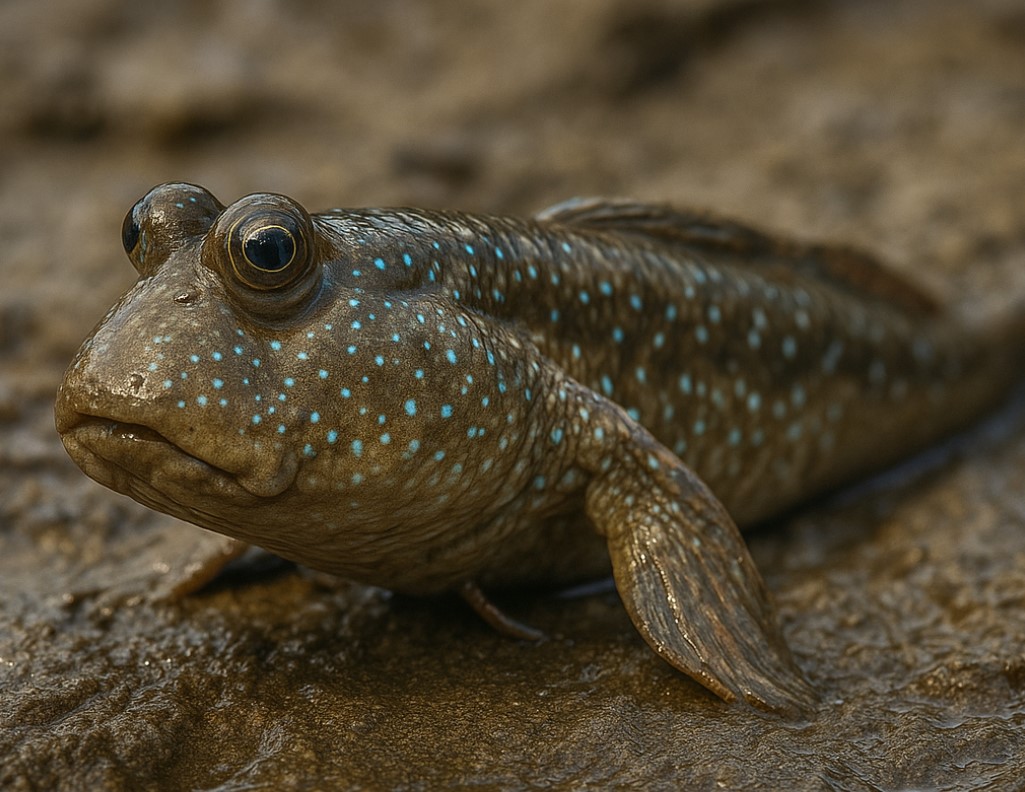
Mudskippers are not your typical fish. They defy the norms of aquatic life. These fascinating creatures can walk on land and breathe air.
Imagine a fish that can survive out of water. That’s the mudskipper. It thrives in both water and on land, making it an amphibious fish.
Mudskippers belong to the family Gobiidae. They are primarily found in mangrove swamps and tidal flats. These habitats are perfect for their unique lifestyle.
Their ability to breathe air is remarkable. Mudskippers use their skin and the lining of their mouth and throat to breathe. This adaptation allows them to explore land.
Mudskippers are known for their modified pectoral fins. These fins enable them to “walk” on land. They can even climb trees and jump on land.
Their protruding eyes give them a wide field of vision. This helps them spot predators and prey. It’s one of the many mudskipper facts that intrigue scientists.
Mudskippers are territorial creatures. They often engage in displays to defend their space. This behavior is crucial for their survival.
They play a vital role in their ecosystem. By aerating the soil and controlling insect populations, they maintain ecological balance.
Mudskippers are a testament to life’s adaptability. They showcase how evolution can lead to extraordinary traits. These fish are truly one of the strangest fish in the world.
What Is a Mudskipper? An Introduction to the Strangest Fish in the World
Mudskippers are a unique group of fish. They belong to the subfamily Oxudercinae within the family Gobiidae. Known for their bizarre adaptations, they are often labeled as the strangest fish in the world.
These fish are amphibious, living both in water and on land. Their adaptations allow them to thrive in challenging environments. Mudskippers are mostly found in intertidal zones where they experience extreme conditions.
Mudskippers are not just about survival; they thrive in their habitats. They are commonly seen in muddy flats and mangroves. Their presence is a sign of a healthy, thriving ecosystem.
One of their most distinctive features is their ability to breathe air. Unlike most fish, mudskippers can breathe by absorbing oxygen through their skin and the lining of their mouth. This adaptation sets them apart in the animal kingdom.
Mudskippers have developed several features that enable them to move on land. Their pectoral fins are modified to act like legs. This adaptation allows them to walk, jump, and even climb trees.
Here’s a quick list of what makes mudskippers unique:
- Ability to breathe air and water
- Mobility on land using modified fins
- Habitat in mangroves and tidal flats
- Protruding eyes for enhanced vision
- Territorial behavior to protect space
Their large, bulging eyes give them an extensive field of vision. This adaptation aids in detecting predators and prey. Vision is crucial for their complex social interactions.
Mudskippers are not solitary creatures. They are territorial and highly social, often seen interacting with each other. Males are known for their elaborate displays to attract mates and defend their territory.
In essence, mudskippers exemplify evolutionary wonders. They demonstrate how life can adapt and evolve in extraordinary ways. Their unique lifestyle continues to captivate scientists and nature enthusiasts alike.
Where Do Mudskippers Live? Habitats and Global Distribution
Mudskippers thrive in a variety of coastal habitats. These include mangrove forests, salt marshes, and tidal flats. The presence of mudskippers indicates a well-functioning ecosystem.
Mangroves serve as their primary habitat. These forests provide shelter and abundant food sources. The dense roots of mangroves also offer protection from predators.
Mudskippers are found in diverse locations across the globe. Their distribution spans the Indo-Pacific region. This area covers parts of Africa, Asia, and Oceania.
The adaptability of mudskippers is notable. They can live in extreme conditions where salt levels fluctuate. They are well-suited to surviving in low-oxygen environments.
These fascinating fish contribute significantly to the health of their habitats. By burrowing, they aerate the soil, benefiting other organisms. Their behavior enhances nutrient cycles in the ecosystem.Here’s a quick overview of their habitat preferences:
- Mangroves, known for complex root systems
- Muddy tidal flats offering ample space
- Salt marshes with fluctuating salt conditions
- Regions prone to seasonal flooding and drying
In different regions, they may prefer slightly varied habitats. For instance, some may favor more saline conditions. Others thrive in areas with greater freshwater influence.
Their preference for muddy environments aids them in camouflaging. These muddy habitats offer both feeding grounds and protection. This adaptability makes them versatile in their range.
Mudskippers’ presence is essential for ecosystem diversity. They play a role in balancing insect populations. Furthermore, their burrowing nature helps in soil turnover, promoting plant growth.
By maintaining a balance in their environment, they support a range of other species. Their role extends beyond survival, contributing to overall ecosystem health. This makes them not only unique but integral to coastal ecosystems around the world.
Anatomy of a Walking Fish: Unique Features and Adaptations
Mudskippers possess a remarkable anatomy that supports their unusual lifestyle. Their bodies have evolved to suit both aquatic and terrestrial environments. This dual capability sets them apart from many other fish species.
One of their most notable features is their pectoral fins. These fins are modified to function like limbs, enabling them to “walk” on land. The fins’ strong muscles give them the power to navigate different surfaces.
Their eyes are another distinguishing characteristic. Mudskippers have protruding eyes that move independently. This unique eye placement offers a wide field of vision, crucial for spotting predators and prey.
Mudskippers have adapted to breathe in both water and air. They rely on their skin and the lining of their mouth and throat for respiration. By keeping their skin moist, they absorb oxygen directly from the air.
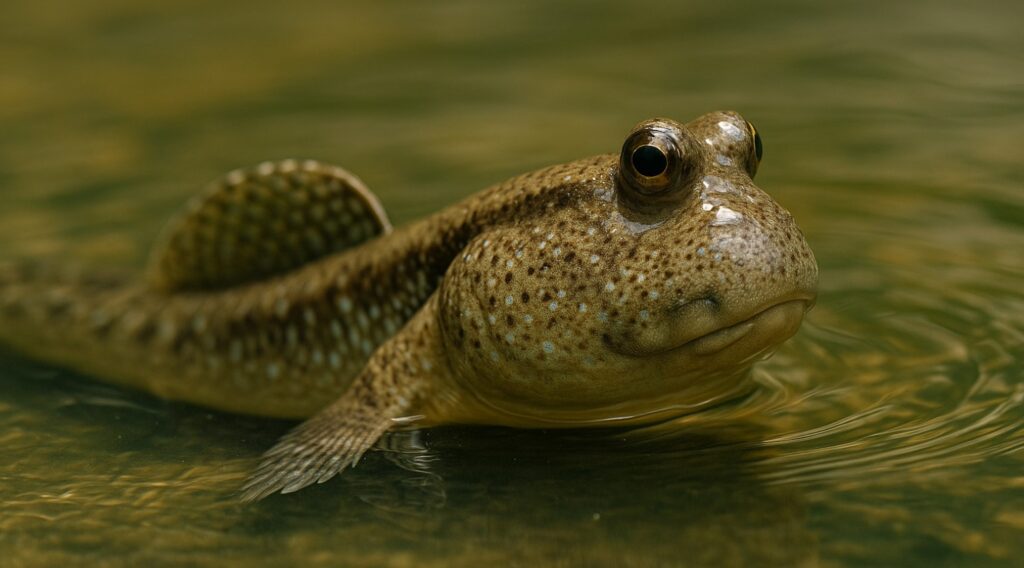
Here are some key anatomical features:
- Pectoral Fins: Modified for walking and hopping
- Protruding Eyes: Provide a broad range of vision
- Skin: Capable of cutaneous respiration
- Mouth and Throat Lining: Assists in air breathing
Their skin is an essential part of their respiratory system. The skin must remain moist to facilitate breathing. This is why mudskippers often stay near water sources even when on land.
Their ability to climb is supported by their strong fins. Mudskippers are known to climb roots and even low branches. This climbing ability is rare among fish species, adding to their distinctiveness.
The mudskipper’s tail is powerful and flexible. It’s designed to propel them in water and to aid jumping on land. The tail’s movement aids in quick escapes from danger, contributing to their survival.
Interestingly, mudskippers have a lateral line system. This system helps them detect changes in water pressure and movement. While common in fish, its adaptation for terrestrial sensing in mudskippers is unique.
They also display territorial behavior, with physical adaptations to back it up. Enlarged gill chambers can be used to intimidate rivals. This blend of anatomy and behavior helps them establish and defend territory.
The combination of these adaptations allows mudskippers to thrive in varied environments. This blend of land and aquatic features marks them as a true evolutionary marvel. Understanding their anatomy offers insights into how life can adapt to diverse worlds.
How Do Mudskippers Breathe? Air, Water, and Skin
Mudskippers have developed an exceptional respiratory system. This allows them to breathe both in water and on land. They demonstrate an intriguing blend of aquatic and terrestrial breathing methods.
Typically, fish rely on gills for breathing underwater. However, mudskippers have adapted beyond traditional gill use. Their gills are structured to retain moisture, allowing partial use on land.
The skin of a mudskipper plays a crucial role in respiration. These amphibious fish absorb oxygen directly through their moist skin. This process, known as cutaneous respiration, is vital for their survival on land.
The lining of their mouth and throat also aids in breathing. This additional respiratory surface allows them to extract oxygen from the air. In essence, mudskippers can leverage different parts of their body for maximum oxygen intake.
Key respiratory adaptations include:
- Moist Gills: Capable of retaining function in limited air exposure
- Cutaneous Respiration: Oxygen absorption through damp skin
- Buccal Cavity Respiration: Mouth and throat lining aids air breathing
Maintaining skin moisture is essential for cutaneous respiration. Without moisture, the oxygen absorption process through the skin would falter. Thus, mudskippers often stay close to water to keep their skin damp.
Their ability to switch respiratory modes grants them incredible flexibility. In shallow waters or mudflats, they may need to breathe air if water oxygen levels drop. Their adaptiveness to environmental changes is fascinating.
Interestingly, mudskippers are not alone in their skin-breathing ability. Some amphibians share this trait, linking these fish to distant relatives. This similarity highlights nature’s innovative solutions to environmental challenges.
By observing mudskippers, scientists gain insights into evolutionary biology. Their unique respiratory methods offer clues about life transitioning from water to land. Thus, these creatures also serve as living models for studying adaptation.
In summary, mudskippers exemplify nature’s ingenuity. Breathing through gills, skin, and oral tissues allows them to thrive in diverse environments. Their respiratory adaptations highlight the intricate relationship between biology and habitat.
Mudskipper Locomotion: Walking, Jumping, and Climbing Trees
Mudskippers have evolved unique movement methods. Unlike most fish, they can venture onto land with ease. Their locomotion abilities are both intriguing and vital for their survival.
The modified pectoral fins of mudskippers act like legs. These fins allow them to “walk” on land. By anchoring their fins in the mud or sand, they push their bodies forward.
Mudskippers are also known for their jumping skills. They use their strong tail fins to propel themselves upward. This helps them navigate over obstacles or escape from predators quickly.
Equally impressive is their ability to climb. Some mudskippers can actually ascend tree roots or low branches. Their muscular fins enable them to grip and pull themselves upward.
These locomotion methods include:
- Walking: Uses pectoral fins to move across surfaces
- Jumping: Tail fin propels them over obstacles and gaps
- Climbing: Ascend trees or roots for better vantage points
Mudskippers adapt their movements based on the environment. In mangrove forests, climbing offers safety from rising tides. On mudflats, walking and jumping help them avoid stagnant water.
Their coordination is remarkable, as they balance on two fins while moving. This ability showcases the specialization of their limb-like structures. These adaptations provide them with a versatile approach to land-based life.
This range of movement aids in feeding as well. By traveling on land, they can access food sources unavailable to typical fish. Mudskippers often capture insects or small prey while out of water.
The energy-efficient techniques used by mudskippers are a marvel of nature. They minimize energy use while navigating both terrestrial and aquatic habitats. This efficiency helps them conserve energy between activities.
To summarize, mudskippers are not just fish—they are multifaceted explorers of their environments. Their ability to walk, jump, and climb is a testament to their evolutionary success. Such skills make them fascinating subjects for both researchers and nature lovers alike.
Daily Life of a Mudskipper: Feeding, Social Behavior, and Territory
Mudskippers lead dynamic and busy lives. These amphibious fish are constantly on the move, seeking food and defending territories. Their behavior on land is captivating and diverse.
Feeding is a primary activity for mudskippers. They hunt for a variety of food, taking advantage of their unique lifestyle. Algae, insects, and small invertebrates are part of their diet. By exploring both aquatic and terrestrial environments, they access a wider range of food sources.
Social behaviors among mudskippers are equally fascinating. These fish often engage in vigorous territorial displays. Males, in particular, are known for their feisty nature. They establish and defend territory with flair and determination.
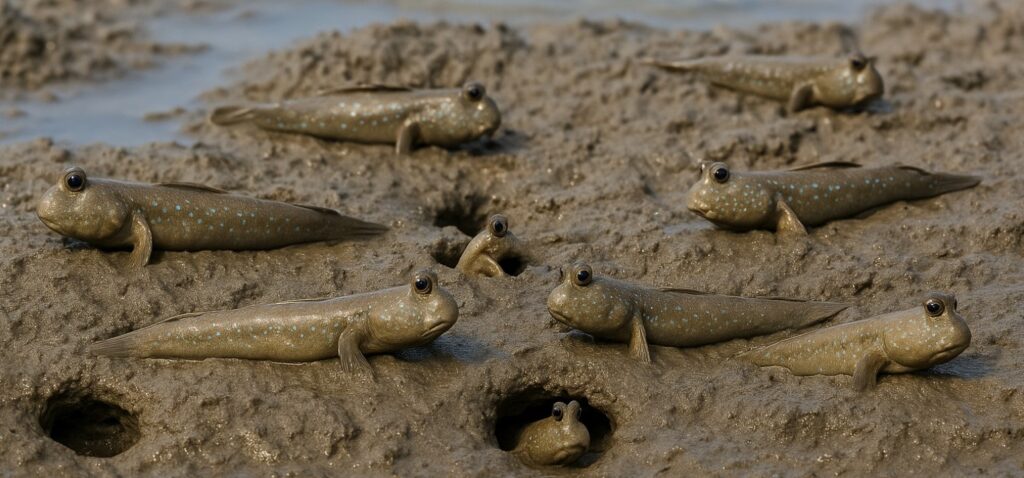
Mudskippers use bold body movements to communicate. Eye-rolling, head bobbing, and fin displays are common signals. These behaviors help resolve conflicts and maintain social order without direct confrontation.
Their territories are typically small, bounded by natural features like mud mounds or puddles. Within these territories, mudskippers assert dominance and fend off rivals. Such interactions highlight their complex social structure.
Despite their combative tendencies, mudskippers also show a cooperative side. Occasionally, they work together to survive environmental changes, such as high tides or predator threats. This adaptability ensures their resilience and longevity.
Mudskipper behavior encompasses several aspects, including:
- Feeding Habits: Diverse diet from land and water sources
- Territorial Displays: Aggressive actions to protect and control areas
- Social Signaling: Complex communication through body movements
Their adaptable nature extends to how they adjust living spaces based on environmental conditions. Mudskippers thrive in fluctuating landscapes, proving their exceptional survival skills.
In essence, mudskippers exemplify the challenges and triumphs of living between two worlds. Their dynamic daily lives offer a window into the natural balance they maintain. Observing them reveals the intricacies of ecosystem interactions and the fundamental struggles of life.
Mudskipper Reproduction: Courtship, Burrows, and Raising Young
Mudskippers exhibit fascinating reproductive behaviors that are perfectly adapted to their environments. These behaviors often highlight the interplay between aquatic and terrestrial lifestyles.
The courtship process in mudskippers is both captivating and competitive. Males engage in elaborate displays to attract females. They perform a series of energetic gestures, showcasing their strength and vitality. Vibrant displays often involve jumping, rolling eyes, and stretching their body.
Success in courtship can lead to nesting. Mudskippers dig intricate burrows in the mud as part of their reproductive strategy. These burrows provide a safe haven for spawning. The burrows are vital, offering protection from predators and harsh environmental conditions.
Once a pair mates, the female mudskipper deposits her eggs inside the burrow. The number of eggs laid can vary, but they are all carefully placed within the secured environment. The male mudskipper takes on the role of protector, guarding the burrow diligently.
Parental care in mudskippers is quite pronounced. The male tends to the burrow by keeping it oxygenated and free from intruders. He frequently checks on the eggs, showcasing a rare commitment among fish species.
After the eggs hatch, juvenile mudskippers start their life in a well-guarded nursery. The young have a safe space to grow before venturing out into the challenging world. Their early life stages are supported by the secure environment their parents have created.
The mudskipper’s reproductive strategies highlight several key aspects:
- Courtship Displays: Energetic movements to attract mates
- Burrow Construction: Creating secure spaces for mating and egg-laying
- Parental Care: Male involvement in protection and monitoring of eggs
These behaviors underline the importance of adaptation and strategy in the survival of species. They not only ensure the immediate safety of offspring but also contribute to the ongoing success of mudskippers as a whole. Through these strategies, mudskippers exemplify the incredible adaptability and resilience of life.
Mudskippers and Their Ecosystem: Role and Importance
Mudskippers are vital members of their ecosystems, playing significant roles in environmental health. Their unique lifestyle impacts both aquatic and terrestrial habitats.
As amphibious fish, mudskippers contribute to soil aeration in intertidal zones. Their movements disturb the mud, mixing oxygen into the soil. This process is crucial for the health of mangrove ecosystems, where they often reside.
Mudskippers are also effective in insect population control. They feed on insects and small invertebrates, maintaining balance within their habitat. This predation helps prevent the overpopulation of certain insect species, which could otherwise become problematic.
Their presence indicates a healthy, functioning ecosystem. Because of their sensitivity to changes, mudskippers serve as bioindicators. A thriving mudskipper population suggests good environmental conditions, as they require specific habitat parameters to survive.
Moreover, mudskippers support biodiversity. By creating and maintaining burrows, they provide habitats for other species as well. These underground networks become shelters for various small animals, enhancing the area’s biodiversity.
Mudskippers also facilitate plant growth. By aerating the soil, they enable better root penetration for plants, especially in mangroves. This relationship supports robust plant life, which in turn stabilizes coastlines and provides critical resources for other species.
To summarize their ecological importance:
- Soil Aeration: Enhancing soil quality and structure
- Insect Control: Natural pest management
- Bioindicators: Reflecting ecosystem health
- Supporting Biodiversity: Creating habitats for multiple species
- Promoting Plant Growth: Aiding in the establishment of plant roots
Mudskippers, with their impressive adaptations, exemplify nature’s complexity and interconnectivity. Their role extends beyond their immediate survival, influencing the broader ecological web. By supporting these fascinating fish, we ensure the continued health and balance of their unique ecosystems.
Mudskipper Facts: Weird and Wonderful Trivia
Mudskippers are among the most fascinating creatures on Earth, boasting unique characteristics that set them apart from other fish species. Known for their extraordinary adaptations, these amphibious fish have intrigued scientists and nature enthusiasts alike.
One of the most peculiar features of mudskippers is their ability to survive out of water for extended periods. They rely on their skin and mucous membranes to breathe air, showcasing a blend of terrestrial and aquatic traits.
These fascinating fish have strikingly protruding eyes, giving them an almost cartoonish appearance. This eye structure allows them to see both above and below water, offering a strategic advantage in spotting predators and prey.
Intriguingly, mudskippers are capable of performing theatrical courtship displays. These behaviors include leaping from the water and flipping in the air to attract mates, showing an unusual form of aquatic romance.
Here are some astounding mudskipper facts:
- Breathing Abilities: Can breathe through skin and lining of the mouth.
- Vision: Eyes adapted for dual-environment visibility.
- Locomotion: Utilizes strong pectoral fins for walking.
- Habitat: Prefers muddy, intertidal zones.
Mudskippers are also remarkable for their territorial behaviors. They often engage in “fin flicking” and mouth-gaping displays to ward off intruders, reflecting their assertive nature.
Their diet includes a variety of food sources, ranging from algae to small insects. This omnivorous diet helps them thrive in diverse environments.
Some more mudskipper trivia for the curious:
- Dietary Habits: Consumes algae, insects, and small crustaceans.
- Social Behavior: Displays territorial aggression.
- Ecosystem Role: Aerates soil and supports biodiversity.
- Physical Adaptations: Possesses a strong tail for jumping.
These fascinating traits make mudskippers a subject of ongoing interest and research, highlighting the adaptability and resilience of life in challenging environments. Understanding mudskippers sheds light on evolution and ecological dynamics, making them truly remarkable creatures in the natural world.
Mudskippers in Science and Culture: Evolution, Research, and Media
Mudskippers have captivated the scientific community, offering insights into evolutionary biology. Their ability to traverse both land and water serves as a living example of adaptation and evolutionary transition.
Research on mudskippers has provided valuable information on how life can successfully move from aquatic to terrestrial environments. These fish highlight the intricate processes of natural selection and adaptation.
The study of mudskippers often focuses on their unique anatomical features. Scientists are particularly interested in their pectoral fins, which function much like legs in assisting their terrestrial locomotion.
In addition to scientific interest, mudskippers have made their mark in popular culture. They have been featured in numerous documentaries and nature programs, showcasing their intriguing lifestyles and unusual capabilities.
Here’s how mudskippers are represented in science and culture:
- Evolutionary Models: Used to study transition from water to land.
- Documentaries: Featured in nature films for their uniqueness.
- Research Focus: Studied for anatomical and respiratory adaptations.
- Cultural References: Appeared in literature and educational materials.
Educational institutions often use mudskippers to illustrate principles of evolution and adaptation, making them vital tools for teaching. Their fascinating life serves as an accessible way to engage students in biology and ecology.
Mudskippers continue to be subjects of fascination and study, illuminating the wonders of nature. Through ongoing research, they remain significant contributors to our understanding of the complexity and adaptability of life on Earth. By examining their unique traits and adaptations, researchers uncover deeper truths about evolutionary processes, further cementing their important role in both science and popular culture.
Frequently Asked Questions About Mudskippers
Mudskippers often prompt questions due to their unusual lifestyle. Here are some frequently asked questions about these intriguing fish.
What exactly are mudskippers?
Mudskippers are a type of amphibious fish capable of living on both land and in water. They are part of the family Gobiidae and are known for their unique adaptations.
How do mudskippers breathe on land?
Mudskippers breathe through their skin and the lining of their mouth and throat. This allows them to absorb oxygen from the air, much like amphibians.
Can mudskippers really climb trees?
Yes, mudskippers possess strong fins that enable them to climb over obstacles, including the roots and trunks of trees in their natural habitat.
What do mudskippers eat?
Their diet includes algae, insects, and small invertebrates. This diverse feeding habit helps them thrive in various environments.
Where are mudskippers typically found?
These fish are usually located in mangrove swamps and tidal flats across Africa, Asia, and Australia, where they can seamlessly move between aquatic and terrestrial ecosystems.
Why are mudskippers considered unique?
Their ability to walk, jump, and breathe air makes them one of the most unusual fish. Their lifestyle challenges the conventional understanding of a fish’s capabilities.
If you’ve ever wondered about these peculiar creatures, you’re not alone. Mudskippers inspire curiosity due to their mix of fish and amphibian traits. By learning about them, we gain insights into evolutionary biology and the adaptability of life. Through these answers, we hope to have shed some light on the many marvels of mudskippers.
Conclusion: Why Mudskippers Matter
Mudskippers offer a profound glimpse into the adaptability of life. Their unique traits demonstrate evolutionary innovation and survival against the odds. These fish challenge our preconceived notions of what it means to be a fish. They not only thrive in water but also on land.
Their presence in diverse ecosystems underscores their ecological significance. Mudskippers help balance environmental interactions by aerating the soil and controlling insect populations. Such roles are crucial in maintaining the health of mangrove and tidal ecosystems.
Studying mudskippers provides valuable insights into evolutionary biology and adaptation. They exemplify how species can adapt to and exploit new environments over time. This knowledge is vital for understanding broader ecological and evolutionary questions.
Furthermore, mudskippers captivate the public imagination, highlighting the diversity and wonder of life on Earth. Their story encourages curiosity and appreciation for the natural world. The mudskipper thus serves as a testament to nature’s resilience and complexity, bridging the gap between aquatic and terrestrial life.