The Evolutionary Logic Behind Natural Horrors
The most disturbing features found in nature are not accidents. They are highly refined solutions to the relentless problems of survival. Evolutionary pressures like predation, resource competition, and reproduction act as the architects of these forms, shaping organisms over millions of years. What we perceive as monstrous is often just a successful answer to a life-or-death question. This process is so logical that it produces similar results in unrelated species through convergent evolution. For instance, both prehistoric mammals and certain invertebrates independently developed saber-like teeth to solve the problem of killing large prey, proving that horrifying forms can be effective, repeatable solutions.
Our psychological reaction to these traits is not arbitrary. The deep-seated fear of fangs, venom, or parasitic behavior is an inherited survival instinct, a biological alarm system passed down from ancestors who learned to avoid these dangers. When we encounter these unsettling natural phenomena, we are reacting to ancient threats.
This article examines some of these scary real animals and organisms not as monsters, but as triumphs of adaptation. By exploring their existence, we can see the cold, impartial scientific logic that makes them possible and understand that reality is often more disturbing than fiction.
Ambush Predators of the Deep
The deep sea is an environment of crushing pressure, total darkness, and scarce food. These extreme conditions have produced some of the most bizarre life forms on the planet. Among them is the bobbit worm, an ambush predator that embodies the efficiency of deep-sea hunting. Growing up to several meters long, its iridescent, segmented body remains hidden beneath the sediment, with only its five antennae exposed to sense passing prey. The attack is a display of incredible speed and force.
The hunting sequence of a bobbit worm predator is brutally simple:
- It lies in wait, completely buried and motionless on the ocean floor.
- Its antennae detect the faint movements of a fish or other creature above.
- It erupts from the sediment with enough power to slice its prey in half.
- It snatches the victim with a complex, inside-out jaw structure called a pharynx and drags it underground to be consumed.
Its method is so effective that it has become a subject of fascination, with publications like BBC Science Focus detailing the mechanics of its terrifying ambush. While the bobbit worm relies on raw power, other strange deep sea creatures use different tactics. The vampire squid, despite its name, does not drink blood. When threatened in the pitch-black depths, it expels a cloud of bioluminescent mucus. This sticky, glowing web disorients attackers, creating a confusing light show that allows the squid to escape into the darkness. Both strategies, one violent and the other deceptive, are perfect adaptations to an environment where every encounter is a fight for survival.
The Body Snatchers of the Insect World
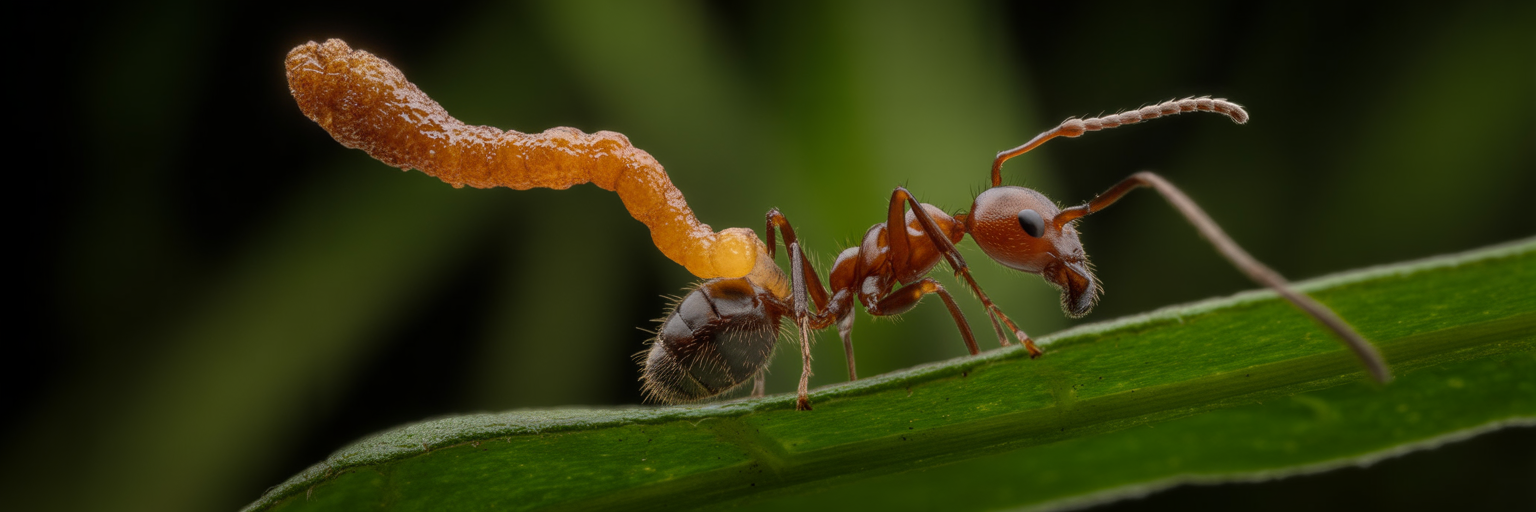
While predators hunt from the outside, parasites destroy from within, and some have evolved the ability to seize control of their host’s mind. The “zombie-ant fungus,” Ophiocordyceps unilateralis, offers a clear and disturbing example of this parasitic manipulation. The process begins when a microscopic fungal spore lands on an unsuspecting ant. It burrows into the ant’s body, slowly replacing its tissues with fungal filaments while leaving the vital organs intact to keep the host alive.
The fungus then hijacks the ant’s central nervous system, compelling it to abandon its colony and normal behaviors. Driven by its new master, the ant climbs a plant stem to a specific height where the temperature and humidity are ideal for fungal growth. In its final act, the ant clamps its mandibles onto the underside of a leaf in a “death grip” so powerful it remains fixed even after death. With the ant secured, the fungus consumes its brain and sprouts a fruiting body from the back of its head, releasing new spores onto the forest floor below. These zombie ant fungus facts reveal a strategy focused entirely on reproduction at the host’s expense.
This form of parasitic control is not unique; a similar process turns snails into zombies, their eyestalks pulsating with parasitic larvae to attract birds. The hairworm manipulates crickets to seek water and drown themselves, allowing the worm to complete its life cycle. In each case, the host’s free will is completely erased, turned into a mere vehicle for the parasite’s continuation.
| Parasite | Host | Manipulated Behavior | Parasite’s Goal |
|---|---|---|---|
| Ophiocordyceps unilateralis | Ant | Leaves colony, climbs to specific height, bites leaf vein (‘death grip’) | Optimal spore dispersal from a stable, elevated position |
| Hairworm (Spinochordodes tellinii) | Cricket or Grasshopper | Seeks out water and jumps in, drowning itself | Return to water to reproduce |
| Toxoplasma gondii | Rodent | Loses fear of cats, may become attracted to cat urine | Increase chances of being eaten by a cat, the parasite’s primary host |
Flora and Fungi That Mimic Decay
The unsettling strategies of nature are not limited to the animal kingdom. Some plants and fungi have evolved to exploit one of the most powerful signals in the natural world: the scent of death. The Devil’s Fingers fungus, Clathrus archeri, begins its life inside a gelatinous “egg” sac. When it hatches, it unfurls four to seven bright red, tentacle-like arms coated in a foul-smelling, spore-rich slime. The purpose of this grotesque display is purely functional. The smell of rotting flesh is irresistible to flies and other carrion insects, which land on the arms and inadvertently carry the sticky spores away to new locations.
This deceptive mimicry is also perfected by the corpse flower, Amorphophallus titanum. Its pollination strategy is a carefully orchestrated event:
- It grows a massive flower structure that can reach over ten feet tall.
- The flower heats up to near human body temperature, which helps volatilize and release a powerful odor of a decomposing animal.
- Carrion-eating beetles and flesh flies are drawn in from a great distance, believing they have found a food source or a place to lay their eggs.
- As the insects move around inside the flower, they transfer pollen, ensuring the plant’s reproduction.
These organisms weaponize disgust, turning the universal signal of decay into a tool for their own survival. While these plants mimic decay, other organisms have mastered acoustic mimicry, a skill demonstrated by lyrebirds that can replicate the sounds of chainsaws and camera shutters with stunning accuracy. It is a different kind of horror, one rooted in grotesque deception rather than direct violence.
When Biological Defense Becomes Unbelievable
Sometimes, an organism’s solution to survival is so extreme it seems to break the rules of biology. The hagfish, a primitive, eel-like creature, possesses one of the most effective defense mechanisms known. When threatened, it does not bite or flee. Instead, it secretes a substance containing mucus and thousands of tightly coiled protein threads. Upon contact with seawater, these threads instantly unfurl and expand, trapping water and transforming the surrounding area into a thick, fibrous gel. A single hagfish can turn a large bucket of water into slime in seconds.
This is a purely defensive act. The slime is not toxic but clogs the gills of would-be predators like sharks, forcing them to retreat or risk suffocation. The hagfish itself can become coated in its own slime but simply ties itself into a knot and scrapes the gel off its body. This defense makes it almost untouchable in its environment. The hagfish’s slime is an incredible defense, but nature has produced other unbelievable survival tactics, such as the frog that freezes solid and thaws back to life, effectively cheating death itself.
From parasitic mind control to slime defenses, nature’s “nightmares” are elegant, if terrifying, solutions to life-or-death problems. These are some of the weirdest creatures on earth, demonstrating that the documented reality of biology is far stranger and more unsettling than anything we could invent.