Most people see a squirrel and think of a fluffy-tailed creature burying an acorn. But deep in the forest, a far more sophisticated crime is underway, orchestrated by a tiny, nocturnal mastermind with an unsettling genius for survival.
A Heist Is Happening in the Canopy
The forest at night is supposed to be quiet. It’s a place of rustling leaves and the distant call of an owl. But if you look closely into the canopy, you might witness a meticulously planned operation. A furry felon, no bigger than your hand, is silently at work, turning the entire forest into its personal, booby-trapped pantry. This is the world of the flying squirrel, and its methods make the common ground squirrel look like an amateur.
We all know the classic squirrel routine: dig a hole, drop in a nut, pat the dirt down, and hope for the best. It’s simple, effective, and utterly predictable. The flying squirrel, however, finds this approach laughably crude. Why bury your treasure where any clumsy oaf can dig it up? What kind of animal is so clever it turns living trees into a network of secure, aerial vaults? This creature has developed one of the most unique animal survival strategies ever documented, a system of food preservation that is part engineering, part paranoia, and entirely brilliant.
This isn’t just about finding a snack for later. It’s a high-stakes operation driven by intense competition and the brutal reality of winter. On the forest floor, every fallen nut is a prize in a chaotic free-for-all. Mice, chipmunks, and ground squirrels are locked in a constant battle for resources. The flying squirrel simply refuses to play that game. Instead, it has taken its operations airborne, executing a heist that unfolds dozens of feet above the heads of its rivals. It’s a chillingly effective strategy that ensures its survival when the world below is frozen and barren.
The Meticulous Art of the Twig Larder
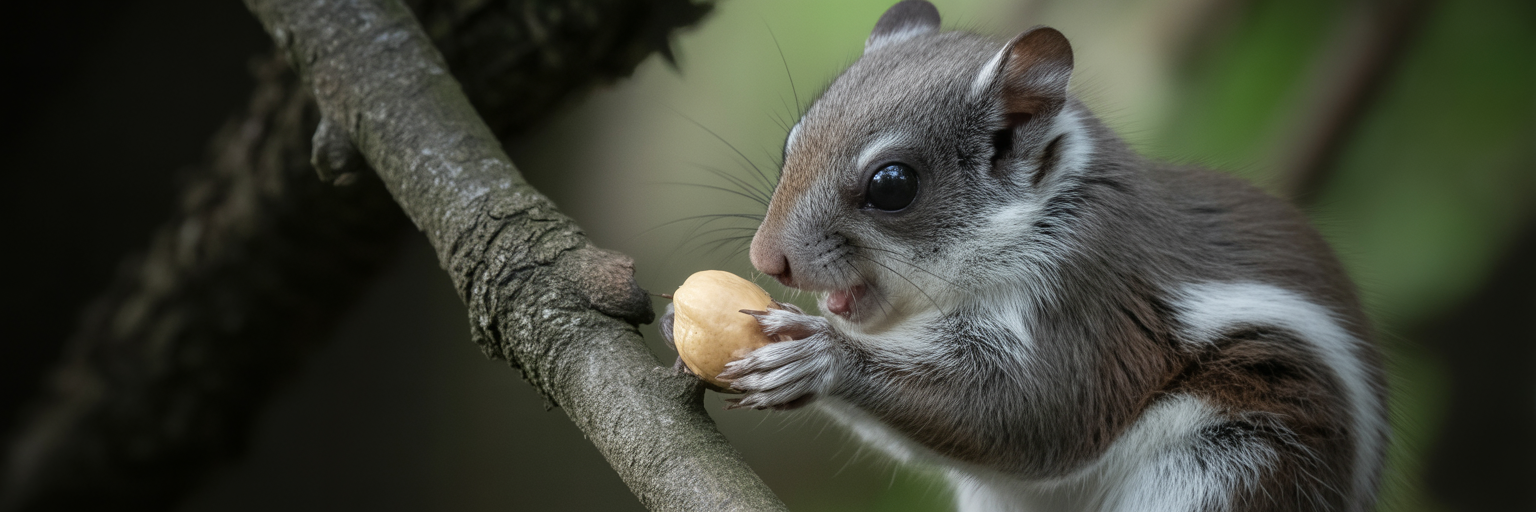
The flying squirrel’s method for flying squirrel food storage is not a simple act of hiding. It is a work of obsessive, miniature craftsmanship. The process begins with an almost comically fussy selection process. This tiny connoisseur doesn’t just grab any nut. It specifically seeks out nuts with an elliptical or oblate shape, ones that will fit its bizarre storage system perfectly. Once a suitable candidate is found, the preparation begins. Like a paranoid chef, it meticulously gnaws away any remaining fruit pulp and inspects for insect larvae, ensuring its future meal won’t spoil from the inside out.
With the nut prepared, the real artistry begins. The squirrel carves a small hole into the nut, creating a perfect socket. Then, it locates a thin, sharp twig on a living tree and expertly wedges the nut onto it. This is a natural form of the mortise and tenon animal behavior, a technique human carpenters have used for centuries to join pieces of wood. The nut is the mortise (the hole) and the twig is the tenon (the peg). The fit is so precise that the nut stays firmly in place, suspended in the air, safe from the damp ground and the grubby paws of ground-dwelling thieves.
Each cache is a tiny, macabre piece of jewelry adorning the forest, a testament to the squirrel’s unsettling dedication. It’s a level of precision you’d expect from a watchmaker, not a rodent. This meticulous preparation is a form of natural bespoke storage, almost like creating custom candy packaging to preserve a valuable treat. The squirrel isn’t just storing food; it’s curating a collection of perfectly preserved, individually wrapped meals, each one a monument to its own creepy genius. It will repeat this process hundreds, if not thousands, of times, creating a distributed network of single-serving pantries across its territory.
Outsmarting an Army of Forest Floor Thieves
So why go through all this trouble? Why engage in miniature carpentry when you could just dig a hole? The answer lies on the forest floor, which is less a peaceful woodland scene and more a 24/7 warzone for food. Every acorn or nut that hits the ground is instantly targeted by a horde of competitors. The flying squirrel’s elaborate system is a brilliant counter-intelligence move designed to bypass this chaos entirely.
The primary advantage is security. By storing nuts high up in the canopy, the squirrel immediately eliminates the vast majority of its rivals. Ground squirrels, mice, and other terrestrial foragers simply can’t reach these aerial caches. The food is hidden in plain sight, yet it’s completely inaccessible to the competition below. Furthermore, this aerial strategy protects the nuts from the two greatest enemies of stored food: moisture and mold. A nut buried in damp soil is a ticking time bomb of decay. A nut suspended on a twig, however, stays dry and fresh for months.
This network of tiny, scattered caches is also a masterclass in risk management. A ground squirrel that buries all its nuts in one large hoard is betting everything on a single location. If a rival discovers that stash, the winter is lost. The flying squirrel, on the other hand, diversifies its portfolio. With thousands of individual caches spread across the forest, the loss of a few to a clever bird or a climbing rival is an acceptable loss, not a catastrophe. These animal caching strategies are a direct and brilliant response to intense environmental pressures. This level of strategic thinking places the flying squirrel among some of nature’s unsettling creations that defy belief, showcasing an evolutionary path that feels both brilliant and bizarre.
The Neural Blueprint of a Master Thief

Executing this forest-wide heist requires more than just nimble paws and sharp teeth. It demands a staggering amount of brainpower. Think about it: how does a creature the size of a chipmunk remember the exact location of thousands of individually placed nuts scattered across acres of woodland? The secret lies in a remarkable, almost unsettling, neural adaptation.
The answer to how squirrels remember food is found in the hippocampus, the brain’s memory and spatial navigation center. As autumn approaches and the caching season kicks into high gear, the flying squirrel’s brain undergoes a dramatic transformation. It begins to grow new neurons in the hippocampus, a process called neurogenesis. In essence, the squirrel gives itself a temporary brain upgrade, expanding its mental hard drive to map out its vast network of food caches. It’s like a computer getting a massive RAM boost specifically for a single, complex project.
This cognitive enhancement is not permanent. It’s a seasonal superpower. Once winter passes and the caches have been retrieved, the extra brain cells die off. The squirrel’s brain returns to its normal size, its job as a temporary savant complete. This physiological change is the secret weapon that makes the entire criminal enterprise possible. This phenomenon isn’t unique to squirrels; a report from the Iowa Department of Natural Resources highlights that black-capped chickadees also grow new brain cells to remember thousands of seed locations. This temporary brain enhancement is a stunning example of adaptation, similar to other animals that can change their internal organs seasonally to survive. It’s a level of biological specialization that feels borrowed from science fiction.
A League of Extraordinary Cachers
The flying squirrel may be a genius, but it’s not the only creature with a clever plan for winter. The world is full of expert animals that hide food, each with its own unique strategy. To truly appreciate the flying squirrel’s artistry, it helps to see how it stacks up against the competition.
First, consider the acorn woodpecker. This bird is the ultimate hoarder, creating a “granary tree” by drilling thousands of holes into a single dead tree and stuffing an acorn into each one. It’s a communal pantry, defended by the entire flock. While impressive, this centralized strategy is the polar opposite of the flying squirrel’s. The granary is a massive, conspicuous target, attracting thieves like bears and, ironically, squirrels. The flying squirrel’s discreet, distributed network is far more secure.
Then there’s the black-capped chickadee, another master of memory. These tiny birds also scatter-hoard thousands of seeds across their territory, relying on a powerful hippocampus to find them again. According to research from UC Davis, these brainy birds are not deterred by harsh weather, retrieving their stashes with remarkable accuracy even in rain or snow. They share the flying squirrel’s incredible spatial memory, but they lack its engineering prowess. They hide seeds in bark crevices, but they don’t build custom-fitted storage units. These fascinating behaviors show just how wild the natural world can be, and you can explore more on NatureIsCrazy.com.
| Animal | Caching Strategy | Key Advantage | Primary Weakness |
|---|---|---|---|
| Flying Squirrel | Distributed Aerial Caching (Mortise-and-Tenon) | High security from ground thieves and mold; low risk if single caches are found. | Requires immense spatial memory and high initial effort per item. |
| Acorn Woodpecker | Centralized Granary Tree | Easy access to a large food supply in one location; defended by the group. | Highly conspicuous and a massive target for thieves (like squirrels and bears). |
| Black-Capped Chickadee | Distributed Scatter-Hoarding | Spreads risk across thousands of locations; difficult for a thief to find all caches. | Relies purely on memory; no physical protection for individual seeds. |
| Gray Squirrel | Ground-Based Scatter-Hoarding (Larder-Hoarding) | Simple and fast; requires less specialized technique. | High competition from other ground animals; caches are vulnerable to being stolen (‘pilfered’). |
The Perfect Hideout for a Perfect Crime
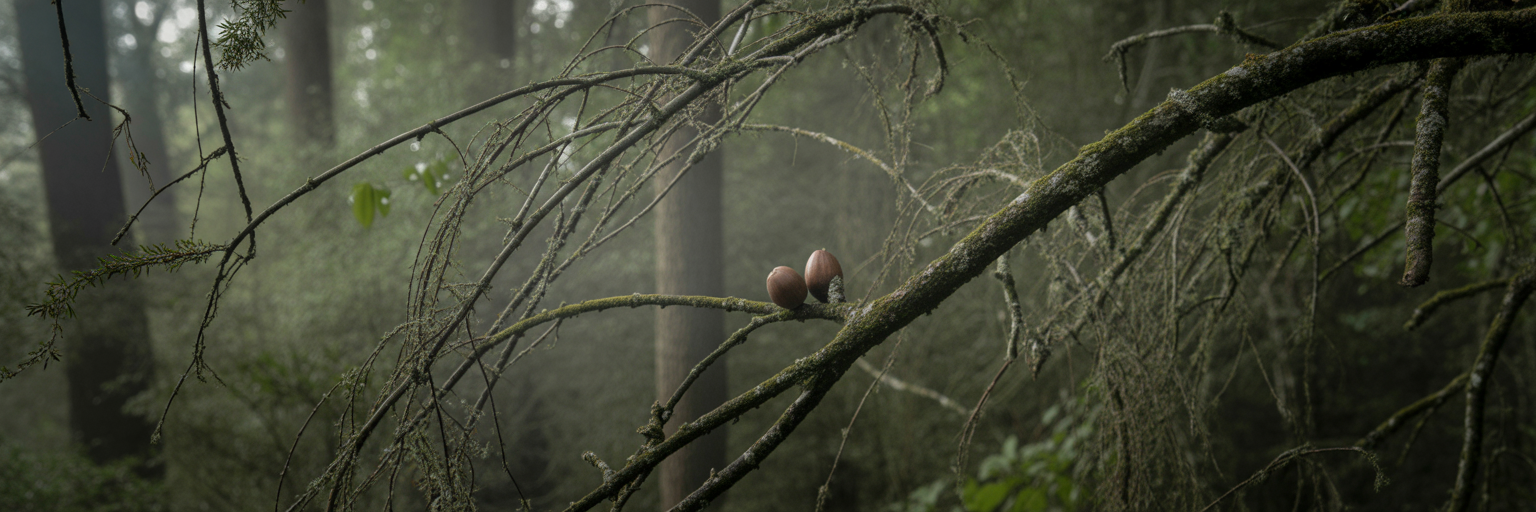
A brilliant strategy is only as good as the environment it’s deployed in. The flying squirrel’s mortise-and-tenon technique is not just a product of its own genius; it’s a direct response to its specific habitat. The perfect crime requires the perfect crime scene, and for this squirrel, that scene is often a humid, dense forest.
A groundbreaking study published in eLife first detailed how these squirrels in the rainforests of China use a mortise-tenon-like structure to fix nuts onto twigs, a behavior previously undocumented. These forests provide the ideal conditions. The understory is thick with thin, flexible twigs that serve as the perfect scaffolding for the squirrel’s aerial pantry. The high humidity, which would quickly spoil any nut buried in the ground, is far less of a threat to food stored in the open air. The environment itself makes ground caching a losing game and aerial caching a winning one.
This raises a fascinating question: is this behavior exclusive to its Asian habitat, or do North American flying squirrels, like those in the Appalachian or Cascade mountains, employ similar tactics? While ground caching is more commonly observed in North American species, the potential is there. The key factors are competition and climate. In an environment with intense ground-level competition and high humidity, this advanced caching technique could provide a significant survival advantage. The squirrel turns the tree into a living pantry, a relationship almost as intricate as that of organisms that can live inside other living creatures without harm. It’s a powerful reminder that an animal’s behavior is shaped just as much by where it lives as by what it is.
The Verdict on Our Furry Felon
After examining the evidence, the conclusion is clear. The flying squirrel is not just another cute woodland creature. It is a master survivalist, a tiny forest engineer, and a brilliant thief all rolled into one. Its entire existence is a masterfully executed heist against the harsh realities of nature.
The master plan is as elegant as it is effective:
- Precision Engineering: It doesn’t just hide its food; it builds custom, weather-resistant storage units for each individual nut using a technique that rivals human carpentry.
- Strategic Genius: It completely bypasses the chaotic competition on the forest floor by taking its entire operation airborne, hiding its treasure in plain sight where rivals can’t reach.
- Super-Powered Memory: It temporarily enhances its own brain, growing new neurons to create a flawless mental map of thousands of scattered caches across a vast territory.
This combination of physical skill, strategic foresight, and cognitive power earns our respect and a healthy dose of suspicion. It forces us to reconsider what’s happening in the quiet woods around us. The forest is full of secrets, and the flying squirrel is one of its most ingenious criminals. So the next time you see a squirrel, don’t just see a fluffy tail. Look closer and wonder what elaborate, unsettlingly brilliant schemes are running through its tiny, powerful brain.