
A single drop of puff adder venom is a biological catastrophe. It’s a complex cocktail of toxins designed to dissolve tissue, shut down nerves, and turn a living creature into a pre-digested meal from the inside out. For most animals, a bite is a death sentence delivered in minutes. The venom’s hemotoxins get to work immediately, rupturing blood cells and liquefying muscle. It is a gruesome, efficient, and final process. Nature, it seems, plays for keeps.
And then there’s the honey badger. This creature looks at the established rules of toxicology, biology, and general good sense, and treats them like a mild inconvenience. Imagine our puff adder, a master of chemical warfare, striking a honey badger. The fangs sink in, the venom pumps, and the snake waits for the inevitable collapse. Instead, the badger might flinch, perhaps with the same annoyance you’d show a mosquito. It then proceeds to kill and eat the snake.
After its meal, the badger might feel a bit drowsy. This is what happens when a honey badger is bitten; the lethal poison acts like a shot of NyQuil. It finds a comfortable spot, takes a brief “venom nap” for an hour or two, and then wakes up, stretches, and goes about its day as if nothing happened. The snake is still in its stomach. This isn’t just toughness. It’s a biochemical middle finger to one of nature’s deadliest weapons. How does an animal treat a dose of liquid death like a sleeping pill? The answer lies inside a walking, snarling laboratory that wages a chemical war on poison while its owner is busy eating.
A Profile in Unreasonable Defiance
To understand the honey badger’s venom trick, you first have to appreciate that its entire existence is a study in absurd over-engineering. The venom resistance isn’t an isolated superpower. It’s just one feature on a creature seemingly designed by a committee that hated every other animal on the planet. Its scientific name, Mellivora capensis, sounds deceptively gentle. The reality is anything but.
More Than Just Thick-Skinned
The honey badger’s defenses are so comprehensive they border on the comical. It’s not just one thing that makes it a nightmare to deal with, but a whole suite of traits that seem fundamentally unfair.
- Loose, Rubbery Skin: Its skin is incredibly thick and loose, allowing it to twist and turn to attack a predator that has it clamped in its jaws. A dog can grab a badger by the scruff of its neck and find itself getting mauled by the very animal it’s holding.
- Bone-Crushing Jaws: Its bite is powerful enough to crunch through a tortoise shell. Bones, shells, and spines are not obstacles but part of the meal.
- Relentless Claws: It possesses long, sturdy claws built for digging through hard earth, ripping apart logs, and, when necessary, tearing into anything that was foolish enough to pick a fight.
These physical tools alone make it a formidable opponent. But it’s the badger’s attitude that truly sets it apart.
An Appetite for Danger
The honey badger’s personality can be summarized as pure, undiluted aggression. It is utterly fearless, known to confront lions and hyenas over a kill. This isn’t bravery so much as a complete inability to recognize that it should be afraid. Its diet is the primary driver for its evolution. It actively hunts and eats things that other animals avoid, including scorpions, porcupines, and, of course, highly venomous snakes.
This creature is also shockingly intelligent. Badgers in captivity have been documented using tools, from sticks and rakes to bundled mud, to engineer escapes from their enclosures. This isn’t a mindless brute. It’s a cunning, problem-solving tank. Its whole being is a collection of bizarre and effective survival traits, making it one of Nature’s unsettling creations that defy belief. Its venom resistance isn’t just a random perk. It’s a necessary tool for an animal that chooses to live on nature’s most dangerous menu.
The Molecular Machinery of a Toxin Takedown
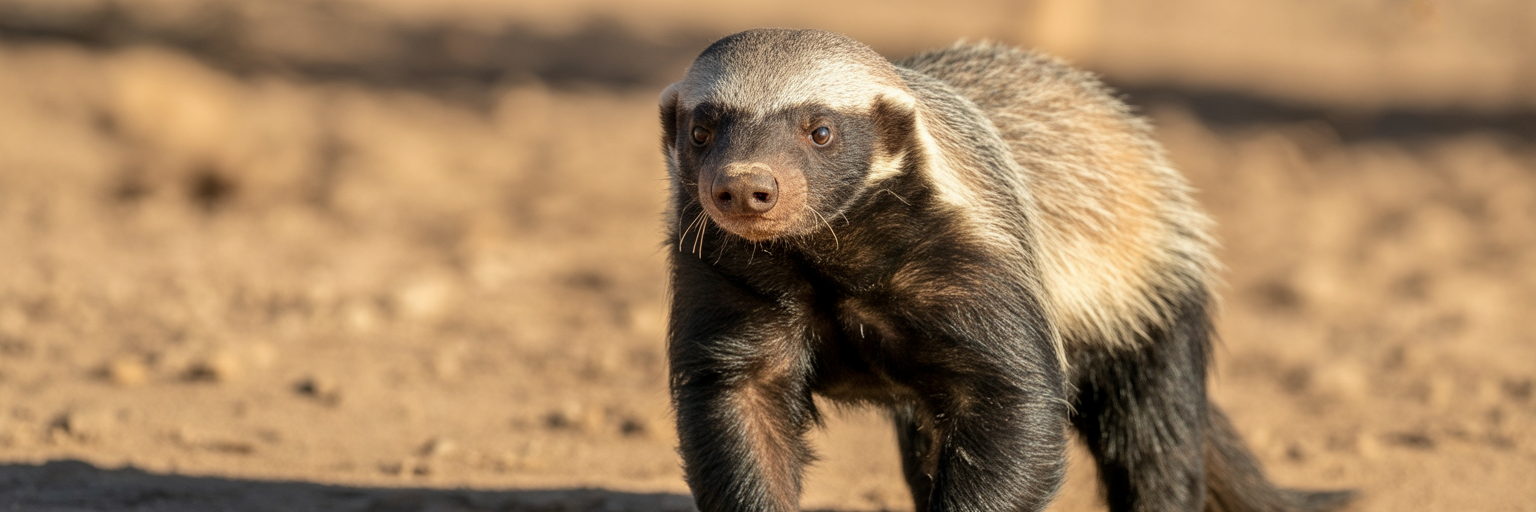
So, how does the honey badger’s body actually defeat a chemical weapon designed to obliterate living tissue? The process is an incredible display of internal warfare, a multi-stage defense that neutralizes and dismantles toxins with terrifying efficiency. To appreciate the badger’s counter-attack, we first need to understand the venom itself.
Understanding the Killer Cocktail
Snake venom isn’t a single substance. It’s a complex blend of proteins and enzymes, each with a specific, destructive job. The two main types are neurotoxins and hemotoxins. Think of neurotoxins as saboteurs cutting the communication lines of the nervous system, causing paralysis and respiratory failure. Hemotoxins are the demolition crew, dissolving cells, destroying tissue, and causing massive internal bleeding. Most vipers, like the puff adder, rely heavily on hemotoxins, but many venoms are a mix of both.
How Venom Wins in a Normal Body
In a typical animal, venom molecules enter the bloodstream and spread rapidly. They bind to specific receptors on cells, like a key fitting into a lock. Once attached, they trigger a catastrophic chain reaction. Nerves stop firing, blood vessels rupture, and muscles cease to function. The body’s own defense system is overwhelmed, unable to stop the molecular onslaught. It’s a swift and decisive victory for the venom.
The Badger’s Biochemical Counter-Offensive
The honey badger’s body doesn’t just endure this attack. It actively fights back on a chemical level. Its biochemical defense mechanisms animals use are a masterclass in poison control. First, it deploys a passive defense. Specialized binding proteins in its blood act like security guards, intercepting venom molecules before they can reach their targets. They essentially put glue in the lock before the venom’s key can even get close.
But the truly remarkable part is the active defense. The badger’s system contains enzymes that function as biochemical scissors. These enzymes don’t just block the venom. They physically grab the toxic proteins and chop them into harmless, inactive pieces. As reported in Slate, biologists have identified specific mutations and proteins that allow the honey badger to neutralize toxins that would be fatal to other animals. This is the core of its ability. It isn’t just resisting the poison. It’s actively breaking it down mid-attack, turning a lethal weapon into simple, useless fragments.
Inside the Body’s Anti-Venom Factory
The badger’s ability to dismantle venom isn’t just a chemical trick. It’s a deeply embedded feature of its genetic makeup and cellular structure. The immediate chemical takedown we just saw is supported by a permanent, biological infrastructure that makes the whole absurd process possible. This is where we see how evolution has hardwired the animal for survival against toxins.
Rewiring the Targets
One of the most elegant aspects of honey badger venom resistance is how its body has modified the very targets the venom aims for. Many neurotoxins work by binding to nicotinic acetylcholine receptors, which are crucial for muscle function. In most animals, the shape of this receptor is a perfect fit for the toxin. The badger, however, has genetic mutations that have altered the shape of these receptors.
The venom’s “key” no longer fits the badger’s cellular “lock.” The toxin simply can’t attach properly, rendering it far less effective. This genetic modification is a permanent, passive defense that works 24/7. It’s a brilliant evolutionary solution that preemptively disarms a major part of the snake’s arsenal. This ability to override deadly signals is an extreme form of biological control, similar to how some creatures can shut down pain signals at will.
The Metabolic Price of Immortality
This incredible anti-venom system doesn’t come for free. Maintaining such a sophisticated defense is energetically expensive. The badger’s body must constantly produce the necessary binding proteins and destructive enzymes, which requires a significant metabolic investment. This is a classic evolutionary trade-off. The energy spent on venom resistance is energy that can’t be used for growth, reproduction, or other activities. For the honey badger, whose diet consists of walking poison, the price is clearly worth it.
Its multi-layered system is a testament to redundancy and robustness:
- Modified Receptors (Passive Defense): The locks have been changed, so the venom’s keys don’t work.
- Toxin-Binding Proteins (Intercepting Defense): Roaming security guards grab the toxins out of the bloodstream.
- Venom-Destroying Enzymes (Active Defense): A specialized cleanup crew actively dismantles the toxins into harmless waste.
It’s not one trick, but a comprehensive strategy that makes the honey badger a fortress against chemical warfare.
The Evolutionary Grudge Match of Toxins and Cures

The honey badger’s incredible defense system didn’t appear overnight. It’s the product of millions of years of a high-stakes conflict between predator and prey. This dynamic is one of the best evolutionary arms race examples in the natural world. Think of it as a perpetual battle between elite hackers (the snakes) and a paranoid cybersecurity team (the badgers).
For generations, snakes in the badger’s environment faced a simple selective pressure: those with more potent, faster-acting venom were more likely to successfully kill their prey and defend themselves, allowing them to survive and reproduce. This drove the evolution of increasingly complex and lethal toxins. The snakes were constantly upgrading their chemical weapons.
In response, any honey badger with even a slight, random mutation that offered a minor improvement in venom resistance had a survival advantage. It might live through a bite that would kill its peers. That badger would then pass its resistant genes on to its offspring. Over countless generations, these small advantages accumulated, leading to the sophisticated, multi-layered defense system we see today. The badgers were constantly developing new firewalls and anti-virus software.
This back-and-forth pressure created a dynamic equilibrium. The snakes never developed a venom so potent that it could wipe out the badgers, and the badgers never became so completely immune that the snakes posed no threat at all. Instead, they are locked in an evolutionary stalemate, a grudge match where each side’s adaptations are a direct response to the other’s. This is a powerful reminder of how predator-prey pressures can lead to incredible biological innovations, much like how some animals can regrow skin stronger than before as a defense mechanism.
How Other Animals Handle a Venomous Insult
The honey badger is not the only creature to have developed a defense against venom, but its method is uniquely aggressive. Looking at other resistant animals provides crucial context and highlights just how over-the-top the badger’s strategy is. Many animals immune to venom have found clever ways to survive, but few do it with such destructive flair.
Species like the mongoose and the Virginia opossum are also famous for their ability to withstand snakebites. The mongoose, a nimble and speedy predator of snakes, relies heavily on mutated acetylcholine receptors, similar to the badger’s passive defense. The opossum has a unique peptide in its blood that acts as a universal neutralizer, binding to and inactivating a wide range of venoms. These are effective, but largely passive, methods of resistance. They weather the storm. The honey badger, by contrast, unleashes a storm of its own.
This table breaks down how animals survive snakebites using different biochemical toolkits.
| Animal | Primary Defense Mechanism | Key Feature |
|---|---|---|
| Honey Badger | Receptor mutation + Active enzymatic breakdown | Actively destroys venom; extremely rapid recovery |
| Mongoose | Mutated acetylcholine receptors | Highly resistant to neurotoxins; relies on speed and agility |
| Virginia Opossum | Blood peptide (LTNF) neutralizes venom | Effective against a wide range of venoms; passive neutralization |
| California Ground Squirrel | Blood proteins bind to and inhibit venom | Resistance is specific to local rattlesnake venom |
What this shows is that while other animals have built shields, the honey badger has built a shield, a missile defense system, and a factory that churns out venom-shredding nanobots. However, even this system has its limits. A massive dose of venom from a very large snake, or a bite directly into a major artery, could potentially overwhelm its defenses. Its superpower is incredible, but it’s not absolute magic. It’s just biology pushed to its most defiant extreme.
Lessons from Nature’s Creepiest Chemist

The honey badger is more than just a walking meme of tenacity. It’s a living example of evolutionary creativity, a creature whose biology solves a deadly problem with an elegance that borders on science fiction. Its internal anti-venom factory holds fascinating potential for human medicine. Scientists are studying the badger’s neutralizing proteins and enzymes, hoping to develop new, broad-spectrum antivenoms that could work more effectively and against a wider variety of snakebites.
By mimicking nature’s solutions, we might be able to design treatments that don’t just counter venom but actively dismantle it, just like the badger does. It’s a powerful reminder that some of the most advanced biochemical solutions are not in a lab, but out in the wild, inside a grumpy, fearless mammal.
In the end, the honey badger is a snarling lesson in resilience. It teaches us that when faced with a lethal problem, one solution is to simply rewrite the chemical rules of the game, take a nap, and get on with your day. The honey badger is just one of many marvels you can find on Nature is Crazy.