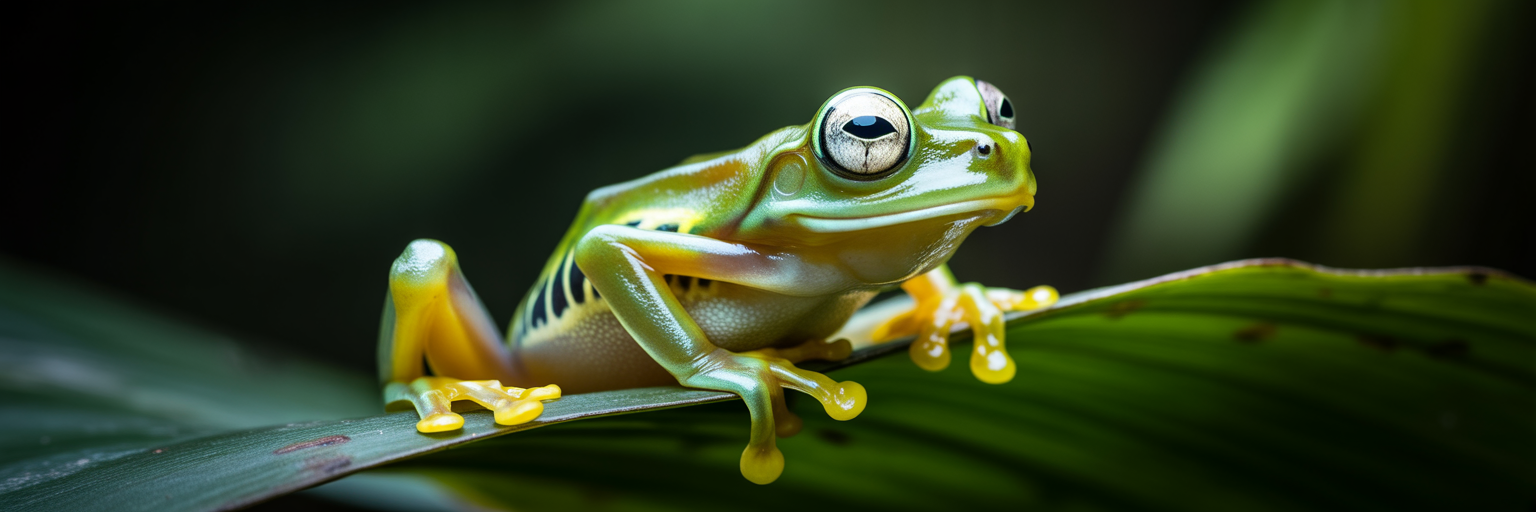
There is a primal unease that comes with the idea of invisibility. It’s the feeling that something is watching you from an empty corner of the room or the chilling thought that the monster in a horror movie didn’t disappear, it just stopped being visible. This concept feels like pure fiction, a power reserved for superheroes and ghosts. But in the quiet, damp rainforests of Central and South America, a creature has mastered this unsettling art. It’s an animal that can will itself to become transparent, turning its body into a living window just long enough to cheat death.
Nature’s Creepiest Disappearing Act
Imagine a predator scanning the forest floor. It spots a small, sleeping creature, an easy meal. It blinks, and in that instant, the creature is gone. Not flown, not scurried away, but simply erased from sight. This isn’t a scene from a sci-fi film. This is the daily reality for anything that tries to hunt the glass frog.
The Thing That Vanishes
The ability to vanish is profoundly disturbing because it breaks a fundamental rule of existence: things that are there should be seen. When an animal achieves this, it taps into a deep seated fear of the unknown. It’s not just about hiding. It’s about ceasing to exist visually, becoming a ghost in your own skin. This isn’t the clumsy camouflage of a moth against bark. This is a physiological disappearing act, a biological sleight of hand that leaves predators and scientists alike baffled.
Meet the Glass Frog: Nature’s Living Window
The protagonist of this strange story is the glass frog, a delicate amphibian that already lives on the edge of visibility. Even in its normal state, its skin is so translucent that you can see its tiny heart beating, its stomach digesting its last meal, and its bones glowing faintly green. It’s a living anatomy lesson, a creature that wears its insides on the outside. This baseline translucency is already bizarre, making it one of nature’s most fascinating oddities. But this is just the opening act. Its true talent lies in taking this transparency to an extreme, pushing its body to a state that should be impossible.
The Impossible Paradox of Red Blood
Here is the central puzzle that makes the glass frog’s ability so mind bending. How can any animal with red blood turn transparent? Blood is red because it’s packed with red blood cells, and those cells are filled with hemoglobin, a protein designed to absorb light. It is fundamentally, stubbornly opaque. You can’t see through a drop of blood, let alone a body filled with it. For the glass frog to become a see through phantom, it would have to solve this paradox. It would need to make its blood disappear. This feat seems to defy the laws of biology, leaving us with a compelling and slightly terrifying question: how does it pull off this impossible biological heist?
Beyond Just Blending In
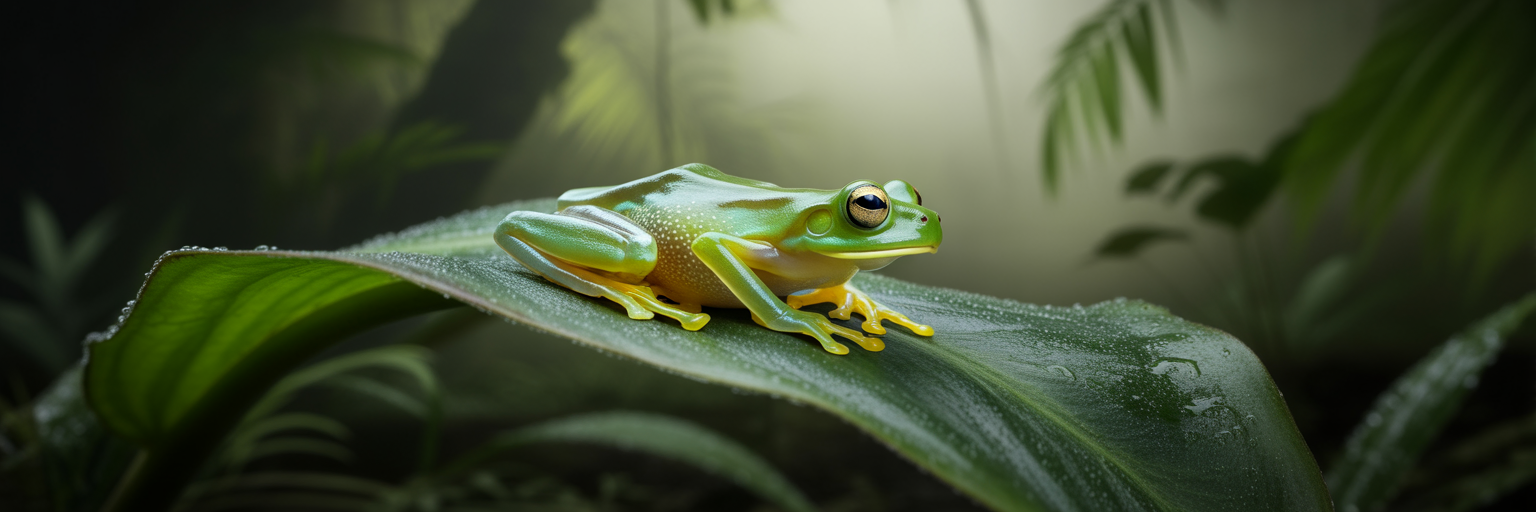
To appreciate the sheer strangeness of the glass frog’s ability, we have to distinguish it from the more familiar tricks animals use to hide. Most survival strategies are about imitation, not erasure. A leopard’s spots mimic the dappled light of the forest floor, and a stick bug’s body resembles a twig. These are clever disguises, but they are entirely dependent on the background. The glass frog’s strategy is in another league entirely. It doesn’t try to match its surroundings. It tries to have no visual presence at all.
Camouflage vs. True Invisibility
Standard camouflage is a reactive defense. It works beautifully as long as the animal stays put in the right environment. A snowshoe hare is perfectly hidden in a blizzard but becomes a glaring white target in a muddy spring field. Transparency, however, is a universal solvent for this problem. It works against almost any background because there is no outline, no color, and no shadow to detect. It’s the difference between wearing a costume and becoming a ghost. While many creatures have evolved incredible animal camouflage adaptations, the glass frog is one of the few that has pushed beyond mimicry into the realm of true invisibility.
The Biological Price of Transparency
Becoming see through is not an easy trick, especially for a complex land animal. Our bodies are built from materials that naturally block, scatter, and absorb light. Skin, muscle, and organs are messy, opaque structures. To achieve transparency, an animal must re-engineer its own tissues to be as non interactive with light as possible. This is a monumental evolutionary challenge. For most creatures, the biological cost is simply too high. The glass frog is an exception, a testament to the extreme pressures of predation that can drive the evolution of such unsettling creations that defy belief.
Active Invisibility: A Tactical Choice
What makes the glass frog even more remarkable is that its transparency is an active, tactical choice. Creatures like jellyfish are passively transparent. They are see through all the time because their simple, gelatinous bodies contain very little to block light. The glass frog, on the other hand, performs a complex physiological feat on demand. It turns its transparency on and off like a switch, deploying it when it is most vulnerable. This isn’t a permanent state but a temporary, high energy power up used for survival. It’s a deliberate act of vanishing.
| Strategy | Mechanism | Primary Advantage | Key Limitation |
|---|---|---|---|
| Pigment-Based Camouflage | Melanin and other pigments create patterns (spots, stripes) that match the environment. | Effective in a specific, consistent habitat (e.g., a leopard in a dappled forest). | Becomes highly conspicuous if the animal moves to a different background. |
| Mimicry | Evolving to resemble another object or organism (e.g., a stick bug looking like a twig). | Deceives predators by misidentifying the animal as something inedible or harmless. | Relies on the predator’s perception and can fail if the disguise is imperfect or discovered. |
| Active Transparency | Physiologically altering the body to allow light to pass through with minimal distortion. | Works against nearly any background, as there is no silhouette to detect. | Extremely energy-intensive and biologically complex, often requiring a low-metabolic state. |
The Great Red Blood Cell Heist
The secret to the glass frog’s disappearing act is both ingenious and deeply weird. It’s a high stakes biological gamble that involves hiding the single most visible component of its body. To solve the paradox of its red blood, the frog doesn’t change its blood. It moves it. While it sleeps, the glass frog stages a grand heist, making almost all of its red blood cells vanish from sight.
Hiding the Evidence: The 90% Disappearance
Here is the stunning reveal. As the frog settles down to sleep, it actively removes up to 89% of its red blood cells from circulation. This is the core of its trick. The opaque, light absorbing cells are systematically filtered out of its veins and arteries, leaving behind only clear plasma. According to a recent study, this process increases the frog’s transparency by two to three times, effectively erasing the red tint that would give it away. The sheer volume of missing glass frog red blood cells is staggering, a feat that would be lethal for almost any other vertebrate.
The Liver: A Mirrored Safe House
So where does all that blood go? The frog packs the confiscated red blood cells into its liver. But just stuffing them into an internal organ wouldn’t be enough, as the dense, red mass would still be visible as a dark spot. The frog has an answer for this too. Its liver is lined with guanine crystals, which are highly reflective. These crystals form a biological mirror, scattering and reflecting light in a way that perfectly conceals the dark, dense collection of blood cells stored within. The liver becomes a mirrored safe house, a cloaked vault holding the evidence of the heist.
Surviving on Fumes: The Metabolic Trade-Off
This raises an obvious and alarming question: how does the frog survive without 90% of its oxygen carrying cells? The answer lies in a drastic metabolic slowdown. While sleeping, the glass frog enters a state of near suspended animation, reducing its oxygen needs to a bare minimum. It essentially survives on fumes, operating on the tiny amount of oxygen that remains dissolved in its blood plasma. This ability to radically alter its physiology is reminiscent of other creatures that can change their internal organs seasonally to cope with extreme conditions. It’s a dangerous trade off, risking suffocation for the ultimate concealment. When the frog awakens, it must rapidly reverse the process, flooding its system with red blood cells to power its muscles and escape into the night.
How Light Bends Around a Living Ghost
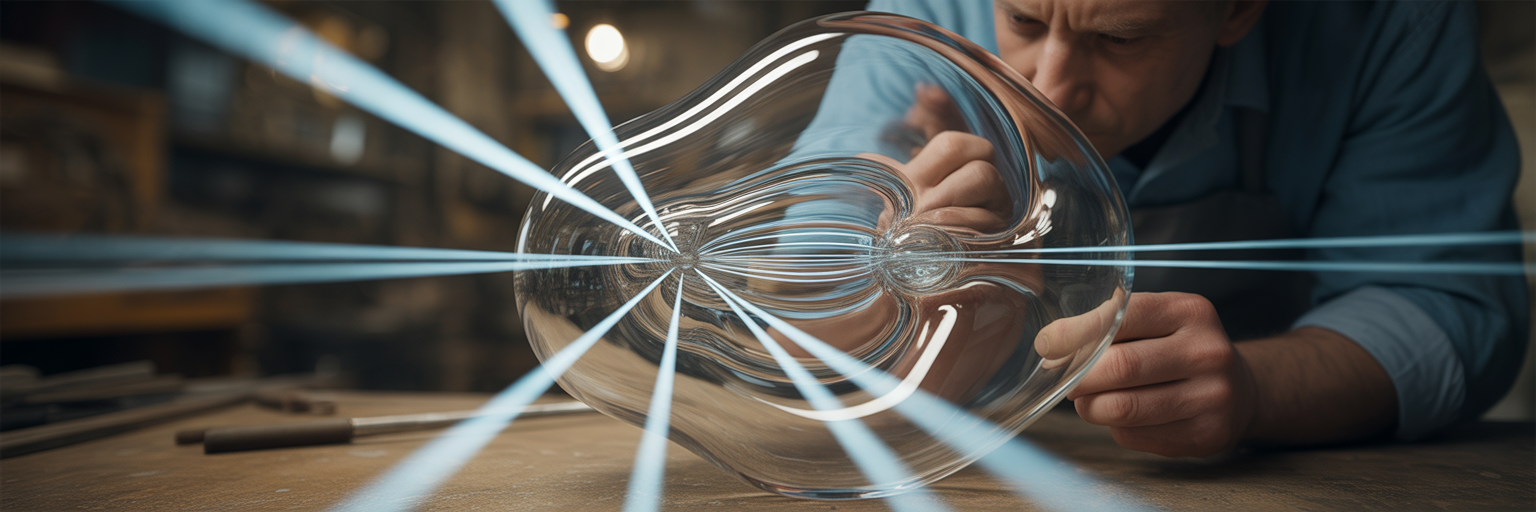
Hiding the blood is the most dramatic part of the glass frog’s trick, but it’s only half the story. If the rest of its body—its skin, muscles, and organs—still scattered light, the frog wouldn’t be transparent. It would just look cloudy or pale, like a piece of frosted glass. To achieve true, crystal clear invisibility, the frog has to solve a problem of physics. It has to convince light to pass straight through its body with minimal distortion. This is where the science of tissue optics in animals comes into play.
An Introduction to Tissue Optics
Tissue optics is the study of how biological materials interact with light. Most tissues are a chaotic jumble of cells, fibers, and fluids, each with different properties. When light hits this mess, it bounces around and scatters in all directions, which is why most living things are opaque. Effective glass frog transparency required evolution to engineer its tissues to be incredibly orderly, creating a clear pathway for light to travel.
Engineering Tissues to Be Invisible
The glass frog’s body is a masterpiece of biological engineering, designed to minimize light scattering. Several key adaptations make this possible:
- Highly Organized Structures: Unlike the jumbled fibers in our own skin, the collagen fibers in the frog’s skin and muscles are arranged in a highly uniform, organized pattern. This structure allows light to pass through in a relatively straight line instead of scattering.
- Minimal Obstructions: The frog’s tissues contain very few other light blocking structures or pigments. Everything that isn’t absolutely essential has been reduced or eliminated to create a clearer medium.
- Refractive Index Matching: This is perhaps the most crucial element. The frog’s tissues and the remaining blood plasma have been fine tuned to have almost the exact same refractive index.
The Supporting Role of Blood Plasma
That last point is the secret ingredient. The refractive index is a measure of how much a material bends light. You see this effect when you put a straw in a glass of water; the straw appears bent because light travels differently through air and water. If the frog’s plasma and its surrounding tissues had different refractive indices, light would bend at every boundary, creating a distorted, blurry image. By matching them almost perfectly, the frog’s body behaves like a single, cohesive piece of glass. Light passes through it without bending, making the entire animal seem to disappear into the background.
A Perfectly Timed Vanishing Act
The glass frog’s incredible ability is not a constant state. It’s a carefully timed, tactical weapon deployed when it is most needed. Understanding when and why the frog turns invisible reveals the intense evolutionary pressure that forged this bizarre adaptation. This isn’t just a cool party trick. It’s a life or death strategy, honed to perfection.
Sleeping with the Enemy
The frog’s disappearing act is performed primarily during the day. While most frogs are nocturnal, the glass frog spends its days sleeping on the undersides of large leaves in the rainforest canopy. This is when it is most vulnerable. Exposed and motionless, it would be an easy target for any predator that happened to glance up. By turning transparent, the frog’s body blends seamlessly with the dappled light filtering through the leaves. It becomes a living ghost, a faint green shimmer that is nearly impossible to distinguish from the leaf it rests on.
The Predators Fooled by Nothingness
This strategy is a direct countermeasure against visually oriented hunters. Predators like snakes and birds rely on detecting the shape, outline, and color of their prey. The glass frog offers them none of these cues. By becoming transparent, it effectively removes itself from their search image. This is a masterclass in how animals become invisible. It doesn’t hide behind something. It hides by becoming nothing. For a predator looking up from below, the frog’s body simply becomes part of the bright, blurry canopy. It’s an ultimate form of evasion, rivaling even the most extreme tactics of animals that can survive being swallowed and escape alive.
The Risks of Living on the Edge
This incredible survival tactic does not come without significant risks. The frog lives its life on a physiological knife’s edge, balancing the reward of invisibility against some serious dangers.
- Immense Energetic Cost: Actively filtering, storing, and then re-circulating nearly 90% of its blood is an incredibly energy intensive process. The frog must expend a huge amount of its resources just to sleep safely.
- The Danger of Blood Clots: For humans, packing red blood cells so tightly together would inevitably lead to massive, fatal blood clots. The glass frog has somehow evolved a mechanism to prevent this, a biological secret that scientists are eager to understand.
- Reduced Emergency Response: While sleeping with its blood packed away, the frog is in a low oxygen state. This means its ability to react quickly to a physical disturbance is likely compromised. It is betting everything on not being seen in the first place.
Evolution’s Unsettling Ingenuity
The glass frog stands as a testament to the strange and often unsettling paths that evolution can take. Its ability to achieve active, physiological transparency places it in a class of its own, pushing the boundaries of what we thought was possible for a vertebrate. It’s a solution so elegant and so bizarre that it forces us to reconsider the very nature of survival.
A Class of Its Own
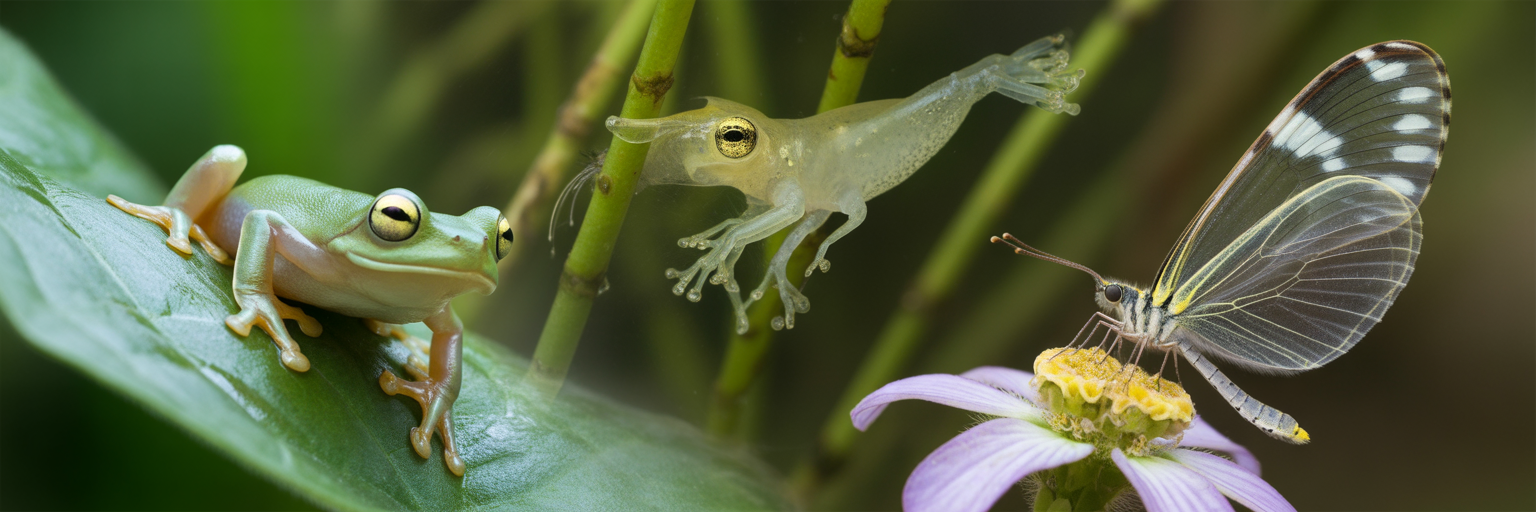
While other creatures have embraced transparency, none do it quite like the glass frog. As an article from The Conversation explains, animals like ghost shrimp and clearwing butterflies also use transparency to evade predators, but their methods are passive and structural. Their bodies are permanently built to be see through. The glass frog’s ability is active and dynamic, a physiological process that it turns on and off. This makes it one of the weirdest animal survival tactics ever documented, a high risk, high reward strategy that is as fascinating as it is strange.
The Uncanny Valley of Invisibility
There is a reason why the glass frog’s ability feels so creepy. Willful, temporary invisibility taps into a primal human fear of the unseen. It’s the unsettling feeling that reality is not as stable as it appears, that things can simply cease to be. The frog’s trick is a biological manifestation of this fear. It’s not just hiding. It’s a temporary erasure of self, a fleeting flirtation with non existence that feels both magical and deeply unnatural.
Lessons from a Living Ghost
Beyond the sheer wonder, the glass frog offers profound scientific insights. Understanding how it safely packs and unpacks its red blood cells without causing clots could have huge implications for human medicine. It could inspire new treatments for cardiovascular diseases like thrombosis and stroke, conditions caused by the very blood clots the frog has learned to avoid. The glass frog is more than just a curiosity. It is a living ghost that holds the secrets to solving some of our most pressing medical challenges, proving that nature’s most unsettling solutions are often its most ingenious.