An Unlikely Alliance in the Ocean’s Depths
The ocean floor is often imagined as a tranquil, silent world, but in reality, it’s a relentless arena of survival. Down in the dim light, life is a constant calculation of risk and reward, where every shadow could hide a predator and every crevice is a potential refuge. In this high-stakes environment, most creatures rely on speed, armor, or camouflage that they evolved over millions of years. It’s a world built on self-preservation, which makes the exceptions all the more startling.
Imagine a creature so vulnerable that it seems destined to be a quick meal. Instead of developing a thicker shell or sharper claws, it takes a different path. It finds another organism, one armed with its own potent defenses, and somehow convinces it to become a partner. This isn’t a fleeting moment of cooperation; it’s a lifelong commitment. The crab essentially recruits a bodyguard, carrying a living weapon that it wields against any threat that comes too close.
This behavior immediately raises questions that challenge our understanding of animal instinct. What drives a creature to form such a bizarre alliance? In a world governed by eat or be eaten, how is trust established between two entirely different species, one a crustacean and the other a stinging polyp? This is not just a clever trick; it is a profound evolutionary statement about the power of partnership. It’s a story that unfolds in the coral reefs and sandy bottoms, revealing that sometimes the strangest strategies are the most successful.
The Boxer Crab’s Living Pom-Poms
The Tiny Brawler of the Reef
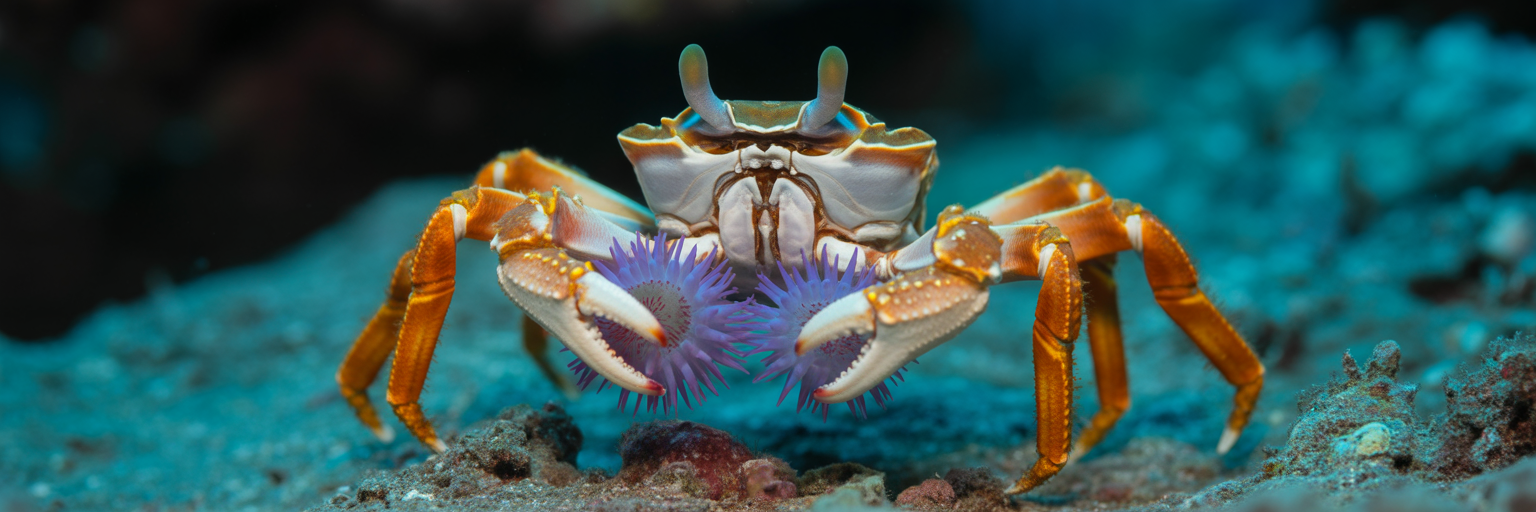
Meet the Boxer Crab, known to scientists as Lybia tessellata. At first glance, it’s anything but intimidating. Barely an inch across, with a delicate, mosaic-patterned shell, it looks more like a piece of jewelry than a fighter. Left to its own devices, its thin exoskeleton would offer little protection against the crushing jaws of a hungry fish. You might wonder how such a fragile creature could possibly survive on a bustling coral reef. The secret isn’t in its own body, but in what it holds in its claws.
A Mutually Beneficial Weapon System
The Boxer Crab is famous for its unique habit of carrying a small sea anemone in each of its front claws, holding them up like a boxer ready to strike. These are not just for show. The anemones are armed with powerful stinging cells called nematocysts, which fire tiny, venom-filled harpoons on contact. This boxer crab defense mechanism is incredibly effective. When a predator approaches, the crab waves its anemones menacingly, creating a stinging, no-go zone that most fish quickly learn to respect. It’s a brilliant example of how crabs use living weapons to level the playing field.
This is one of nature’s most perfect examples of mutualism. The crab gets a formidable defense system, turning its vulnerability into a strength. But what does the anemone get out of it? Mobility. Anemones are typically stationary, waiting for food to drift by. By hitching a ride with the crab, they are exposed to a much wider range of feeding opportunities. As the crab moves and forages, the anemones can snag passing particles of food. It’s a classic win-win situation, forming one of the most fascinating unusual animal partnerships in the ocean.
The Art of Anemone Aquaculture
The most remarkable part of this story is how the crabs acquire and maintain their living weapons. The relationship is so essential that a Boxer Crab is rarely seen without its anemones. If it loses one, it will try to steal one from a rival, leading to a comical tug-of-war. But what if it only has one anemone and can’t find another? It performs an act of astonishing foresight. The crab will carefully tear its single anemone in half. It then holds onto both pieces, patiently waiting for them to regenerate into two complete, functional anemones.
This incredible behavior, a form of crustacean aquaculture, was not just anecdotal. As documented in a PeerJ study, researchers observed that crabs actively induce this asexual reproduction through fission to ensure they always have a matched pair of weapons. This isn’t just instinct; it’s a deliberate, calculated action to cultivate the tools necessary for survival. The crab isn’t just a user of weapons; it’s a farmer of them.
The Mechanics of a Mutualistic Partnership
Defining Symbiosis: More Than Just Friendship
The relationship between the Boxer Crab and its anemones is a textbook case of symbiosis, a term describing any long-term interaction between two different biological species. But not all symbiotic relationships are created equal. They fall into three main categories. Parasitism is a one-sided arrangement where one organism benefits at the other’s expense, like a tick on a dog. Commensalism is where one benefits and the other is unaffected, like a barnacle on a whale. Then there is mutualism, where both partners gain a significant advantage. The symbiotic relationships in crabs, particularly the Boxer Crab, are a clear example of mutualism, where survival depends on teamwork.
A Breakdown of Benefits
The advantages in these partnerships are deeply intertwined, creating a system where each organism’s success is linked to the other’s. Let’s break down what each partner gets from the deal.
- For the Crab: The primary benefit is an active defense system that deters predators. The anemones also provide a degree of camouflage, helping the crab blend in. Some scientists even believe the crab uses its anemones to help mop up food particles.
- For the Anemone: The most obvious gain is mobility and transport. This increases its access to food and oxygen-rich water. Being carried also protects the anemone from being buried in sediment and keeps it safe from its own predators, like sea stars and certain fish.
This exchange of services is so effective that it has become an obligate relationship for the Boxer Crab; it cannot thrive without its partners. Nature is full of examples where organisms that can live inside other living creatures without harm have evolved similar dependencies, but the Boxer Crab’s external, tool-wielding approach is particularly unique.
The Hidden Costs of Co-evolution
While the benefits are clear, this deep evolutionary commitment comes with a significant trade-off. By dedicating its primary claws to holding anemones, the Boxer Crab has effectively given up their other functions. It can no longer use them for foraging, digging burrows, or manipulating objects with the same dexterity as other crabs. Its entire anatomy and behavior have been shaped around this single survival strategy. This is the hidden cost of specialization. The crab has bet its entire evolutionary future on the availability and cooperation of another species, a high-stakes gamble that highlights the delicate balance of co-evolution.
Masters of Disguise: The Sponge-Carrying Crabs
Introducing the Dromiidae Family
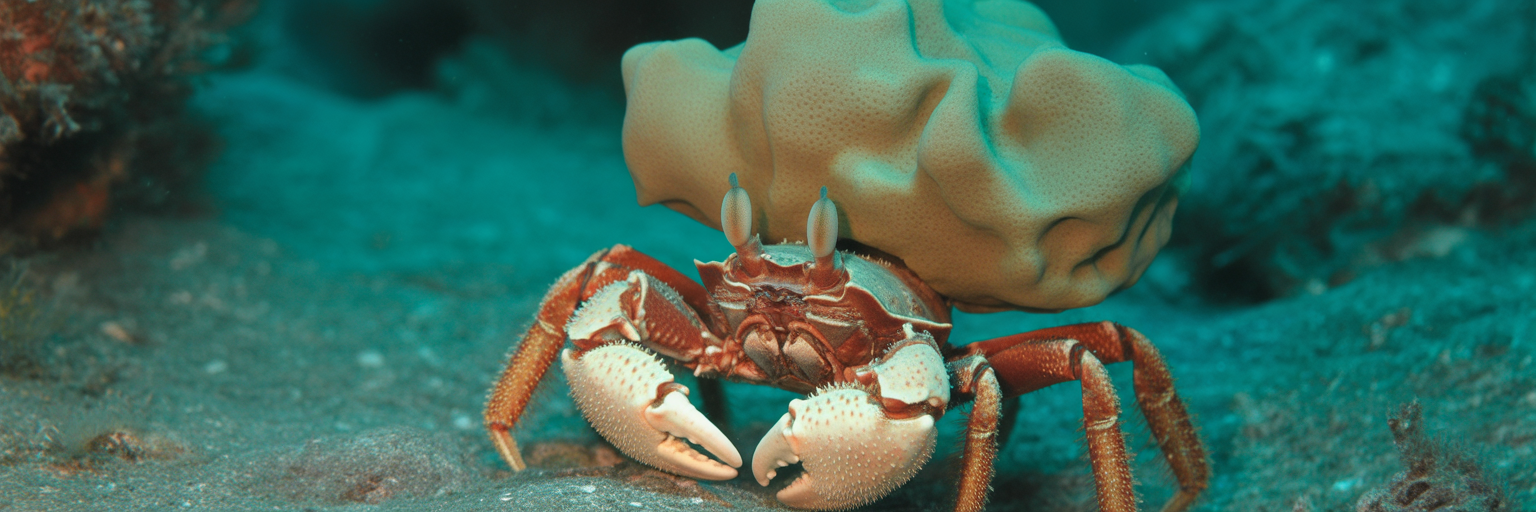
While the Boxer Crab opts for an active, in-your-face defense, another group of crabs has perfected the art of not being seen at all. Meet the Dromiidae, commonly known as sponge crabs. These crabs have a different approach to partnership, one based on concealment rather than confrontation. Their anatomy is uniquely suited for this task. Their last two pairs of legs are smaller than the others and are bent upwards over their back, tipped with sharp claws designed for one purpose: to hold something over their body like a living shield.
A Shield of Sponge: Camouflage and Chemical Warfare
The sponge crab’s partner of choice is, as its name suggests, a living sponge. After finding a suitable specimen, the crab uses its claws to snip and trim it into a shape that fits snugly over its carapace. It then hoists this living cap onto its back and holds it in place with its modified rear legs. This provides two powerful layers of defense. The first is the highly effective sponge crab camouflage. A piece of living sponge is one of the last things a predator expects to see walking along the seafloor. The crab simply vanishes into the background.
The second benefit is a form of chemical warfare. Many sponges are unpalatable or even toxic to predators, producing a cocktail of chemicals to deter anything that might try to take a bite. By carrying this sponge, the crab effectively borrows its chemical defenses, cloaking itself in a shield that tastes and smells disgusting to potential threats. It’s a passive but brilliant strategy: why fight your enemies when you can convince them you’re not worth eating?
A Tailor-Made Defense
The behavior of a sponge crab is more than just grabbing the nearest piece of debris. It is a deliberate and surprisingly sophisticated process. The crab is highly selective, often “testing” different sponges before choosing one. Once selected, it meticulously carves out a concave space in the sponge so it fits perfectly, like a custom-made hat. This act of shaping an object for a specific purpose is a clear example of tool use in invertebrates. The crab becomes a living sculptor, tailoring its defense to its own body. This passive concealment stands in stark contrast to the Boxer Crab’s active weaponry, showcasing the diverse evolutionary paths that can solve the same fundamental problem of survival.
| Factor | Boxer Crab (Lybia tessellata) | Sponge Crab (Dromiidae) |
|---|---|---|
| Defense Type | Active and Confrontational | Passive and Concealment-Based |
| Organism Used | Sea Anemones | Living Sponges |
| Primary Benefit | Deterrence via Stinging Cells | Visual and Chemical Camouflage |
| Method of Use | Wielded in Claws as Weapons | Carried on Carapace as a Shield |
| Key Trade-Off | Occupies main claws, limiting foraging | Slightly reduced mobility due to carrying a load |
| Level of Interaction | High; requires active manipulation and care | Moderate; requires shaping and holding |
A Walking Tapestry of Marine Life
The Ultimate Decorator: The Velcro Crab
If the Boxer Crab is a brawler and the Sponge Crab is a spy, then the Decorator Crab is an artist. The most extreme example is the Velcro Crab (Camposcia retusa), a species that takes camouflage to a whole new level. Its body is covered in tiny, hooked bristles known as setae. These act like natural Velcro, allowing the crab to attach an astonishing variety of materials directly to its shell and legs. It doesn’t just carry one partner; it curates a living collection.
A Living Suit of Armor
The decorating process is methodical and continuous. The crab actively seeks out materials from its environment and uses them to build a living suit of armor. This mobile mosaic can include bits of sponge, algae, feathery hydroids, and even small anemones. This strategy combines the benefits seen in other crabs: it provides visual camouflage, chemical defense from toxic organisms, and a physical barrier that makes the crab’s own body difficult to find. This is just one of many of nature’s unsettling creations that defy belief, blurring the line between an animal and its habitat. The process is quite deliberate:
- Selection: The crab carefully inspects and selects materials from its surroundings.
- Preparation: It uses its sharp claws to snip off a piece of the chosen organism.
- Attachment: It then meticulously attaches the item to the hooked setae on its body.
- Completion: The crab repeats this process until it is completely covered, effectively disappearing beneath a walking garden.
The Gardener of the Sea
This living suit requires constant maintenance. When the crab grows and needs to molt, it faces a dilemma: it must leave its carefully constructed camouflage behind. In a remarkable display of foresight, many decorator crabs will carefully remove their favorite decorations from their old shell and transfer them to their new one. They are not just decorating; they are gardening. They cultivate a mobile ecosystem on their backs, becoming a living, breathing, and walking piece of the reef. This behavior represents the pinnacle of using the environment for defense, where the crab becomes so intertwined with its surroundings that it is almost impossible to distinguish where the crab ends and the reef begins.
The Evolutionary Arms Race Driving These Partnerships
Survival’s Never-Ending Battle
These strange and wonderful partnerships did not arise in a vacuum. They are the product of a co-evolutionary arms race, a never-ending battle between predators and prey. As predators evolve more effective ways to hunt—sharper teeth, better eyesight, faster reflexes—prey must evolve equally effective ways to avoid being eaten. For a small, slow-moving crab, the odds are stacked against it. Evolving a thicker shell or more powerful claws takes countless generations and a great deal of energy. But some crabs found a shortcut.
The Evolutionary Shortcut
Instead of reinventing the wheel, these crabs began to co-opt the defenses of other organisms. Why spend millennia evolving your own venom when you can simply pick up a sea anemone that has already perfected it? This is the genius behind how crabs use living weapons. It is an evolutionary shortcut that allows them to instantly acquire sophisticated defense mechanisms. These unusual animal partnerships are not just biological curiosities; they are highly efficient solutions to the relentless pressure of natural selection. The crab outsources its defense, saving itself the energy and time it would take to evolve these traits on its own.
Why Living Defenses Outperform Static Armor
A hard shell is a good defense, but it’s finite. It can be crushed. Static camouflage works, but only if you stay in the right spot. A living defense, however, is dynamic. A stinging anemone actively fights back. A decorator crab can change its camouflage to match a new environment. These living shields and weapons are adaptable, regenerative, and often have a deterrent effect that a simple shell lacks. They represent a more sophisticated form of protection, born from the creativity of evolution. This drive for survival produces some truly incredible outcomes, much like the animals that can survive being swallowed and escape alive, proving that life always finds a way to push the boundaries of what seems possible.
Beyond Crabs: A Wider Look at Defensive Symbiosis
While these crabs are extraordinary, the strategy of borrowing defenses is a recurring theme across the animal kingdom. It’s a successful evolutionary blueprint that has been adopted in various forms. The most familiar example involves other crabs with sea anemones: the hermit crab. Many species of hermit crabs will actively place anemones on their borrowed shells. This provides excellent protection, but there is a key difference. The hermit crab places the anemone on an inanimate object, while the Boxer Crab wields it directly as a tool, suggesting a higher level of interaction and control.
This pattern of defensive symbiosis extends far beyond crustaceans. Nature is filled with examples of species forming alliances for protection:
- Clownfish and Anemones: The classic example of mutualism, where the clownfish is protected from predators by the anemone’s stinging tentacles, and in return, it cleans the anemone and scares away its predators.
- Nudibranchs: Certain species of these colorful sea slugs feed on stinging organisms like hydroids. Instead of just digesting them, they incorporate the stinging cells (nematocysts) into their own skin, effectively stealing their prey’s weapons for their own defense.
These examples show that the crabs featured in this article, while extreme, are part of a much larger story. They illustrate a fundamental principle of evolution: when faced with overwhelming odds, sometimes the best solution is not to go it alone, but to find a friend.
The Fragility of Nature’s Strangest Alliances
The crab that carries a living weapon is a testament to evolutionary ingenuity. These highly specialized partnerships are brilliant solutions for survival, but their very specialization makes them inherently fragile. They are finely tuned to a stable environment, and when that environment changes, their greatest strength becomes their greatest vulnerability. The fate of the Boxer Crab is inextricably linked to the fate of its anemones. The survival of the Sponge Crab depends entirely on a healthy population of sponges.
Today, these delicate relationships face unprecedented threats. Climate change is causing coral bleaching and ocean acidification, which can devastate the anemone and sponge populations these crabs rely on. Pollution and habitat destruction further shrink the resources available. A Boxer Crab cannot simply find a new weapon if its anemone partners disappear. Its entire existence is built upon that single, vital alliance. What happens to these creatures when their living tools vanish?
These strange alliances are more than just fascinating stories. They are a poignant reminder of the complex, interconnected web of life that is now under threat. The crab with pom-poms and the crab with a sponge hat are powerful symbols of nature’s creativity, but they are also canaries in the coal mine, warning us of the silent unraveling of marine ecosystems. As we continue to explore the wonders of our planet, we must also recognize our responsibility to protect them. You can continue exploring the incredible diversity of life on our planet and learn more about the delicate balance that sustains it.