
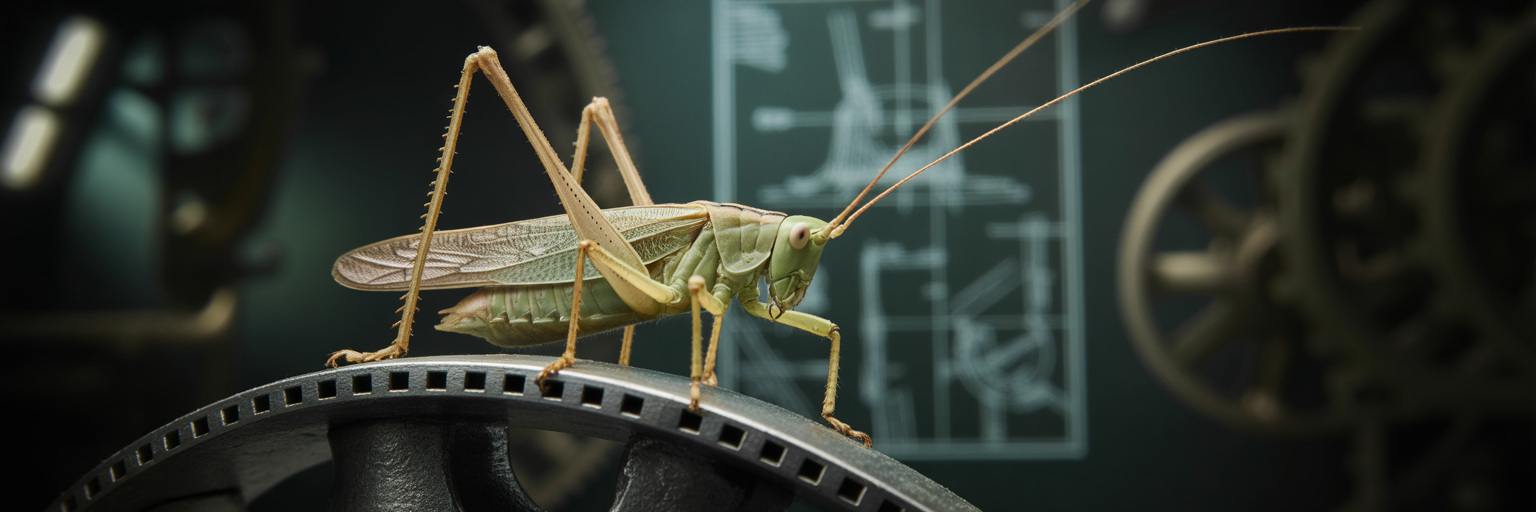
There are certain unspoken rules for building a body. Eyes go in the head. A mouth goes somewhere below the nose. And ears, with their delicate folds and funnels, belong on the sides of the skull. It’s a blueprint we understand instinctively. So when you learn that a creature is walking around listening to the world through its legs, it feels fundamentally wrong. It’s a detail from a low budget sci-fi movie, a biological typo that should have been corrected.
The culprit is the katydid, an insect that looks like a leaf with legs, something you’d dismiss as just another grasshopper. It’s entirely, deceptively normal in appearance. Yet, hidden just below its front knee joints are a pair of fully functional ears. This isn’t some vague sensitivity to vibrations. These are sophisticated auditory organs, capable of discerning pitch, direction, and the ultrasonic shrieks of its deadliest predator. The idea is unsettling. Imagine hearing the world through your shins, every footstep a thunderclap, every conversation a vibration traveling up your bones.
This anatomical weirdness forces us to ask some fundamental questions. How is it even possible to hear without a head-mounted ear? Why would evolution produce such a bizarre solution? And what must the world sound like to a creature whose sense of hearing is located in its limbs? The katydid’s existence is a quiet rebellion against our assumptions of how life is supposed to work, and its story is far stranger than its leafy camouflage suggests.
Anatomy of a Leg-Ear
That we can even discuss an ear on a leg is a testament to nature’s strange ingenuity. The katydid’s auditory system isn’t a simple sensor. It’s a complex, miniaturized piece of biological machinery that rivals the function of our own ears. To understand how do katydids hear, we need to look closely at this marvel of engineering, known as a tympanal organ.
A Miniature Marvel of Bio-Engineering
If you were to examine a katydid’s front leg, you’d find two tiny, parallel slits just below the joint that serves as its knee. These openings look like little more than decorative vents, but they are the entry point to a sophisticated auditory world. These slits open into an air-filled chamber within the leg, which contains the core components of the hearing organ. The entire structure is a masterclass in packing complex function into a tiny, protected space.
How the Knee-Ear Translates Sound
The process of hearing in a katydid’s leg follows a blueprint that is shockingly familiar. It mirrors the basic principles of the mammalian ear, converting airborne vibrations into neural signals. This structure, which converts vibrations into nerve signals, is remarkably analogous to our own, a fact highlighted in research published by Scientific American showing that human and insect ears share similar functional principles. The process breaks down into three main steps:
- The Tympanum: Just behind the slits lies a pair of thin, delicate membranes, the equivalent of our eardrums. When sound waves travel through the air and into the leg slits, they cause these membranes to vibrate.
- The Lever System: Connected to the tympanum is a tiny, intricate lever that acts much like the bones in our middle ear. This lever amplifies the vibrations from the eardrum and transfers that mechanical energy deeper into the organ.
- The Sensory Cells: The amplified vibrations stimulate a cluster of specialized nerve cells. These cells, much like those in our cochlea, convert the mechanical movement into electrical impulses that are sent to the katydid’s brain for processing.
Stereo Hearing, Leg Edition
Having two ears is critical for locating the source of a sound, and the katydid is no exception. The space between its two front legs creates just enough of a delay for its brain to calculate where a sound is coming from with incredible precision. By simply turning its body, it can pinpoint the high-pitched chirp of a potential mate or the ultrasonic click of an approaching bat. The variety and complexity of tympanal organs in insects is vast, but the katydid’s system is one of the most refined examples of hearing adapted for a life lived in the foliage.
Evolution’s Logic for Bizarre Hearing
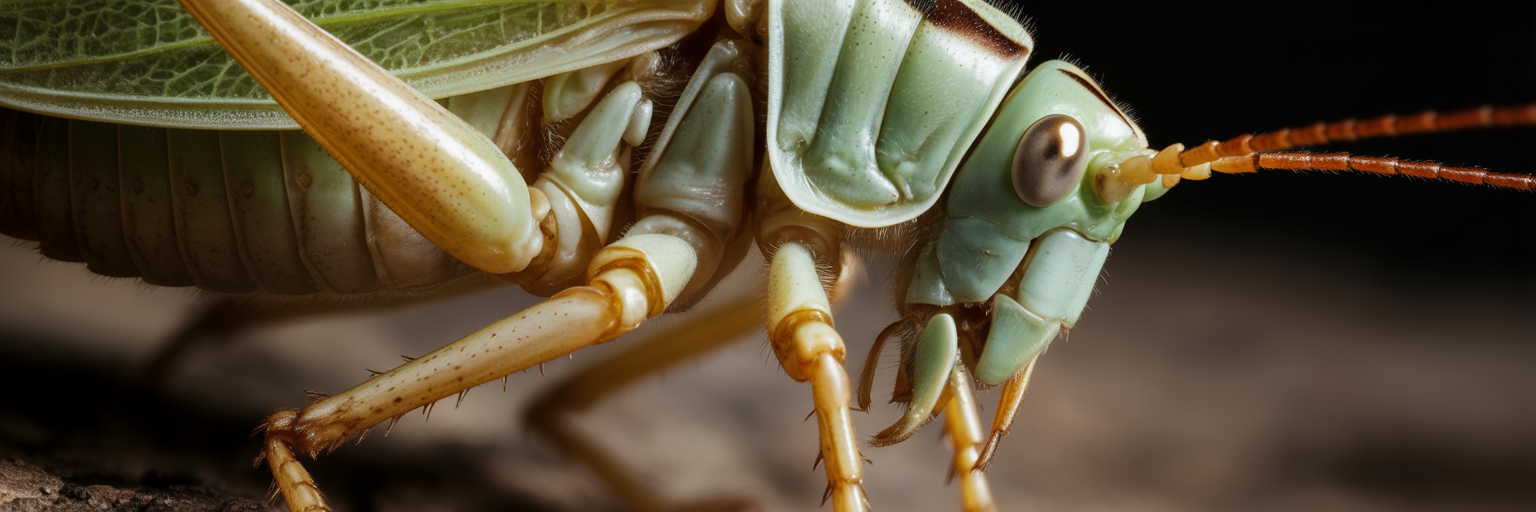
So we have this impossibly intricate listening device built into a leg. It’s a marvel of biological engineering, but it begs a bigger question: why go to all that trouble? The answer lies not in a grand design but in the relentless, practical pressures of survival. The evolution of hearing is a story of function over form, and for the katydid, putting ears on its legs was simply the smartest solution.
The Pragmatic Tinkerer
Evolution doesn’t invent new body parts from scratch. It tinkers with what’s already there. The katydid’s hearing organ evolved from a pre-existing sensory structure in its legs used for detecting vibrations. Over millions of years, this simple vibration detector was refined, becoming more and more sensitive until it could pick up sound waves traveling through the air. Placing the ears on the legs was the path of least resistance, a modification of an existing tool rather than the creation of a new one.
The Hunt for a Mate
Katydids live in a world of sound. They communicate with one another using high-frequency calls, often hidden from sight in dense leaves and grass. For a male katydid, broadcasting his song is a risky move that exposes him to predators. For a female, the ability to precisely locate that song is a matter of reproductive success. Well-placed, highly directional ears are essential. The insect ears on legs provide the perfect stereo separation needed to triangulate a mate’s position in a cluttered, noisy environment.
An Early Warning System for Predators
Perhaps the most powerful driver for this strange adaptation is the katydid’s mortal enemy: the bat. Bats hunt using ultrasonic echolocation, emitting clicks far too high for human ears to hear. For a katydid, these sounds are a death sentence. Their leg-ears are exquisitely tuned to these ultrasonic frequencies, acting as an early warning system. Hearing a bat’s clicks gives the katydid a precious split-second to drop from its perch and vanish into the undergrowth. This evolutionary arms race forces creatures to develop incredible defenses, much like the animals that can survive being swallowed and escape alive. Furthermore, legs are less vulnerable than a head, offering a degree of physical protection for such a vital sensory organ.
The World Perceived Through Vibrations
Understanding the anatomy and evolution of the katydid’s ear is one thing. Imagining what the world actually sounds like through them is another. For the katydid, hearing is not a passive sense isolated to the head. It is an immersive, full-body experience where the line between hearing and feeling blurs into a constant stream of information.
The leg-ears have a dual function. They are brilliant at picking up airborne sounds like a mate’s call or a predator’s cry. But because they are physically connected to the ground, they are also exceptional at detecting substrate-borne vibrations. Every footstep of a nearby beetle, every rustle of a leaf from a stalking spider, sends a tremor through the branch that the katydid perceives as sound. This ability to perceive the world through vibrations is as alien to us as the idea of plants that can detect touch without any nervous system.
Think of the last time you stood near a speaker at a concert, feeling the bass vibrate through the floor and up your legs. Or how you can feel the rumble of an approaching train through the rails long before you can hear it. For the katydid, this is not a momentary sensation but a constant, high-fidelity reality. It lives within a 3D “sound map” constructed from both the air and the ground. This gives it an almost supernatural awareness of its surroundings, making it one of the most fascinating animals that hear with knees.
Nature’s Gallery of Auditory Oddities

The katydid might be the poster child for misplaced ears, but it is far from alone. Once you start looking, you find that evolution has placed hearing organs in some of the most unexpected places imaginable. This pattern of weird animal hearing shows that there is no single “correct” way to listen to the world. The katydid is just one entry in a vast catalog of nature’s unsettling creations that defy belief.
Other creatures with unconventional hearing include:
- Crickets: Like their katydid cousins, crickets also hear with their front legs, using their tympanal organs to find mates in the dark.
- Praying Mantis: This predator has a single, cyclopean ear located in a groove in the middle of its chest. It isn’t used for communication but serves one purpose: detecting the ultrasonic cries of hunting bats so it can perform evasive aerial maneuvers.
- Some Moths: Certain species, like hawk moths, have ears located near their mouths. This placement allows them to not only hear approaching bats but also to emit their own ultrasonic clicks to jam the bat’s sonar.
- Grasshoppers: Many grasshoppers have their ears on their abdomens, with a tympanal membrane on each side of their first abdominal segment, perfectly positioned to pick up sounds from ground level.
- Fish: While not a tympanal organ, the lateral line system in fish is a form of hearing. It’s a series of receptors running along the body that detects pressure changes and vibrations, allowing the fish to “feel” sound and movement throughout the water.
| Creature | Location of ‘Ear’ | Primary Function | Unique Feature |
|---|---|---|---|
| Katydid | Forelegs (below the ‘knee’) | Mating calls & predator detection (bats) | Functions for both airborne sound and surface vibrations. |
| Praying Mantis | Single slit on its thorax (chest) | Detecting ultrasonic bat cries | It’s a single, cyclopean ear used almost exclusively for evasion. |
| Lacewing | Base of its wings | Detecting bat echolocation | Allows for immediate evasive flight maneuvers when predators are detected. |
| Bladder Grasshopper | Abdomen (first segment) | Communication with other grasshoppers | The ears are positioned to best receive sounds from ground level. |
| Some Moths (e.g., Hawk Moths) | Near their mouthparts (labial palps) | Detecting bat echolocation | Uses its ‘face’ to listen for danger, allowing it to jam bat sonar. |
| Fish | Lateral Line System (along the body) | Detecting water movement and pressure changes | Effectively ‘feels’ sound and vibrations across its entire body. |
The Physics of Feeling Sound
The effectiveness of the katydid’s leg-ear isn’t just a biological curiosity. It’s grounded in the fundamental physics of how sound travels. Sound is nothing more than a vibration moving through a medium, whether that medium is air, water, or a solid object like a tree branch. The katydid’s anatomy is perfectly optimized to capture these vibrations from multiple sources.
Hearing through legs is particularly effective for detecting vibrations traveling along surfaces. Sound waves often move more efficiently and with less energy loss through solids than they do through air. By keeping its “ears” in direct contact with the surface it’s standing on, the katydid gains access to a rich source of information that airborne-only hearing would miss. This physical connection gives it a distinct advantage in perceiving its immediate environment.
The real genius of the system lies in a concept called impedance matching. This is the challenge of efficiently transferring vibrational energy from one medium to another. Think of how a doctor’s stethoscope works. It takes the faint vibrations from a patient’s chest and effectively channels them into the air in the tubes leading to the doctor’s ears. The katydid’s ear does something similar. The biomechanics of hearing in katydids, as detailed in journals like SpringerLink, show a sophisticated system for transferring energy from the solid exoskeleton to the internal sensory cells with minimal loss. It’s a natural stethoscope, perfectly designed to listen to the heartbeat of its world.
Rethinking the Blueprint of Life
The creature that hears with its knees does more than just fascinate us. It actively challenges our most basic assumptions about biology. We tend to view our own body plan as the default, the logical endpoint of evolution. But the katydid is a potent reminder that our way is just one of countless possible solutions to the problem of survival. There is no universal rule that says ears must go on a head.
This is a powerful example of convergent evolution. Despite being separated by hundreds of millions of years of evolution, the insect ear and the mammalian ear arrived at remarkably similar mechanical solutions: a tympanum to catch vibrations and a lever system to amplify them. This shows that there are certain “good ideas” in engineering that life discovers over and over again, regardless of the body plan. The evolution of hearing is a story with many different authors writing in many different languages, yet they often arrive at the same conclusions.
The katydid forces us to reconsider what is normal and what is strange. Its existence proves that evolution is not a linear march toward a perfect form but a wildly creative and unpredictable process. It tinkers, repurposes, and finds ingenious solutions that our own imaginations might dismiss as impossible. This forces us to reconsider our basic assumptions about biology, much like when we learn about organisms that breathe metal instead of air. The katydid, listening silently through its knees, is a beautiful and unsettling testament to the fact that in nature, the only rule is what works.