Picture the common garden snail. It is a creature of quiet, damp mornings, moving with a deliberate slowness across leaves and soil. We see it as a harmless herbivore, a symbol of patience and tranquility. This peaceful image, however, conceals one of nature’s most shocking reproductive strategies. Before mating, these seemingly gentle animals engage in a surprisingly violent act. They shoot a sharp, calcareous projectile into their partner’s body. This brutal reality stands in stark contrast to the snail’s unassuming appearance, turning a simple courtship into a bizarre and aggressive affair. This raises a fascinating question about garden snail reproduction. Why does this creature resort to such a hostile method to continue its species?
An Unexpectedly Brutal Romance
The serene image of a garden snail, a fixture of damp mornings and quiet vegetable patches, is deeply misleading. We think of them as slow, harmless herbivores, symbols of patience. This perception shatters when you learn about their mating ritual. These snails engage in a violent act, shooting a sharp projectile at their chosen partner. This is not a gentle nudge but a forceful stabbing. The brutal reality of this behavior completely upends our view of this common creature. It immediately prompts the question at the heart of this bizarre display: Why does this seemingly gentle animal resort to such an aggressive method for its garden snail reproduction?
Anatomy of the Cupid’s Dagger
The term “love dart” sounds almost poetic, but it is no metaphor. The projectile is a physical object, a sharp, needle-like dagger made of calcium carbonate. This weapon is formed inside a specialized organ called the dart sac, prepared for a forceful deployment during courtship. The stabbing is a pre-copulatory event, happening before any sperm is exchanged. What makes this even more chaotic is that common garden snails are hermaphrodites. Both individuals in a mating pair possess male and female reproductive organs, and both can produce and shoot snail love darts. This turns their courtship into a tense duel where each snail maneuvers to strike the other while trying to avoid being struck itself.
The entire sequence is a calculated biological assault:
- Formation: The dart is meticulously constructed from calcium carbonate within the snail’s reproductive system, ready for a single use.
- Courtship: The snails engage in a slow, circling dance, each attempting to find the perfect angle to jab its partner. This can last for hours.
- The Strike: With surprising force, one snail thrusts the dart into the other’s body, where it lodges in the tissue. Success is not guaranteed, and many darts miss their target.
The Chemical Warfare of Reproduction
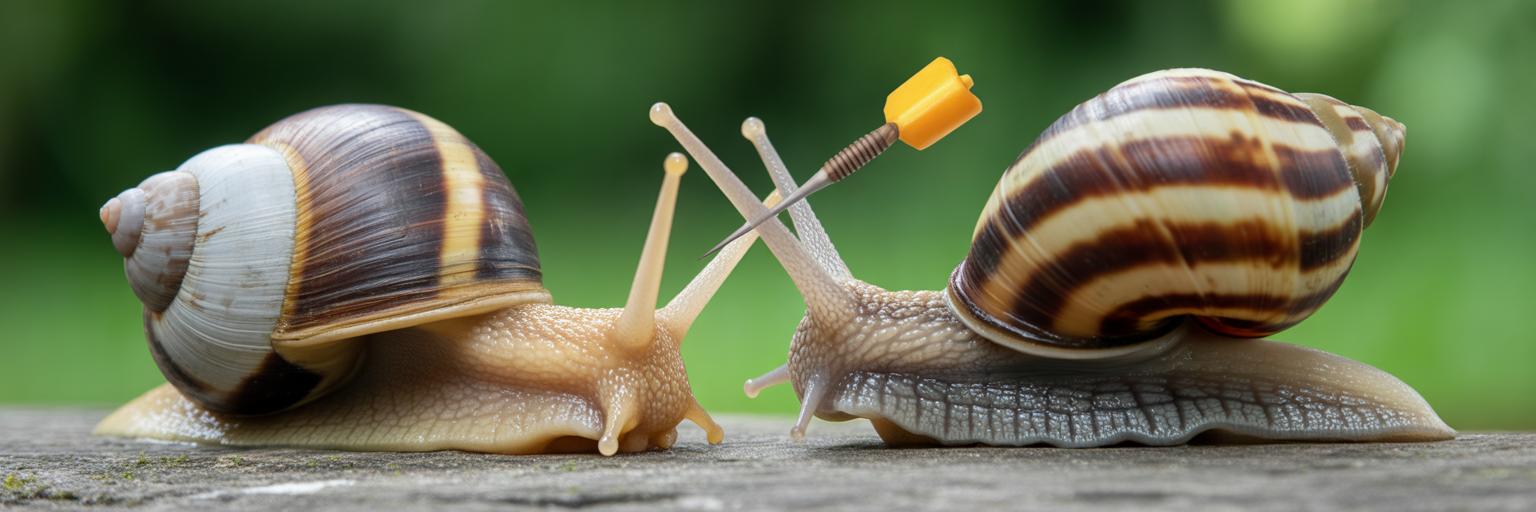
The physical act of stabbing is just the beginning. The dart itself is merely a sophisticated delivery system, a hypodermic needle designed for a single, manipulative purpose. The real weapon is what it carries.
More Than Just a Stab
The dart’s primary function is not to inflict pain or cause injury, though it certainly does. Its true purpose is to inject a cocktail of hormones into the recipient’s bloodstream. This is where the encounter shifts from a physical assault to a form of biochemical warfare.
The Hormonal Payload
Coating the dart is a special mucus packed with hormones. These chemicals are designed to manipulate the recipient’s physiology. Snails have an organ called the bursa copulatrix, which acts as a digestive system for foreign sperm, destroying the majority of it after mating. The hormones on the dart counteract this defense, effectively disabling the recipient’s ability to reject the shooter’s sperm. It is a direct intervention to ensure the shooter’s genetic material survives the journey.
The Genetic Payoff
This strategy provides a staggering advantage. The answer to why do snails shoot darts lies in paternity. According to a study published by the National Center for Biotechnology Information (NCBI), snails that successfully land a dart can father up to twice as many offspring as those that fail. By chemically manipulating their partner, they bypass the competition and secure their genetic legacy. The dart is a tool for winning a high-stakes reproductive lottery.
| Factor | Successful Darting (Shooter) | Unsuccessful/No Darting (Shooter) |
|---|---|---|
| Paternity Success | Significantly higher (up to double) | Standard/Lower |
| Sperm Survival in Recipient | High; recipient’s digestive organ is suppressed | Low; most sperm is destroyed by recipient |
| Genetic Legacy | Maximized; ensures genes are passed on | Uncertain; faces high competition |
| Physiological Cost to Recipient | Tissue damage and hormonal manipulation | None from a darting event |
Note: Data is based on findings from studies on sexual selection in hermaphroditic snails like Cornu aspersum, which demonstrate the direct link between darting success and increased paternity rates.
An Evolutionary Arms Race in the Garden
This violent courtship is a textbook example of “sexual conflict,” where the reproductive interests of two partners are opposed. What benefits the sperm donor, ensuring paternity, is physiologically costly for the recipient, who is stabbed and hormonally manipulated. This conflict has driven an evolutionary arms race right in our backyards, making it one of the most weird animal mating rituals known to science.
This escalating cycle of adaptation and counter-adaptation unfolds over generations:
- Offensive Adaptation: Snails evolve darts to increase their chances of fathering offspring.
- Defensive Counter-Adaptation: In response, recipient snails may evolve thicker skin or more robust sperm-digesting organs to resist the dart’s effects.
- Escalation: This defensive pressure then drives the evolution of sharper darts, more potent hormones, and more complex darting behaviors in the shooter.
The promiscuous nature of snails, which often mate with multiple partners, fuels this relentless competition. When sperm from several individuals is present, any competitive edge becomes critical for reproductive success. This biological “technology” is a fascinating example of the innovations of modern science found in nature, where survival of the fittest is played out with brutal efficiency.
Nature’s Unsettling Ingenuity

The common garden snail, a creature we barely notice, is a vessel for a ruthless and highly effective reproductive strategy. The question of how do snails mate reveals a process that is less about romance and more about genetic warfare. This behavior is a stark reminder that evolution operates on a single, cold principle: reproductive success, no matter how violent the method. The brutal logic of the love dart stands in sharp contrast to human concepts of love and partnership, which are central to our culture.
It is unsettling yet brilliant. The snail’s dart is a testament to nature’s ingenuity, proving that the most extraordinary stories are often hidden in the most familiar places. The next time you see a snail inching its way across a garden path, you might look at it with a newfound, and slightly unnerving, respect. We encourage you to continue exploring the strange and wonderful aspects of the natural world with us at Nature Is Crazy.