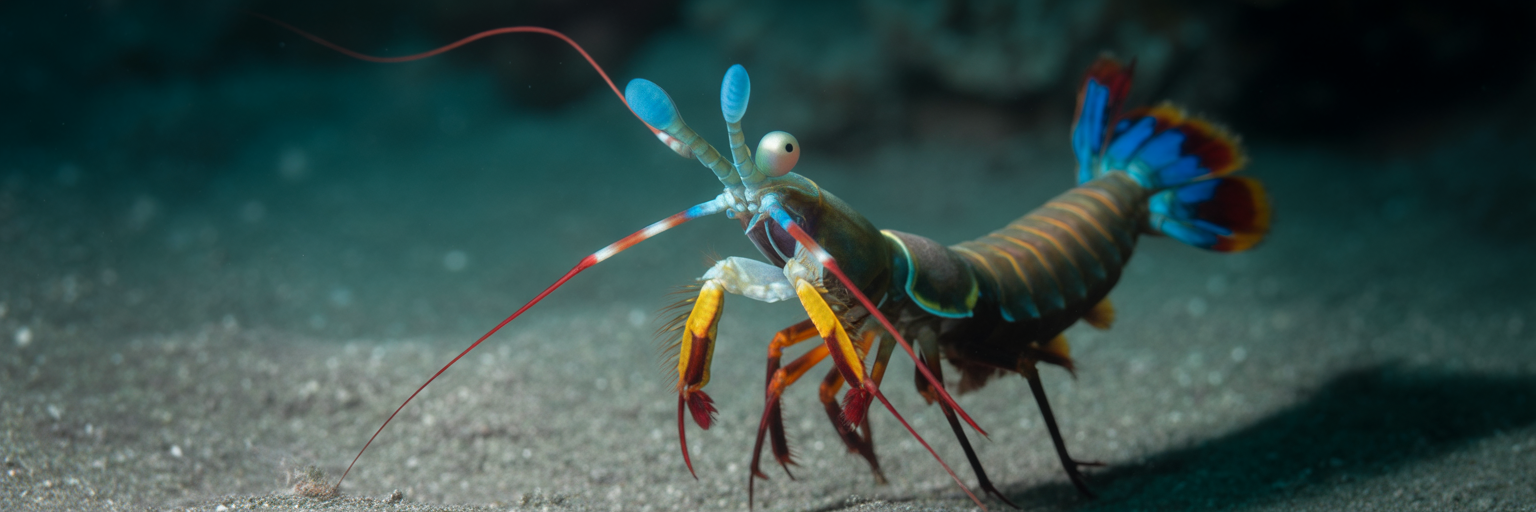
An Unseen Underwater Haymaker
The coral reef is deceptively peaceful. Sunlight filters through the gentle turquoise water, casting shifting patterns on the white sand. A small crab, armored and confident, scuttles out from under a ledge, its claws methodically sifting through the sediment for a meal. The world is a quiet hum of currents and the distant clicking of other reef dwellers. There is no sense of danger, no shadow of a predator, nothing to suggest that this crab’s existence is about to end in a display of physics so violent it borders on the supernatural.
Then it happens. Not a bite, not a grab, but an event. A silent, concussive force erupts from nowhere. The water itself seems to punch the crab. There is a flicker of impossible, psychedelic color, a blink-and-you-miss-it rainbow that vanishes instantly. The crab doesn’t just crack. Its thick, calcified shell, a fortress built to withstand the crushing jaws of fish, simply disintegrates into a cloud of white dust and fragments. The surrounding water shimmers with the impact, and a small, stunned fish nearby is knocked sideways by a shockwave it cannot see.
What just happened here? There was no large attacker, no visible weapon. There was only a serene environment, then a sudden, brutal erasure. This is the work of a predator that has weaponized physics. It has mastered the art of the hydraulic explosion, a force that turns the water itself into a hammer. The crab was not merely hunted; it was obliterated by a creature that wields a power far greater than its size would suggest. The fleeting glimpse of color was the only clue, the signature of a tiny monster that carries one of nature’s most devastating weapons in its own arms.
Meet Nature’s Psychedelic Brawler
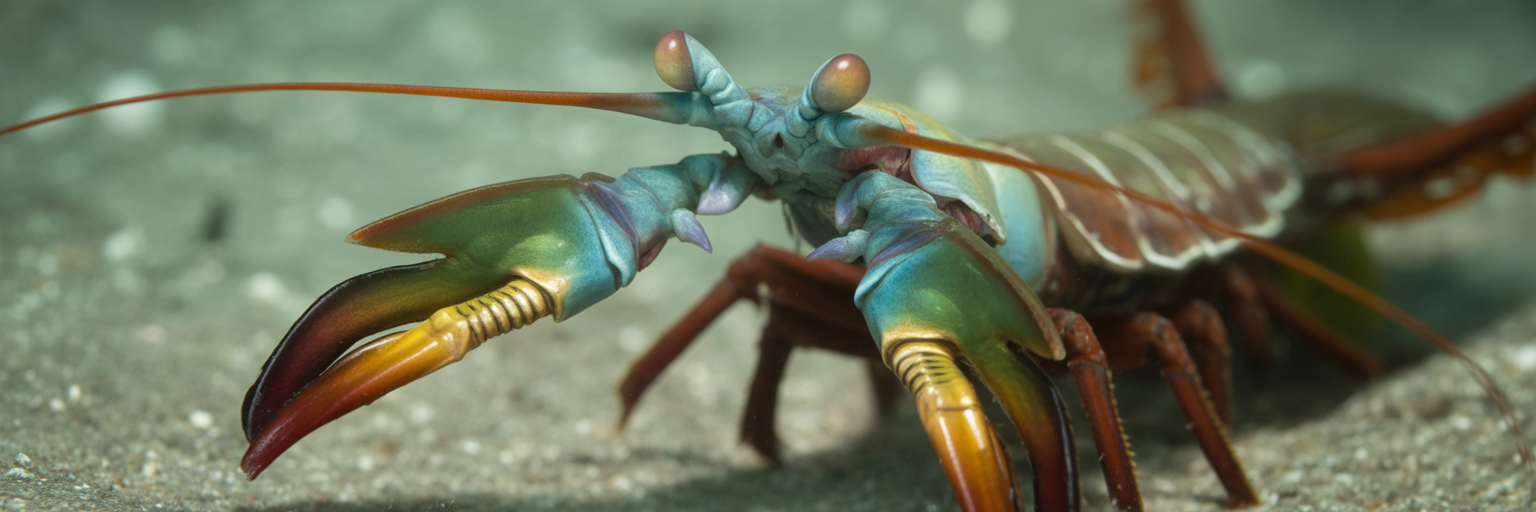
The architect of this underwater demolition is the peacock mantis shrimp, Odontodactylus scyllarus. It is, without a doubt, one of the most visually stunning and paradoxically violent creatures in the ocean. Its existence is a contradiction, a masterpiece of beauty designed for breathtaking brutality. To understand this predator, you have to look past the vibrant shell and see the terrifyingly perfect machinery it conceals.
The Misleading Beauty of a Killer
At first glance, the peacock mantis shrimp looks like a piece of living jewelry. Its body is a kaleidoscope of iridescent greens, blues, oranges, and reds that shimmer and shift with every movement. This dazzling display is reminiscent of the way light plays across the inside of an abalone shell, a natural wonder of color and light. But this beauty is a clever deception. It distracts from the fact that this creature is one of the most formidably armed predators on the planet. Its vibrant appearance is just one of many bizarre traits that place it among nature’s most unsettling creations.
Spearers vs. Smashers: Choosing Your Weapon
Mantis shrimp are broadly divided into two guilds based on their hunting style: “spearers” and “smashers.” Spearers possess slender, barbed appendages designed to impale soft-bodied prey like fish with a quick, lethal stab. They are ambush predators, lying in wait to skewer anything that swims too close. But our focus is on the smashers, the brawlers of the reef. Smashers, like the peacock mantis shrimp, have evolved a different tool: a pair of dense, heavily calcified clubs. They don’t stab their prey. They pulverize it.
Anatomy of a Hammer
The smasher’s primary weapons are its two raptorial appendages, which terminate in what are known as dactyl clubs. These are not simple claws. They are biological hammers, marvels of natural engineering. Each club is a multi-layered composite material, with a dense, impact-resistant outer layer made of hydroxyapatite—the same mineral found in bone and teeth—and a softer, shock-absorbing inner layer. This structure allows the club to deliver catastrophic blows without shattering itself, a design that materials scientists are actively studying.
The Eyes of a Super-Predator
To land such a precise and devastating blow, the mantis shrimp needs an equally sophisticated guidance system. Its eyes are arguably the most complex in the animal kingdom. Mounted on stalks, they can move independently, giving it a wide field of view. Each eye has trinocular vision, meaning it can perceive depth with just one eye. Furthermore, while humans have three types of color-receptive cones, the mantis shrimp has between 12 and 16. It can see a spectrum of colors we can’t even imagine, including polarized light, which helps it detect transparent prey and communicate with other mantis shrimp. This incredible vision makes it a calculated hunter, not just a mindless brute, allowing it to identify a target’s weak points before unleashing its attack.
The Biomechanics of a Super-Powered Punch
The sheer force of the mantis shrimp’s strike seems to defy biology. How can a creature just a few inches long generate enough power to shatter shells and boil water? The secret isn’t brute strength. In fact, its muscles are surprisingly weak. The power comes from a brilliant feat of mechanical engineering, a spring-loaded system that stores and releases energy with terrifying efficiency.
It’s Not Muscle, It’s a Spring-Loaded System
Think of the mantis shrimp’s arm not as a fist, but as a crossbow. The muscles don’t power the strike directly. Instead, they work slowly to compress a powerful biological spring, loading it with an immense amount of elastic potential energy. This process can take a moment, but it allows the shrimp to store up power that its muscles could never generate in a single, explosive contraction. This principle of animal biomechanics explained shows how evolution found a way to bypass the physical limitations of muscle tissue. The club’s incredible durability is also key, as it must withstand its own force, a trait seen in other creatures with remarkable regenerative abilities like those that can regrow skin stronger than before.
The ‘Saddle’: Nature’s Power-Loading Spring
The core of this system is a unique structure in the shrimp’s arm called the hyaline saddle. Shaped like a Pringles potato chip, this saddle is made of a stiff but elastic bioceramic material. As the shrimp prepares to strike, muscles contract and force this saddle to flatten out, compressing it like a powerful spring. The shape of the saddle is crucial; it’s designed to store a massive amount of energy as it deforms. The more it’s compressed, the more violent the eventual release will be. It’s a tiny, elegant solution for storing an outsized amount of power.
The Latch: A Microscopic Trigger for a Megaton Punch
All that stored energy would be useless without a trigger. Holding the compressed saddle in place is a tiny latch mechanism. This latch acts as a microscopic catch, restraining the immense force that is straining to be released. The tension in the system is incredible. For a fraction of a second, the entire power of the impending strike is held in check by this one small component. When the shrimp decides to attack, a muscle flexes and disengages the latch. The result is instantaneous and catastrophic. The saddle snaps back to its original curved shape with explosive speed, launching the dactyl club forward like a bullet fired from a gun.
An Attack Faster Than a Speeding Bullet
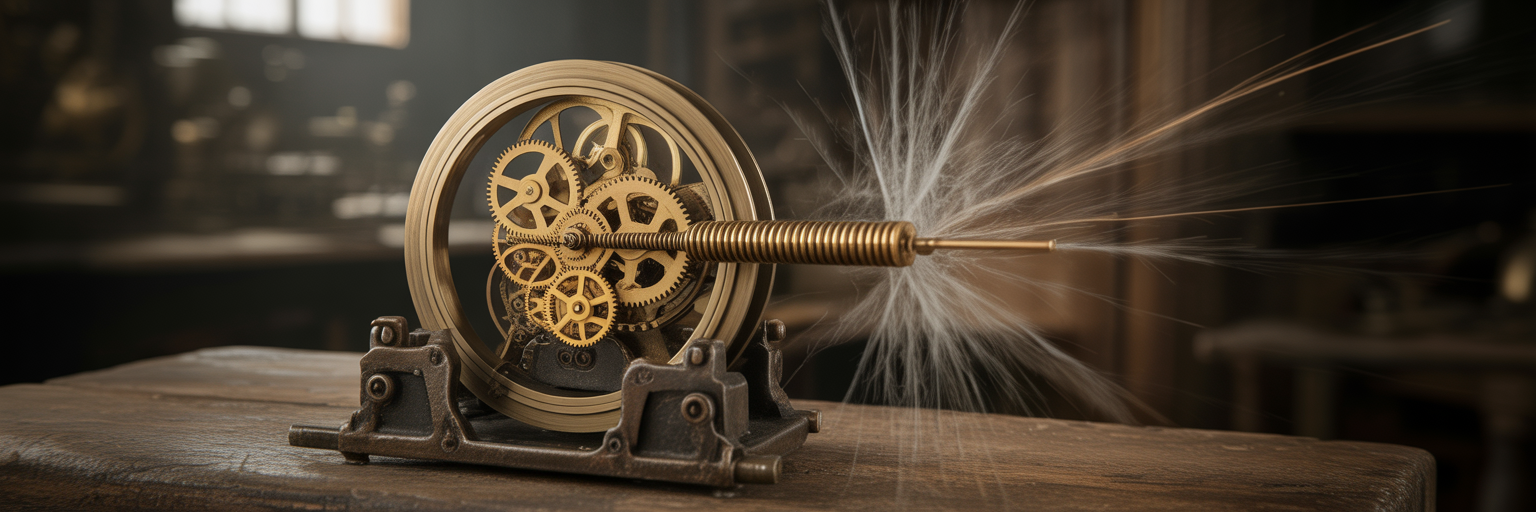
The release of the spring-loaded mechanism unleashes a level of speed and acceleration that is difficult to comprehend. The numbers behind the fastest animal strike on the planet are staggering, and they explain why the impact is so devastating. It’s an attack that moves so quickly it literally breaks the physics of the water around it.
The dactyl club launches forward at speeds of up to 23 meters per second (about 50 mph) from a dead stop. While that may not sound as fast as a cheetah, it’s happening underwater, where water resistance is nearly 800 times greater than air. To put it in perspective, the club accelerates so quickly that if a car could do the same, it would go from 0 to 60 mph in less than a thousandth of a second. Research from UC Berkeley confirms this, clocking the appendage’s acceleration at over 65,000 m/s², a force more than 6,600 times the force of gravity.
This incredible velocity is faster than a .22 caliber bullet. The sheer speed is the first part of the weapon. The club moves so fast that the water in front of it simply cannot get out of the way. This inability of the fluid to move creates a pocket of near-zero pressure, setting the stage for the strike’s truly terrifying second act.
| Object/Animal | Top Speed (m/s) | Acceleration (m/s²) | Key Mechanism |
|---|---|---|---|
| Peacock Mantis Shrimp Strike | 23 m/s | ~65,000 m/s² | Elastic Energy Release |
| Cheetah Sprint | ~29 m/s | ~10 m/s² | Muscular Contraction |
| .22 Caliber Bullet (Muzzle) | ~370 m/s | ~1,600,000 m/s² | Gunpowder Expansion |
| Human Boxer’s Punch | ~11 m/s | ~50 m/s² | Muscular Contraction |
| Trap-Jaw Ant Mandible Snap | ~64 m/s | ~1,000,000 m/s² | Elastic Energy Release |
This table provides context for the mantis shrimp’s strike by comparing its speed and acceleration to other well-known high-velocity movements. Note that while a bullet and a trap-jaw ant are faster, the mantis shrimp’s punch is unique for generating its destructive force within a dense medium like water.
Weaponizing the Physics of Boiling Water
The physical impact of the dactyl club is only half the story. The true horror of the mantis shrimp’s attack lies in what happens immediately after the club connects with its target. This is where the hydraulic explosion predator earns its name, by creating a weapon out of thin air, or more accurately, out of nothing at all.
The Cavitation Bubble: A Hole in the Ocean
When the club rockets through the water, the pressure in its wake drops so dramatically that it falls below the vapor pressure of the water. This causes the water to literally boil at room temperature, forming a small bubble of water vapor. This phenomenon is called cavitation, and the shrimp has turned it into a cavitation bubble weapon. For a brief moment, a void, a hole in the ocean, trails behind the club. This bubble travels with the strike and collapses onto the target moments after the initial impact.
The Second Strike: An Implosion of Light and Sound
The collapse of this bubble is the second, and often more powerful, part of the attack. As the surrounding water pressure normalizes, it rushes in to fill the void, causing the bubble to implode violently. This implosion generates a powerful underwater shockwave punch, a blast of force that can be strong enough to kill or stun prey on its own. The collapse is so energetic that it produces a tiny flash of light (a phenomenon called sonoluminescence) and a point of intense heat, with temperatures briefly reaching several thousand degrees Celsius, nearly as hot as the surface of the sun.
This two-part attack sequence is what makes the mantis shrimp so lethal:
- The club launches at an acceleration greater than a bullet.
- The extreme speed creates a low-pressure cavitation bubble in its wake.
- The club makes physical contact, delivering the first blow.
- The cavitation bubble collapses, unleashing a devastating secondary shockwave of heat, light, and force.
This means that even if the shrimp’s aim is slightly off, the prey is still hit by the secondary blast. A near-miss is often just as deadly as a direct hit.
The Ultimate Evolutionary Advantage
Why would evolution produce such a complex, energy-intensive, and ridiculously violent weapon? The answer lies in the never-ending arms race between predator and prey on the coral reef. The mantis shrimp’s punch is the ultimate solution to two major hunting challenges: heavily armored opponents and fast, agile targets.
The Perfect Shell-Cracker
The primary diet of a smasher mantis shrimp consists of hard-shelled animals like crabs, snails, and clams. These creatures are living fortresses, protected by thick armor that most predators can’t break. The mantis shrimp punch is perfectly designed to overcome this defense. The initial high-velocity impact delivers a massive amount of kinetic energy to a single point, creating fractures in the shell. But it’s the secondary cavitation blast that finishes the job. The shockwave propagates through the initial cracks, shattering the shell from the inside out. It’s a one-two combination of brute force and physics that no armor can withstand.
An Area-of-Effect Attack for Agile Prey
While devastating against armored targets, the cavitation blast also gives the shrimp an advantage against faster, more agile prey like fish. A small fish can easily dodge a simple physical strike. However, it cannot dodge the shockwave. The cavitation bubble’s collapse creates a small area of effect, a kill zone around the point of impact. A fish that is near the strike but not directly hit can still be stunned or killed by the shockwave, making it easy for the shrimp to retrieve and consume. This turns a precision weapon into a small grenade, increasing the odds of a successful hunt.
The peacock mantis shrimp is more than just a predator. It is a master of biomechanics, a creature that has harnessed the laws of physics to create one of the most efficient and terrifying biological weapons in the world. Its strike is a testament to the extreme and incredible solutions that evolution can produce, a reminder that some of nature’s most amazing survival strategies are also its most violent, much like other animals that have developed extreme methods to survive.