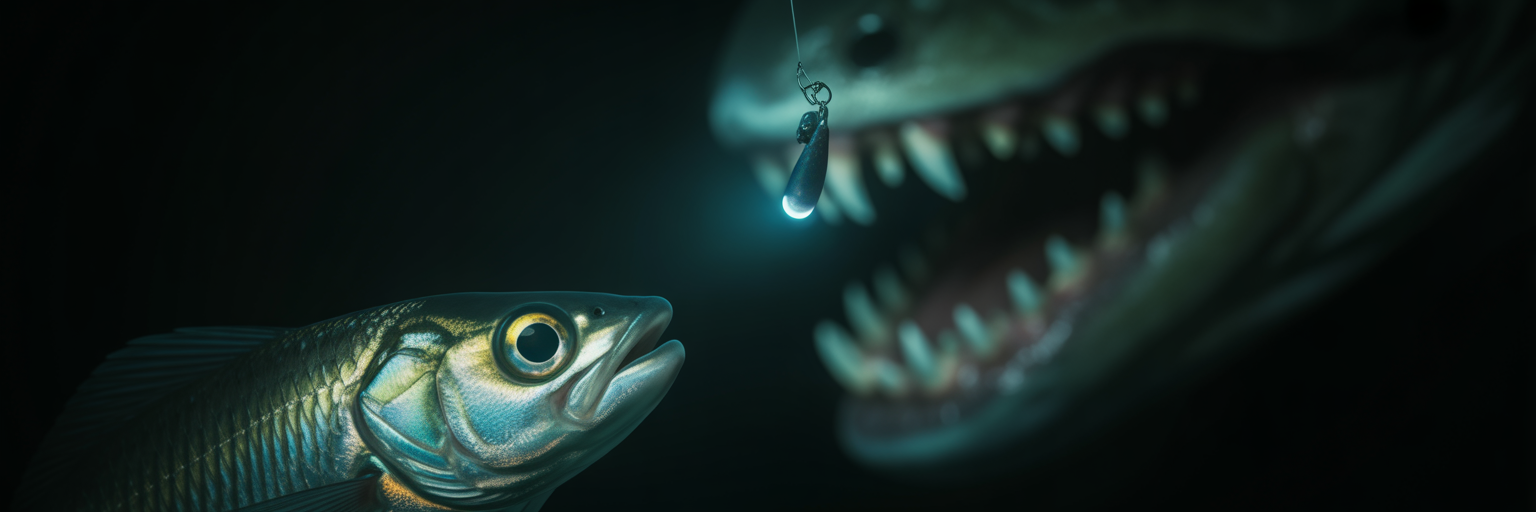
A Sinister Spark in the Endless Dark
Imagine a place of absolute blackness. Not the kind of dark you find in a bedroom with the curtains drawn, but a profound, crushing void. Think of the deep ocean, miles below the surface, where the weight of the water above could crumple a submarine. Or picture a remote, moonless forest so dense that starlight never reaches the floor. In these places, survival is a constant, silent struggle fought in the dark. A single glimmer of light isn’t always a sign of hope. Sometimes, it’s a dinner invitation from a monster.
Bioluminescence, the ability of living things to create their own light, often serves beautiful purposes. Fireflies use it to find mates, and certain fungi glow to attract insects that will spread their spores. It’s a language of life written in photons. But evolution has a dark sense of humor. It took this tool of communication and courtship and twisted it into a weapon. In the hands of certain predators, light becomes a lure, a hypnotic beacon that promises everything but delivers only a swift, toothy end. These are some of nature’s most creepy animal hunting techniques, turning a fundamental instinct toward the light into a fatal weakness.
This strategy is diabolically simple. In a world of nothing, a single point of light becomes everything. It’s an irresistible anomaly that draws the eye and scrambles the brain. The creature that follows it is not stupid; it is simply obeying a biological command that has, for millions of years, meant safety or food. The predator just happens to be waiting at the end of that command, mouth open. It raises a chilling question. What if the most beautiful thing you ever saw was also the last?
The Deep Sea’s Deadliest Nightlight
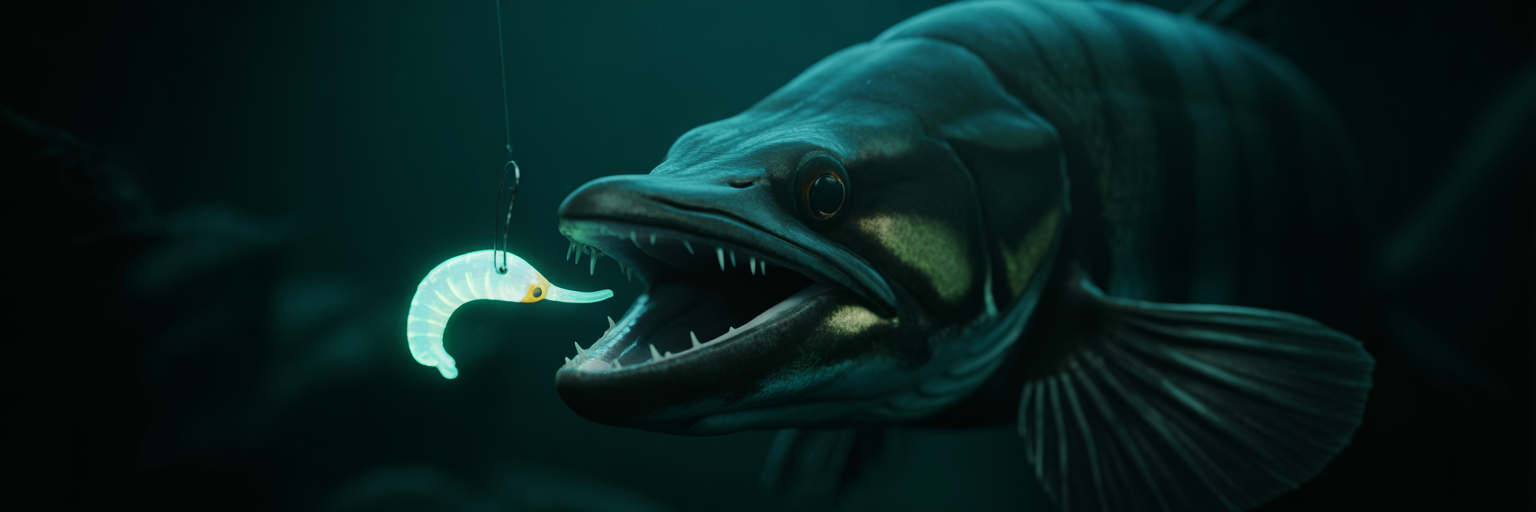
Nowhere is this sinister strategy more perfected than in the abyss with the deep-sea dragonfish. This creature is pure, distilled nightmare fuel. It’s less a fish and more a floating set of jaws with a body attached as an afterthought. To truly appreciate its hunting prowess, we need to look at its specialized toolkit.
Meet the Monster with a Fishing Rod
The dragonfish looks like something a child would draw after being told a particularly scary bedtime story. Its body is long, black, and eel-like, designed to disappear into the crushing dark. But its face is where the horror truly lives. Its mouth is filled with a collection of long, transparent teeth that look like shards of glass. The jaw itself is hinged so grotesquely that it can swing open to an angle wider than its own head, like a disconnected bear trap ready to snap shut on anything that drifts too close.
The Science of a Deadly Glow
Attached to its chin is a long, fleshy filament called a barbel, and at the end of this barbel is a photophore, its personal light-up lure. This isn’t just a simple glow. The dragonfish is a master puppeteer. It can control the intensity of the light, making it pulse rhythmically or wiggle erratically to mimic the movements of a small crustacean. This deadly glow is the result of a simple chemical reaction, where a substance called luciferin reacts with oxygen to produce light without heat. The dragonfish hunting strategy is to dangle this hypnotic spark in the darkness, waiting for a curious, hungry fish to investigate. As The dragonfish’s bioluminescent lure acts like a hypnotic beacon, drawing in smaller fish and invertebrates that are unable to resist the glowing temptation, a tactic well-documented by science communicators at HowStuffWorks.
A Private Sniper Scope of Red Light
As if a glowing death-lure wasn’t enough, the dragonfish has another terrifying trick. Most deep-sea creatures can only see blue light, as it’s the only wavelength that penetrates deep into the ocean. Red light is effectively invisible. The dragonfish, however, can both produce and perceive red light. It has a second set of photophores near its eyes that emit a faint red glow. For its prey, nothing is there. But for the dragonfish, it’s like having a private sniper scope. It can illuminate a victim without the victim ever knowing it’s being watched, lining up the perfect shot before the prey even senses danger. This remarkable feature is a prime example of the complex evolutionary adaptations involving light that have emerged in extreme environments, a topic we explore further in our blog. These bioluminescent hunting methods make the dragonfish one of the most brutally efficient predators in the abyss.
Mesmerized into the Maw
Let’s leave the predator for a moment and consider its victim. Imagine you are a tiny lanternfish, no bigger than a human finger. Your entire existence is defined by three things: the crushing pressure, the endless dark, and the gnawing hunger. Food is scarce, and every shadow could hide a threat. Your life is a series of reflexive twitches, guided by instincts honed over millennia. You don’t think; you react. Survival is a program running in your simple brain.
Then, you see it. In the featureless black, a single point of light appears. It pulses gently, a tiny, rhythmic star where no star should be. Your brain doesn’t register danger. It registers opportunity. Is it a tiny, glowing shrimp? A potential mate? It doesn’t matter. The light is a promise. It’s the most interesting thing to happen in your entire, short life. You feel an irresistible pull, a biological command that overrides all caution. This is the terrifying power of animals that hypnotize prey.
You drift closer, your fins barely moving. The light seems to grow, becoming warmer, more inviting. It’s a beautiful, mesmerizing dance, and you are its sole audience. All other senses fade away. The faint vibrations in the water, the scent of other creatures, none of it matters. There is only the light. You are in a trance, moving toward the prettiest thing you have ever seen. And then, in a flash, the light is no longer a distant star. It’s a spotlight, and it’s illuminating a cavern of needle-like teeth right in front of you. The world snaps from a hypnotic glow to a cage of bone. There is no time to scream, no time to flee. There is only the light, and then, the dark returns. This is just one of many examples of nature’s unsettling creations that defy belief.
A Tangled Web of Stolen Light
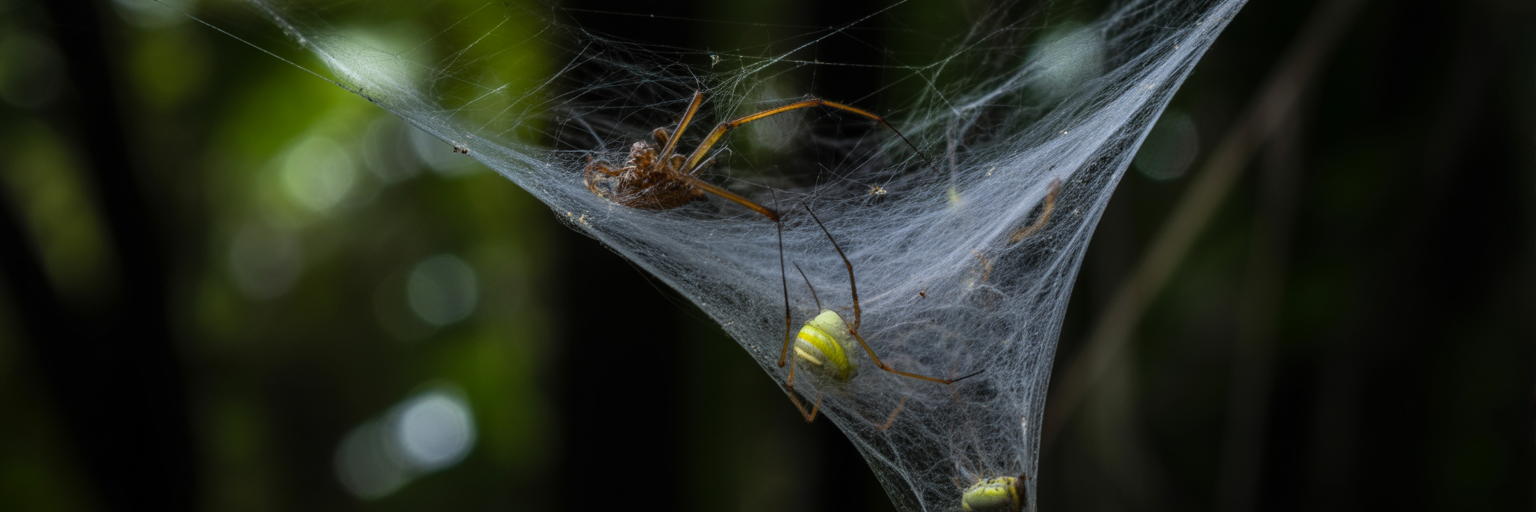
This sinister use of light isn’t confined to the deep sea. On land, in the dark forests of Taiwan, a different kind of predator has mastered a similar, yet distinct, form of luminous deception. Meet the sheet-web spider, a creature that proves you don’t need to produce your own light to weaponize it. You just need to be clever enough to steal it.
Unlike the dragonfish, this spider doesn’t have a built-in lure. Instead, it outsources the job. Its strategy is a masterclass in manipulative genius. The spider spins its web and then captures fireflies. But it doesn’t eat them, at least not right away. It keeps them alive, tangled in the silk. The trapped fireflies continue to flash, turning the entire web into an illuminated death trap. This tactic of spiders using fireflies as bait is a brilliant example of using one victim to catch another. Other nocturnal insects, drawn to the promise of a mate, fly directly into the sticky, glowing web.
The deception goes even deeper. As reported by National Geographic, researchers have observed that these spiders can manipulate the flashing to mimic female firefly responses, luring hopeful males to their doom. The spider essentially hijacks the language of love and turns it into a siren song. This is a chilling form of aggressive mimicry, where the predator uses its prey’s own biology against it. This kind of complex interaction is a reminder of nature’s strangeness, much like organisms that can live inside other living creatures without harm.
| Feature | Deep-Sea Dragonfish | Sheet-Web Spider |
|---|---|---|
| Environment | Pitch-black deep ocean | Dark forests at night |
| Light Source | Self-produced (bioluminescence) | Outsourced (captured fireflies) |
| Hunting Style | Active ambush predator | Passive trap-setter |
| Deception Method | Mimics small, edible prey | Weaponizes victims’ mating signals |
| Primary Tool | Single, controllable lure (photophore) | Entire web illuminated by victims |
This table highlights the divergent evolutionary paths of two different predators that both weaponize light. While the dragonfish is a self-sufficient hunter with a built-in tool, the spider is a resourceful trapper that turns its victims into bait.
The Fatal Flaw in a Creature’s Brain
So why does this work so well? Why do countless creatures, from the deep sea to the forest floor, swim or fly directly toward their doom? The answer lies in a fundamental, hardwired instinct called positive phototaxis. In simple terms, it’s the innate tendency of many organisms to move toward a light source. For millions of years, this has been a solid survival strategy. Light often signals the surface of the water, an escape from the dark depths. For many insects, it can indicate a clear flight path or the warmth of the sun.
But predators that use light to hunt have turned this survival code into a fatal flaw. They are, in essence, biological hackers. They create a false signal that hijacks the prey’s brain, tricking it into making a deadly mistake. The process is a simple but terrifying psychological trap:
- Detection: In a world of darkness, the prey spots a lone, anomalous light. It immediately commands attention.
- Attraction: The prey’s brain, running on ancient software, instinctively interprets the light as a good thing: food, safety, or a mate. The impulse to move toward it is automatic.
- Fixation: As the creature gets closer, the light source can overwhelm its other senses. It develops a kind of tunnel vision, fixating on the glow and becoming oblivious to the larger, darker threat attached to it.
- Capture: The very instinct that was meant to ensure survival leads the creature directly into the predator’s grasp. The code has been exploited.
Of course, not all creatures are drawn to light; some exhibit negative phototaxis and flee from it. But for those that don’t, this instinct is a powerful and vulnerable part of their being. It’s a fascinating parallel to other simple organisms, such as animals that can navigate without a brain, which rely on hardwired responses to survive.
Nature’s Other Eerie Lanterns
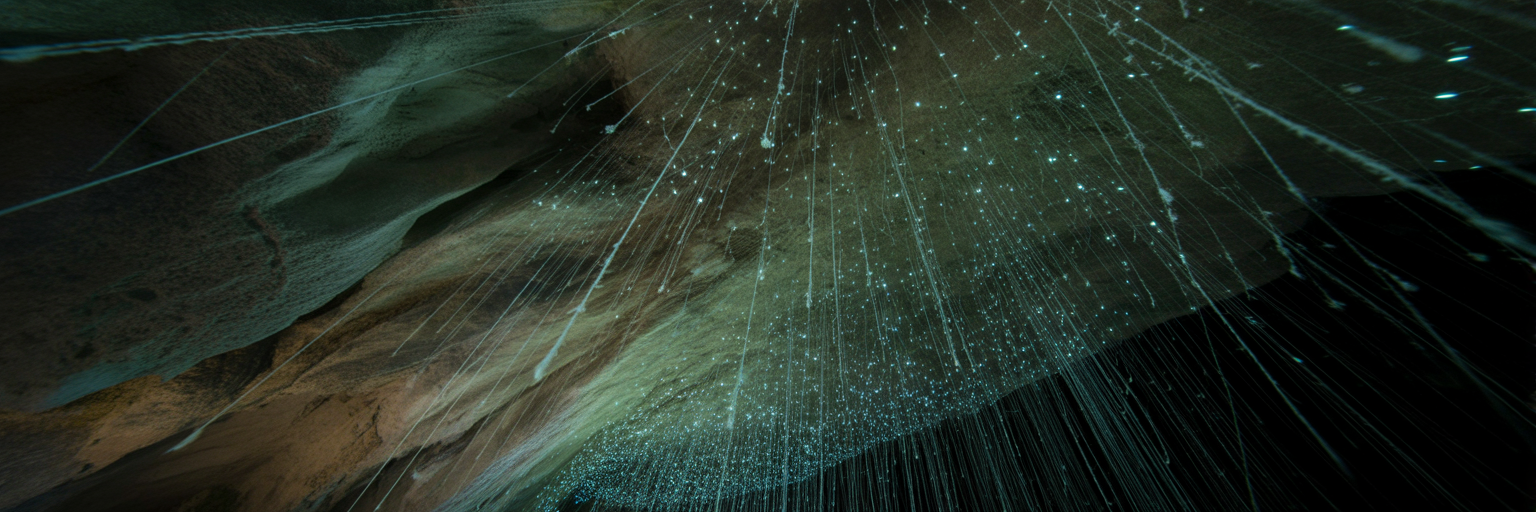
The dragonfish and the sheet-web spider are star players in this creepy theater, but they are far from the only actors. Nature has equipped a diverse cast of creatures with the ability to use light as a tool for survival and predation. One of the most visually stunning examples is the glowworm, particularly the species found in the caves of New Zealand and Australia.
Visitors to these caves are treated to a breathtaking sight: the ceiling is covered in thousands of tiny blue-green lights, like a subterranean galaxy. But this beautiful spectacle is a deathtrap. Each point of light is a larva of the fungus gnat, and dangling below it are sticky, silk threads beaded with mucus. Flying insects, hatched in the dark caves and instinctively drawn to the light, fly upward toward the “stars” only to become ensnared in the deadly filaments. The cave ceiling is a galaxy of doom.
Other creatures employ more subtle light-based tricks:
- The Cookiecutter Shark: This small, aggressive shark has a glowing underside that helps it camouflage against the brighter surface water when viewed from below. It uses this counter-illumination to get close to much larger prey, like tuna and even whales, before taking a cookie-cutter-shaped bite out of them.
- The Flashlight Fish: This fish has a pouch of bioluminescent bacteria under each eye, which it can cover with a flap of skin. It uses this blinking light to startle predators, attract prey, and communicate with other flashlight fish in the dark.
– The Railroad Worm: This isn’t a worm at all, but a beetle larva. It has a row of yellow-green lights along its body and two red lights on its head, making it look like a tiny train. The exact purpose is still being studied, but it’s likely used for both defense and predation.
Whether it’s a single dangling lure, a web of living bait, or a cave full of sticky snares, the principle is the same. These predators have all learned to weaponize a fundamental biological urge with a simple, irresistible flash of light.
The Everlasting Arms Race of Light and Shadow
The relationship between these light-wielding predators and their mesmerized prey is a perfect example of an evolutionary arms race. For the predator’s trick to work, it must remain a relatively rare and convincing anomaly. If too many lights in the dark lead to death, won’t prey eventually evolve to be more cautious? Are there populations of fish in the deep sea that are now genetically programmed to fear strange lights?
This delicate balance is what keeps the strategy effective. The predator’s lure must be just convincing enough to hijack the prey’s instincts, while the prey’s instincts must remain strong enough for the species to survive in other contexts. It’s a constant, silent battle of adaptation and counter-adaptation fought over millennia. But this ancient struggle is now facing a modern complication: human-caused light pollution.
The artificial light from cities, ships, and offshore rigs is bleeding into natural environments, from forests to the deep ocean. How does this affect a predator that relies on being the only light in the darkness? Could a dragonfish’s lure become lost in the background noise of human activity, rendering its primary hunting tool useless? Or will these predators adapt in new, unforeseen ways, perhaps developing brighter or more complex light patterns to compete? The answers remain hidden in the dark.
It’s a powerful reminder that nature’s ingenuity is both beautiful and terrifyingly clever. The next time you see a firefly blinking in your backyard, you might see it a little differently. You’re not just watching an insect; you’re watching a participant in an ancient war of light and shadow. To explore more of the bizarre and fascinating phenomena our planet has to offer, remember that nature is crazy.