
Nature’s Most Extreme Case of Sibling Rivalry
Most of us know sibling rivalry. It’s the fight over the last slice of pizza, the argument about who gets the TV remote, or the passive aggressive note left on a carton of milk. It feels dramatic at the moment, but it rarely ends in bloodshed. In the animal kingdom, however, family disputes are handled with a bit more finality. Forget arguing over who gets the front seat, some siblings are fighting for their very existence before they even leave the womb.
Let’s get right to it. Some animals engage in something called intrauterine cannibalism. This is a biological strategy where the first and strongest embryo hatches inside its mother, develops teeth, and proceeds to hunt and eat its own siblings. It’s a family drama so intense it makes our most chaotic holiday dinners look like a peaceful meditation retreat. This isn’t some random act of violence or a biological glitch. It is a calculated, albeit gruesome, evolutionary strategy that has been perfected over millions of years.
The very idea is horrifying. A mother’s womb, typically a symbol of safety and nourishment, becomes a battleground where only one can emerge victorious. It’s a brutal system that ensures the survivor is the strongest, best-fed, and most prepared for the outside world. The cost of this advantage is a family tree with a lot of missing branches.
In this article, we will explore this bizarre corner of the natural world. We’ll uncover which animals practice this prenatal purge, examine the biological mechanics that make it possible, and dissect the cold, hard evolutionary logic that turns eating your unborn siblings into a winning ticket for survival. Prepare yourself, because nature is about to get weird.
The Womb as a Gladiatorial Arena

To understand this phenomenon, we need to leave our human ideas of family at the door. The womb, in these specific cases, is not a nurturing cradle. It is a closed ecosystem, a competitive arena where the rules are simple: eat or be eaten. This process has a scientific name that sounds as menacing as the act itself: adelphophagy, which literally translates from Greek to “eating one’s brother.”
Defining the Brutality: Adelphophagy
Adelphophagy is a specific form of intrauterine cannibalism. It’s not just about an embryo absorbing a less-developed neighbor. It’s an active hunt. The most developed embryo hatches first, grows functional jaws and teeth, and systematically consumes its littermates. This isn’t a passive competition for resources. It is an aggressive, predatory act that eliminates all rivals before they have a chance to be born. The intrauterine cannibalism explained here is a survival strategy, not a random occurrence. It’s a feature, not a bug, in the reproductive software of certain species.
The Battleground Within
Imagine a cage match where the prize is life itself, and the mother provides the cage. The first embryo to develop its predatory tools gets an insurmountable advantage. It has a captive, high-protein food source readily available. While its siblings are still developing, the firstborn is already feasting, growing larger and stronger with every meal. This womb-turned-arena is just one of many of nature’s unsettling creations that defy belief. The mother isn’t a passive observer in this process. Her body provides the environment that facilitates this deadly competition, ensuring that the offspring she eventually gives birth to is a proven survivor.
Not Your Average Cannibalism
It’s important to distinguish this behavior from other forms of cannibalism. This isn’t filial cannibalism, where parents sometimes eat their young to regain energy or cull the weak. It’s also different from post-birth siblicide, where siblings kill each other after hatching or birth to monopolize parental care. Adelphophagy is a preemptive strike. It’s about eliminating the competition before the race has even officially begun. The goal is to absorb the resources of your siblings to become so formidable at birth that your own chances of survival skyrocket. It’s a strategy that prioritizes the quality of one offspring over the quantity of many.
Meet the Champions of Prenatal Carnage
While this behavior sounds like something from a sci-fi horror film, it’s a real and effective strategy for several species. These animals have turned the womb into the ultimate proving ground, where only the most ruthless survive. Let’s meet some of the champions of this prenatal war.
The Sand Tiger Shark: Poster Child of the Womb-Wars
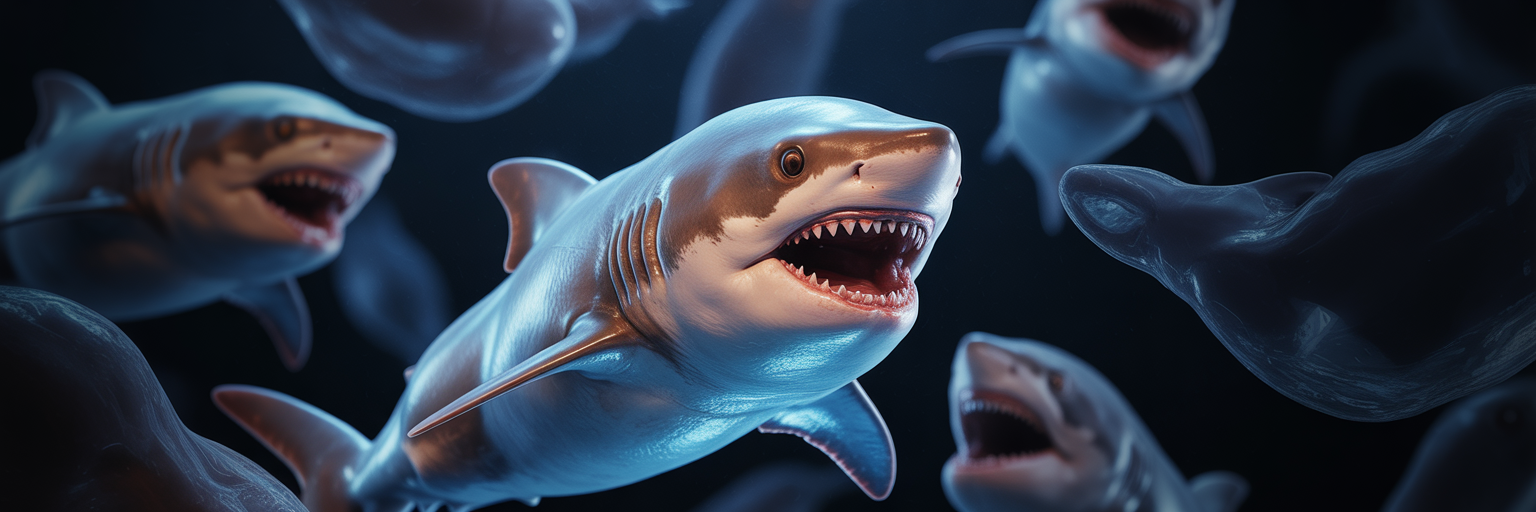
When it comes to adelphophagy in sharks, the sand tiger shark is the undisputed king. This is one of the most well-documented cases of animals that eat siblings before birth. The female sand tiger shark has two separate uteri, and each one becomes an independent deathmatch arena. She produces multiple eggs that are fertilized and develop in each uterus. However, the first embryo to hatch in each uterus quickly develops a full set of sharp teeth and a voracious appetite.
This tiny, unborn predator then proceeds to hunt and consume all of its smaller, less-developed siblings within that uterus. But it doesn’t stop there. The mother continues to produce unfertilized eggs, which serve as a constant food supply for the two surviving embryos. This process of eating unfertilized eggs is called oophagy. By the time the mother gives birth, she releases just two pups, one from each uterus. These pups are enormous, often over three feet long, and are born as experienced predators. As highlighted by Wikipedia, this process, known as intrauterine cannibalism, is well-documented in certain shark species, where embryos actively prey on one another.
The Fire Salamander: A Flexible Cannibal
The fire salamander demonstrates that this strategy can be flexible. Unlike the sand tiger shark, which is locked into this reproductive cycle, the fire salamander adapts its approach based on its environment. When conditions are good, with plenty of food and water, a female fire salamander will give birth to a large number of small, gilled larvae in a pond or stream. It’s a standard amphibian approach.
However, if the mother is stressed or resources are scarce, she holds onto her young for longer. Inside her oviduct, the developing larvae begin to turn on each other. The larger ones eat the smaller ones, growing bigger and stronger until only a few, or sometimes just one, remain. These survivors continue to develop inside the mother, absorbing their gills and emerging as fully formed, air-breathing juvenile salamanders. This is a brilliant adaptation. When times are tough, the mother ensures she produces a few formidable offspring with a much higher chance of survival, rather than many weak ones that would likely perish.
Parasitoid Wasps: The Hunger Games in a Caterpillar
This list of weird animal reproduction wouldn’t be complete without parasitoid wasps. These insects lay their eggs inside a living host, such as a caterpillar. The host serves as a living nursery and a non-renewable food source for the wasp larvae. When a female wasp lays multiple eggs inside one host, she initiates a brutal competition. The caterpillar can only provide enough nutrients for a limited number of wasps to reach maturity.
As the larvae hatch, they begin to feed on the host’s tissues. But they also feed on each other. The strongest, fastest-growing larvae will often attack and consume their siblings to eliminate competition for the limited food supply. It’s a race against time to get big enough to pupate before the host is completely consumed. The tenacity required for these larvae to survive is remarkable, echoing the resilience of some animals that can survive being swallowed and escape alive. In this gruesome battle royale, only the most efficient cannibals emerge to continue the life cycle.
The Cold, Hard Logic Behind Eating Your Family

At this point, you might be wondering what could possibly justify such a brutal system. The horror of it all can easily overshadow the evolutionary genius at play. But for nature, morality is irrelevant. Efficiency is everything. Answering the question of why animals are cannibals in this context reveals a set of powerful survival advantages. This isn’t madness. It’s a high-stakes solution to the fundamental problems of life.
- Brutal Quality Control
Adelphophagy is evolution’s most intense vetting process. There is no room for weakness. The embryo that survives is, by definition, the strongest, the most aggressive, and the quickest to develop. It has already won its first life-or-death battle before it was even born. This ensures that only the most robust genes are passed on to the next generation. It’s a system that guarantees the continuation of a powerful lineage. - A Built-in Lunchbox
The nutritional benefit is immense. The consumed siblings are not waste. They are a perfectly balanced, high-protein first meal. This prenatal feast gives the survivor a massive head start. It is born larger, more energetic, and better developed than it would have been otherwise. For a predator like the sand tiger shark, being born at a large size is a critical advantage, making it less vulnerable to other predators and more capable of hunting immediately. - A Response to Scarcity
This strategy often evolves in response to unpredictable or resource-poor environments. Instead of producing a dozen offspring that might all starve, the mother’s biology facilitates a system that guarantees one or two formidable babies. The womb becomes a self-contained ecosystem where the mother’s investment is consolidated into a single, highly viable offspring. This is an extreme example of the complex ways organisms that can live inside other living creatures interact with their host environment, even when that host is their own mother. - The Ultimate High-Stakes Bet
Reproduction is always a gamble. This strategy is the equivalent of going all-in on a single hand. It drastically reduces the number of offspring produced in a single reproductive cycle. However, it dramatically increases the survival rate of the chosen few. For species with long gestation periods and high energy investment in each pregnancy, ensuring the success of at least one offspring is paramount. It’s a high-risk, high-reward strategy that has clearly paid off for the species that employ it.
When Mom Herself Is on the Menu
Just when you thought family dynamics in the animal kingdom couldn’t get any more shocking, nature introduces matriphagy: the act of offspring eating their mother. If adelphophagy is the ultimate sibling rivalry, matriphagy is the ultimate act of parental sacrifice. It’s a strategy that takes parental investment to its horrifying and logical conclusion.
The most famous practitioner of matriphagy in spiders is the desert spider, Stegodyphus lineatus. The mother’s life culminates in one final, gruesome act of devotion. After laying her eggs, she guards them fiercely. Once the spiderlings hatch, her job is not over. She begins to liquefy her own internal organs, regurgitating the nutrient-rich slurry to feed her newborns. This is their first meal. Their second meal is her.
She actively encourages her offspring to consume her. The spiderlings swarm her body, injecting it with digestive enzymes and drinking her liquefied tissues until nothing is left but an empty exoskeleton. As Wikipedia explains, this horrifying act of self-sacrifice is known as matriphagy, where the offspring consume their mother for survival. Her body provides a massive, safe, and perfectly balanced meal that gives her young a significant survival advantage in a harsh desert environment. While both adelphophagy and matriphagy are forms of familial cannibalism for a nutritional head start, their motivations are polar opposites. One is an act of pure competition, the other an act of ultimate cooperation.
| Cannibalism Type | Who Eats Whom? | Primary Purpose | Key Example |
|---|---|---|---|
| Adelphophagy (Intrauterine) | Embryo eats sibling embryos | Eliminate competition before birth; gain nutritional head start | Sand Tiger Shark |
| Matriphagy (Mother-Eating) | Offspring eat their mother | Ultimate parental investment; provides a massive first meal | Desert Spider (Stegodyphus) |
| Filial Cannibalism (Post-Birth) | Parent eats their own offspring | Regain energy, remove weak/sick young, survive resource scarcity | Mouthbrooding Cichlids |
| Siblicide (Post-Birth) | Sibling kills and/or eats sibling | Eliminate competition for parental care and food | Nazca Boobies |
A Parent’s Grim Decision to Cull the Brood
While womb-wars and mother-eating are shocking, the most common form of family cannibalism is far more straightforward: parents eating their own young. This behavior, known as filial cannibalism, is widespread across the animal kingdom, from fish to insects to mammals. Unlike the other strategies, this isn’t about a single, ultimate sacrifice or a prenatal deathmatch. It’s a pragmatic, often grim, decision made for the sake of long-term survival.
The reasons why animals are cannibals in this context are purely practical and devoid of the emotion we would associate with such an act. The drivers typically fall into a few key categories:
- Energy Recoupment: Reproduction is incredibly taxing. A parent, exhausted and depleted, may consume some of its own offspring to regain vital energy needed to care for the remaining young or to survive to breed again.
- Quality Control: Parents may eat sick, weak, or deformed offspring. This redirects precious resources like food and protection toward the healthier young who have a better chance of survival.
- Environmental Stress: During times of famine, drought, or high predation, a parent might consume its entire brood. It’s a harsh calculation. If the chances of the young surviving are near zero, the parent can reabsorb those resources to survive and wait for better conditions to try again.
A classic example is the mouthbrooding cichlid. The mother holds her eggs and newly hatched fry in her mouth for protection. During this time, she cannot eat. If she begins to starve, she may swallow a few of her own fry. This gives her just enough energy to continue protecting the rest of the brood. It’s a brutal trade-off, but it increases the odds that at least some of her offspring will make it. The resilience required to make such a choice echoes the extreme adaptations seen in other species, like animals that can regrow skin stronger than before after an injury.
Why We Can’t Look Away from Nature’s Brutality
After exploring prenatal sibling slaughter, maternal self-sacrifice, and pragmatic infanticide, it’s natural to feel a mix of horror and fascination. These behaviors are so alien to our own sense of family and morality that they are both repulsive and captivating. This reaction reveals a common mistake we make when observing the natural world: the anthropomorphic trap. We project our human values onto animals, expecting them to operate by our rules of right and wrong.
But nature doesn’t have morals. It has one guiding principle: ruthless efficiency. The behaviors we’ve discussed are not monstrous acts committed by evil creatures. They are highly successful evolutionary strategies, honed over millions of years to solve the fundamental problem of survival and reproduction. Adelphophagy ensures the strongest offspring is born. Matriphagy provides the ultimate nutritional head start. Filial cannibalism is a tool for resource management in a harsh world.
Studying these extremes gives us a profound appreciation for the sheer diversity of life’s solutions. It forces us to confront the fact that our way is just one way, and it may not be the most effective in a different context. These brutal family dynamics challenge our understanding of what it means to be a parent, a sibling, and a survivor. They prove that the drive to pass on one’s genes is a force capable of producing strategies more creative, and more terrifying, than we could ever imagine. By exploring these behaviors, we see just how wild the natural world is, reminding us that nature is crazy in ways we’re only beginning to understand.