The Unassuming Terror of the Treetops
Picture a quiet afternoon in an open field, maybe a suburban park with scattered trees and a quaint barbed-wire fence. You might spot a small, handsome **shrike bird** perched on a branch, looking no more threatening than a robin or a sparrow. It has the plump body and sweet face of a classic songbird. It might even let out a series of pleasant, melodic trills. It looks innocent, almost charming. But this bird is hiding a secret, a habit so gruesome it feels ripped from a horror film. This is nature’s tiny Hannibal Lecter, a feathered butcher with a song.
This unassuming creature is the infamous **bird that impales prey**. Long before it eats its meal, it performs a chilling ritual. It finds a sharp object, a thorn on a hawthorn bush, a jagged piece of a branch, or a barb on a wire fence, and meticulously skewers its victim. You might stumble upon its handiwork and find a grasshopper, a lizard, or even another small bird impaled like a macabre shish kebab, left to hang in the open air. It’s a scene that creates an immediate, unsettling question: why would a creature that looks so harmless behave with such calculated brutality?
This behavior isn’t random cruelty. It’s a highly specialized survival strategy that makes the shrike one of the most fascinating predators in the avian world. It’s a songbird that thinks it’s a hawk, trapped in a body that lacks the right equipment for the job. This article explores the bizarre and fascinating world of the shrike, explaining why this seemingly sweet **songbird predator** has earned its notorious reputation as the butcherbird. We will look into the anatomy, methods, and motivations behind its chillingly effective technique.
Identifying the Masked Predator
In North America, the most common culprit is the Loggerhead Shrike. At first glance, it’s an exercise in understated elegance. It boasts clean gray plumage on its back, a bright white underside, and bold black markings on its wings and tail. But the feature that gives it away, the one that lends it a classic villainous flair, is the sharp black mask stretching across its eyes. It’s a disguise that feels almost too perfect, a clear signal that this bird is more than it appears to be.
What makes the shrike an evolutionary puzzle is its classification. Biologically, it is a passerine, or a perching songbird. Its feet are designed for gripping branches, not for seizing prey like the powerful, locking talons of a hawk or an eagle. Yet, it has the heart and appetite of a raptor. This contradiction is the key to understanding its entire existence. It is a predator without a predator’s most essential tools. To compensate, it evolved a different kind of weapon: a sharp, hooked beak that acts more like a falcon’s than a finch’s.
You won’t find shrikes deep in the forest. They are birds of the open country, preferring grasslands, savannas, and agricultural fields with scattered shrubs and fence lines. This habitat isn’t a random preference. It’s a strategically chosen hunting ground, offering high perches for spotting prey and an abundance of thorny plants and fences for the gruesome work that follows. The landscape itself is an extension of the shrike’s toolkit. Its vocalizations further highlight this duality. It can produce a beautiful, complex series of trills and warbles, but it also emits harsh, grating calls that sound more like a warning than a song.
The Anatomy of a Tiny Executioner
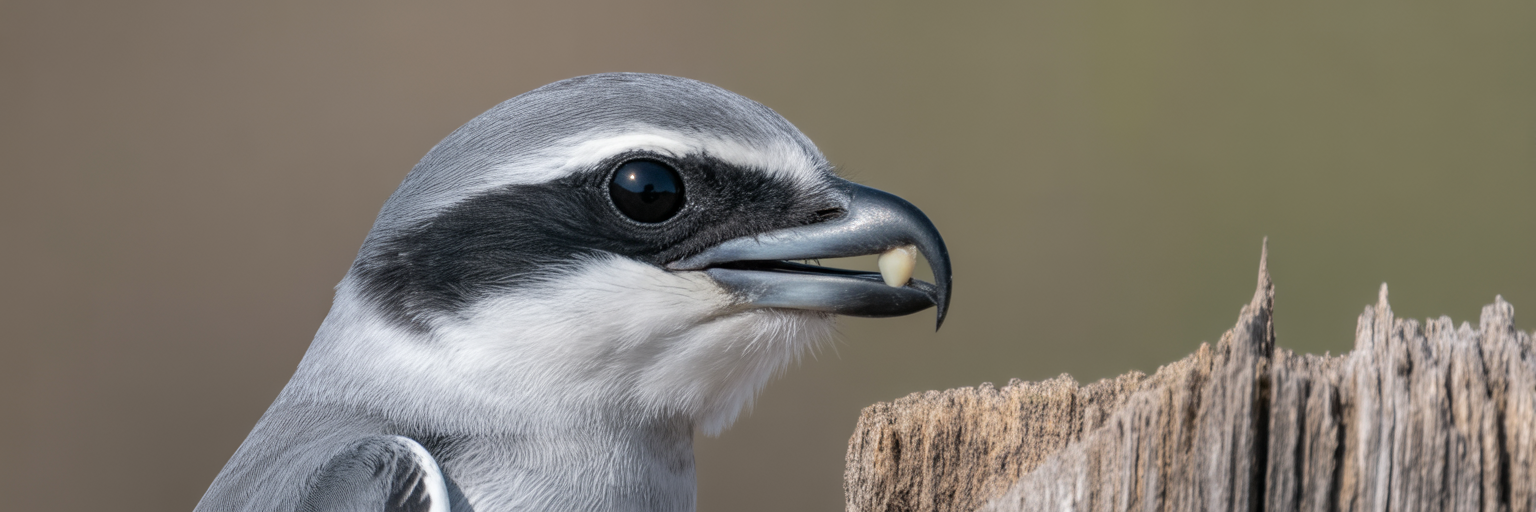
The shrike’s most formidable weapon is its beak. While it may look like a typical songbird beak from a distance, a closer look reveals a feature worthy of a raptor. The tip is sharply hooked, perfect for tearing into flesh. But the true innovation is a small, sharp projection on each side of the upper mandible called a “tomial tooth.” This isn’t a true tooth like a mammal’s, but a razor-sharp notch in the beak’s keratin. This anatomical feature is the shrike’s execution tool.
Unlike a hawk, which uses its powerful talons to crush or suffocate its prey, the shrike uses precision. After ambushing a mouse or a small bird, it uses its beak to deliver a swift, targeted bite to the back of the neck. The tomial tooth slides between the vertebrae, cleanly severing the spinal cord. It’s a neurologically devastating attack that paralyzes and kills the victim almost instantly. This method is brutally efficient, allowing the shrike to take down prey that is sometimes as large as itself, a feat made possible by its surprisingly strong neck and jaw muscles.
The critical difference between a shrike and a true raptor is what happens next. A hawk can hold its meal down with one foot and tear it apart with its beak. A shrike cannot. Its songbird feet are too weak to grip a struggling lizard or hold a dead mouse steady. This evolutionary shortcoming is the direct driver for its signature impaling behavior. It needed a way to secure its food to eat it. The kill itself is a masterclass in precision, but it’s only the first step in a much stranger process.
The Gruesome Gallery: Why the Shrike Bird Impales
The question that puzzles everyone who discovers this bird is simple: **why do shrikes impale** their victims? The answer is not a single one, but a collection of brilliant, if gruesome, solutions to the challenges of being a small predator. The impaled carcasses you might find decorating a thorn bush are not just for show. They serve several critical functions that are key to the shrike’s survival.
The Butcher’s Pantry: A Macabre Meal Prep
The most straightforward reason for impaling is food storage. Shrikes create a “larder” or “pantry” of skewered prey. This behavior allows them to cache food during times of plenty to be consumed later when hunting is difficult, such as during harsh weather or winter months. An impaled beetle or mouse is a ready-to-eat meal waiting for a rainy day. This foresight is a remarkable cognitive adaptation for a bird of its size.
A Makeshift Carving Station: Solving the Talon Problem
As mentioned, shrikes lack the powerful talons needed to hold their food while they eat. Impaling solves this problem perfectly. By wedging a carcass firmly onto a thorn or barbed wire, the shrike creates a stable anchor. This makeshift carving station allows it to use its hooked beak to rip and tear off bite-sized pieces of flesh without the meal sliding away. It’s a simple yet ingenious workaround for an anatomical limitation.
The Detoxification Chamber: Letting Toxins Expire
Perhaps the most fascinating function is detoxification. Some of the shrike’s favorite prey, like the vividly colored lubber grasshopper, are highly toxic. Shrikes have been observed impaling these poisonous insects and leaving them for several days before eating them. As a study in ScienceDirect notes, this behavior is a complex adaptation. The waiting period allows the toxins in the insect’s body to break down and degrade, rendering the meal safe to eat. The shrike essentially turns the thorn into a tiny detoxification chamber.
A Grisly Courtship Gift: A Larder of Love
For male shrikes, a well-stocked larder is more than just a pantry. It’s a status symbol and a courtship display. A male with an impressive collection of impaled lizards, mice, and large insects is demonstrating his hunting prowess to potential mates. A female will inspect his larder, and its size and quality are a direct signal of his fitness as a provider. A bigger, more gruesome gallery means he is a better hunter and more likely to be able to provide for her and their future offspring. Nature is full of bizarre survival strategies, and this behavior is as fascinating as the way a caterpillar that tricks ant colonies into raising it.
| Function | Description | Primary Benefit |
|---|---|---|
| Food Storage (Larder) | Prey is stored on thorns or wire for future consumption. | Ensures a stable food supply during winter or when prey is scarce. |
| Carving Station | The carcass is secured, allowing the shrike to tear off pieces of flesh. | Compensates for the lack of strong, gripping talons found in raptors. |
| Toxin Neutralization | Poisonous insects are left impaled for several days before being eaten. | Allows harmful toxins within the prey to break down and become safe to ingest. |
| Mating Display | Males create impressive larders to demonstrate their hunting skills to females. | Signals genetic fitness and ability to provide for offspring, increasing mating success. |
Note: This table summarizes the primary motivations behind the shrike’s impaling behavior. These functions are not mutually exclusive and often overlap, showcasing the bird’s remarkable evolutionary adaptations to its ecological niche.
A Killer’s Eclectic Menu
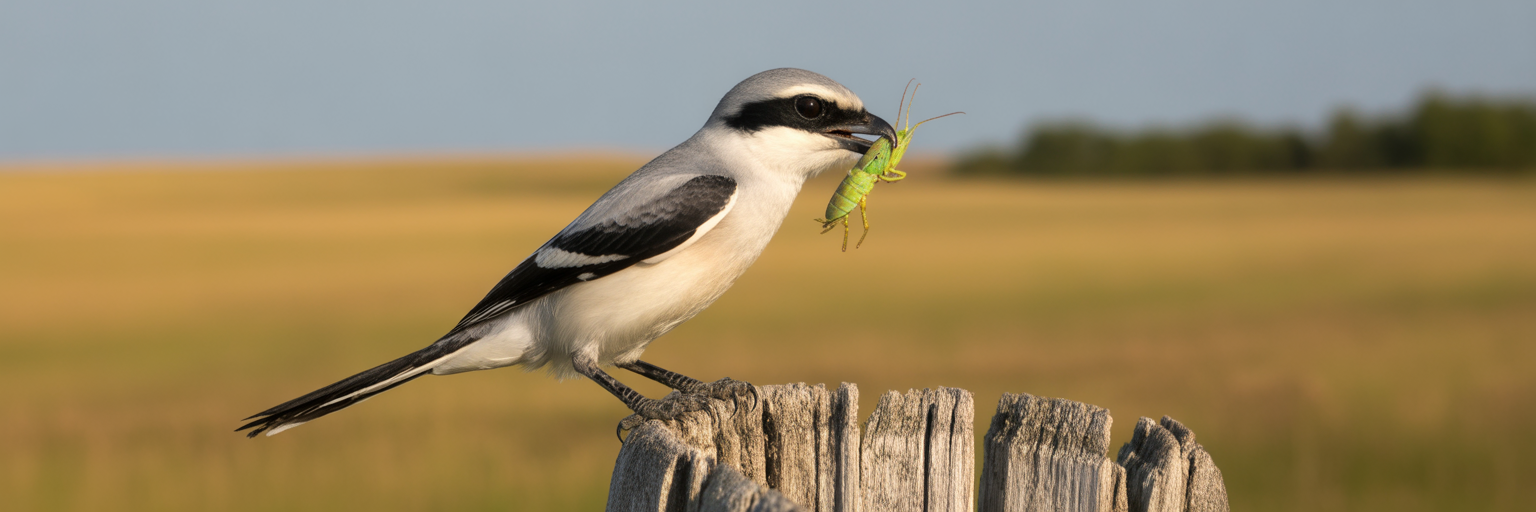
The shrike is not a picky eater. Its diet is a testament to its voracious appetite and opportunistic nature, ranging from the mundane to the truly shocking. The bulk of its meals consists of large insects. Grasshoppers, crickets, and beetles are staple foods, easily snatched from the ground or from low-lying vegetation. These are the bread and butter of the shrike’s larder, often found skewered in large numbers.
From there, the menu escalates. Shrikes regularly hunt small vertebrates, punching well above their weight class. They will readily take on lizards, frogs, and even small snakes. Rodents are also on the menu, with mice and voles falling victim to the shrike’s swift, neck-severing bite. Seeing a bird the size of a robin carrying a mouse is a startling sight, a clear demonstration of the David-and-Goliath dynamic that defines its hunting style.
But the most unsettling part of its diet is other birds. The **shrike bird** is a cannibal of the songbird world, preying on sparrows, finches, warblers, and other small birds that share its habitat. It will ambush them at feeders or chase them in mid-air, a songbird hunting a songbird. This behavior solidifies its reputation as a ruthless and formidable predator. The shrike’s hunting technique is as calculated as its diet is varied. It perches motionlessly on a high vantage point, like a telephone wire or the top of a tree, scanning the ground below with keen eyesight. Once it spots a target, it swoops down in a swift, silent ambush. This calculated hunting method is as specialized as that of the archerfish that shoots bugs out of the air with water.
The Butcherbird’s Social Life
While much of the shrike’s reputation is built on its solitary, violent acts of predation, its social life is surprisingly complex. The gruesome larder serves purposes beyond food and courtship. A well-stocked pantry also functions as a territorial marker, a clear and grisly warning to other shrikes to stay away. It’s a fence of corpses that communicates a simple message: this territory is occupied by a capable and deadly hunter.
The mating ritual offers a fascinating glimpse into their world. When a male tries to attract a mate, the female doesn’t just glance at his larder. She meticulously inspects it. She assesses the quantity, quality, and freshness of the impaled prey. A larder full of large, nutritious items like lizards and mice is far more impressive than one filled with small insects. This inspection is one of the most important **butcherbird facts**, as it shows that the female is making a calculated decision about the male’s ability to provide for their young.
Once paired, shrikes are dedicated parents. Both the male and female work to build a sturdy cup nest, and they share the duties of incubating the eggs and feeding the chicks. The larder becomes a critical resource for the family, providing a steady supply of food for the hungry, growing nestlings. In this context, the brutal hunting behavior is reframed as an act of parental devotion. This brutal efficiency in ensuring offspring survival is a common theme in nature, seen in cases where some animals hatch inside their mother and eat their siblings. For the shrike, every impaled victim is another guarantee that its lineage will continue.
An Uncertain Future for a Tiny Killer
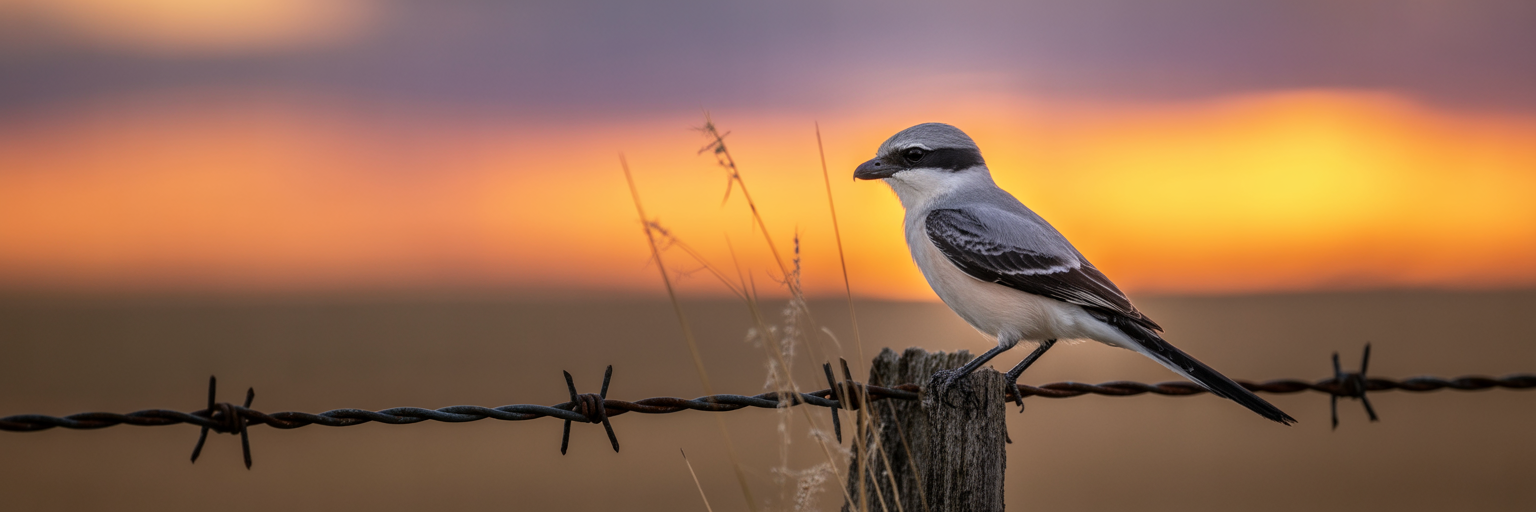
Despite its ferocity and ingenuity, the shrike is in trouble. Across North America, populations of the Loggerhead Shrike have been in steep decline for decades. This fascinating predator, once a common sight in open country, is slowly disappearing from the landscape. The reasons for its decline are tied directly to the very things that make its unique lifestyle possible.
The threats to the shrike are a direct result of human activity and changing landscapes. Understanding the nuances of **loggerhead shrike behavior** is key to grasping its vulnerability. The primary threats include:
- Habitat Loss: Modern agricultural practices often involve removing the very things shrikes need to survive. The clearing of hedgerows, thorny shrubs, and the replacement of traditional barbed-wire fences with smoother electric ones deprive shrikes of their essential impaling sites and perches. Without these tools, their primary hunting strategy becomes impossible.
- Pesticide Use: The widespread use of pesticides in agriculture has a devastating two-fold effect. First, it drastically reduces the populations of large insects like grasshoppers, which are a primary food source. Second, shrikes can suffer from bioaccumulation, where toxins from poisoned insects build up in their bodies over time, leading to sickness or death.
The decline of the shrike is more than just the loss of a single species. It serves as a warning. As a top predator of insects and small rodents, the shrike is an important indicator of ecosystem health. Its disappearance signals broader environmental problems that affect countless other species. Appreciating this strange, macabre, and utterly unique bird means recognizing its vital role in its environment and the urgent need to protect the wild spaces it calls home, before its gruesome galleries vanish forever.