Nature’s Most Elaborate Con Artist
An ant colony operates like a fortress. It is a marvel of social cohesion where millions of individuals work as one, guided by an unbreakable system of trust. Identity is not assumed, it is proven. Every member carries a chemical signature, a scent that acts as a passport, confirming its place in the collective. This system is the colony’s greatest strength, a security protocol that has worked for millions of years. It is also a fatal flaw waiting to be exploited.
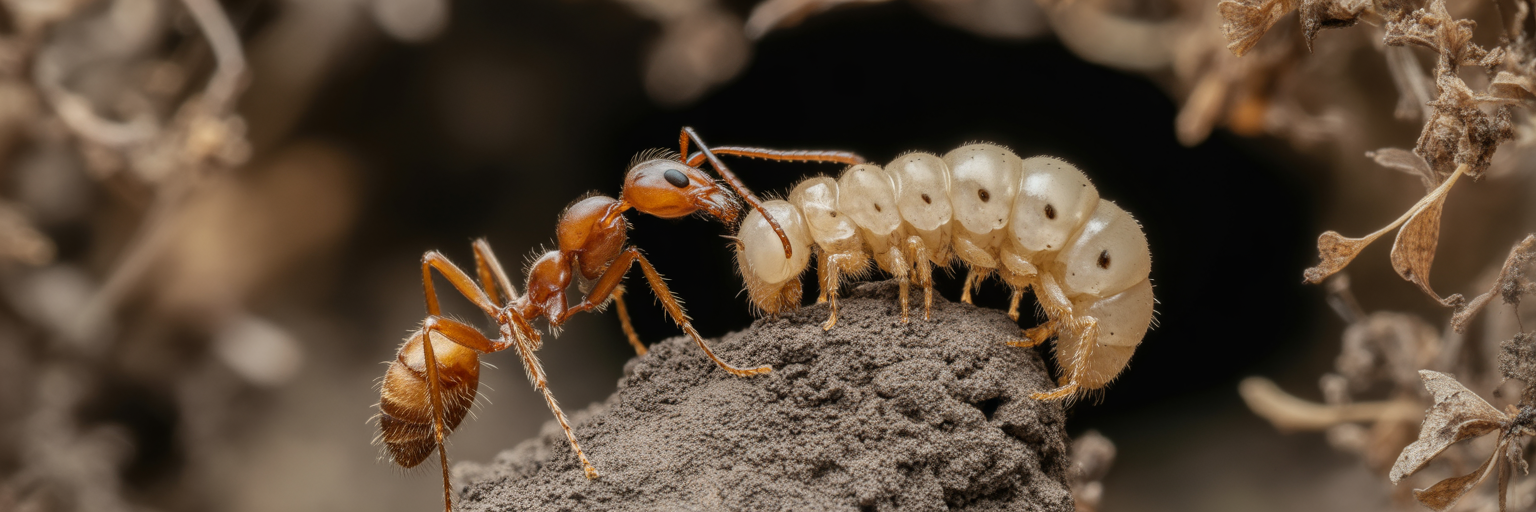
Enter the ultimate infiltrator. It is not a rival ant or a fearsome predator. It is a small, soft-bodied larva, a creature that should be an easy meal. But this is the Phengaris caterpillar, the larval stage of the Alcon blue butterfly, and it is a master criminal executing a flawless, multi-generational heist. It does not break into the fortress. It gets invited in, carried past the guards, and placed directly into the royal nursery.
This deception is not a simple trick. It is a calculated, multi-stage con that begins with forged chemical passports and escalates to stolen royal sound codes. The caterpillar turns the ants’ sophisticated social structure against them, hijacking their instincts for care and protection. For the vulnerable larva, this elaborate fraud is not a choice. It is the only path to survival.
The stakes are absolute. If the con is successful, the caterpillar will be raised as royalty. It will be protected by an army of deceived workers, fed the colony’s finest food, and cared for more diligently than the ants’ own young. If the con fails, if the disguise is even slightly imperfect, the caterpillar will be instantly identified as an intruder. It will be swarmed, stung, and torn apart by the very workers it sought to fool.
This raises a series of unsettling questions. How does a seemingly simple larva orchestrate such a complex deception? What precise tools does it use to fool a superorganism built on chemical verification? And why do the ants fall for it so completely, betraying their own kin for a parasite that will drain their resources and devour their young?
The Art of Chemical Deception
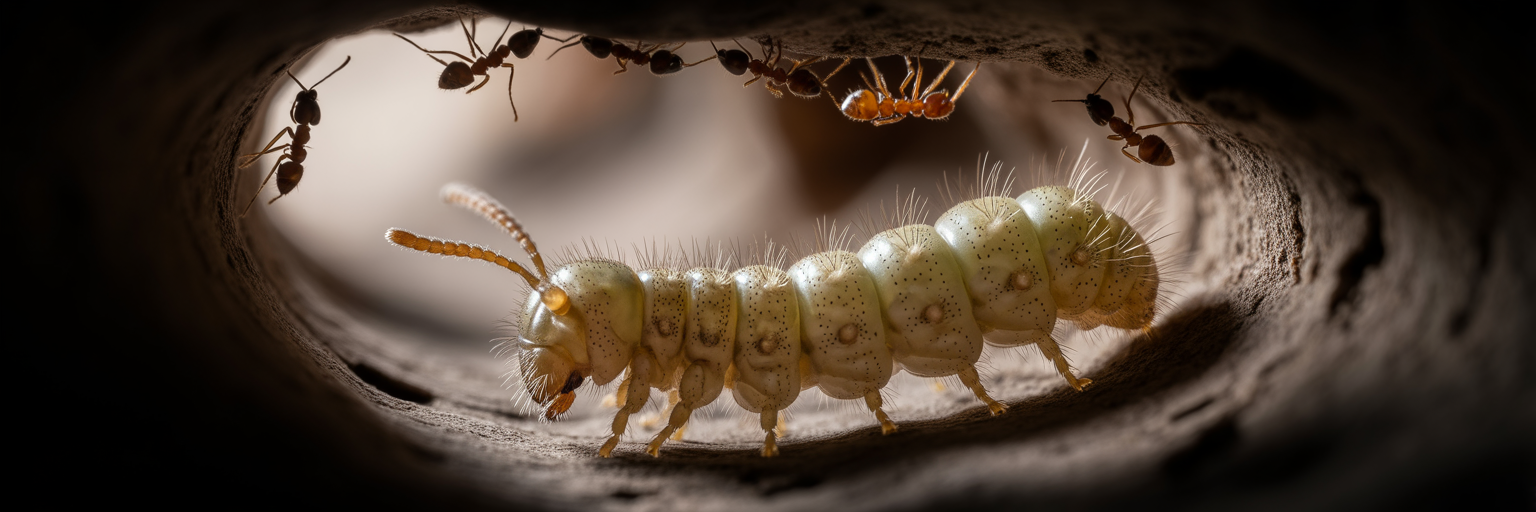
The first stage of the heist is a masterpiece of forgery. The caterpillar must convince the ants that it is one of them, and in an ant’s world, identity is determined almost entirely by smell. This is the science of chemical mimicry in insects, and the Phengaris caterpillar is its most unnerving practitioner.
The Colony’s Chemical Password
Ants perceive their world through a complex language of chemicals. Their bodies are coated in a specific blend of compounds called cuticular hydrocarbons (CHCs). This CHC profile is not just a scent. It is a uniform, a passport, and a family crest all in one. It is unique to each colony, allowing ants to instantly distinguish between a nestmate and a foreign intruder. Any organism that does not carry the correct chemical password is treated as a threat.
Forging a Perfect Identity
The Phengaris caterpillar has evolved the incredible ability to crack this code. After hatching and feeding on its host plant, it begins to synthesize or acquire a CHC profile that is a near-perfect match for the larvae of its target host, a specific species of *Myrmica* ant. This is not a generic “ant smell.” It is a highly specific, flawless forgery of the scent of a helpless ant larva. The precision required is staggering. The caterpillar must replicate the exact chemical composition that screams “I am one of your babies, and I am lost.”
The Moment of Deceptive Adoption
Now the stage is set for the adoption. The caterpillar drops from its plant to the ground and waits. When a foraging *Myrmica* worker discovers it, the ant’s senses are completely hijacked. Its brain registers the chemical signals not of prey, but of a lost member of its own brood. All instincts to attack vanish, replaced by an overwhelming urge to protect. The worker ant gently picks up the parasitic caterpillar and carries it back to the nest, believing it is performing a noble rescue. It walks right past the guards, its precious cargo’s chemical passport granting them both unrestricted access. While the caterpillar uses scent, this is just one form of natural fraud. Other animals rely on visual tricks, a tactic we explored in our article on how fake eyes scare predators.
Infiltrating the Fortress
Getting the chemical disguise right is only half the battle. The caterpillar must also execute a perilous physical journey, a sequence of events where a single misstep means certain death. This is the most vulnerable part of the Alcon blue butterfly life cycle, a high-stakes gamble that relies on precision, timing, and luck.
The infiltration unfolds in a series of calculated stages:
- The Precise Egg Placement: The adult Alcon blue butterfly does not lay its eggs randomly. It carefully selects a specific host plant, often a species of gentian, that is growing in close proximity to a nest of its target *Myrmica* ant species. The entire con is planned before the caterpillar is even born.
- A Brief, Normal Life: After hatching, the caterpillar spends a short time feeding on the flowers of the host plant. This is the only conventional part of its larval stage, as it builds up just enough energy for the next phase.
- The Perilous Drop: Having reached a specific point in its development, the caterpillar does something that defies all logic for a soft, slow-moving creature. It deliberately drops from the safety of its plant to the exposed ground below.
- The Tense Audition: Now completely vulnerable, the caterpillar waits. It is an open invitation for predators, and discovery by the wrong species of ant would be fatal. It must be found by a worker from the correct *Myrmica* colony, the one whose chemical signature it is programmed to mimic.
- The Deceptive Adoption: A duped worker ant, convinced it has found a lost larva, carries the caterpillar into the nest. Its perfect chemical disguise acts as an all-access pass, allowing it to bypass layers of security that would stop any other intruder.
This entire process is a testament to an incredibly specialized host-parasite relationship. As detailed in scientific resources, including Wikipedia’s extensive entry on Phengaris rebeli, the caterpillar’s life is intricately tied to both its host plant and its host ant. Without this precise sequence of events, the entire lineage would collapse.
Speaking the Language of Royalty
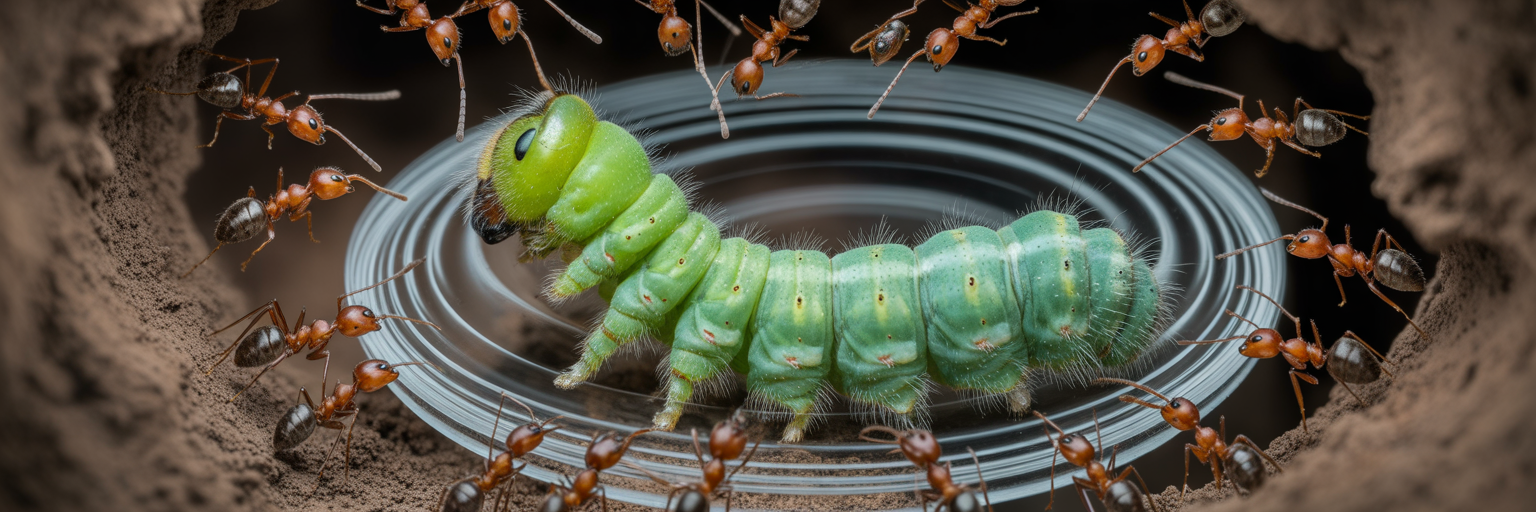
Smelling like an ant larva gets the caterpillar through the door. But what happens next is what elevates this deception from a simple trick to a masterpiece of manipulation. Once inside the nest, the caterpillar deploys its second, more sophisticated weapon: sound. It does not just want to be accepted. It wants to be worshipped.
The world of an ant colony is not silent. It is filled with subtle acoustic signals. Ants communicate using stridulations, which are faint sounds created by rubbing parts of their body together. These sounds convey information about status and needs. The most important sound in the entire colony is the one made by the queen. Her unique, high-status stridulation commands the workers’ utmost attention and care. It is a sound that says, “I am the heart of this colony. Serve me.”
This is where the caterpillar performs its masterstroke of acoustic deception in animals. The Phengaris caterpillar has evolved the ability to produce sounds that are nearly identical to the stridulations of a *Myrmica* queen. It has learned to speak the language of royalty. This incredible claim is not speculation. As highlighted in a study reported by Physics Today, scientists who placed sensitive microphones inside nests discovered the mimicry. They recorded the caterpillar’s sounds and the queen’s, finding them to be a near-perfect match.
Playback experiments confirmed the deception’s power. When the caterpillar’s sounds were played, worker ants immediately prioritized the source, rushing to attend to it just as they would their own queen. The impact is profound. The workers are chemically and acoustically tricked into believing this parasitic larva is the most important individual in the colony. This ensures it receives preferential treatment, a level of care far beyond that of a common larva. The caterpillar’s use of sound is a bizarre sensory adaptation, much like how some creatures have evolved unusual hearing mechanisms, such as the creature that can hear with its knees.
Life as a Deceptive Prince
The successful infiltration and acoustic mimicry lead to a truly unsettling outcome for the ant colony. The caterpillar now lives a life of privilege inside the royal brood chambers, a life built on lies. The full scope of how the caterpillar tricks ants becomes horrifyingly clear as it exploits their social structure from within.
The parasite is cleaned, protected, and fed directly by the worker ants. It receives food through trophallaxis, the mouth-to-mouth regurgitation process normally reserved for the queen and the most valuable young. But the deception goes even deeper. During times of scarcity, when the colony is struggling for food, the ants’ priorities are completely warped. They will sacrifice their own larvae, feeding them to the parasitic caterpillar to ensure its survival. They are so convinced of its royal status that they will kill their own children to feed the imposter.
Some species of Phengaris are not content to be passively fed. They become active predators within the nursery, preying on the ant eggs and larvae around them. The duped workers stand by, continuing to groom and protect the cannibal as it devours their sisters. The parasite is not just a resource drain. It is a monster in the heart of the family, dismantling the colony’s future generation by generation.
| Factor | Phengaris Caterpillar (The Parasite) | Myrmica Ant Larva (The Native) |
|---|---|---|
| Status in Colony | Treated as royalty due to acoustic mimicry | Treated as a common member of the brood |
| Feeding Method | Direct mouth-to-mouth feeding (trophallaxis) from workers | Receives standard feeding, often less prioritized |
| Food Priority | Receives the most nutritious food first | Fed after the parasite and other high-status members |
| Fate During Scarcity | Protected at all costs; may be fed the ants’ own larvae | Sacrificed and fed to the parasite or other colony members |
| Protection | Guarded fiercely by worker ants | Receives standard protection, but is expendable |
| Behavior | Passively receives care or actively preys on ant brood | Passively awaits care from workers |
This table starkly illustrates the injustice. The caterpillar’s deception secures it a superior and ultimately fatal position within the colony. It is an extreme survival strategy, pushing the boundaries of what seems possible, much like the animal that survives by shrinking its own organs.
The Evolutionary Payoff for a Life of Deceit
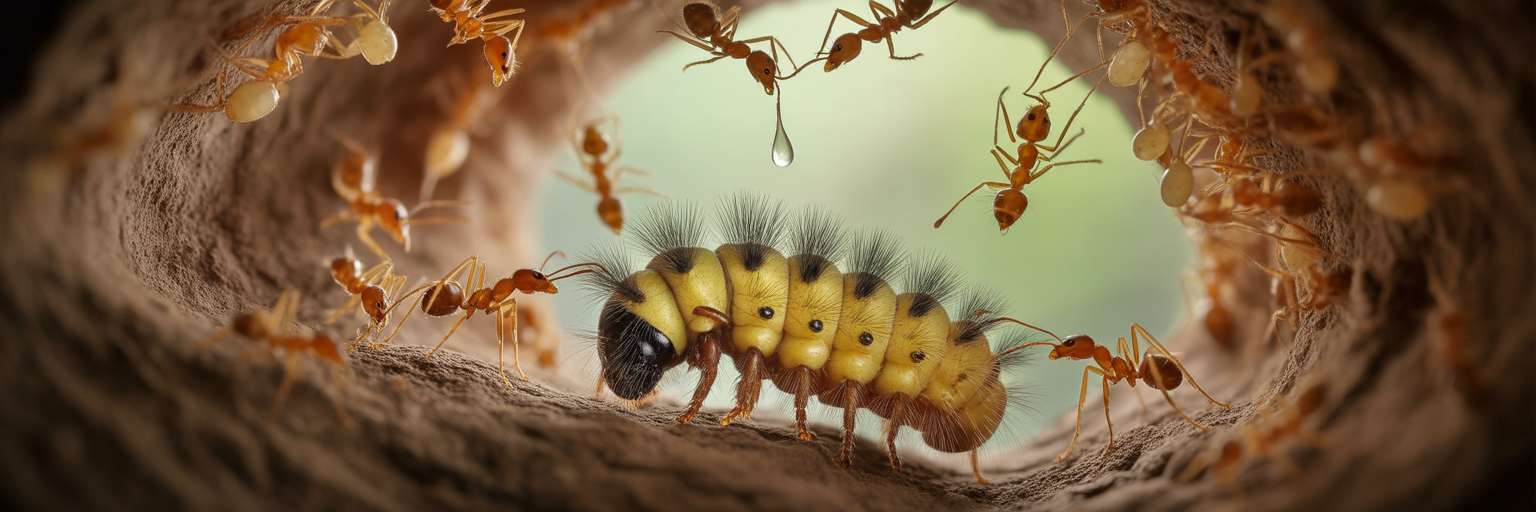
Why would evolution favor such a bizarre, high-risk strategy? The answer lies in the immense payoff that comes with a successful con. An ant nest is the perfect incubator, a fortress that offers solutions to every problem a vulnerable larva faces.
The contrast between life outside the nest and life inside is stark:
- Outside: A world of constant threat. The caterpillar faces a high probability of being eaten by birds, spiders, or other insects. It is exposed to rain, drought, and temperature swings. It must constantly search for food.
- Inside: A world of absolute safety. The nest is temperature-controlled, predator-free, and stocked with a constant supply of food. The caterpillar is protected by an entire army of loyal guards.
This specialized evolutionary path is a gamble. It requires a perfect chemical and acoustic match, and the sheer luck of being found by the right ant at the right time. But the reward is a near-guaranteed chance of reaching adulthood, a dramatic increase in survival compared to its free-living relatives. The deception is worth the risk because the prize is life itself.
The final act of the Alcon blue butterfly life cycle is just as tense. After spending nearly a year inside the nest, the caterpillar pupates. When the adult butterfly emerges from its pupal case, its disguises no longer work. Its scent and sound are now that of a butterfly, not an ant queen. It is instantly recognized as an intruder. The butterfly must crawl through the dark tunnels and escape the nest as quickly as possible, before the very ants that raised it as their queen realize they have been conned and turn on it with lethal force.
A Wider World of Natural Deception
The story of the Phengaris caterpillar, while extreme, is not entirely unique. It is a chilling example of a widespread evolutionary strategy known as brood parasitism. The most familiar of brood parasitism examples is the cuckoo bird, which lays its eggs in the nests of other birds, tricking them into raising its young. The caterpillar simply takes this deception to a far more intimate and manipulative level.
This relationship also illustrates the concept of an “evolutionary arms race.” The ants are not helpless victims forever. Any ant colony that evolves a slightly better ability to detect the parasite’s chemical or acoustic forgery gains a massive survival advantage. This, in turn, puts evolutionary pressure on the caterpillar to perfect its deception even further. It is a perpetual cycle of spy versus counter-spy, played out over thousands of generations in the dark tunnels beneath our feet.
The unsettling truth revealed by this story is that survival in nature is not always about being the strongest, fastest, or most venomous. Sometimes, it is about being the most effective manipulator. The caterpillar turns the ants’ greatest strength, their unwavering social unity, into their greatest vulnerability.
The Phengaris caterpillar is a living testament to the bizarre, ruthless creativity of evolution. It is a real, documented phenomenon that feels like it belongs in science fiction. It reminds us that the natural world is filled with deceptions and tricks far stranger than we can imagine, like the bird that builds fake doors to confuse predators, proving that truth is often more unsettling than fiction.