

Nature’s Most Devious Plant Impostor
Meet the hammer orchid, nature’s ultimate botanical catfish. This is not just a plant that looks a bit like an insect; this is a calculating impostor so committed to its lie that it has abandoned nectar, sweet scents, and bright colors entirely. Its entire survival hinges on a high-stakes con with absolutely zero reward for its target. This is one of the weirdest plants in the world, a master of deception with roots.
The scam is known as pseudocopulation, a term that sounds clinical but describes a truly bizarre act. The orchid tricks male thynnid wasps into attempting to mate with its flower. The wasp gets nothing, not even a sip of nectar for its trouble. The orchid, however, gets everything it needs to reproduce. It’s a relationship built on pure, one-sided exploitation.
You might expect such a devious organism to be a towering, menacing figure in the plant kingdom. But the Drakaea orchid is surprisingly unassuming. Native to the sandy soils of Western Australia, it grows low to the ground, often just a single, heart-shaped leaf and a slender stalk. This modest appearance is the perfect cover for its sophisticated deception. It’s the quiet neighbor you’d never suspect of running an elaborate pollination racket.
This contrast between its humble look and its manipulative strategy is what makes it so fascinating. It’s a stationary organism that has evolved to perfectly mimic the look, feel, and even the specific sex pheromones of a female insect. So, how does a plant with no brain, no eyes, and no ability to move pull off one of the most specific and strangest scams in the natural world?
Dressed to Deceive: The Orchid’s Wasp Costume
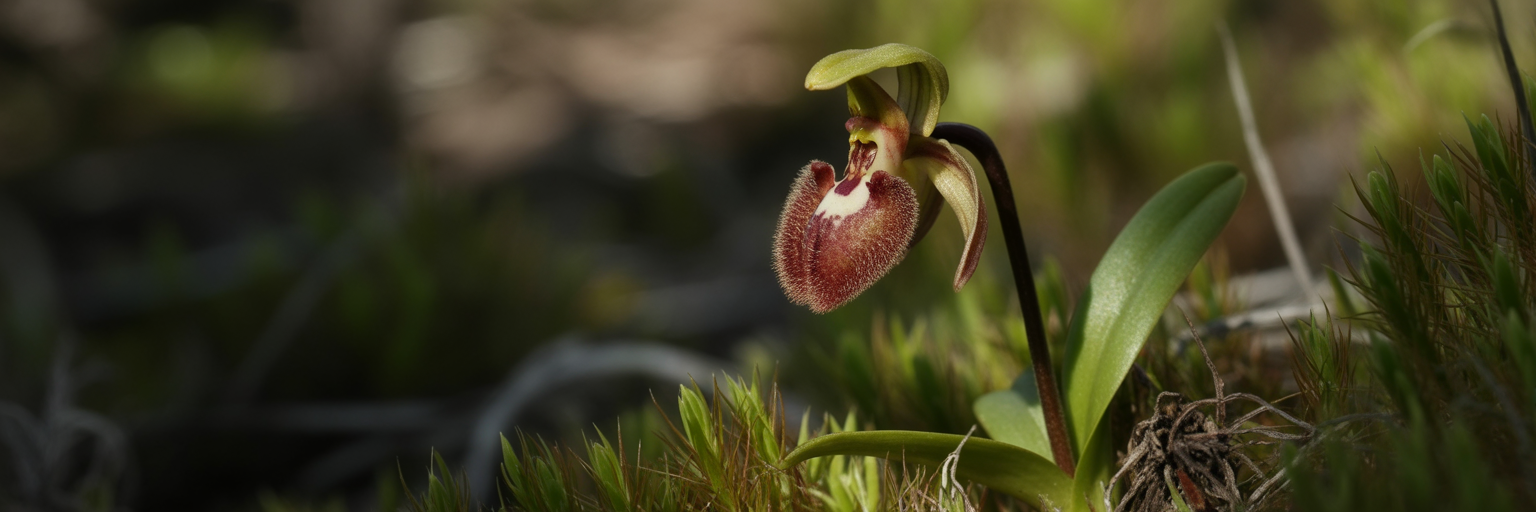
The first step in any good con is looking the part, and the hammer orchid is a master of disguise. The deception is centered on a single, modified petal called the labellum. This is not just a petal; it’s a meticulously crafted wasp dummy, a piece of botanical art designed for one purpose: to fool a very specific, very horny male wasp. This is the orchid’s profile picture, and it has been carefully curated to be irresistible.
The labellum is dark, hairy, and vaguely lumpy, with a dull sheen that mimics the chitinous exoskeleton of an insect. It looks less like a flower and more like a piece of dried-up bug stuck on a stem. But this isn’t a vague resemblance. It’s a precise imitation of a female thynnid wasp. The female of this particular wasp species is flightless. To find a mate, she climbs to the top of a twig or stem and waits for a male to spot her and carry her away. The orchid positions its labellum at the exact height and posture a real female wasp would adopt, creating a visual trigger the male is biologically programmed to respond to.
The shape and texture also serve a crucial tactile purpose. When the male wasp arrives, drawn in by other cues, the labellum feels right. It provides a convincing landing strip and a solid grip, reinforcing the male’s belief that he has found a receptive female. He grabs onto the dummy, ready to fly off with his prize, completely unaware that he is a pawn in a much larger game. The orchid’s strategy of mimicking another creature for its own benefit is a fascinating example of evolutionary deception. This tactic is not unique in the animal kingdom, as seen in the case of the caterpillar that tricks ant colonies into raising it, a story that showcases a similar level of manipulative genius.
This visual and tactile mimicry is so effective that it sets the stage for the next, more violent part of the con. The male wasp is convinced he has found his mate, and his instincts take over. He has no reason to doubt what his eyes and legs are telling him. The trap is set, and the orchid is just waiting for the wasp to make his move.
The Alluring Perfume of a Phantom Female
While the orchid’s wasp costume is convincing up close, it’s the invisible weapon that does the heavy lifting. The most critical part of this plant that mimics insects is its scent. The hammer orchid has essentially hacked the private communication channel of the thynnid wasp, synthesizing a chemical blend that is a near-perfect forgery of the female’s sex pheromones. This isn’t just a generally sweet or floral smell; it’s a highly specific, targeted chemical signal designed to attract one, and only one, species of pollinator.
This chemical warfare is incredibly precise. The orchid produces a cocktail of compounds, including specific hydroxymethylpyrazines, that are chemically indistinguishable from the pheromones released by a ready-to-mate female thynnid wasp. This potent perfume travels on the breeze, acting as a long-range beacon that male wasps simply cannot ignore. It’s a scent that promises the ultimate biological reward, and it draws them in from far and wide, ensuring that the orchid doesn’t waste its efforts on the wrong insects.
Scientists were so intrigued by this orchid sexual deception that they used advanced methods to confirm the forgery. According to research highlighted by Chemistry Europe, scientists have been able to isolate the exact chemical components in the orchid’s scent. Using a technique called gas chromatography–electroantennography (GC-EAD), they were able to test the orchid’s chemical compounds against the antennae of live male wasps. This method allowed them to see exactly which molecules triggered a neural response in the wasp. The results were stunning: the orchid was producing the exact same key compounds as the female wasp. It wasn’t just a similar scent; it was a counterfeit so perfect that the wasp’s own sensory system couldn’t tell the difference.
This chemical mimicry is the true genius of the orchid’s scam. It ensures that only the right victim shows up, ready to be duped. The visual lure confirms the target up close, but the scent is what initiates the entire interaction. The wasp is flying blind, guided by an irresistible lie whispered on the wind.
| Cue Type | Hammer Orchid’s Lure (The ‘Catfish’) | Female Thynnid Wasp’s Signal (The Real Deal) | Purpose of the Signal |
|---|---|---|---|
| Visual Cue | Dark, hairy, insect-shaped labellum positioned on a stem. | Dark, hairy, flightless female body climbing a stem. | Provides a close-range confirmation and landing target. |
| Chemical Cue | Synthesizes a precise blend of hydroxymethylpyrazines and other compounds. | Releases a species-specific sex pheromone containing the same compounds. | Acts as a long-range attractant to guide males. |
| Tactile Cue | Lumpy, textured labellum provides a convincing grip for the male. | The actual body of the female wasp. | Confirms physical contact and encourages mating attempt. |
| Reward Offered | None. The wasp wastes time and energy. | A genuine mating opportunity. | Ensures the continuation of the wasp species. |
The Hammer Orchid’s Bait-and-Switch Pollination
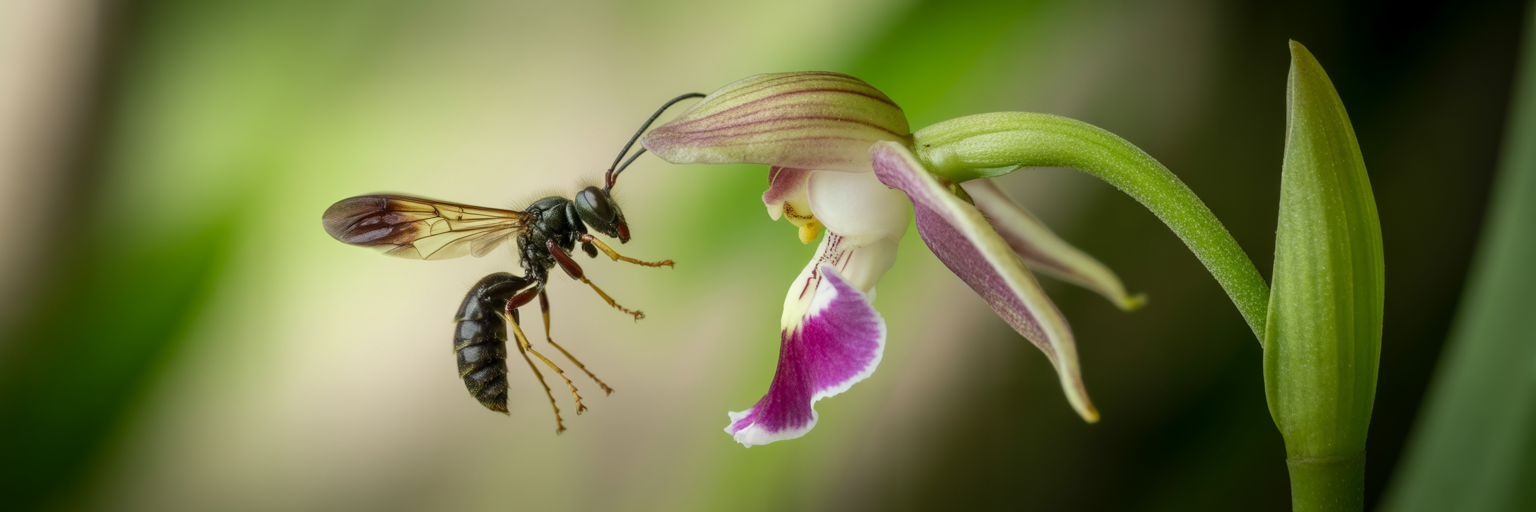
With the male wasp completely fooled by the visual and chemical lures, the final act of the deception begins. This is where the hammer orchid gets its name, and it’s a moment of pure, mechanical violence. The climax of this bait-and-switch is a physical interaction that turns the wasp from a hopeful suitor into an unwitting postal worker. The entire process is a stunning display of botanical engineering, a spring-loaded trap that uses the wasp’s own instincts against it.
The sequence of events is as brutal as it is brilliant:
- The Grab: The male wasp, convinced he has found a female, lands on the labellum. He firmly grips the dummy and attempts to fly away with it, just as he would with a real mate. This is the critical mistake the orchid has been waiting for.
- The Swing: The labellum is attached to the rest of the flower by a thin, spring-loaded hinge. The force of the wasp trying to lift off triggers this hinge, causing the entire labellum arm to swing rapidly in an arc.
- The Slam: The wasp, still clinging to the dummy for dear life, is violently slammed against the orchid’s reproductive column. The motion is so fast and forceful that it resembles a tiny, flowery hammer striking an anvil.
- The First Delivery: As the wasp’s body hits the column, a sticky packet of pollen, called a pollinium, is precisely glued onto its thorax. The placement is exact, ensuring it will be in the right position for the next step.
- The Confused Departure: The wasp, having been thwacked against a flower part instead of flying off with a mate, is likely confused. It received no reward, only a mild concussion. It lets go and flies away, now carrying the orchid’s pollen like an unwanted backpack.
- The Second Scam: The con isn’t over. The wasp, driven by the same powerful instincts, eventually falls for the same trick on a different hammer orchid. It grabs the new dummy, gets swung and slammed again, but this time, the pollinium from the first flower is perfectly deposited onto the second flower’s stigma, completing the act of thynnid wasp pollination.
The wasp is used as a tool, twice, all for the benefit of a plant that offered it nothing. The swift, mechanical action of the orchid is a stunning display of botanical engineering. This rapid movement is reminiscent of other fast-acting plants, such as the Venus flytrap, which is a plant that can count before it eats, showcasing another form of sophisticated plant behavior.
The Science Behind Nature’s Strangest Scam
The hammer orchid’s elaborate con is not just a weird fluke of nature; it’s an extreme example of a recognized evolutionary strategy known as orchid sexual deception. This strategy has evolved independently in various orchid groups around the world, but Australian orchids are a particular hotspot for this kind of manipulative behavior. The hammer orchid, however, takes it to another level with its “dual-mimicry” system. It doesn’t just mimic the scent or the look; it mimics both with incredible fidelity. One lure without the other would likely fail, making this a high-stakes, all-or-nothing approach.
This level of exploitation, where one species manipulates another’s core instincts, is a recurring theme in nature. A similarly one-sided relationship is seen in the parasite that drives a snail to sacrifice itself, another chilling example of behavioral control. In the orchid’s case, the deception is so complete that it raises questions about which part of the mimicry is more important.
Recent research suggests that while the visual disguise is crucial for the final stage of the con, the pheromone forgery is the most critical component. An experimental evaluation of traits in sexually deceptive orchids published in the Journal of Evolutionary Biology found that odor-mediated cues are the primary driver of pollinator behavior. This means that a powerful and accurate scent can be so effective that it can compensate for a less-than-perfect visual disguise. The orchid’s perfume is so intoxicating that it can convince a male wasp to investigate something that, upon closer inspection, might not look exactly like a female. The scent essentially overrides any minor doubts the wasp might have, proving that in the world of sexual deception, a good perfume is everything.
An Evolutionary Arms Race Without an Enemy
Typically, when we see such a complex relationship between two species, we think of an evolutionary arms race, where each side is constantly adapting to outsmart the other. But the dynamic between the hammer orchid and the thynnid wasp is something different. It’s a completely one-sided affair where the orchid is the only participant actively evolving. The wasp is not an enemy; it’s a victim, trapped in a sensory prison of its own making.
This begs the question: why don’t the wasps evolve to avoid the trick? Why don’t they learn to recognize the fake female? The answer lies in a concept known as a “sensory trap.” The male wasp’s drive to find a mate is one of the most powerful and fundamental instincts it has. The evolutionary cost of ignoring a potential real female is enormous—it means failing to pass on its genes. The cost of occasionally being fooled by an orchid, however, is relatively low. It wastes a bit of time and energy, but it isn’t fatal.
Because the orchid’s signal is such a perfect forgery of the real thing, the wasp is caught in a terrible bind. To evolve resistance to the orchid’s lure, it would also have to evolve resistance to the lure of a real female, which would be evolutionary suicide. The orchid has perfectly exploited this non-negotiable, hardwired instinct. There is no strong selective pressure for the wasps to change their behavior, especially since the orchids are not common enough to significantly harm the wasps’ overall reproductive success. The orchid’s hunting method is passive but incredibly precise, relying on fooling its target’s senses. Other predators use more active but equally specialized sensory tactics, like the star-nosed mole that eats faster than you can blink by using its bizarre nose to feel for prey with incredible speed.
This is not co-evolution. This is a masterful case of exploitation. The orchid has not evolved *with* the wasp; it has evolved to take advantage of the wasp’s pre-existing sensory biases. It has turned the insect’s most fundamental drive into a free, albeit violent, pollination service, making it one of the most fascinating Drakaea orchid facts.
The Fragility of a Perfect Con
The hammer orchid’s bizarre and ruthless scam is a testament to the creative power of evolution. It has developed one of the most specialized pollination strategies on the planet. But this hyper-specialization is a double-edged sword. The very thing that makes the orchid so successful is also its greatest weakness. Its entire existence is tied to the fate of a single, specific species of thynnid wasp.
This perfect, intricate relationship is incredibly fragile. The orchid has no Plan B. If its pollinator disappears, the orchid disappears too. This dependency creates several significant conservation risks in a rapidly changing world:
- Habitat Loss: Both the orchid and the wasp rely on the same native bushland in Western Australia. As this habitat shrinks due to development and agriculture, the wasp population can decline, leaving the orchid without a partner.
- Pesticide Use: Widespread use of insecticides can have devastating effects on non-target species like the thynnid wasp. A decline in the wasp population, even miles away, could spell doom for the orchid.
- Climate Change: The timing of the orchid’s flowering and the wasp’s emergence is perfectly synchronized. Climate change can disrupt these delicate life cycles, causing the flower to bloom when the wasps are not active, or vice versa.
The orchid cannot adapt quickly to these changes. This perfect mimicry took millions of years to evolve. In the face of rapid environmental shifts, it is left dangerously exposed. The story of the hammer orchid is a powerful and poignant reminder that the most specialized and clever relationships in nature are often the most vulnerable. Its genius is also its Achilles’ heel.