An Alien Presence Beneath Our Feet
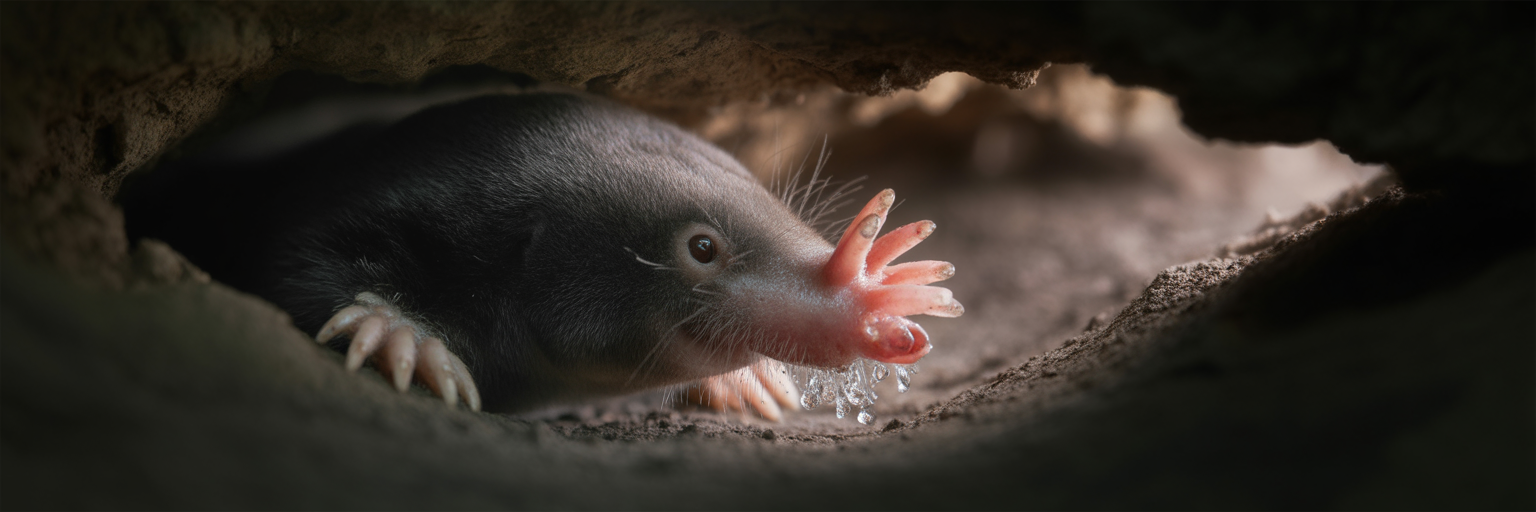
Beneath the damp soil of North American wetlands, in the mud and muck of swamps and marshes, lives something that defies easy explanation. It is not a creature of myth or a visitor from another world, though its appearance suggests both. It is the star-nosed mole (Condylura cristata), a small, burrowing mammal whose existence feels like a glitch in the code of biology. Forget what you think you know about moles. This animal is something else entirely.
Imagine digging into wet earth and unearthing a creature whose face is a writhing, fleshy star. Twenty-two pink, tentacle-like appendages radiate from its snout, constantly twitching and probing the darkness. It is a profoundly unsettling sight, a biological structure so strange it seems impossible. Yet, this is not a rare mutation or a deep-sea monster. The star-nosed mole is a common resident of eastern Canada and the northeastern United States, a living, breathing example of how profoundly bizarre the natural world can be.
In its subterranean world, sight is a useless luxury. The tunnels are a realm of absolute blackness, a place where survival depends not on what you see, but on what you can feel. This is the evolutionary problem that the star was built to solve. While other animals evolved keen eyes or sensitive ears, the star-nosed mole invested its entire being into the sense of touch. Its star-shaped nose is not a nose in the traditional sense. It is a hyper-sensitive tactile organ, an appendage that allows the mole to “see” its world through feeling.
The presence of this animal creates a strange feeling of cognitive dissonance. We associate such bizarre anatomy with the alien depths of the ocean or the pages of science fiction. To find it thriving in a mundane wetland habitat is a reminder that some of the most weird animals in North America are not in remote, inaccessible locations. They are often hidden just out of sight, operating by rules of biology that challenge our understanding. The Condylura cristata is a perfect testament to this fact. It is a creature so specialized, so extreme, that it forces us to reconsider the limits of evolution.
This brings us to the central mystery of this animal. What exactly is that star-like appendage, and how does it function? More importantly, how does this fleshy star enable the mole to operate at speeds that seem to violate the laws of biology? The answers reveal a sensory system so advanced and so efficient that it makes our own senses feel primitive by comparison. We are about to explore a world perceived not through light, but through the rapid, constant touch of a face made of fingers.
Anatomy of a Sensory Superweapon
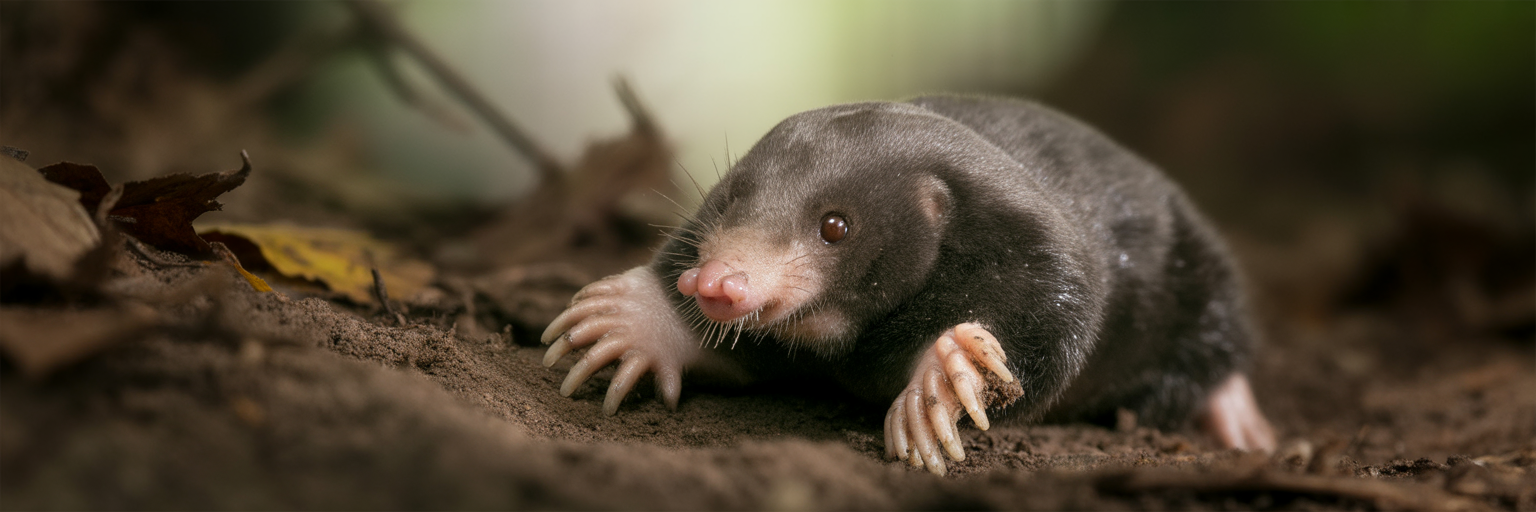
To understand the star-nosed mole, you must first understand its most defining feature. The star is not a cosmetic oddity. It is a biological superweapon, an organ of touch so sophisticated that it transforms the mole’s dark, muddy world into a high-resolution tactile map. Its structure and function are a masterclass in evolutionary engineering, where every component is optimized for speed and precision.
A Face Made of Fingers
The first thing to clarify is that the star is not a nose for smelling. It is a touch organ. Composed of 22 mobile, fleshy rays, or tentacles, this appendage is more like a pair of hands attached to the mole’s face. These rays are in constant motion, probing and palpating the environment with a disturbing, fluid grace. They are packed with nerve endings, making them one of the most sensitive touch structures in the entire animal kingdom. This extreme sensitivity is not a passive trait. The mole actively uses its star to build a three-dimensional picture of its immediate surroundings, feeling out the shape, texture, and location of everything in its path. This unique sensory adaptation is a powerful reminder of nature’s creativity. Other creatures have evolved equally strange systems, like the katydid, which is essentially a creature that can hear with its knees, but the mole’s star is a pinnacle of tactile perception.
The Power of Eimer’s Organs
The true secret to the star’s sensitivity lies at a microscopic level. The surface of each of the 22 rays is covered in tiny, dome-like structures known as Eimer’s organs. For those seeking an Eimer’s organs explained breakdown, these are highly specialized sensory receptors. The star-nosed mole has more than 25,000 of them packed onto its star, each one a complex sensor capable of detecting microscopic textures and pressure changes. Each Eimer’s organ is innervated by multiple nerve fibers, allowing it to transmit a rich stream of tactile data to the brain. This dense array of sensors gives the mole a level of touch resolution that is difficult to comprehend. It can distinguish between objects with incredible accuracy, identifying the subtle textural differences between a tiny insect larva and a worthless piece of grit in complete darkness.
A System of Constant Motion
The mole’s use of its star is not random. It follows a highly efficient, two-stage process that is remarkably analogous to human vision. The outer, larger rays (rays 1-10 on each side) are in constant, rapid motion. They perform a broad, sweeping scan of the environment, much like our peripheral vision. Their job is to detect anything of potential interest. When one of these outer rays touches something, the mole does not immediately try to eat it. Instead, it performs a second, more precise action. It swivels its entire star to bring the central, smallest pair of rays (ray 11 on each side) into contact with the object. This central pair forms what scientists call the “tactile fovea,” a high-resolution zone analogous to the center of our retina. The tactile fovea is used for detailed identification, confirming in milliseconds whether the object is food. This system of constant motion allows the mole to search a large area quickly while dedicating its most sensitive resources only to objects that warrant closer inspection.
| Component | Description | Primary Function |
|---|---|---|
| The Star | A fleshy, bilaterally symmetrical organ with 22 mobile rays or tentacles. | The primary interface for interacting with and mapping the environment through touch. |
| Rays 1-10 (per side) | The outer, larger rays that are in constant motion. | Broad, low-resolution scanning of the immediate area to detect potential objects of interest. |
| Ray 11 (per side) | The smallest, central pair of rays, forming the ‘tactile fovea.’ | High-resolution identification and detailed analysis of objects, especially potential food. |
| Eimer’s Organs | Microscopic sensory receptors, with over 25,000 covering the star. | Detecting fine-grained textural information, pressure, and movement at a microscopic level. |
The 120-Millisecond Hunt
The star-nosed mole holds a remarkable title. It is the fastest eating animal on Earth. This is not an exaggeration. Its ability to find, identify, and consume prey is so rapid that it operates at the very limits of what is biologically possible. The entire hunting sequence is a blur of motion, a process so fast that it is invisible to the naked human eye. To appreciate this incredible feat, we must slow it down and examine it step by step.
The hunt begins the moment one of the star’s rays makes contact with a potential food item, such as a tiny worm or an aquatic insect. From that first touch to the final swallow, the entire process can take as little as 120 milliseconds. To put that number in perspective, a human eye blink takes between 300 and 400 milliseconds. The star-nosed mole can find and eat a piece of food two to three times in the time it takes you to blink once. This almost unbelievable speed is not speculation. As reported in a study featured by Scientific American, the entire process from the first touch of the star to the complete ingestion of a food item can be completed in as little as 120 milliseconds, making it the fastest foraging behavior ever recorded in a mammal.
So, how do moles hunt at this impossible speed? The sequence is a marvel of neural efficiency:
- Initial Contact: As the mole burrows, its constantly moving star touches an object.
- Brain Processing: The tactile information from the star travels to the mole’s brain. The brain identifies the object’s texture and shape in as little as 8 milliseconds. This is faster than some individual neurons can fire.
- The Decision: Based on this near-instantaneous analysis, the brain makes a “go/no-go” decision. If the object is identified as food, a signal is sent to initiate the eating motion.
- Ingestion: The mole rapidly repositions its head and snaps up the prey with its tweezer-like incisors. The entire motion, from the decision to the swallow, is a fluid, explosive action.
This entire four-step process is completed in just over a tenth of a second. The mole’s reaction time is so fast that if it touches two objects in quick succession, one being food and one being non-food, it can decide to eat the first one and have already moved on before its brain has even fully registered the second. It is a system built for pure, unadulterated speed. This hunting strategy is a marvel of efficiency, but it is not the only creature to develop bizarre survival tactics. In the insect world, for example, some species have evolved equally strange behaviors, such as the phenomenon explained in why do bugs flip over when they die, a seemingly simple event with complex biological reasons.
The mole’s prey consists of tiny invertebrates, worms, and aquatic insects found in its wet, marshy habitat. Because each individual prey item is so small and offers little caloric reward, the only way for the mole to survive is to consume a huge number of them. Its speed is the key. By minimizing the time it takes to handle each piece of food, the mole can eat enough to meet its high metabolic needs. It is a strategy of quantity over quality, made possible by the most efficient foraging system in the mammalian world.
A Brain Rewired for Extreme Touch
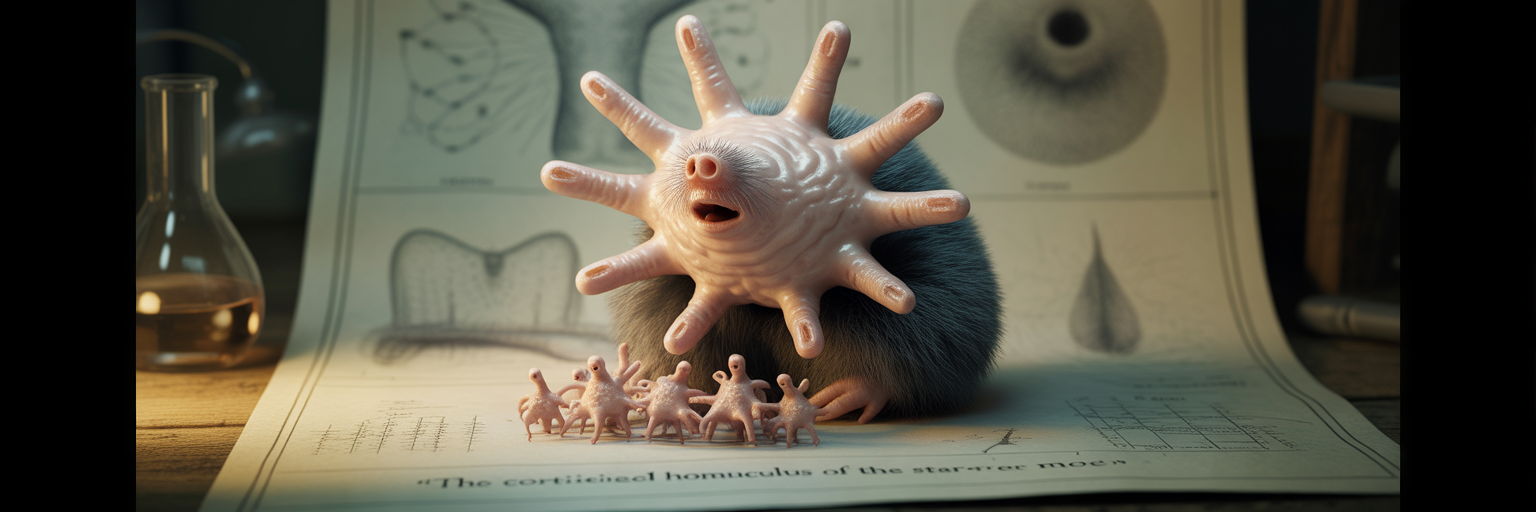
The star-nosed mole’s incredible speed is not just a product of its unique nose. The star is merely the hardware. The true engine behind its 120-millisecond hunt is the software: a brain that has been profoundly and grotesquely rewired to serve a single purpose. A massive portion of the mole’s cerebral cortex is dedicated exclusively to processing the torrent of sensory information coming from its star. This neurological specialization is what allows for the near-instantaneous decision-making that defines its existence.
To visualize this, scientists use a concept called the cortical homunculus. This is a distorted representation of the human body, where body parts are drawn in proportion to how much brain tissue is devoted to them. In a human homunculus, the hands and lips are enormous, reflecting their sensory importance. If we were to create a homunculus for the star-nosed mole, it would be a monstrous figure. It would be almost entirely dominated by a gigantic, multi-fingered star. The rest of its body, its limbs, its torso, would appear as tiny, insignificant appendages by comparison. This unsettling image provides a powerful illustration of the mole’s sensory priorities. Its brain perceives the world almost entirely through the lens of its star.
The neural pathways connecting the star to the brain are like biological fiber-optic cables, transmitting data with almost zero delay. When a ray touches an object, the signal reaches the brain’s somatosensory cortex in a matter of milliseconds. The brain does not need to “think” in the way we do. The decision to eat is less a conscious choice and more of a reflex, hardwired into its neural architecture. This extreme biological trade-off, where one system is sacrificed to perfect another, is a recurring theme in nature. A similarly profound adaptation can be seen in the glass frog, the animal that turns transparent just long enough to survive by effectively vanishing.
This intense focus on touch has come at a significant cost. The star-nosed mole is functionally blind. Its eyes are tiny, poorly developed, and can likely do little more than detect the difference between light and dark. However, this should not be seen as a weakness. It is a profound evolutionary trade-off. The brain has reallocated the neural real estate that would normally be used for vision and repurposed it to enhance the sense of touch. In its world of total darkness, sight would be useless anyway. By abandoning vision, the mole has been able to create a world-class tactile system that is far more valuable for its survival. It has traded a useless sense for a superpower, a decision that has made it one of the most successful predators in its environment.
Evolutionary Logic Behind the Bizarre
The existence of the star-nosed mole begs a fundamental question: why? Why would evolution produce a creature with such a bizarre and highly specialized anatomy? The answer lies in the unique challenges of its environment and the ruthless logic of foraging theory. The star is not a random mutation. It is a perfect solution to a very specific set of ecological problems.
The mole lives in a niche where small prey is incredibly abundant. The wet soil and muddy bottoms of marshes are teeming with tiny worms, insect larvae, and other invertebrates. However, this abundance comes with a catch. Each individual prey item is minuscule, offering a negligible amount of energy. For a predator to survive on such a diet, it must be able to find and consume prey with extreme efficiency. This is where foraging theory comes into play. This theory states that an animal’s feeding behavior is a compromise between the benefits of nutrition and the costs of obtaining it, such as the energy spent and the time required. The key to profitability is minimizing “handling time,” the time spent processing each food item.
The star-nosed mole is the ultimate specialist in minimizing handling time. Its 120-millisecond hunt allows it to consume up to 12 prey items per second under ideal conditions. This incredible speed makes even the tiniest, lowest-calorie insects a profitable meal. It can afford to eat things that other, slower predators would have to ignore because the time and energy cost of consumption is almost zero. This allows it to outcompete other animals in its habitat, exploiting a food source that is effectively unavailable to them.
However, this extreme specialization comes with a high price. Maintaining the star and the massive amount of brain tissue required to operate it is metabolically expensive. The mole must constantly eat to fuel its sensory superweapon. This makes it incredibly successful in its specific habitat, but it also means it is likely unable to survive anywhere else. If its environment were to change or its preferred food source were to disappear, the mole’s greatest strength would become its fatal weakness. Its entire biology is a high-stakes gamble on the continued availability of tiny, abundant prey.
To further cement its status as a creature of extreme adaptation, the star is not its only unique ability. The star-nosed mole is also one of the few mammals that can “smell” underwater. It does this by blowing a bubble of air onto an object and then re-inhaling the bubble to catch any scent molecules that have been released. This behavior is a fascinating example of tool use in the animal kingdom, reminiscent of other surprising innovators like the dolphin, which is an animal that uses bubbles as tools for hunting and communication. This ability, combined with its tactile star, makes the mole a formidable predator in its semi-aquatic world.
Living in a World of Constant Sensation
To truly understand the star-nosed mole, we must try to imagine the world from its perspective. For us, its subterranean tunnels would be a place of sensory deprivation: dark, silent, and empty. But for the mole, this world is anything but empty. It is a vibrant, constantly updating tapestry of information, a world rendered not in light and shadow, but in a rich symphony of textures, vibrations, and pressures.
Every brush of a root, every shift in the soil, every wriggle of a worm is an event, a piece of data to be processed by its incredible star. The world it experiences is a three-dimensional tactile landscape, mapped out in real-time by the 22 twitching fingers on its face. It does not live in darkness. It lives in a world of constant, overwhelming sensation, a reality so profoundly different from our own that it is almost impossible to fully grasp. Its existence is a powerful reminder that an animal’s reality is fundamentally shaped by its senses.
Ecologically, the star-nosed mole is not a monster or an alien. It is a perfectly adapted and essential predator. By consuming vast quantities of invertebrates, it plays a crucial role in controlling their populations and maintaining the health of its wetland ecosystem. It is a testament to evolution’s capacity for producing solutions that appear bizarre and unsettling to us but are perfectly logical within their own context. The star-nosed mole is a living example of how nature’s truths can be far stranger than fiction. Its unsettling appearance and incredible abilities remind us that the world is filled with creatures that defy our expectations, much like the sea slug that steals sunshine to photosynthesize.
The final, unsettling truth of the star-nosed mole is its proximity. This creature, with its tentacled face and impossibly fast reflexes, is not a relic from a prehistoric age or an inhabitant of a remote, unexplored jungle. It is here, now, living just beneath the surface of our world. It is a quiet, constant reminder that nature’s capacity for the bizarre and the extreme is not something you have to travel to the ends of the Earth to find. Sometimes, it is hiding right under your feet.