A Tiny Tyrant of Thread and Twig
Deep within the humid, tangled undergrowth of Asia lives the tailorbird, a creature that seems to run on pure, unadulterated survival anxiety. This is not your cheerful garden songbird. This is a tiny, olive-green artisan, perpetually on edge, whose entire existence revolves around a single, obsessive-compulsive task: stitching together a fortress for its unborn young. Weighing less than a few coins, it operates with the frantic energy of a doomsday prepper who knows something the rest of us do not.
Its world is the dense, shadowy floor of tropical forests and overgrown gardens, a place where every rustle in the leaves could be a snake and every shadow could be a predator. In this high-stakes environment, a simple twig nest is a death sentence. The tailorbird seems to have understood this on a profound, genetic level. It looks at the broad, living leaves of a host plant not as foliage, but as raw architectural material. Its mission is to transform them into a suspended, camouflaged nursery, a feat of engineering that feels both brilliant and slightly unhinged.
You can almost picture its thought process, a constant, buzzing monologue of “what ifs.” What if the wind tears the seam? What if a predator spots the entrance? What if the leaf dies? This constant worry fuels an audacious project. While other birds gather twigs, the tailorbird embarks on a complex textile project, armed with nothing but its beak and scavenged fibers. The sheer audacity of this tiny creature, deciding it will sew its home into existence, makes you wonder about the pressures that forged such a paranoid and resourceful mind. It is a testament to the fact that in nature, brilliance is often born from sheer terror.
The Seamstress’s Essential Toolkit
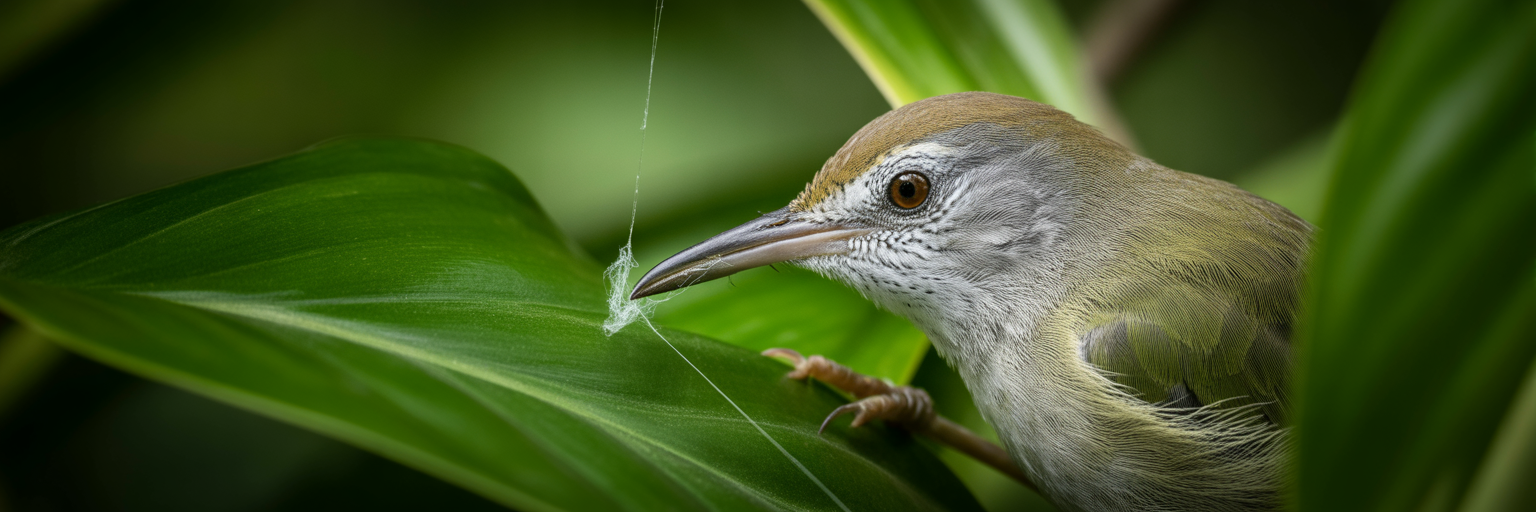
To accomplish its architectural marvels, the tailorbird relies on a specialized set of biological tools and a discerning eye for materials. This is not random construction. This is a calculated process where every component is chosen for its specific properties. The bird’s entire anatomy and behavior are geared toward this one singular purpose, revealing how tailorbirds build nests with such precision.
The Biological Awl: A Needle-Sharp Beak
The tailorbird’s most critical instrument is its beak. Long, slender, and needle-sharp, it is a masterpiece of biological design. It functions not as a clumsy pair of pliers but as a surgical awl. When the bird selects one or more large leaves to form its cradle, it uses the fine point of its beak to pierce a series of tiny holes along the edges. The genius lies in the execution. The beak punctures the leaf cleanly, without causing the jagged tears that would weaken the structure or kill the leaf. A dead, brown leaf would be a glaring advertisement to predators, so the living integrity of the foliage is paramount. This delicate piercing is the foundation of the entire structure, a task requiring immense precision from a creature that seems to be in a constant state of high alert.
A Discerning Eye for Thread
With the holes prepared, the seamstress needs its thread. The tailorbird becomes a frantic scavenger, a tiny thief driven by instinct. It harvests plant fibers, bark, and cotton, but its most prized material is spider silk. You can imagine it, darting through the undergrowth, plucking strands of silk directly from a web with a chilling efficiency. It values the silk for its incredible tensile strength and elasticity, properties that create a stitch strong enough to hold the leaves together but flexible enough to sway in the wind without snapping. It is a master of material science, instinctively understanding which fiber is best for which task. This resourcefulness is a common theme in nature; for instance, the archerfish that shoots bugs out of the air with water also manipulates its environment with stunning accuracy. The tailorbird will even opportunistically use human-made debris, incorporating discarded thread or fine fishing line into its work, adding a modern, almost post-apocalyptic touch to its ancient craft.
| Material | Primary Source | Key Property | Role in Nest Construction |
|---|---|---|---|
| Plant Fibers (e.g., cotton, bark) | Foraged from local flora | Coarseness and bulk | Provides structural integrity and ‘rivet’ material |
| Spider Silk | Harvested from spider webs | Strength and elasticity | Used for strong, flexible stitches that can withstand movement |
| Animal Hair / Feathers | Gathered from the environment | Softness and insulation | Primarily used for interior lining, not structural sewing |
| Human-Made Debris (e.g., thread, fishing line) | Scavenged from human settlements | High tensile strength | Opportunistically used for exceptionally strong seams |
Stitching a Nursery Against All Odds
With materials gathered and tools at the ready, the real work begins. This is not a leisurely craft. It is a high-speed, high-stakes construction project performed with the intensity of a surgeon in a field hospital. The bird works with a relentless, obsessive focus, as if racing against an invisible clock counting down to disaster. The process is a masterclass in efficiency and precision, a sequence of actions repeated hundreds of time.
The construction follows a clear, methodical pattern:
- Leaf Selection and Manipulation: First, the bird chooses one or several large, pliable leaves still attached to the plant. It pulls the edges together, forming a cone or cup shape that will serve as the outer shell of the nest. This living cradle is the core of its defensive strategy.
- Piercing the Seam: Using its sharp beak as an awl, it punches a series of neat holes along the overlapping edges of the leaves. Each puncture is deliberate, spaced just right to ensure a strong seam without compromising the leaf’s structure.
- Threading the Needle: The bird then takes a piece of its chosen thread, often a strand of spider silk or a plant fiber, and pushes it through a hole with its beak. It pulls the fiber from the other side, creating the first part of a stitch.
- Securing the Rivet: Here lies the most ingenious part. The tailorbird does not tie knots. Knots can slip or come undone. Instead, it pulls the fiber through and then twists the end on the outside, or pushes a small tuft of plant material through the loop, creating a secure “rivet” that holds fast. It repeats this process, stitch by stitch, rivet by rivet, until the entire leaf structure is securely sewn together.
A single nest can contain well over 100 stitches, sometimes approaching 200, each one meticulously placed. The sight is astonishing: a tiny bird, darting back and forth, pulling and twisting, its entire body consumed by the task. If a thread snaps or a leaf tears, there is no pause. The bird immediately sets about repairing the damage, its movements becoming even more frantic. This is not just building; this is a desperate, ongoing battle against entropy and predation, stitched one fiber at a time.
A Fortress of Living Foliage
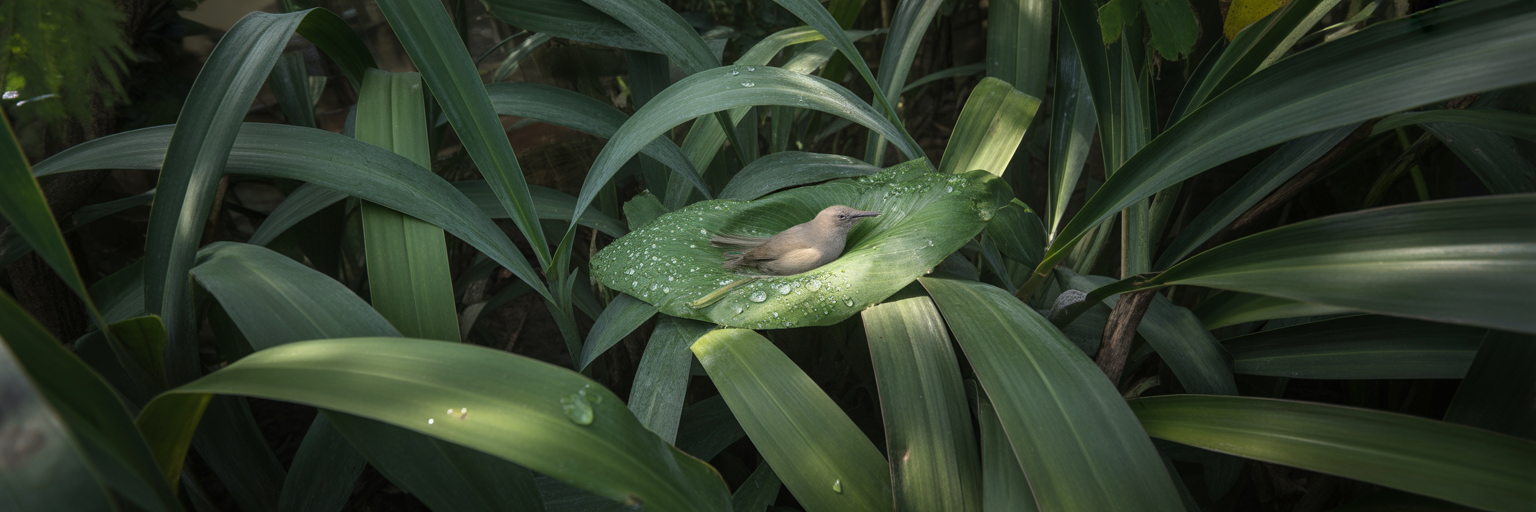
Why go to all this trouble? Why not just build a simple cup of twigs like so many other birds? The answer lies in the brutal reality of the tailorbird’s world. The elaborate sewing is not for show; it is a brilliant and desperate defense mechanism. The entire structure is a fortress of living foliage, designed for one purpose: to be invisible.
The Genius of the Tailorbird Nest Camouflage
The true genius of the tailorbird nest is its camouflage. By stitching living leaves together, the nest does not look like a nest at all. It simply looks like part of the plant. It remains green, alive, and perfectly blended with the surrounding foliage, making it nearly invisible to the host of predators that relentlessly hunt for eggs and chicks. In the dense tropics of Asia, this is not a small advantage. It is everything.
The list of threats is long. Tree snakes can slither through branches, coucals and other predatory birds scan the canopy from above, and lizards can climb with silent stealth. As documented by researchers and institutions like the Natural History Museum, the dense foliage of tropical Asia is a high-risk environment for nesting birds, making camouflage a critical survival trait. A traditional twig nest, no matter how well built, stands out as a clear target. The tailorbird’s creation, in contrast, is a ghost. Its placement is just as strategic, typically built only a meter or so off the ground. This is a calculated compromise, low enough to be hidden in dense shrubbery but high enough to be out of reach for many ground-dwelling threats. This constant threat of death, and the intricate strategies evolved to avoid it, puts into perspective the life-or-death stakes that drive all living things, a reality that even humans must consider when planning for different funeral types. This is a common problem in the animal kingdom, and different creatures have evolved unique solutions, like the animal that can detect a predator just from its shadow, showcasing nature’s diverse playbook for survival.
Interior Design for Maximum Survival
The tailorbird’s obsessive preparation does not end once the leafy exterior is stitched shut. The outer shell is merely the camouflaged fortress. Inside, another phase of frantic construction begins, this time focused on creating a safe and stable environment for the delicate eggs and chicks. If the exterior is about hiding, the interior is about surviving. The bird is not just an architect and a seamstress; it is also a paranoid interior designer.
Once the leaf pouch is secure, the bird begins lining it with an assortment of soft materials. This is not a haphazard collection of fluff. Each element is chosen for its insulating properties. The goal is to build a climate-controlled survival pod.
- Fine Grasses: These form the base layer, providing structure and a bit of cushioning.
- Plant Down: Soft, fluffy material from seeds like cotton or kapok is packed in to create a thick, insulating wall.
- Soft Feathers: The final touch is often a layer of the softest feathers the bird can find, creating a perfect, downy cup for the eggs.
– Animal Hair: Scavenged fur or hair adds another layer of warmth and softness.
This soft lining serves a critical function: thermoregulation. In a tropical climate with fluctuating temperatures and sudden rainstorms, the eggs and naked, vulnerable chicks need protection from both heat and cold. The thick, soft padding insulates them, keeping the internal temperature of the nest stable. This is not about comfort; it is a non-negotiable requirement for survival. Every detail, from the stitched exterior to the padded interior, is a calculated move to thwart death. This level of parental investment is extreme, but not unique. Nature is filled with bizarre and effective methods of protecting young, such as the Suriname toad that gives birth through holes in its back.
An Ancient Blueprint for Avian Engineering
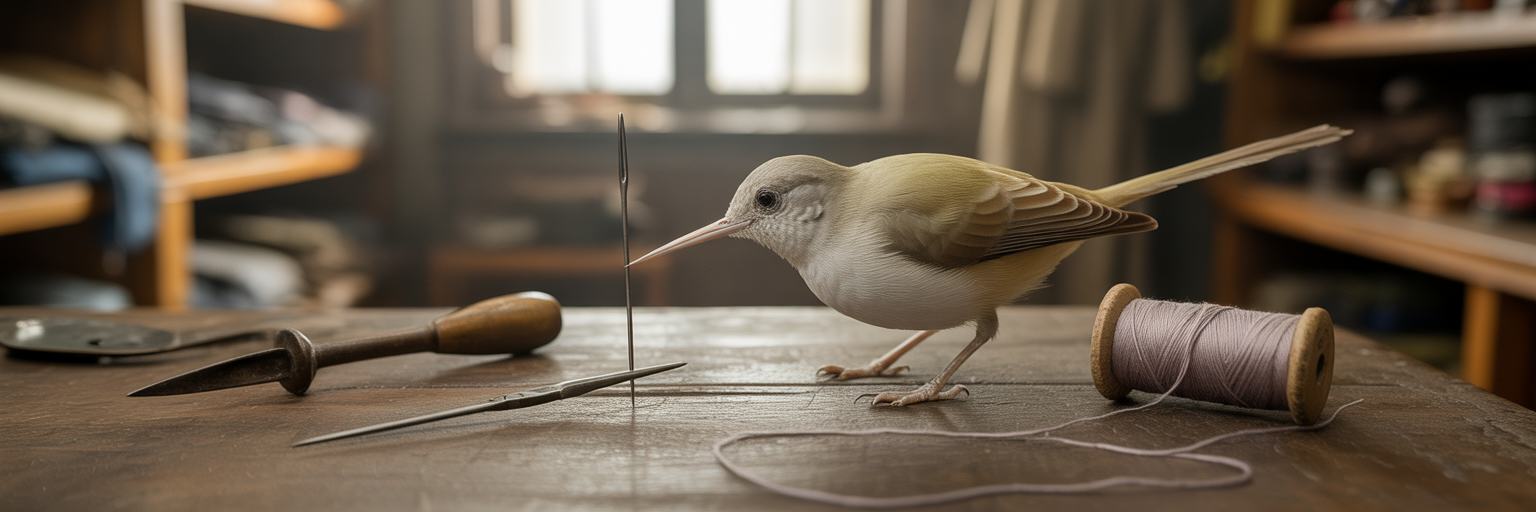
This raises a fascinating question: how does a tailorbird know how to do any of this? No one teaches it. A young tailorbird does not watch its parents and take notes. The entire, complex process of selecting leaves, piercing holes, and securing rivets is performed perfectly on its very first try. The answer is that this incredible skill is not learned. It is a profound example of instinctive animal behavior.
The bird is born with a complete architectural blueprint encoded in its DNA. It is less a builder learning a trade and more a biological machine executing a program that has been refined over millions of years. According to evolutionary biologists, this ability to manipulate the environment with tools is not a learned trade but an evolutionary imperative, hardwired over millennia. The logic of natural selection is ruthless and efficient. Over countless generations, tailorbirds that were genetically predisposed to build slightly better, more hidden, or more insulated nests were more likely to see their offspring survive. Those survivors passed on their superior nest-building genes. The ones that built sloppy nests were quickly removed from the gene pool by predators.
What we see today is the result of this relentless filtering process. The tailorbird belongs to the Cisticolidae family of warblers, but its sewing technique is a highly specialized evolutionary masterpiece, one of the most remarkable examples of tool use among birds. It is a living vessel of ancient, genetic wisdom, a tiny creature carrying the accumulated knowledge of millions of ancestors. This power of instinctive animal behavior drives some of the most incredible stories in nature, like that of the caterpillar that tricks ant colonies into raising it, proving that complex strategies can be hardwired from birth.
A Frantic Partnership in Parenting
The construction and maintenance of this survival pod is a frantic partnership. While the female is typically the master seamstress, performing the intricate stitching, the male is not idle. He acts as a vigilant guard and an anxious materials supplier, constantly flying back and forth with choice bits of spider silk and plant down. He defends the territory with aggressive chirps and displays, attempting to drive away any potential threats while his partner is preoccupied with her delicate work.
Once the eggs are laid and the chicks hatch, the parents’ paranoia shifts into overdrive. Their focus turns to keeping the nest’s location an absolute secret. This leads to one of the creepiest and most brilliant aspects of their behavior: nest hygiene. Chicks produce fecal sacs, which, if left in or near the nest, would create a scent trail leading predators directly to them. The tailorbird parents meticulously remove these sacs. Often, they swallow them. This act, while unsettling, is the ultimate expression of their survival anxiety. They are literally consuming the evidence, erasing any clue that might betray their hidden nursery.
After weeks of this intense, secretive care, the fledglings are finally ready to leave. They emerge from the leafy pouch, and after a short time, they are on their own. The nest, this temporary monument to fear and ingenuity, is abandoned. It slowly weathers, the stitches giving way and the leaves returning to the forest floor. The cycle is complete, but for the parents, the anxiety never truly ends. Soon, they will begin the frantic process all over again. This level of extreme parenting highlights the brutal pressures of survival, a theme seen in other species, such as in the story of why some animals hatch inside their mother and eat their siblings. The tailorbird’s life is a fleeting, triumphant, and utterly exhausting masterpiece of survival.