
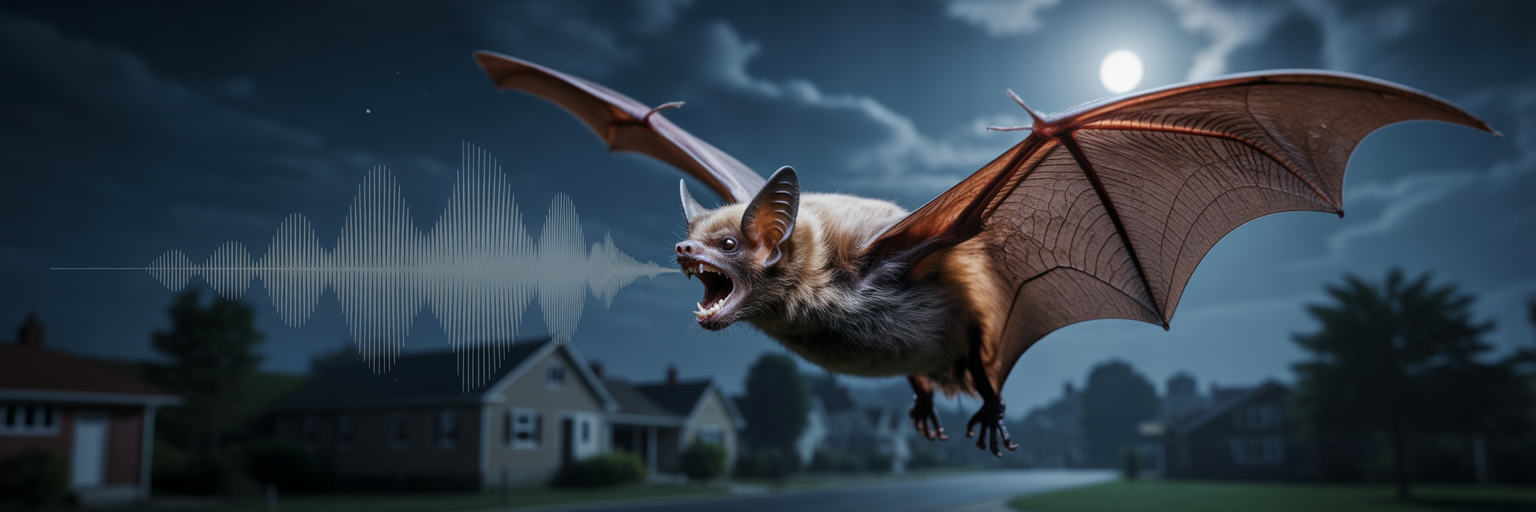
An Unsettling Superpower Hiding in Plain Sight
Let’s be honest. When you see a bat flitting across the twilight sky, you probably think of a blind, slightly panicked flying mouse. A gothic accessory. A creature of simple, spooky folklore. You think bats are just blind, flying rodents? That’s precisely what they want you to believe. They are in on a cosmic joke, and for millions of years, you have been the punchline.
These creatures are not stumbling through the darkness. They are masters of it. While you are fumbling for a light switch, a bat is experiencing the world in a way your brain cannot begin to process. It navigates with a high-definition, 3D map constructed entirely from sound. Every object, every movement, every texture is rendered in its mind with breathtaking clarity. Your sight, by comparison, is a flat, low-resolution image projected onto the back of your eyeballs. It’s quaint.
The truth is, bats are operating on a completely different sensory plane. They possess a biological sonar system so advanced it makes our most sophisticated military technology look like a child’s toy. They don’t just see the world. They feel it, taste it, and map it with a series of ultrasonic screams and whispers. This isn’t just an adaptation. It is one of the most advanced animal senses ever to exist on this planet, a superpower hiding in plain sight.
They have been silently judging your clumsy, light-dependent existence for eons. They know the exact distance to the tip of your nose, the texture of your jacket, and the subtle flutter of your pulse as you read this. In the following sections, we will pull back the curtain on this unsettling reality. We will reveal the mechanics of their impossible perception, the biological machinery that powers it, and the chilling precision that comes with it. Prepare to have your understanding of the natural world fundamentally and permanently altered.
Painting the World with Sound
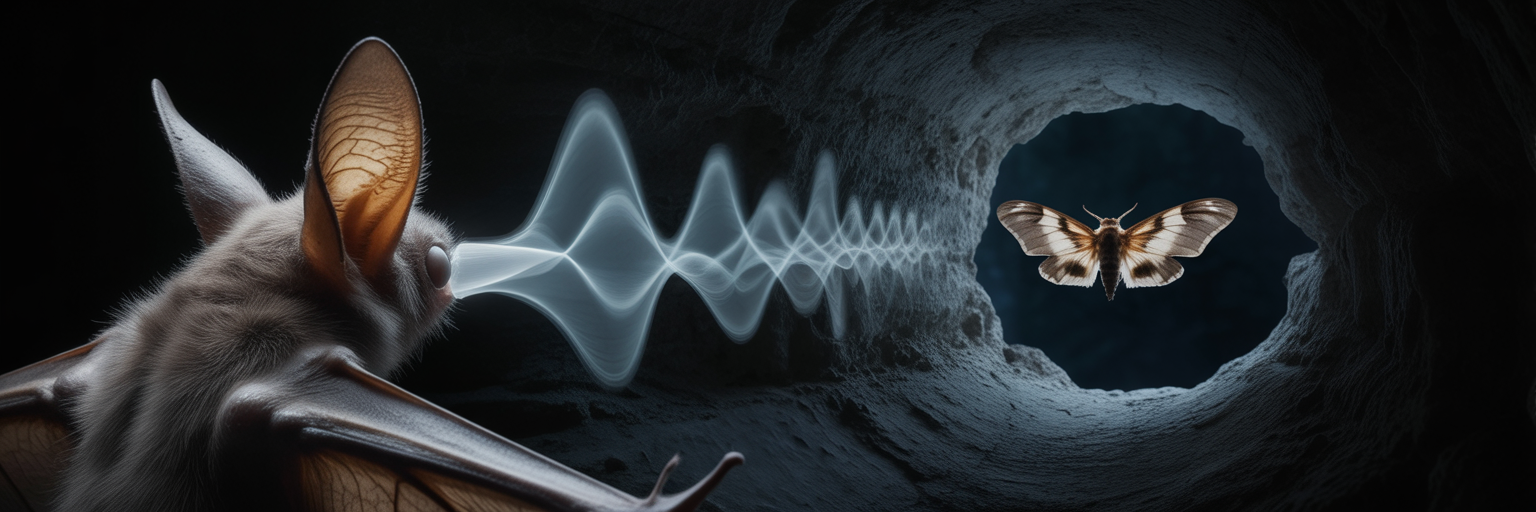
So, how does echolocation work? Forget everything you think you know about seeing. Vision requires light. Echolocation requires a void. The bat does not look into the darkness. It screams into the abyss and builds a universe from the returning whispers. It is a process of creation, a constant, real-time rendering of reality from nothing. As National Geographic explains, echolocation functions as nature’s own built-in sonar system, but that description feels far too sterile for what is actually happening.
The process is a symphony of biological engineering, executed hundreds of times per second. It is a four-part act of predatory genius:
- The Scream: It begins with a sound you will never hear. The bat unleashes an ultrasonic pulse from its larynx, a click so high-pitched it exists entirely outside the range of human hearing. It is a silent, directional shout into the night, perfectly shaped to carry information.
- The Journey: This sound wave travels through the darkness at incredible speed, a ghostly probe searching for form. It strikes an object, a moth, a tree branch, or perhaps your unsuspecting face.
- The Echo’s Return: The sound bounces back. This is not a simple echo like one you would hear in a canyon. This is a faint, complex messenger carrying a wealth of data. The echo has been distorted, stretched, and colored by the object it touched.
- The Translation: The returning echo is captured by the bat’s exquisitely shaped ears. This is where the true strangeness begins. The bat’s brain, a biological supercomputer, instantly analyzes the echo. It measures the time delay to calculate distance, the change in pitch to determine velocity, and the subtle variations in intensity to perceive shape, size, and even texture. It builds a complete 3D image from these fragments of sound.
While we see a world illuminated by an external source, the sun, the bat illuminates its own world from within. Darkness is not an obstacle. It is a blank canvas on which the bat paints a masterpiece of perception. Other animals, like dolphins, use a similar method in the water, but the bat’s aerial acrobatics require a level of intricacy that is almost alien. Nature has produced many strange sensory tools, like the creature that can hear with its knees, but the bat’s ability to turn sound into sight is in a class of its own.
The Biological Machinery of a Sonar God
Understanding the process of echolocation is one thing. Witnessing the biological hardware that makes it possible is another entirely. The bat sonar system is not a single organ but a suite of hyper-specialized tools that work in perfect, terrifying harmony. This is not evolution’s gentle tinkering. This is high-performance engineering.
The Supersonic Voice Box
The source of the bat’s power lies in its larynx. The muscles controlling its vocal cords are among the fastest-contracting muscles ever recorded in a mammal. They can produce ultrasonic clicks at a rate of up to 200 times per second. This is not singing. This is a biological machine gun firing precisely aimed bullets of sound into the environment. Each click is a carefully modulated pulse, designed to extract the maximum amount of information from the world. The sheer speed and control are so extreme that the bat has to disengage its inner ear muscles with every click to avoid deafening itself. It is screaming and listening in the microscopic pauses between its own shouts.
Finely Tuned Receivers
Look at a bat’s ears. Really look at them. The bizarre folds, ridges, and satellite-dish shapes are not accidents of nature. They are acoustic lenses, engineered to capture and triangulate the faintest returning echoes with pinpoint accuracy. Many bats can move their ears independently, like two separate radar dishes scanning the environment for threats and opportunities. One ear might focus on a potential meal while the other monitors the surrounding clutter. The shape of the ear itself helps the bat determine the vertical position of an object, giving its sound-map a true third dimension that our two forward-facing eyes struggle to replicate.
Hearing Movement with Doppler Shift
This is where the system becomes truly predatory. Bats do not just see a static world. They see movement. Using what are known as constant frequency (CF) calls, a bat can detect the Doppler shift in a returning echo. In simpler terms, it can hear the change in sound frequency caused by a moving object. This allows it to perceive the frantic, terrified flutter of an insect’s wings against the background of a still forest. It is literally hearing the velocity and trajectory of its prey. It can tell not only where the moth is but where it is going. This is then combined with frequency-modulated (FM) calls, which are short, broadband sweeps of sound that provide a high-resolution snapshot of an object’s shape and texture. It is a dual-system approach, allowing the bat to track a target’s movement and identify its physical properties simultaneously.
A Precision That Should Be Impossible
The true horror of the bat’s ability is not just that it can see with sound, but the impossible level of detail it can perceive. The resolution of its acoustic vision is so fine it defies our understanding of biological limits. This is not just about avoiding trees in the dark. This is about rendering the world with a precision that should not be possible. Here are just a few unsettling bat echolocation facts that illustrate this point.
- Detecting the Invisible: In complete and total darkness, some species of bats can detect an object as fine as a single human hair from several feet away. Let that sink in. Your own hair, a nearly weightless strand, creates a big enough disturbance in the air to register on their sonar.
- Feeling with Sound: A bat’s echolocation is so sophisticated it can determine texture. From across a clearing, a bat can tell the difference between the hard, smooth shell of a beetle and the soft, fuzzy body of a moth. The returning echo carries a signature, a “color” and “feel” that its brain translates into a tactile sensation. It is the equivalent of having fingertips that can feel things from across a room.
- The Echo Library: Bats do not just hear a generic “bug.” They can distinguish between different species of insects, and even identify poisonous ones, based on their unique echo signatures. They have a mental encyclopedia of sounds, a library of acoustic profiles that allows them to identify their preferred meal before they even attack. This cognitive ability to categorize and identify is eerily similar to the complex behaviors seen in other organisms, like the plant that can count before it eats.
This all culminates in the hunt’s final, terrifying moments. As a bat closes in on its prey, it unleashes what is known as the “terminal buzz.” The rate of its ultrasonic clicks accelerates dramatically, reaching up to 200 pulses per second. This is not just noise. This is the bat creating a real-time, high-frame-rate video of its target’s final, desperate evasive maneuvers. Each click provides an updated frame, ensuring that no matter how the insect twists or turns, the attack is inescapable. It is a guided missile system perfected by nature.
Thriving in a World of Chaos
A simple sonar might work in an empty room, but the world is a messy, chaotic place. The true genius of the bat’s system is its adaptability. It is not a static tool but a dynamic, intelligent process that actively overcomes environmental challenges that would cripple our best man-made technology.
Cutting Through the Clutter
Imagine hunting a tiny insect in a dense forest at night. For a system based on sound, this is an acoustic nightmare. Every leaf, branch, and twig sends back an echo, creating a deafening storm of confusing information. Yet, a bat can fly through this chaos at high speed, its brain effortlessly filtering out thousands of irrelevant echoes to isolate the single, faint signal of a beetle crawling on a leaf. It can distinguish the echo of its prey from the echo of the surface the prey is sitting on. This is signal processing on a level that our most powerful computers struggle to replicate.
The Silent Hunt: Overcoming Countermeasures
This is not a one-sided affair. Nature is a constant arms race. Some species of moths have evolved the ability to hear the ultrasonic clicks of an approaching bat, allowing them to take evasive action. But the bat is always one step ahead. In response, some bats have learned to switch to frequencies their prey cannot detect. Others employ a “stealth mode,” lowering the volume of their clicks as they get closer, giving the moth no warning before the final attack. This is not a pre-programmed instinct. This is active, strategic adaptation, a silent war fought every night in the skies above us. It is a testament to survival, much like the struggle of how tiny insects survive fungal artillery fire.
Navigating the Swarm
Perhaps the most mind-bending feat is how bats function in a swarm. Imagine a cave containing millions of bats, all emerging at once, all screaming into the night. The air should be an impenetrable wall of ultrasonic noise. Yet, each bat navigates this cacophony without issue. How? Each bat’s brain is finely tuned to the unique signature of its own voice. It can pick out its own returning echoes from the deafening roar of thousands of its neighbors. It is like trying to hear a single pin drop in the middle of a rock concert, and succeeding every time.
The Echolocation Champions
Bats are not the only animals that use echolocation. Dolphins and whales use it to navigate the vast, dark oceans, and certain birds, like cave swiftlets, use crude clicks to avoid walls in their subterranean nests. These are impressive feats, to be sure. But when you analyze the details, it becomes clear that there is no real contest. The bat is the undisputed champion.
Navigating open water, while challenging, is a fundamentally simpler task than what a bat accomplishes. The ocean has fewer complex, cluttered obstacles than a dense forest. A cave swiftlet’s clicks are basic, low-resolution pings used for simple obstacle avoidance. The bat, however, operates in a chaotic, three-dimensional aerial environment at high speed, hunting tiny, erratically moving targets. Its system is built for a level of precision and adaptability that its aquatic and avian counterparts simply do not require.
Let’s settle this once and for all. If echolocation were an Olympic sport, the results would be obvious.
| Feature | Bats | Dolphins/Whales | Cave Swiftlets |
|---|---|---|---|
| Environment | Complex, cluttered air (forests, caves) | Open to semi-cluttered water | Simple, static air (caves) |
| Resolution | Ultra-high (detects hair, texture) | High (detects fish size, shape) | Low (detects large walls) |
| Frequency | Ultrasonic (20-200 kHz) | Ultrasonic (10-150 kHz) | Audible Clicks (1-15 kHz) |
| Primary Use | Hunting tiny, fast-moving insects; navigation | Hunting fish, communication, navigation | Basic obstacle avoidance in darkness |
| Adaptability | Extremely high (adjusts frequency, intensity) | High (can adjust clicks for different tasks) | Very low (simple, repetitive clicks) |
This table compares key attributes of echolocation across different animal groups. Data is synthesized from general zoological knowledge regarding animal sensory biology, highlighting the bat’s specialization for high-precision tasks in complex, cluttered environments.
The verdict is clear. For its unmatched combination of precision, adaptability, and efficiency in the most challenging environments, the bat takes home the gold. It is not just a participant in the world of echolocation. It is the master.
When Human Technology Tries to Copy a Superhero
For centuries, we dismissed the bat as a creature of myth and superstition. Now, our brightest minds are desperately trying to copy it. The field of biomimicry is filled with engineers and scientists studying the bat’s sonar, hoping to replicate its abilities for our own technology. They are trying to build better radar, more advanced medical imaging devices, and more intelligent autonomous navigation for drones and robots.
The results, so far, are humbling. Our most advanced systems cannot come close to matching the bat’s combination of compact size, energy efficiency, and real-time clutter filtering. We have created ultrasonic canes for the visually impaired, a direct, if simplified, copy of the bat’s basic principle. It is a wonderful invention, but it is the equivalent of copying a single note from a symphony. We are finally catching on to a trick that nature perfected millions of years ago.
As noted in resources covering animal echolocation, the bat’s sonar is a prime subject of study for developing more advanced systems. Yet, we are still just scratching the surface. We can build machines that emit and receive sound, but we cannot replicate the neural supercomputer that translates those sounds into a rich, detailed, and instantaneous perception of the world. The fact that we are turning to this small, nocturnal mammal for inspiration is the ultimate proof of how weirdly advanced it truly is. We are the students, and the bat is, and has always been, the master.
They Hear You When You’re Sleeping
So, the next time you see a bat silhouetted against the evening sky, try not to see a simple animal. See it for what it is: a piece of biological surveillance technology so advanced it borders on science fiction. It is not flying randomly. It is actively scanning, mapping, and rendering its surroundings with a sense you can barely comprehend.
As it flits by, understand that it is not just aware of your presence. It knows your shape, your distance, and the texture of the clothes you are wearing. It can perceive the subtle movements of your breathing. It is building a hyper-detailed 3D model of you in its mind, constructed entirely from sound waves you cannot hear.
They are not blind. They see more than you do. They see a world of texture and movement and depth, painted with a palette of echoes. They are the silent cartographers of the night, and you are just another feature on their ever-changing map.
And remember, even when you cannot see them, they most definitely “see” you. Sweet dreams.