Meet Nature’s Most Audacious Rule-Breaker
Imagine for a moment that your body treated catastrophic injury as a minor inconvenience. A shattered bone? A severed limb? A completely missing jaw? To us, these are life altering events. To one creature, they are simply items on a biological to do list. This animal looked at the standard vertebrate operating manual, the one that says vital structures are permanent and damage is forever, and decided it was more of a suggestion than a rule. It doesn’t just heal. It rebuilds. It reconstructs its own face from scratch and gets back to the business of hunting, often without so much as a scar to remember the incident.
This isn’t about regrowing a tail, a trick many lizards have mastered. This is about manufacturing a new jaw, one of the most complex and essential pieces of predatory equipment. The jaw is a marvel of engineering, a delicate assembly of bone, muscle, nerves, and teeth. For virtually every other predator on Earth, losing it means a slow, inevitable starvation. But for this creature, it’s a temporary setback. It possesses a biological cheat code that allows it to defy what we consider fundamental laws of anatomy. It’s as if its cells hold a perfect blueprint of the original model, ready to deploy a construction crew the moment disaster strikes.
This ability goes beyond simple healing. It’s a form of biological defiance. While other animals patch themselves up with scar tissue, a messy and imperfect fix, this one rebuilds with pristine, factory new parts. It treats its own body like a set of high end modular components. Lost a leg in a fight? It will grow another. Suffered brain damage? It can patch that up too. This nonchalant approach to self repair is one of the most fascinating and frankly unsettling weird animal facts you will ever encounter. It forces us to question our own biological limitations and wonder what it would be like to view our bodies not as fragile, finite things, but as endlessly repairable machines. Before we reveal its identity, understand this: we are talking about an animal that can have its smile ripped away and simply grow a new one.
The Smiling Predator of Lake Xochimilco
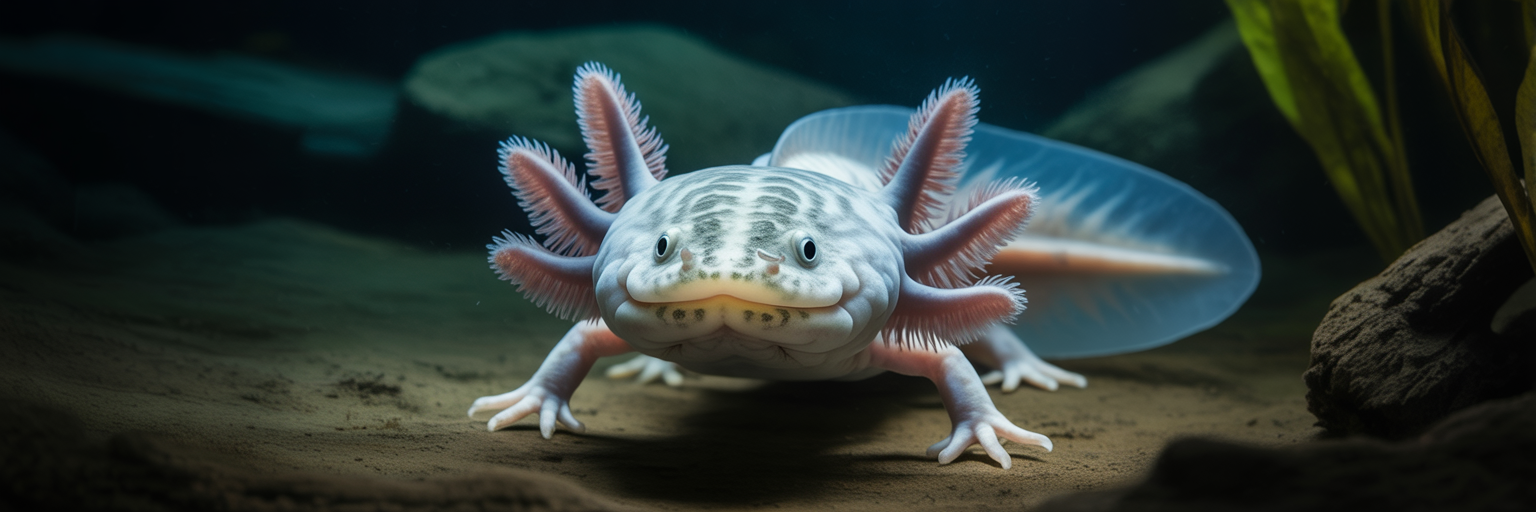
The creature with this unnerving talent is the axolotl (Ambystoma mexicanum), a salamander that seems to have been designed by a cartoonist with a dark sense of humor. It lives exclusively in the canals and lakes of Xochimilco near Mexico City, a tiny corner of the world for an animal with such a monumental ability. Its appearance is a masterclass in contradiction, a blend of adorable features and predatory function that leaves you unsure whether to feel charmed or deeply unsettled.
An Unsettling Appearance
At first glance, the axolotl looks like a half finished Pokémon. It has a wide, upturned mouth fixed in a permanent, unnerving smile. Feathery external gills branch from its head like a bizarre, fleshy crown, pulsing gently in the water. Its eyes are dark, lidless beads that stare into the middle distance with an expression of serene indifference. This seemingly harmless look is a clever disguise. The axolotl is a patient and effective predator, a silent hunter that waits for worms, insects, or small fish to drift too close to its deceptively cheerful face.
The Peter Pan of Salamanders
Adding to its strangeness, the axolotl is a neotenic species. This means it reaches sexual maturity without undergoing metamorphosis. It is, in essence, the Peter Pan of the amphibian world, an eternal youth that never grows up. While its salamander cousins develop lungs and move onto land, the axolotl remains in its larval, fully aquatic form for its entire life. This arrested development is directly linked to its incredible regenerative powers. It retains the potent stem cells of an embryo, giving it the lifelong ability to rebuild itself. This collection of axolotl facts paints a picture of a creature existing in a state of perpetual potential, forever on the cusp of a transformation it never makes.
A Fragile Stronghold
Here lies the greatest paradox of the axolotl. This master of regeneration, this creature that can rebuild its own brain, is critically endangered in the wild. Its only natural home, the Xochimilco canal system, is threatened by pollution and the introduction of invasive fish like tilapia and carp, which prey on young axolotls. The animal that can survive having its face torn off is being pushed to extinction by a deteriorating environment. Its survival depends entirely on its “gape and suck” hunting method, where it opens its mouth with explosive speed, creating a vacuum that pulls in water and prey. A functional jaw isn’t just an advantage; it’s everything. Nature is full of such strange adaptations, like the creature that can hear with its knees, but the axolotl’s combination of power and vulnerability is truly unique.
Anatomy of a Surprisingly Powerful Bite
The axolotl’s jaw is not a tool of brute force. You won’t find it crushing shells or tearing flesh from bone. Instead, it is a highly specialized piece of biological machinery built for one purpose: speed. The entire system is designed around creating a sudden, powerful vacuum. When an unsuspecting worm or crustacean wanders into range, the axolotl’s mouth opens in milliseconds. The rapid expansion creates negative pressure, and the surrounding water, along with the prey, rushes into its mouth. It’s less of a bite and more of a controlled implosion.
Inside that smiling mouth are rows of tiny, needle like teeth. These are not for chewing. The axolotl swallows its prey whole. The teeth are there for one reason: to grip. Once the prey is sucked inside, these fine points ensure it cannot escape before being swallowed. This method of axolotl hunting is incredibly efficient, allowing it to catch quick moving prey with minimal energy expenditure. It simply waits, watches, and then in a flash, its meal is gone. The success of this entire strategy hinges on the perfect, unobstructed function of its jaw.
For any other predator, this level of specialization would be a huge risk. A broken jaw would mean the end of its ability to feed. A slight misalignment could compromise the suction, rendering its primary hunting tool useless. This is why the ability to regrow its jaw is so profound. It removes the single greatest point of failure in its survival strategy. This biological optimization is a masterclass in efficiency, where the axolotl’s entire existence depends on its specialized feeding mechanics. This principle of a finely tuned system being essential for success is not unique to nature. For instance, the operational flow of a restaurant is just as critical, and a disruption can be just as fatal, which is why robust systems, sometimes supported by tools like small business loans for restaurants, are vital for survival.
The Cellular Blueprint for Rebuilding a Head

When an axolotl suffers an injury as severe as a missing jaw, it doesn’t panic. Its body initiates a calm, orderly, and terrifyingly efficient reconstruction process. It’s like a biological construction crew arriving at a demolition site with the original blueprints in hand, ready to rebuild the structure exactly as it was before. There is no messy scar tissue, no imperfect patch job. Just a perfect, functional replacement.
The Call for Construction
The moment the injury occurs, a signal goes out. The remaining tissues at the wound site immediately begin to organize. A thin layer of skin cells migrates to cover the open wound within hours, preventing infection and creating a controlled environment for the miracle that is about to unfold. This initial step is crucial, setting the stage for the complex work ahead.
The Blastema: A Biological Command Center
Next, specialized cells from the surrounding bone, muscle, cartilage, and skin begin to de-differentiate. They shed their specific roles and revert to a more primitive, stem cell like state. These cells then migrate to the injury site and accumulate into a mass called a blastema. This blastema is the command center for the entire operation. It contains all the genetic information and positional cues needed to rebuild the lost structure, whether it’s a toe, a leg, or an entire jaw.
Perfect Reconstruction, No Scars Allowed
With the blastema in place, the reconstruction begins. The process follows a precise, step by step sequence, guided by the original developmental blueprint.
- Cellular Recruitment: Stem like cells are called to the injury site, forming the foundation of the blastema.
- Pattern Formation: The blastema organizes itself, mapping out where bone, muscle, nerves, and blood vessels need to go. It knows exactly how to shape a jaw, position the teeth, and connect the nerves.
- Growth and Differentiation: The cells within the blastema begin to multiply and differentiate, transforming back into specialized bone, muscle, and nerve cells in their correct locations.
- Seamless Integration: The new structure grows and integrates perfectly with the existing body, leaving no trace of the original injury.
The secret to this flawless regeneration is the axolotl’s ability to inhibit scarring. As a 2020 article in Knowable Magazine highlights, scar tissue prevents complex regeneration in mammals. The axolotl, however, keeps this process in check, allowing its cells to focus on rebuilding instead of just patching. This mastery of axolotl jaw regeneration is what makes it one of nature’s most remarkable architects.
Beyond the Jaw: A Full-Body Parts Department
The ability to regrow a jaw is arguably the axolotl’s most shocking trick, but it is far from its only one. Its body is less a single, cohesive unit and more a collection of replaceable parts. The same regenerative process that rebuilds its face can be applied to almost any other part of its anatomy. This isn’t just healing; it’s a complete system of self-replacement that makes the axolotl one of the most resilient vertebrates on the planet.
Its list of regenerative “superpowers” reads like a biological fantasy, showcasing a level of recovery that other animals can only dream of.
- Limbs: If a predator bites off a leg, the axolotl will regrow a perfect replacement, complete with bones, muscles, nerves, and skin. It can do this dozens of times without any loss of function.
- Tail: Like many of its relatives, it can regenerate its tail. However, the axolotl’s version is a high fidelity copy, not a simplified cartilage rod like you see in some lizards.
- Spinal Cord: This is where things get truly incredible. An axolotl can recover from a completely severed spinal cord. It can repair the damaged neural connections and regain full mobility, a feat that is currently impossible for mammals.
- Brain: Even damage to its central processing unit is not a permanent problem. The axolotl can regenerate portions of its brain, including parts of the forebrain, without suffering significant long term cognitive loss.
- Heart: After a heart injury, mammals form scar tissue, which weakens the organ. The axolotl, true to form, simply regenerates the damaged cardiac muscle, ensuring its heart continues to function perfectly.
This comprehensive salamander regeneration capability places the axolotl in a class of its own. It treats its body like a modular system where any damaged component can be swapped out for a new one. This resilience is a fascinating survival strategy, much like how other creatures have evolved to endure harsh conditions. For example, you can read about the animal that survives by shrinking its own organs when resources are scarce, another of nature’s extreme solutions to the problem of survival.
The Evolutionary Edge of a Self-Repairing Hunter

Why did the axolotl develop such an extreme set of abilities? The answer lies in the brutal realities of its freshwater ecosystem. In a world filled with predatory fish, birds, and even other cannibalistic axolotls, injury is not a possibility; it is an inevitability. The ability to fully recover from physical damage that would kill or permanently cripple any other animal provides a colossal survival advantage. It allows the axolotl to be a more reckless hunter and a more resilient survivor.
A failed attack on a spiny fish or a violent encounter with a rival is not a death sentence. It is a temporary setback. While a wolf with a broken jaw starves and a bird with a broken wing falls from the sky, the axolotl simply retreats, regrows, and returns to the hunt. This makes it one of the most formidable animals that can regenerate. Its superpower is not aggression or strength, but the quiet, stubborn refusal to stay broken. The following table puts this advantage into stark perspective.
| Predator | Common Career-Ending Injury | Typical Outcome | Axolotl Equivalent Outcome |
|---|---|---|---|
| Gray Wolf | Broken Jaw | Inability to hunt, starvation | Temporary inconvenience, full recovery |
| Bald Eagle | Shattered Wing Bone | Inability to fly and hunt, death | Regrows limb, returns to hunting |
| Great White Shark | Severely Damaged Fin | Impaired mobility, reduced hunting efficiency | Regrows appendage, full mobility restored |
| Axolotl | Jaw bitten off by rival | Regrows entire jaw structure | Full recovery and function |
This table illustrates the profound survival advantage regeneration provides. While a severe injury is a death sentence for most predators, for the axolotl, it is a temporary problem with a built in solution. This incredible defense is one of many in the animal kingdom. For instance, some animals survive venom by neutralizing it mid attack, another fascinating adaptation you can learn about in our article on the animal that survives venom by breaking it down mid-attack.
What This Anatomical Anomaly Teaches Humanity
The axolotl is more than just a biological curiosity. It is a living blueprint for the future of medicine. Scientists around the world are intensely studying this small, smiling salamander, hoping to understand the genetic and cellular mechanisms behind its incredible abilities. Its massive genome, which is about ten times larger than the human genome, holds secrets that could one day revolutionize how we treat human injuries and diseases.
A Biological Roadmap for Medicine
The axolotl offers a proof of concept from nature. It shows us that vertebrate animals are capable of perfect, scar free regeneration. Researchers are particularly focused on several key areas. They are studying how the axolotl repairs damaged heart tissue, hoping to find ways to help human hearts heal after a heart attack. They are analyzing its ability to repair its spinal cord, searching for clues that could lead to treatments for paralysis. The complete axolotl jaw regeneration process provides a model for how we might one day regrow complex craniofacial structures in humans after trauma or surgery.
Unlocking Our Own Latent Potential
It is important to be realistic. We are not on the verge of regrowing human limbs in a lab. The biological gap between amphibians and mammals is immense. However, the axolotl provides a biological roadmap. By understanding how it activates and controls its regenerative pathways, we may learn how to awaken similar, dormant pathways in our own cells. The goal is not to become axolotls, but to learn from their mastery of cellular repair to develop therapies that promote better, scar free healing in our own bodies.
From its fragile home in a single lake in Mexico, this unassuming creature challenges our most basic assumptions about what is biologically possible. It reminds us that nature is full of extraordinary solutions and that some of its greatest secrets are hidden in its strangest creations. To continue exploring these incredible stories, visit us at Nature is Crazy.