A Tiny Scavenger on the Garden Battlefield
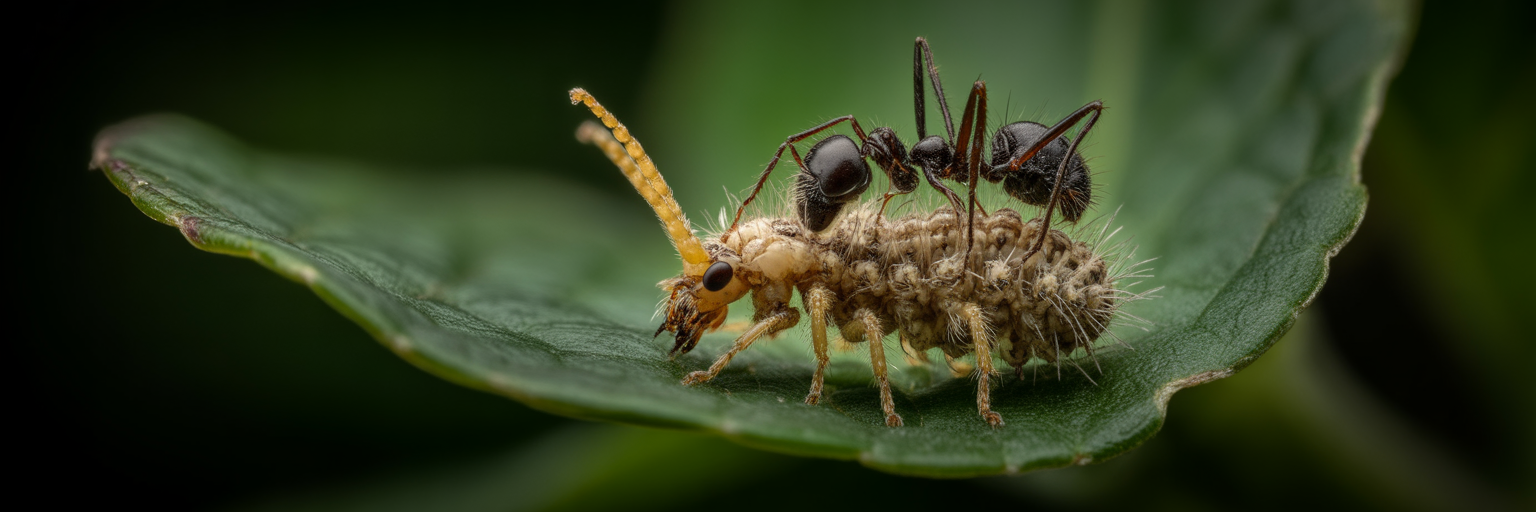
Imagine a creature that stalks its prey, drains it of life, and then wears the corpse as a trophy. In the microscopic war zone of your backyard, one warrior has perfected this macabre art. While the title might conjure images of a very confused caterpillar, the true artist behind this gruesome display is the notorious junk bug. This tiny scavenger turns the seemingly peaceful foliage of an American garden into its personal battlefield, where the remains of its enemies become its greatest asset.
The junk bug, the larva of the green lacewing, is a master of a strategy that is as brilliant as it is bizarre. It constructs a shield on its back, a messy pile of debris, plant matter, and, most unsettlingly, the hollowed-out husks of its victims. You might spot one as a shambling mound of lint and dirt, completely oblivious to the fact that it is a walking graveyard. This is not random hoarding. Every piece of its gruesome armor serves a purpose.
This mobile junk pile is a multi-layered defense system. It is a form of camouflage that makes the larva disappear into the background. It is a chemical cloak that fools its most dangerous adversaries. And it is a physical shield that can be shed in a moment of danger, leaving a predator with a mouthful of trash instead of a meal. Why does this creature go to such extraordinary and grisly lengths to survive? The answer reveals one of nature’s most fascinating and creative solutions to the constant struggle for existence.
Identifying the Fearsome Aphid Wolf
Before we can understand its methods, we must properly identify the creature behind the corpse pile. The lacewing larva is often called an “aphid wolf” or “aphid lion,” and for good reason. It is a voracious predator with an insatiable appetite for soft-bodied insects. Its appearance is something out of a miniature monster movie. It has a long, flattened body that looks vaguely like a tiny alligator, complete with six spindly legs that carry it across leaves and stems with surprising speed.
Its most formidable features are its head and mouthparts. The larva is equipped with a pair of large, sickle-shaped mandibles that are longer than its head. These are not for chewing. Instead, it uses them to pierce the soft bodies of its prey, such as aphids, mites, and thrips. Once impaled, the larva injects digestive enzymes that liquefy the victim’s insides, allowing it to suck the resulting nutrient slurry through its hollow jaws. It is an efficient and terrifyingly effective hunter, making it a welcome resident for any gardener battling pests.
The true marvel of this creature is its life cycle. This grotesque, ground-hugging predator undergoes a complete transformation. The adult lacewing is the polar opposite of its larval form. It is a delicate, almost ethereal insect with large, intricately veined wings that look like they are made of green lace. With its slender body and shimmering golden eyes, the adult flits through the evening air, a picture of grace. This stark contrast makes its larval stage even more fascinating. The name junk bug itself is reserved for the specific species of lacewing larvae that have perfected the art of carrying debris, turning their predatory habits into a mobile defense strategy.
Constructing the Corpse Armor
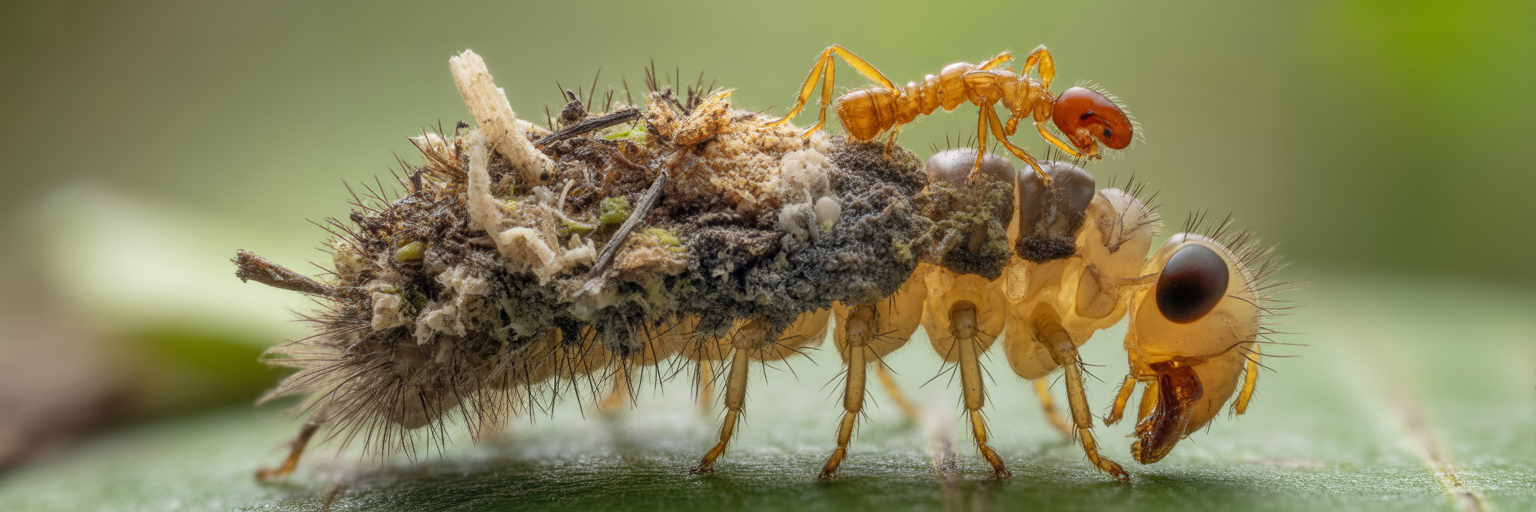
The creation of the junk bug’s shield is a meticulous process, a masterclass in battlefield engineering. This is not a random pile of garbage. It is a carefully constructed piece of defensive equipment, built one piece at a time with chilling precision.
The Blueprint for a Body Shield
The larva’s back is covered in specialized, hook-like bristles called setae. These structures are perfectly evolved to act as natural Velcro, anchoring the various components of its shield. The process of adding a new piece, particularly the husk of a victim, is a deliberate ritual:
- Ambush and Kill: The larva stalks and impales its prey, often an ant or an aphid, with its sickle-like jaws.
- Enzymatic Injection: It pumps digestive enzymes into the victim, turning its internal tissues into a liquid meal.
- Consumption: The larva patiently sucks the liquefied contents out of the exoskeleton, leaving behind a hollow, empty shell.
- The Hoist: In a feat of strength, the larva twists its head and neck, carefully maneuvering the empty husk onto its back where it is snagged by the hooked setae.
A Catalog of Creepy Components
The ant head helmet is just the beginning. The junk bug is an equal-opportunity scavenger, curating a collection of materials to build its protective pack. Each item is chosen for its specific properties, contributing to the overall effectiveness of the shield. The junk bug’s strategy of using its victims is a fascinating form of adaptation. This is reminiscent of other bizarre survival tactics, such as how some creatures are driven to sacrifice themselves for a parasite, showcasing the extreme lengths organisms go to survive.
| Material | Description | Primary Function in the Shield |
|---|---|---|
| Insect Husks (Ants, Aphids) | Hollowed-out exoskeletons of prey | Chemical camouflage (smell), structural bulk |
| Lichen and Moss | Small fragments of plant matter | Visual camouflage, moisture retention |
| Wood Splinters & Bark | Tiny pieces of woody debris | Physical armor, structural integrity |
| Soil and Sand Grains | Mineral particles from the environment | Added weight and texture for camouflage |
| Spider Silk | Scavenged strands of silk | Binding agent to hold the pack together |
The Chemical Ghost: Infiltrating the Ant Fortress
Perhaps the most brilliant aspect of the junk bug’s strategy is its use of chemical warfare. The world of insects is dominated by scent, and the junk bug has learned to turn this to its advantage. This is a masterclass in chemical mimicry in insects. Ants, one of the most formidable predators in the micro-world, identify friend from foe using a complex cocktail of chemicals on their bodies known as cuticular hydrocarbons (CHCs). Each colony has a unique scent profile, an olfactory uniform that allows them to instantly spot an intruder.
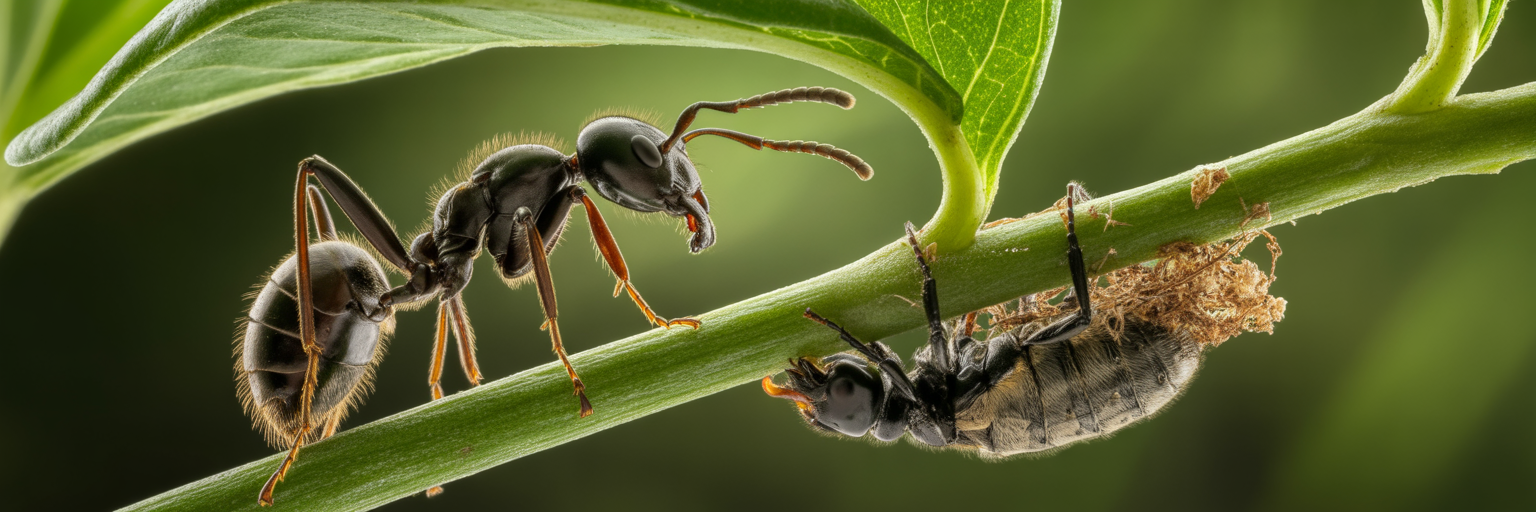
This presents a problem for the junk bug, which loves to eat aphids. Many ant species have a symbiotic relationship with aphids, acting as tiny shepherds. They protect the aphids from predators in exchange for a sugary waste product called honeydew. An aphid colony is an all-you-can-eat buffet guarded by a highly organized army. To get past the guards, the junk bug employs its ghoulish disguise. By piling the corpses of ants and aphids onto its back, it cloaks itself in their CHCs. It literally wears the scent of its enemies and their flock.
As research published in journals like the Proceedings of the Royal Society B has shown, this chemical disguise is incredibly effective. The ants, sniffing the air for intruders, detect the familiar scent of their own colony members and their aphid livestock. They perceive the shambling junk bug not as a threat, but as a harmless piece of debris or, even more deceptively, as one of their own. This allows the larva to walk directly into the heart of the ant-patrolled aphid colony and begin its feast, completely undetected. This method of tricking an entire colony is not unique to the junk bug. A similar form of deception is seen in the caterpillar that tricks ant colonies into raising it as one of their own. The complex world of biological signaling is a field of intense study, with research exploring everything from insect communication to how chemical cues are investigated in medical contexts.
More Than Camouflage: A Junk Bug’s Physical Shield
While the chemical cloak allows the junk bug to be a ghost, its debris pack also serves as a very real physical shield. This is where the strategy shifts from stealth to brute force defense. The collection of corpses, lichen, and wood splinters creates a tangible barrier between the larva’s soft, vulnerable body and the jaws of a predator that manages to see through its disguise.
The physical advantages of this lacewing larvae camouflage are numerous and highly effective:
- The Decoy Detachment: If a predator like a spider or a bird manages to grab the junk bug, the larva has a brilliant escape plan. It can instantly detach its entire debris pack. The attacker is left with a mouthful of worthless trash, giving the larva precious seconds to scurry away to safety. It is a “get out of jail free” card made of corpses.
- The Size Illusion: The bulky pack makes the larva appear significantly larger and more formidable than it actually is. This illusion of size can be enough to deter smaller predators from attacking in the first place. It also makes it physically more difficult for an attacker to get a proper grip on the larva’s body.
- The Armor Plating: The hard components of the shield, such as sand grains and tiny wood splinters, act as a form of natural armor plating. This can help deflect the bites of other insects or the stings of aggressive ants that have discovered its ruse.
- Environmental Protection: The shield offers secondary benefits beyond defense. The pack helps to insulate the larva, regulating its body temperature. It can also retain moisture, protecting the junk bug from drying out in hot, arid conditions.
This use of a detachable, protective covering is a brilliant defensive mechanism. Nature has produced many such strange shields, including the parrotfish that sleeps inside a bubble of its own slime to mask its scent from predators.
Psychological Warfare on a Microscopic Scale
Beyond the physical and chemical, the junk bug’s strategy enters the realm of psychological warfare. Its appearance is designed not just to hide, but to confuse and repel. This is one of the most fascinating of all weird insect facts. Predators, like all hunters, often rely on a “search image,” a mental template of what their prey is supposed to look like. A bird looking for a juicy larva expects to see something green, plump, and caterpillar-shaped.
The junk bug shatters this expectation. What the predator sees is a bizarre, shambling mound of dirt and death. It does not fit the search image for “food.” This cognitive dissonance can cause a predator to simply overlook the junk bug, its brain failing to categorize the moving junk pile as a potential meal. It is not just hiding; it is presenting a profile so strange that it actively disrupts a predator’s decision-making process.
Then there is the disgust factor. While it is risky to attribute human emotions to animals, the appearance of decay and death is often a powerful deterrent in the natural world. A creature covered in corpses might signal to a predator that it is diseased, rotten, or otherwise not a viable meal. The junk bug’s appearance screams “do not eat” on a primal level. It is a walking biohazard sign. Disrupting a predator’s senses is a powerful tool. Some animals take this to an extreme, like the predator that hypnotizes prey with light, showing how manipulating perception can be just as effective as physical defense.
From Grotesque Larva to Ethereal Adult
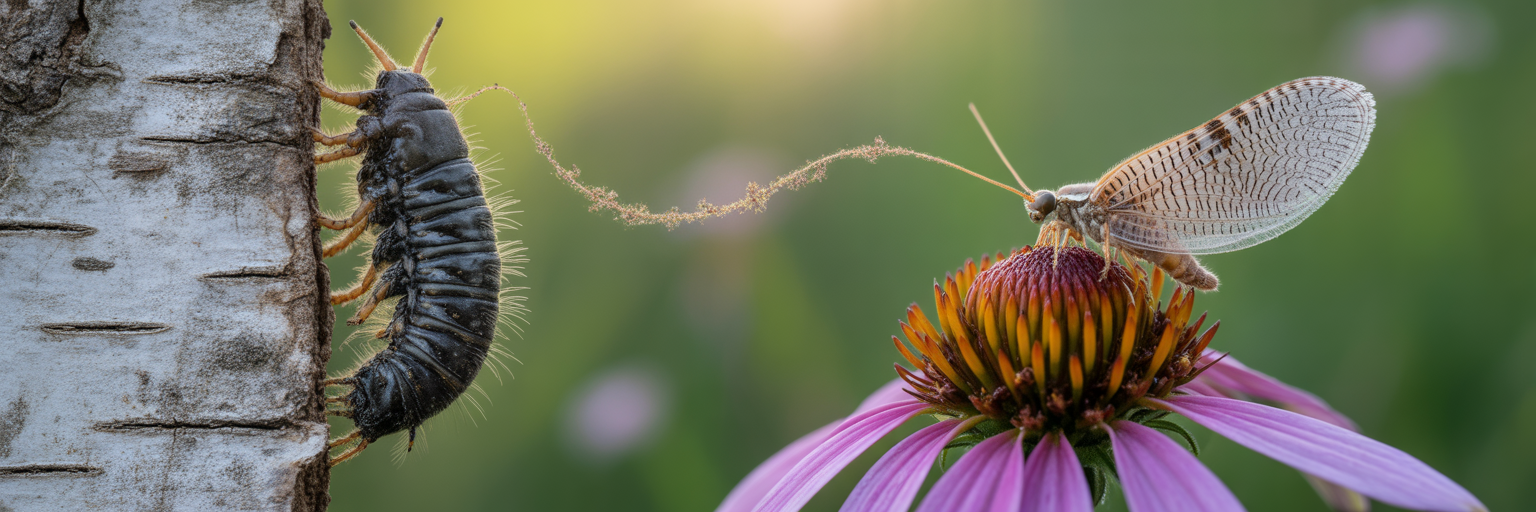
The final act in the life of the junk bug is its most dramatic transformation. After weeks of hunting and hoarding, the larva is ready to pupate. In a final, practical use of its macabre collection, it often incorporates its debris pack into the construction of its cocoon. It spins silk, binding the junk, corpses, and all, into a final, protective shelter. Inside this fortified tomb, one of nature’s most remarkable changes takes place.
When the metamorphosis is complete, what emerges is almost unrecognizable. The grotesque, earth-bound scavenger is gone. In its place is the adult lacewing, a creature of the air. Its body is a delicate, slender green. Its eyes are large and metallic gold. But its most stunning feature is its wings: large, translucent, and patterned with a fine network of veins that gives the insect its name. It is a creature of breathtaking beauty, a stark contrast to the walking junkyard it once was.
This transformation is mirrored by a complete shift in lifestyle. Many adult lacewings trade their predatory diet for one of nectar and pollen, becoming gentle pollinators. The journey from a grotesque battlefield crawler to a graceful creature of the air is a perfect illustration of complete metamorphosis.
| Attribute | Larva (Junk Bug) | Adult (Lacewing) |
|---|---|---|
| Appearance | Grotesque, alligator-like, covered in debris | Delicate, green, with large, translucent wings |
| Diet | Predatory (aphids, mites, ants) | Nectar, pollen, and sometimes other insects |
| Mobility | Crawling on plants and ground | Flying, highly mobile in the air |
| Primary Defense | Corpse armor, chemical mimicry | Flight, camouflage among leaves |
| Ecological Role | Pest control predator | Pollinator and aerial predator |
The Ecological Genius of Wearing Your Victims
The story of the junk bug is more than just a creepy tale from the garden. It is a testament to the creative power of evolution. Its strategy of wearing its victims is a multi-layered defense system that is almost unparalleled in its complexity. It combines the stealth of chemical mimicry, the brute force of a physical shield, and the confusion of psychological warfare into a single, cohesive survival plan. This is not a freakish anomaly; it is a brilliant solution to the intense pressures of a world filled with predators.
In its broader ecological context, the junk bug is a vital component of a healthy garden ecosystem. As a voracious predator of common pests, it provides a natural and highly effective form of pest control across the United States. Its presence is a sign of a balanced environment where nature’s own systems are at work. The junk bug’s strategy is a masterclass in survival against overwhelming odds. It’s a reminder of the incredible ways life adapts, much like how tiny insects survive fungal artillery fire in their own microscopic battles.
Ultimately, the behavior of these insects that wear debris forces us to reconsider our own definitions. In the brutal, efficient world of the junk bug, the line between trash and treasure, between armor and victim, is beautifully and grotesquely blurred. It is a powerful reminder that in nature, nothing goes to waste.