
The Reef’s Most Colorful Weirdo
Coral reefs are home to some of the most visually stunning creatures on the planet, and the parrotfish is certainly one of them. With scales that shimmer in electric blues, vibrant greens, and shocking pinks, it moves through the water like a living piece of abstract art. Its name comes from its mouth, where its teeth are fused into a hard, beak-like structure strong enough to bite off chunks of rock and coral. It is, by all accounts, a beautiful and essential inhabitant of the reef.
But its beauty masks a deeply strange existence. The parrotfish is the reef’s tireless, obsessive landscaper. It spends its days scraping and crunching, using its powerful beak to grind up algae-coated coral skeletons. This process, known as bioerosion, is vital for the health of the reef, as it cleans surfaces and makes room for new coral to grow. What it consumes passes through its digestive system and is excreted as fine, white sand. That’s not an analogy. The pristine, powdery sand of many tropical beaches is, quite literally, the processed and expelled remains of coral, courtesy of the parrotfish.
A single large parrotfish can produce hundreds of pounds of this sand every year. It is a creature that builds beaches with its own body, a living testament to the bizarre and interconnected cycles of the natural world. You could be forgiven for thinking that its most peculiar trait is its diet or its role as a sand factory. But you would be wrong. The true strangeness of the parrotfish doesn’t reveal itself until the sun sets and the reef grows dark. Its daytime job is peculiar, but its nightly ritual is something else entirely, a habit so unsettling it feels like it belongs in a science fiction film, not a coral reef.
A Bedtime Routine Made of Mucus
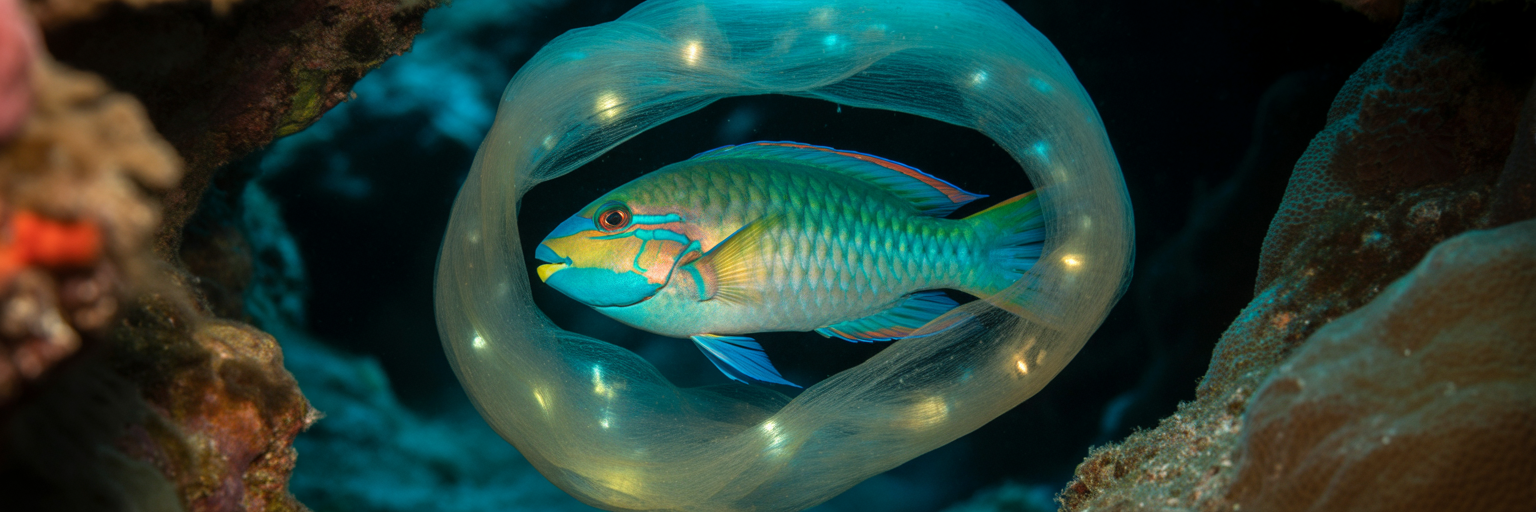
As twilight descends upon the reef, a strange transformation begins. The once-active parrotfish slows its pace, its vibrant colors dimming in the fading light. It seeks out a quiet crevice, a small cave in the coral where it can rest, but it doesn’t simply go to sleep. Instead, it begins one of the most bizarre bedtime routines in the animal kingdom. From a specialized gland near its gills, it starts to secrete a thick, gelatinous mucus. This isn’t a small amount of slime; it’s a deliberate, sustained effort to build a structure.
For up to an hour, the parrotfish painstakingly exudes this goo, spinning it around its body. The substance is clear and viscous, shimmering faintly in the dim light filtering through the water. Slowly, methodically, it envelops itself completely, creating a transparent, gelatinous sac. This is the parrotfish mucus cocoon, a self-made snot-sac that serves as its bedroom for the night. Once the structure is complete, the fish becomes still, suspended inside its own creation like a specimen in a jar.
The final image is profoundly unsettling. The beautiful, colorful fish hangs motionless, sealed off from the ocean within a bubble of its own making. This is the ultimate parrotfish sleeping bag, a custom-built fortress of slime. To an outside observer, it looks like the fish is being digested by some invisible amoeba, trapped in a shimmering prison. This is how the fish that sleeps in slime spends its nights, a grotesque yet fascinating display of biological engineering that raises an obvious question: why go to all this trouble?
The Science Behind the Slime Shield
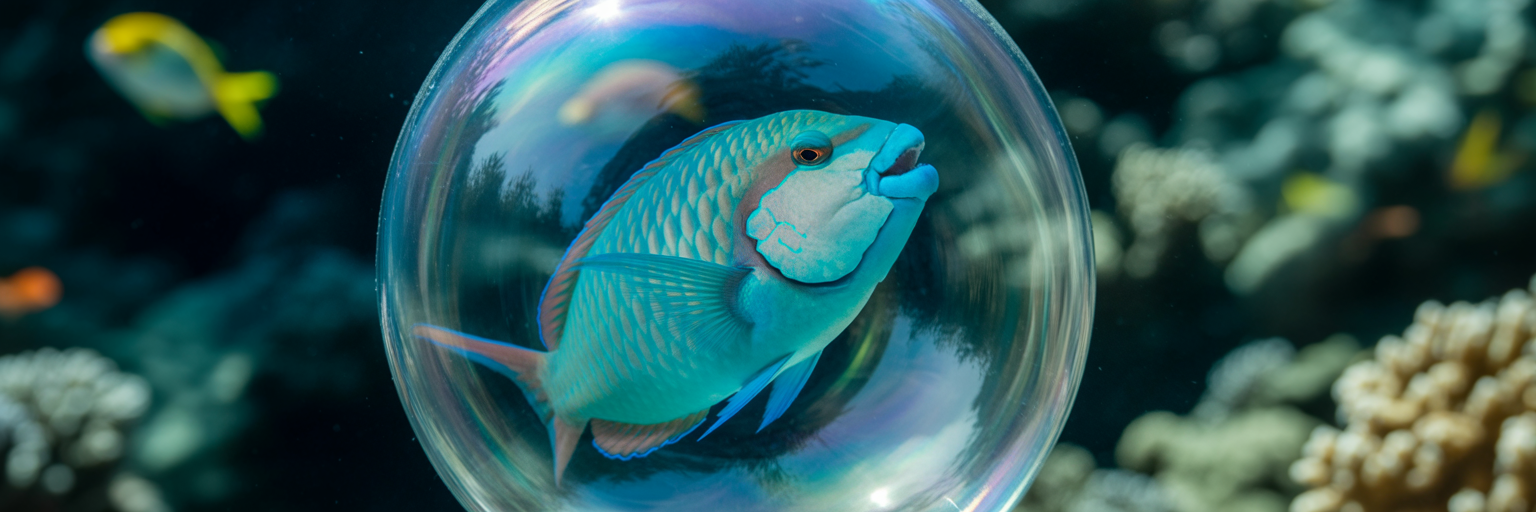
The enormous energy the parrotfish expends on its nightly cocoon points to a serious threat. Scientists have long been fascinated by this behavior, and the leading theory is that the slime provides protection from tiny, bloodsucking parasites. This defensive strategy is well-documented. A study published in the journal Coral Reefs confirmed that parrotfish actively select sleeping sites and form these cocoons specifically to reduce the risk from parasites and predators, highlighting how critical this behavior is for their survival.
The Nocturnal Nemesis: Bloodsucking Isopods
The primary antagonists are small crustaceans called gnathiid isopods. These creatures are the vampires of the reef. During the day, they hide in the sand or coral rubble. But at night, they emerge to hunt for sleeping fish, latching on to feed on their blood. They are tiny, persistent, and can cause significant harm, leading to blood loss, stress, and open wounds that are prone to infection. For a resting fish, these parasites are a relentless nocturnal menace.
A Physical Barrier Against Parasites
The parrotfish mucus cocoon appears to be a direct countermeasure to these isopods. It functions as a physical barrier, a custom-built mosquito net that the tiny crustaceans cannot easily penetrate. The gelatinous texture may be difficult for them to grip, or it may simply present an obstacle they are unwilling to cross. By sealing itself inside, the parrotfish creates a safe zone where it can rest without being constantly bitten by these bloodsuckers.
Evidence from the Reef
Scientific experiments have provided strong evidence for this theory. Researchers have observed that when a parrotfish is prevented from building its cocoon, or when the cocoon is experimentally removed, it is swarmed by gnathiid isopods. In contrast, fish resting inside their cocoons are almost completely ignored. The data is stark, showing a dramatic difference in parasite attacks. The cocoon’s function as a defense against tiny attackers is a fascinating example of evolutionary arms races, similar to how other creatures have developed unique survival tactics. For instance, some insects have evolved ways to endure attacks from their own microscopic foes, a struggle you can read about in our article on how tiny insects survive fungal artillery fire. Some scientists also believe the mucus may have antibiotic properties, helping to heal any wounds the fish sustained during the day.
| Condition | Primary Threat | Observed Attack Rate | Survival Outcome |
|---|---|---|---|
| Parrotfish with Mucus Cocoon | Nocturnal Gnathiid Isopods | Near 0% | Fish remains undisturbed and parasite-free. |
| Parrotfish without Mucus Cocoon (Experimentally Removed) | Nocturnal Gnathiid Isopods | Up to 85% of fish attacked | Fish suffers from blood loss, stress, and potential infection. |
| Parrotfish in Crevice (No Cocoon) | Nocturnal Gnathiid Isopods | Moderate to High | Hiding alone is insufficient; parasites can still locate the fish. |
Note: Data is synthesized from multiple observational and experimental studies on parrotfish and gnathiid isopod interactions. The exact attack rate can vary based on isopod density and reef location.
An Olfactory Invisibility Cloak
While protection from parasites is the leading theory, the slime shield likely serves another crucial purpose: hiding from predators that hunt by smell. Every living creature in the ocean releases a unique chemical trail, an “olfactory signature” that disperses into the water. Nocturnal hunters like moray eels and some species of reef sharks have an incredibly acute sense of smell, which they use to locate prey in the dark. A sleeping fish, tucked into a crevice, is still vulnerable if its scent drifts out into the current.
This is where the parrotfish mucus cocoon provides a second, equally brilliant defense. The gelatinous bubble is thought to act as an olfactory invisibility cloak. It traps the fish’s scent, preventing it from leaking out and advertising its location to every hungry predator in the vicinity. The mucus itself is believed to be largely odorless, making the sleeping parrotfish chemically invisible. This method of olfactory camouflage is a clever trick, but nature is full of deceptive survival strategies. Other animals rely on visual misdirection, such as developing patterns that look like what we’ve described in Nature’s Creepiest Illusion: How Fake Eyes Scare Predators.
Imagine a moray eel, its long body weaving through the coral as it sniffs the currents for a meal. It might pass inches away from a crevice containing a sleeping parrotfish, completely unaware of the easy meal hidden inside. The slime bubble contains the scent, effectively removing the fish from the eel’s sensory world. While this hypothesis is more difficult to prove with hard data than the parasite theory, it is a widely accepted and logical secondary benefit. It explains why a fish would go to such lengths to create a complete, sealed enclosure rather than just a partial covering.
The Biological Cost of a Fortress
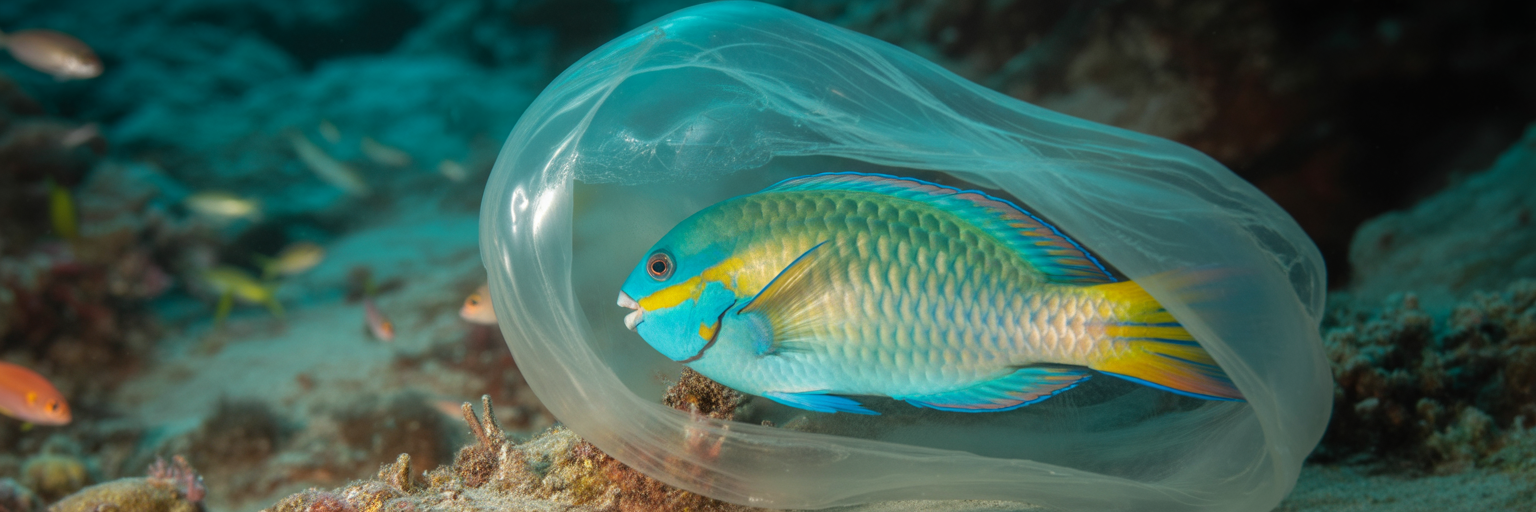
Creating a fortress of slime every single night is not a trivial task. This behavior comes at a significant biological cost, which is precisely why it offers such compelling evidence of its importance. Scientists have estimated that producing the mucus for the cocoon consumes about 2.5% of the parrotfish’s total daily energy budget. This is a substantial investment. As Smithsonian Ocean experts note, this nightly expenditure is a significant biological investment, which underscores just how dangerous the nocturnal reef environment is for a sleeping fish. For the parrotfish to evolve a trait that uses up so much energy, the benefits must be immense.
The mucus itself is a complex substance, primarily made of glycoproteins. Producing these molecules requires diverting valuable resources that could otherwise be used for growth or reproduction. The high cost of the cocoon is a clear indicator of the severe evolutionary pressure exerted by parasites and predators. The question of why do parrotfish make bubbles is answered by the simple math of survival: the energy spent on the cocoon is less than the energy that would be lost to bloodsucking parasites or a fatal encounter with a predator.
The total cost of this nightly ritual can be broken down into several components:
- Energy Expenditure: The direct metabolic cost of synthesizing and secreting the mucus.
- Time Investment: The hour spent building the cocoon is an hour the fish is stationary and potentially vulnerable before its defenses are complete.
- Material Resources: The biological compounds used to create the slime must be constantly replenished through feeding.
When morning comes, the routine is reversed with abrupt efficiency. The parrotfish simply bursts out of its slimy sleeping bag, leaving the tattered, single-use structure behind to dissolve in the current. It immediately gets back to its day job of crunching coral, gathering the energy needed to build it all over again that night.
Not All Parrotfish Indulge in Slime
Just when the story seems straightforward, nature adds a layer of complexity. The cocoon-building behavior, as bizarre as it is, is not universal among all parrotfish. Of the more than 90 species in the parrotfish family, only a subset are known to create these elaborate mucus shelters. Many species, including some of the largest, simply wedge themselves into tight crevices at night and hope for the best, forgoing the slime shield entirely.
This variation provides a fascinating natural experiment for scientists. Why would some species invest so heavily in this defense while their close relatives do not? The answer likely lies in a combination of factors. Some species may have evolved on reefs where gnathiid isopods are less common, making the high energy cost of a cocoon an unnecessary expense. Others might have developed alternative defenses, such as tougher scales, a more effective immune response to parasites, or the ability to find hiding spots that are so tight that even tiny isopods cannot reach them.
By comparing the biology and environments of cocoon-building species with their non-cocooning relatives, researchers can better isolate the specific advantages the behavior provides. If a cocoon-building species and a non-cocooning species live on the same reef, scientists can study their parasite loads and predation rates to directly measure the slime’s effectiveness. This diversity within the parrotfish family is a powerful reminder that evolution is not a single, linear path toward a perfect solution. Instead, it is a branching process of different strategies, each tailored to a specific set of environmental challenges and trade-offs.
A Life of Bizarre Transformations
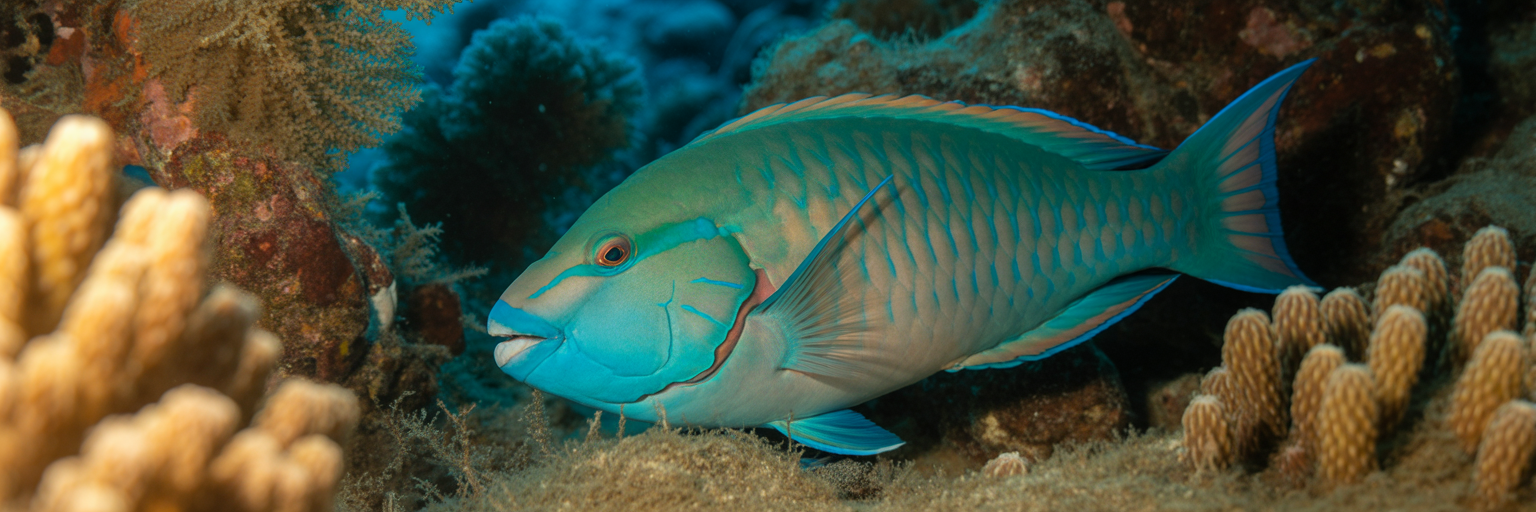
The nightly ritual of building a slime cocoon is just one chapter in the incredibly strange life of the parrotfish. The creature seems defined by transformation, constantly changing its body, its behavior, and even the world around it. Its sleeping habit is a behavioral transformation, but its entire life cycle is a series of biological ones. Many parrotfish species are sequential hermaphrodites, meaning they can change their sex. An individual may spend the first part of its life as a female, laying eggs, only to later transform into a fully functional male. This change is often accompanied by a dramatic shift in color and size, with the new “terminal phase” males becoming larger and more brightly colored.
Then there is the environmental transformation. The parrotfish is a geological force in a biological body. Its relentless consumption of coral and rock, and the subsequent excretion of sand, literally shapes coastlines. The iconic white sand beaches of Hawaii and the Caribbean are not primarily made of shells or minerals; they are overwhelmingly composed of parrotfish excrement. This is one of the most startling weird ocean animal facts: the beautiful landscape so many people travel to see is the product of a fish’s digestive system.
From its fused, beak-like teeth to its sex-changing life and its role as a sand factory, the parrotfish is a portrait of bizarre and essential change. Its life is a series of strange transformations, but it’s not the only creature with a bizarre life cycle. Some animals take it to an even more extreme level, as seen in the phenomenon of adelphophagy, where, as we’ve detailed in our article, some animals hatch inside their mother and eat their siblings. The nightly construction of a mucus cocoon fits perfectly into this life of constant, weird, and wonderful adaptation.
The Fragile World of the Slime-Sleeper
The story of the fish that sleeps in slime is more than just a biological curiosity. It is a powerful illustration of the intricate and fragile connections that define a healthy ecosystem. The parrotfish and the coral reef are locked in a relationship of deep codependency. The fish needs the reef’s complex structure to provide shelter for its nightly cocoon-building, and it relies on the algae growing on the coral for food. Without the reef, the parrotfish has nowhere to hide and nothing to eat.
In turn, the reef desperately needs the parrotfish. By grazing on algae, these fish act as the reef’s gardeners, preventing fast-growing seaweed from smothering and killing the slow-growing coral colonies. This balance is delicate and easily broken. Major threats like climate change, which causes coral bleaching, pollution that clouds the water, and overfishing that removes key grazers like the parrotfish, are pushing reefs to the brink of collapse. The loss of parrotfish populations can trigger a downward spiral, where algae take over and the entire reef ecosystem dies.
The bizarre image of a parrotfish suspended in its mucus cocoon is therefore not just a strange spectacle. It is a symbol of a perfectly functioning, healthy reef. It represents a world of complex interactions, where every creature has a role and survival depends on strange and wonderful adaptations. The parrotfish’s survival is tied to its environment, just as the reef’s health is tied to the parrotfish. This intricate relationship is a common theme in nature, where even seemingly passive organisms have evolved their own defense mechanisms, creating a world where, as we’ve explored, the coral that can fight back like a living army is a reality. The fate of this colorful, sand-producing, slime-sleeping weirdo is tied to the fate of one of the most important ecosystems on Earth.