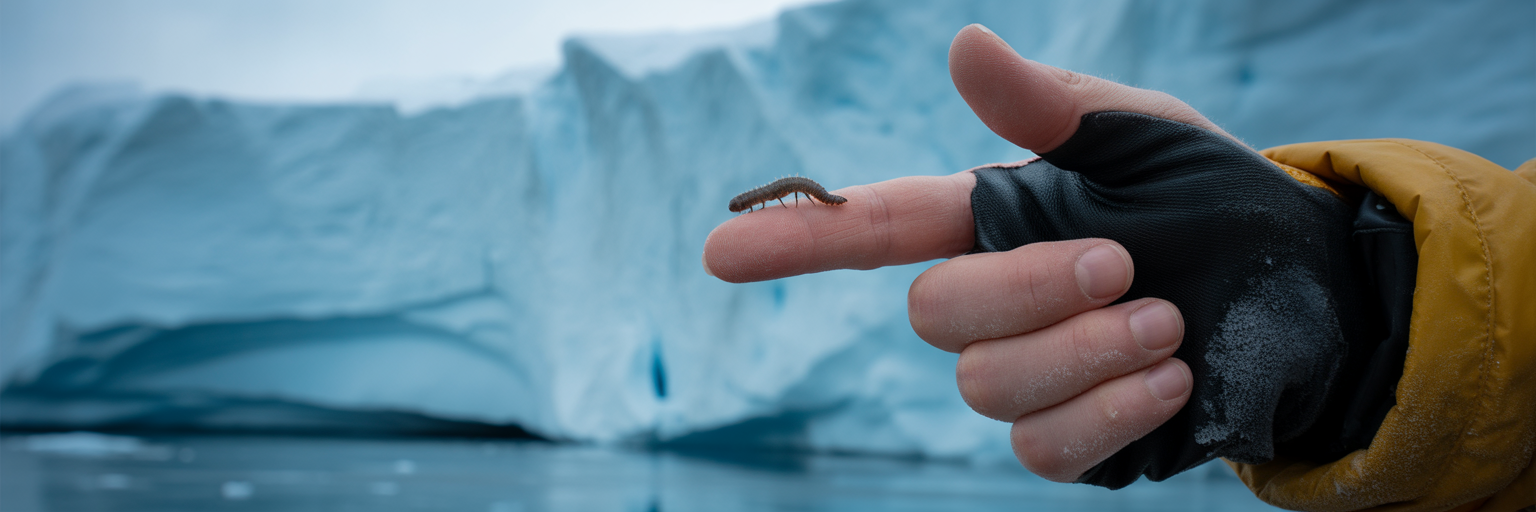
Nature’s Cold, Wriggling Anomaly
In 1887, on the desolate expanse of Alaska’s Muir Glacier, explorers first documented a life form that defied all logic. They found worms, black and writhing, living inside the solid ice, a discovery that has puzzled science ever since.
This is the story of the ice worm, Mesenchytraeus solifugus. But to call it a simple animal feels wrong. It’s more like a biological error, a piece of living code that nature forgot to delete. Its home is the crushing, silent emptiness of a Pacific Northwest glacier, an alien landscape of immense pressure and crystalline blue walls. Here, in a world defined by its hostility to life, this creature thrives. It is a place where the air is thin, the silence is absolute, and the only movement is the slow, grinding creep of ice and the squirming of these impossible worms.
The central paradox of the ice worm is what makes it so deeply unsettling. This creature that lives in ice is most comfortable at 32°F (0°C), the exact point where water turns to solid. Yet, if the temperature rises to a mild 40°F (5°C), a temperature most life finds pleasant, the ice worm’s body chemistry goes haywire. Its cellular bonds break down, and it disintegrates into a puddle of goo. It doesn’t just die; it dissolves, melting like the ice it calls home.
When first discovered, the scientific community met the reports with disbelief. Worms living in solid ice sounded like something from folklore, a cryptid that had crawled out of tall tales and into a respected journal. As highlighted in publications like National Geographic, its existence is still considered a profound scientific paradox. It possesses a fragility so extreme it feels almost supernatural. The ice worm is a living contradiction, a thread of life stitched into a frozen shroud, constantly wriggling on the edge of two opposing states of oblivion: freezing solid or melting away.
A Life Lived Inside a Crystal Prison
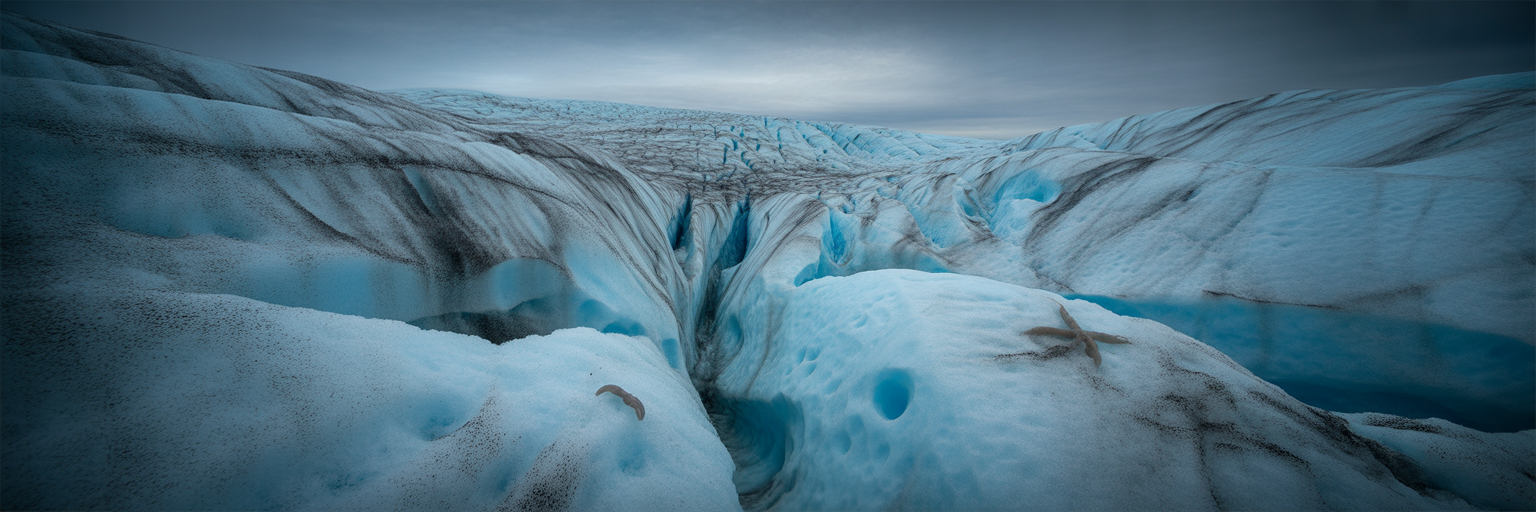
To understand the ice worm is to understand its home, which is far from a static block of ice. A glacier is a dynamic, shifting environment. Between its immense, tightly packed ice crystals are microscopic veins of liquid water, a hidden network of tunnels and chambers. This interstitial water, colder than freezing but kept liquid by immense pressure, contains the algae and bacteria that the worms feed on. The glacier’s interior is a kind of frozen sponge, a crystalline labyrinth, and the worms are its sole, squirming navigators.
Their daily life is a frantic, vertical migration dictated by a lethal sun. During the day, the surface of the glacier becomes a death trap. The warmth and UV radiation are fatal, so the worms burrow deep into the ice, sometimes several meters down, to find refuge in the constant, near-freezing darkness. They spend their days in this cold, pressurized sanctuary, waiting. This behavior is well-documented on glaciers managed by the U.S. National Park Service in Alaska, where these worms are a key feature of the glacial ecosystem.
Then, as dusk falls and the sun’s lethal rays retreat, a truly eerie spectacle begins. Millions of these tiny black threads emerge onto the glacier’s surface to feed. The ice, which was stark white and empty moments before, becomes covered in a writhing carpet of black worms. They move with a strange, directed purpose, grazing on wind-blown pollen and algae trapped on the surface. It’s a silent, synchronized emergence, a mass of life appearing from a seemingly lifeless solid. They have mastered their crystal prison in a way that is both beautiful and deeply strange, much like the insect that can turn a leaf into a complete ecosystem, engineering their survival in a world that should kill them.
Anatomy of a Biological Contradiction
At first glance, the ice worm is unimpressive. It’s a simple, dark, thread-like entity, usually no more than an inch long. It looks less like a complex animal and more like a living shadow or a stray suture stitch left behind on the ice. But this primitive appearance hides a masterpiece of specialized engineering. Its body is a collection of brilliant solutions to impossible problems, and a closer look reveals some fascinating ice worm facts.
Its dark, almost black pigmentation is not for camouflage; in a world of white ice, it stands out starkly. Instead, the pigment serves two critical functions. First, it helps the worm absorb faint amounts of heat from the filtered sunlight that penetrates the ice, providing just enough energy to keep its metabolism ticking. Second, and more importantly, it provides powerful UV protection. It’s a built-in, full-body sunscreen that shields the worm’s delicate tissues from the intense solar radiation at high altitudes. This is a stark contrast to animals that rely on visual deception for survival, such as those that employ fake eyes to scare off predators; the ice worm’s defense is purely chemical.
The worm’s body is covered in setae, which are tiny, bristle-like structures common to annelids (segmented worms). On an ice worm, however, these are not just hairs. They function as microscopic crampons, allowing it to grip the treacherous, slippery walls of its ice tunnels. As it moves through the crystalline labyrinth, these setae provide the traction needed to navigate vertical shafts and resist the crushing, shifting pressures of the glacier. This simple annelid body plan, one of the most ancient in the animal kingdom, has been fine-tuned to conquer a lethal, modern environment. It’s a biological contradiction: a primitive creature with a god-like mastery of its frozen world.
The Biochemical Sorcery of Never Freezing

So, how do ice worms survive in a place that should turn them into tiny, lifeless popsicles? The fundamental problem for most life at freezing temperatures is internal ice formation. When water inside a cell freezes, it forms sharp crystals that act like microscopic daggers, shredding membranes and destroying the cell from within. The ice worm has solved this problem with a form of biochemical sorcery that still mystifies scientists.
While the exact mechanisms are a subject of ongoing research, we know their survival depends on a suite of remarkable Mesenchytraeus solifugus adaptations. These worms are among the few animals that don’t freeze while remaining fully active. Their internal chemistry is a finely tuned engine running on the edge of physical law.
- Antifreeze Compounds: The ice worm’s cells are flooded with cryoprotectants. While the specific molecules are still being identified, they are thought to function like antifreeze proteins found in other cold-dwelling organisms. These substances latch onto any tiny ice crystals that begin to form, preventing them from growing into the cell-destroying daggers that would otherwise kill the worm.
- Cold-Optimized Enzymes: In most creatures, metabolic reactions grind to a halt as temperatures approach freezing. Ice worm enzymes, however, are built differently. They are specifically structured to function optimally in extreme cold, allowing the worm to move, digest, and even reproduce at temperatures that would leave other animals as frozen statues. Their entire metabolic machinery is cold-dependent.
- High-Energy Cells: To power this constant fight against the cold, ice worm cells maintain incredibly high concentrations of ATP and GTP, the universal “energy currency” of life. It’s as if their cells are constantly red-lining, keeping their internal engines supercharged to generate the chemical energy needed to function and prevent freezing.
This combination of adaptations allows the ice worm to live, not just survive, in the ice. It doesn’t shut down or go dormant. It remains active, wriggling, and feeding. Science has only scratched the surface of this biological alchemy, and the remaining mysteries only add to the worm’s unsettling mystique.
An Evolutionary Glitch in the System
The existence of the ice worm raises a profound evolutionary question: why? Why would a creature evolve such an extreme and narrow specialization? The answer seems to be a high-stakes gamble. The ice worm traded the ability to live almost anywhere else on Earth for absolute dominion over one of the planet’s most hostile environments. It has no competitors and few predators. It is the undisputed king of its frozen, empty kingdom.
This strategy of extreme specialization is one of several Mesenchytraeus solifugus adaptations that set it apart, even from other extremophiles. While many hardy organisms, like the tardigrade, survive freezing by entering a dormant state of cryptobiosis, the ice worm remains fully active. It doesn’t just endure the cold; it lives in it. This is a fundamental difference in survival strategy, as seen when comparing it to other tough life forms.
| Organism | Environment | Survival State | Key Adaptation |
|---|---|---|---|
| Ice Worm | Glacial Ice (Near 0°C) | Fully Active | Biochemical antifreeze; cold-active enzymes |
| Tardigrade (Water Bear) | Virtually Anywhere (Extreme Heat, Cold, Vacuum) | Dormant (Cryptobiosis) | Dehydrates and replaces water with protective sugars |
| Deep-Sea Vent Worm | Hydrothermal Vents (Extreme Heat & Pressure) | Fully Active | Symbiotic bacteria metabolize toxic chemicals for energy |
This table highlights how the ice worm’s strategy of remaining fully active in its extreme environment is unique, even among the world’s toughest organisms.
This active approach is a bizarre evolutionary path, similar in its strangeness to the animal that survives by shrinking its own organs to conserve energy. But has the ice worm adapted itself into an evolutionary corner? By becoming the perfect master of ice, it has lost the ability to live anywhere else. It is not entirely alone in its world; birds like the snow bunting and rosy finch have learned to feed on the worms, timing their visits to the glaciers to coincide with the worms’ evening emergence. This proves the worm is part of a bizarre, high-altitude food web, but its fate is inextricably tied to its frozen habitat.
A Cold Existence on Thinning Ice
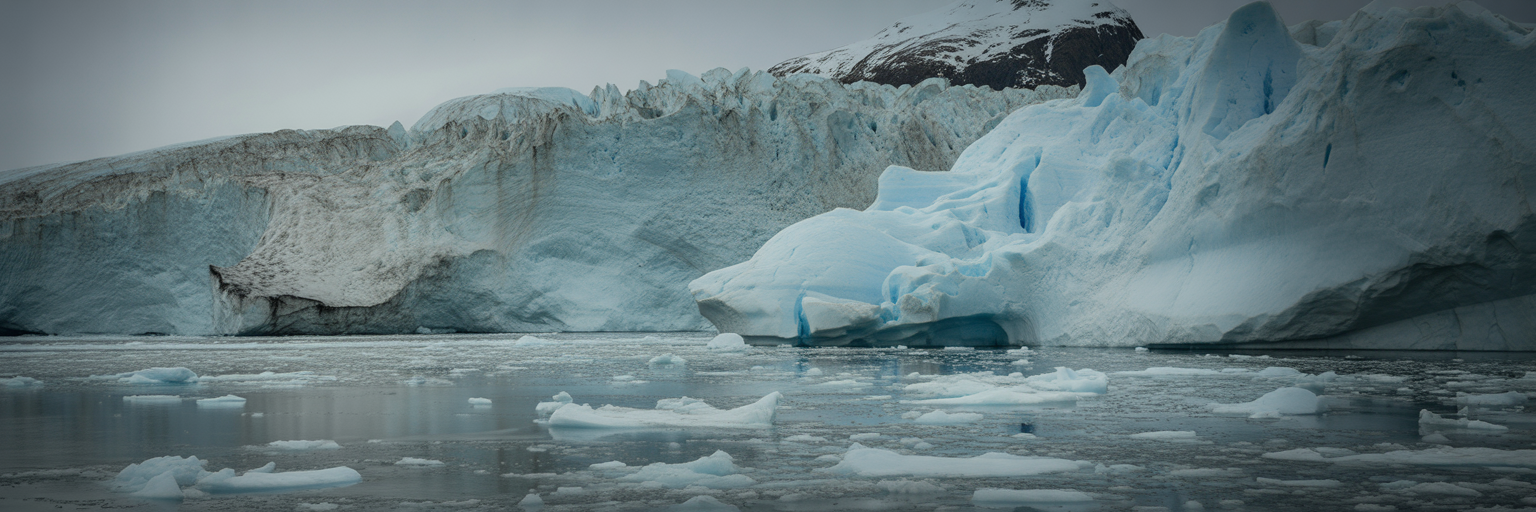
Here lies the ultimate, cruel irony of the ice worm’s story. The very specialization that allowed it to conquer the cold is now its greatest vulnerability. The creature that lives in ice is existentially threatened by warmth. As global temperatures rise and glaciers around the world recede at an alarming rate, the ice worm’s kingdom is shrinking.
The threat is not just a loss of habitat. For the ice worm, a warming world is a direct, physical assault. As average temperatures on the glaciers climb, they are increasingly pushing past the worm’s narrow survival threshold. The ice that has been its sanctuary for millennia is now melting, and the environment is becoming too warm for its hyper-specialized body to handle. They are, quite literally, dissolving into extinction.
One can imagine a final, somber scene: the worms emerging at dusk, as they have for thousands of years, onto the surface of a glacier that is visibly weeping, its edges retreating and its surface slick with meltwater. They wriggle across a home that is disappearing from beneath them, a writhing elegy for a world of cold that is vanishing forever. The ice worm’s story is a testament to life’s incredible, almost perverse tenacity, but it is also a stark, squirming reminder of the fragility of even the toughest creatures in a changing world.