
An Introduction to the Mud’s Most Confident Resident
Picture a landscape that time forgot. A vast, shimmering expanse of primordial ooze, where the sea reluctantly pulls back to reveal a world of gray, sucking mud. It’s a desolate, forgotten place, smelling of salt and decay. This is not a kingdom for the faint of heart. It is a realm that only a creature with supreme, almost delusional, confidence would dare to call home. And patrol it, this creature does.
The Unsettling Swagger of a Fish Out of Water
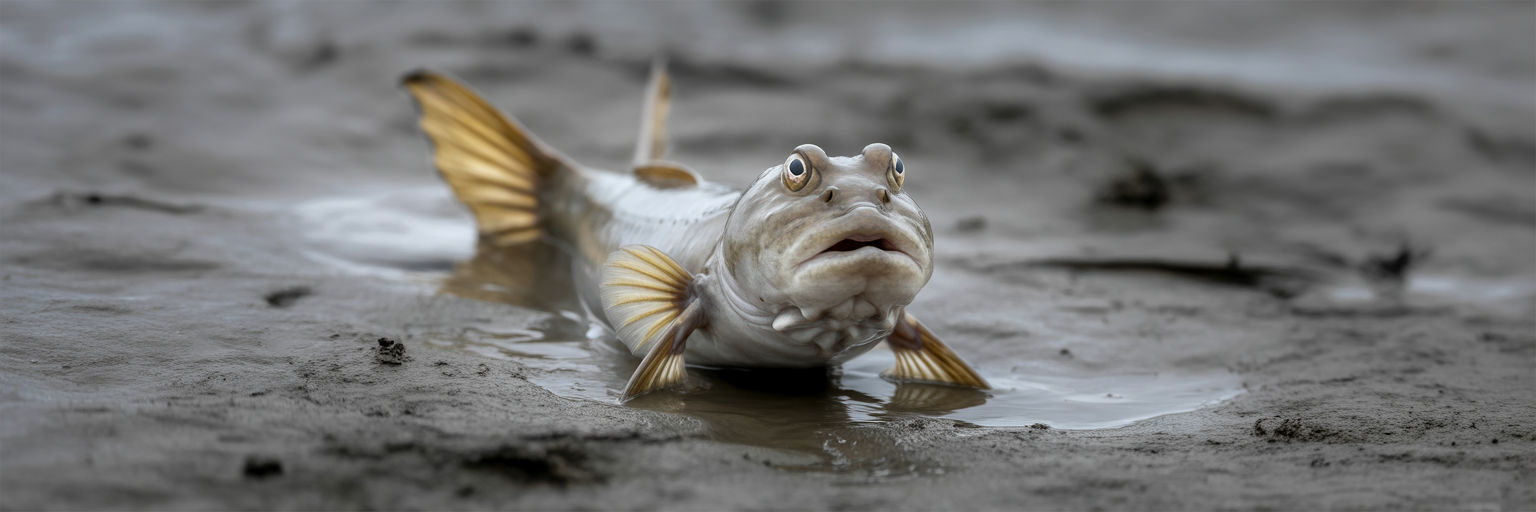
Out of a murky puddle, something emerges. It’s a fish, but it carries itself with the defiant posture of a creature that has fundamentally misunderstood its evolutionary purpose. This is the mudskipper, and it doesn’t swim through its domain. It walks. It struts across the mud with an unnerving swagger, planting its fins like little crutches and heaving its slimy body forward. Each movement is a deliberate, unnatural act, a clear rejection of its aquatic heritage. It’s a fish that can walk, and it seems deeply, personally proud of this fact.
Its appearance is a masterpiece of grotesque design. Two bulging, periscopic eyes sit atop its head, swiveling independently like twin turrets on a slimy tank. They give it a near 360-degree view of its muddy manor, missing nothing. Its mouth is perpetually agape, frozen in an expression that’s halfway between a disgruntled sigh and the prelude to an insult. The body itself is a lumpy, ill-fitting tube of brown and gray, glistening with a layer of slime that seems both essential and deeply unpleasant.
A Kingdom of Primordial Ooze
This creature patrols its kingdom of sludge as if it were a palace garden. It stops, cocks its head, and surveys its territory with an air of ownership that is frankly unearned. You can’t help but stare and wonder what cosmic secret this bizarre animal is hoarding. What gives this slimy, goggle-eyed weirdo the right to be so arrogant? It is easily one of the weirdest fish in the world, a living contradiction that chose to crawl out of the water and conquer the mud. While the mudskipper’s confidence is legendary, it’s just one of nature’s many creepy masterpieces, like the sea slug that literally steals sunshine to survive.
The answer to its confidence lies in a suite of biological hacks so audacious they border on cheating. This fish decided the rules of being a fish were boring, so it rewrote them. Its unnerving power comes from its ability to breathe air, walk on its fins, and dominate a habitat that would kill almost any other creature. To understand the mudskipper is to understand the anatomy of pure, unadulterated ego.
How to Breathe When You’ve Decided Water Is Optional
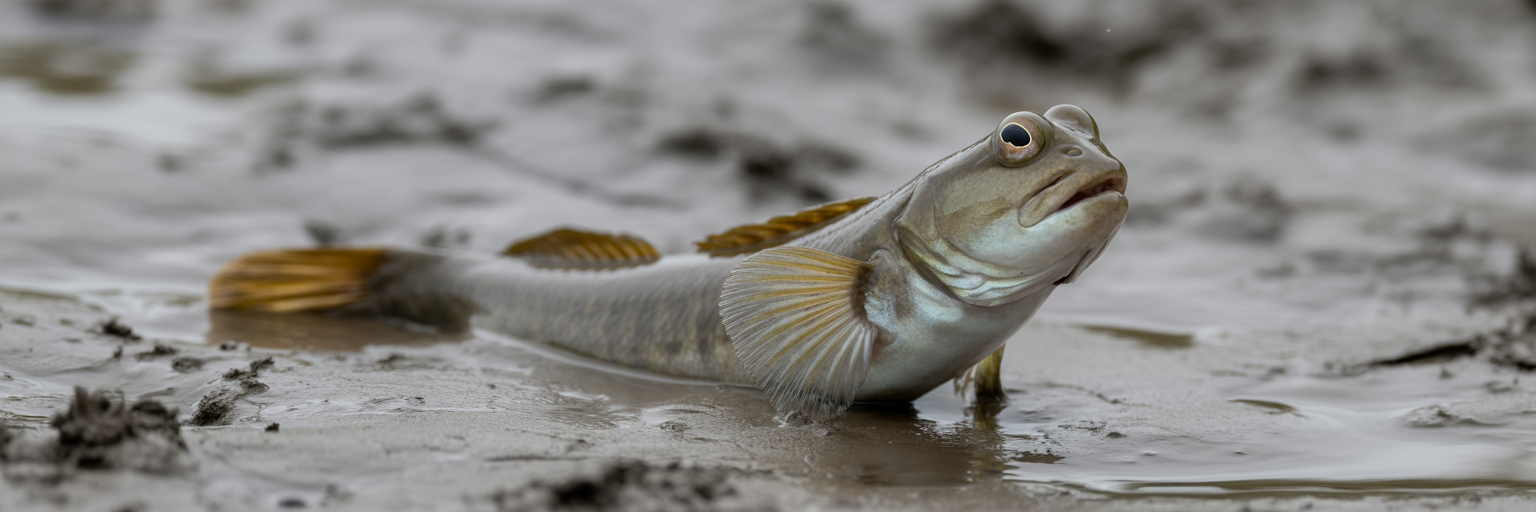
For a normal fish, leaving the water is a death sentence. Gills, so elegant and efficient underwater, become useless, collapsing into a sticky mess. The fish flops, gasps, and quickly succumbs to suffocation. The mudskipper, however, seems to view this entire process with disdain. It has mastered the art of mudskipper breathing air through a series of adaptations that are as brilliant as they are bizarre. It didn’t just learn to survive on land; it made land its front porch.
Wearing Your Lungs on the Outside
The mudskipper’s first and most unsettling trick is breathing through its skin. Its entire body, along with the lining of its mouth and throat, is covered in a dense network of capillaries just beneath the surface. This allows it to absorb oxygen directly from the atmosphere, a process called cutaneous respiration. In essence, it wears its lungs as a slimy, full-body coat. This is why it must stay moist; the slime isn’t just for show, it’s a critical part of its respiratory system. A dry mudskipper is a suffocating mudskipper, a fact it seems to handle with casual dips and rolls in the mud, as if merely adjusting its royal robes.
The Personal Scuba Tank Technique
Breathing through its skin is only part of the strategy. The mudskipper also has a built-in scuba tank. Before embarking on a terrestrial patrol, it takes a large gulp of water and traps it within its oversized gill chambers. These chambers are much larger and more robust than those of a typical fish, preventing them from collapsing out of water. By trapping water against its gills, it can continue to extract dissolved oxygen. But it gets weirder. It also gulps air, holding a bubble in its mouth and throat to absorb oxygen that way. This premeditated act of “buccal gulping” is a clear sign of a creature that plans its excursions. And if breathing through your skin sounds strange, it’s worth remembering that nature has even weirder solutions, like the fish that can breathe through its gut.
A Masterclass in Staying Moist
All these systems rely on one thing: moisture. You’ll often see a mudskipper suddenly flop over and roll in a shallow puddle. This isn’t an act of clumsiness. It’s a calculated, deliberate re-moistening of its skin and a replenishment of the water in its gill chambers. It treats these puddles like personal charging stations, allowing it to spend hours out of the water, hunting, fighting, and generally lording over its domain. The stark difference between its abilities and those of its aquatic peers is a testament to its evolutionary audacity.
| Breathing Feature | The Audacious Mudskipper | The Boringly Normal Fish |
|---|---|---|
| Primary Oxygen Source on Land | Atmospheric air | Non-existent; leads to rapid suffocation |
| Primary Breathing Surface | Skin, mouth lining, and throat (cutaneous/buccal) | Gills (for water only) |
| Air Storage Mechanism | Traps air in enlarged gill chambers (buccal gulping) | None; gills collapse in air |
| Time Spent on Land | Hours at a time, as long as it stays moist | Seconds to minutes, followed by certain doom |
| Survival Strategy | Actively patrols, hunts, and lives on land | Frantically flops until it finds water or dies |
The Unsettling Mechanics of Fin-Based Walking
If breathing air wasn’t enough of a rebellion against its fishy nature, the mudskipper’s method of getting around on land seals its reputation as an evolutionary iconoclast. It doesn’t just survive out of water; it moves with purpose. The mechanics of its locomotion are a core reason why it’s known as the fish that can walk, and watching it is like witnessing a biomechanical miracle born of pure spite.
The ‘Crutching’ Gait of a Conqueror
The mudskipper’s primary walk is a form of “crutching” that uses its pectoral fins as powerful, makeshift legs. The movement is both awkward and impressively effective, a rhythmic sequence that carries it across the mud with surprising speed. The process is a masterclass in repurposing anatomy:
- The Plant: The mudskipper firmly plants its two pectoral fins into the mud ahead of its body, angling them slightly outward for stability.
- The Lock: It stiffens its body and locks the fins in place, creating a solid anchor point.
- The Swing: Using the fins as a pivot, it swings its entire body forward in a powerful, muscular heave, landing a few inches ahead of its starting point.
- The Reset: It then lifts its fins and repeats the process, creating a rhythmic, strutting gait.
This isn’t the desperate flopping of a stranded fish. This is controlled, directed movement. This is walking.
Fins That Are Basically Arms
This gait is only possible because a mudskipper’s pectoral fins are nothing like the delicate, flimsy fins of a goldfish. They are proto-limbs. At the base of each fin is a powerful fusion of bones that forms a joint, similar to a shoulder. Strong muscles connect these fins to the body, allowing the mudskipper to support its own weight and propel itself forward. These aren’t just fins; they are proto-limbs, the result of a remarkable process of natural Design and Development that transformed a simple appendage into a powerful tool for terrestrial locomotion. Using fins as legs is a profound evolutionary shift, as strange in its own way as the creature that can hear with its knees.
Leaping, Skipping, and Climbing: Beyond the Walk
The crutching walk is just its cruising speed. When it needs to move quickly, whether to catch prey or flee a predator, the mudskipper employs a move called “skipping.” By curling its powerful body and tail and then suddenly straightening, it can launch itself into the air, covering surprising distances in a single bound. The biomechanics of this motion are a subject of scientific fascination, with general information on their unique fin structure and musculature detailed in resources like Wikipedia, which notes their ability to leap over half a meter. But its mobility doesn’t stop there. Mudskippers are also adept climbers, using their pectoral fins to grip and haul themselves up the tangled roots of mangrove trees. This ability gives them a vertical advantage, allowing them to escape high tides and get a better vantage point over their muddy kingdom. Every movement is a tool of power, used to hunt, fight, and assert its absolute dominance.
Master of a Kingdom Between Two Worlds
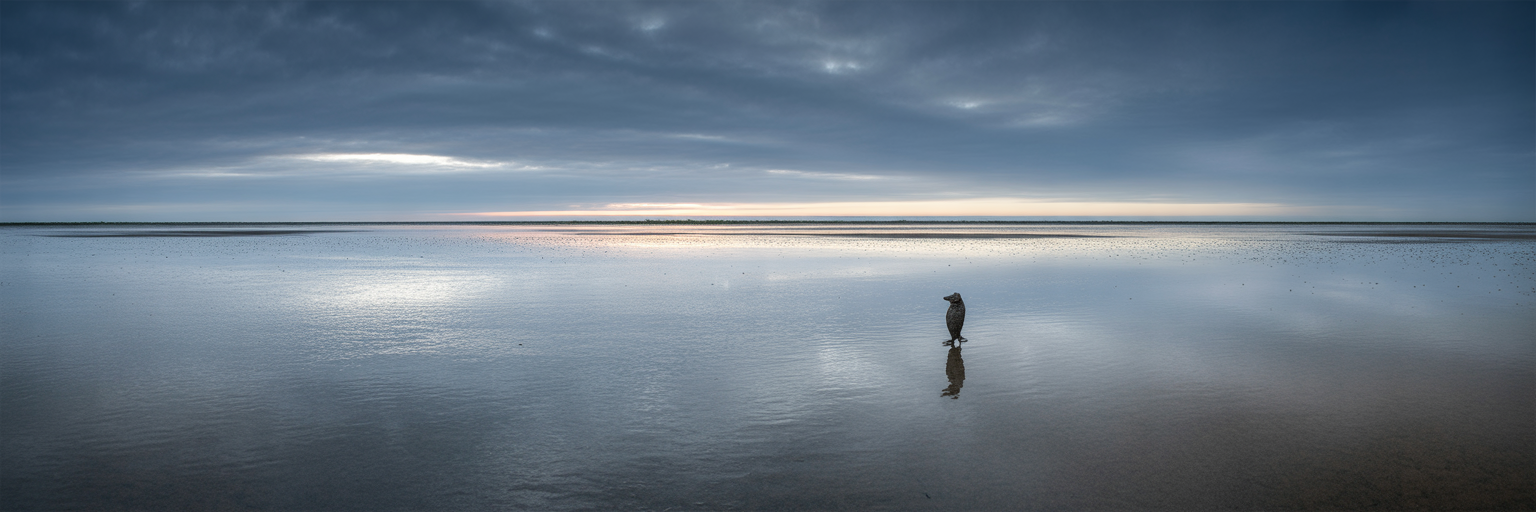
So, we have a fish that breathes air and walks on land. But why? Why go to all this evolutionary trouble? The answer lies in the brutal, chaotic environment it calls home: the intertidal zone. This is the strip of land exposed during low tide and submerged during high tide. It’s a world of constant change and harsh conditions, a battleground that most species avoid. The mudskipper didn’t just adapt to it; it conquered it, turning a no-man’s-land into its personal throne room by exploiting a suite of incredible amphibious fish adaptations.
The Intertidal Throne Room
By being equally comfortable in and out of the water, the mudskipper plays both sides of the fence and wins every time. This mastery of the intertidal zone, a habitat that is brutally challenging for most species, is what defines the mudskipper’s success, a point explored in articles like ‘The Fish That Walks on Land’ on Vocal Media. Its amphibious lifestyle gives it a unique set of advantages:
- Predator Evasion: If a predatory bird like a heron appears, the mudskipper can instantly dive into the nearest puddle or its burrow. If a larger fish attacks in the water, it can simply walk out onto the mud. It has an escape route for every threat.
- Reduced Competition: Most fish are trapped in the water, competing for the same limited resources. The mudskipper leaves them all behind, venturing onto the mudflats where the competition is virtually nonexistent.
- Thermoregulation: The mud is its thermostat. If it gets too hot under the sun, it takes a dip. If the water is too cool, it basks on a warm patch of mud. It actively manages its body temperature with a level of control other fish can only dream of.
Playing Both Sides and Winning
This strategic positioning makes the mudskipper the undisputed king of its niche. It has effectively created a world where it has few, if any, direct competitors. While other animals are specialists, locked into a single environment, the mudskipper is a generalist with a specialist’s toolkit. It has carved out a kingdom for itself by refusing to choose between land and sea, instead claiming the chaotic borderland between them as its own.
The Mudflat Buffet and the Underwater Fortress
Its ability to walk on land grants it access to a personal, all-you-can-eat buffet. While other fish nibble on algae and aquatic invertebrates, the mudskipper hunts insects, small crabs, worms, and other terrestrial morsels left stranded by the receding tide. It has a food source that is completely unavailable to its water-bound relatives. But its mastery doesn’t end there. For protection, reproduction, and a safe place to ride out the high tide, the mudskipper engineers its own home. It digs deep, Y-shaped burrows into the mud. These aren’t just holes; they are underwater fortresses. One entrance is typically below the low-tide line, while the other is on the exposed mudflat. Inside, it creates a special air-filled chamber where it can rest and even lay its eggs, ensuring its next generation is born into the heart of its muddy empire.
The Gaze and Grandeur of a Mud-Dwelling Despot
A creature this confident needs the sensory tools and social behaviors to back up its ego. The mudskipper’s life is a constant performance of dominance, from the way it sees the world to how it interacts with its own kind. Its strange anatomy and aggressive posturing make it one of the most fascinating and creepy ocean animals, a tiny despot ruling its slimy kingdom with an iron fin.
Eyes on the Prize, and Everywhere Else
The mudskipper’s most prominent and unsettling feature is its eyes. Perched high on its head like watchtowers, they can move independently, allowing it to look forward and backward at the same time. This gives it a panoramic, near-360-degree view of its surroundings, making it almost impossible to sneak up on. These all-seeing turrets are a key tool in its arsenal, a practical application of the same principle behind nature’s creepiest illusion: how fake eyes scare predators. But the weirdness doesn’t stop there. To keep them moist and clean, the mudskipper can retract its eyes down into fleshy, cup-like sockets. It’s a profoundly strange action, like a cartoon character sucking its eyeballs back into its head for a quick wash.
The Ego Has Landed: Territorial Disputes
Mudskippers are fiercely territorial, and their disputes are pure theater. A male will defend his patch of mud with a series of dramatic threat displays designed to intimidate rivals. These confrontations are a spectacle of raw ego:
- The Gape: Two rival males will face off, opening their wide mouths as far as they can in a show of aggression.
- The Fin Flash: They will suddenly raise their dorsal fins, often brightly colored, to make themselves appear larger and more threatening.
- The Leap Attack: If posturing doesn’t work, fights can become physical, with the mudskippers launching themselves at each other in acrobatic, open-mouthed clashes.
These battles over a few square feet of mud are a clear window into the creature’s psyche. Every inch of its kingdom is worth fighting for.
A Bizarre Ballet of Courtship
When it comes to mating, the male mudskipper’s confidence goes into overdrive. To attract a female, he performs an energetic and almost desperate dance. He will leap high into the air, flash his colorful fins, and perform a series of vigorous head-nods and body-wiggles. It’s a bizarre ballet, a strange and compelling performance designed to prove his fitness and worthiness. To complete the alien picture, mudskippers also communicate using a series of soft clicks, pops, and croaks. This auditory layer adds to their otherworldly presence, turning the mudflats into a landscape filled with the quiet, confident chatter of its tiny, slimy rulers.
An Evolutionary Blueprint for Unreasonable Confidence
The story of the mudskipper is a perfect storm of evolutionary audacity. It is a creature that looked at the fundamental rules of being a fish and decided they were merely suggestions. Its ability to breathe air, its unsettling fin-walking, its mastery of a hostile niche, and its aggressive, territorial behavior all point to one thing: a biology built on self-assurance. These are not just random mudskipper facts; they are the components of a blueprint for unreasonable confidence.
In the grand scheme of life, the mudskipper is a living transitional fossil, a snapshot of the incredible journey from water to land. But it feels less like a creature in transition and more like one that got halfway, took a look around, and decided it had perfected the form. It saw no need to go further. Why become a full-fledged land animal when you can rule the boundary between two worlds, exploiting the best of both?
The mudskipper is not just a survivor. It is a thriving, swaggering despot whose entire existence is a declaration of its own greatness. The next time you imagine a desolate mudflat, picture this tiny, goggle-eyed king strutting across its empire. It plants its fins in the ooze, lifts its head to survey its domain, and carries on with its patrol, utterly and completely convinced that it owns the place. And honestly, who are we to argue?