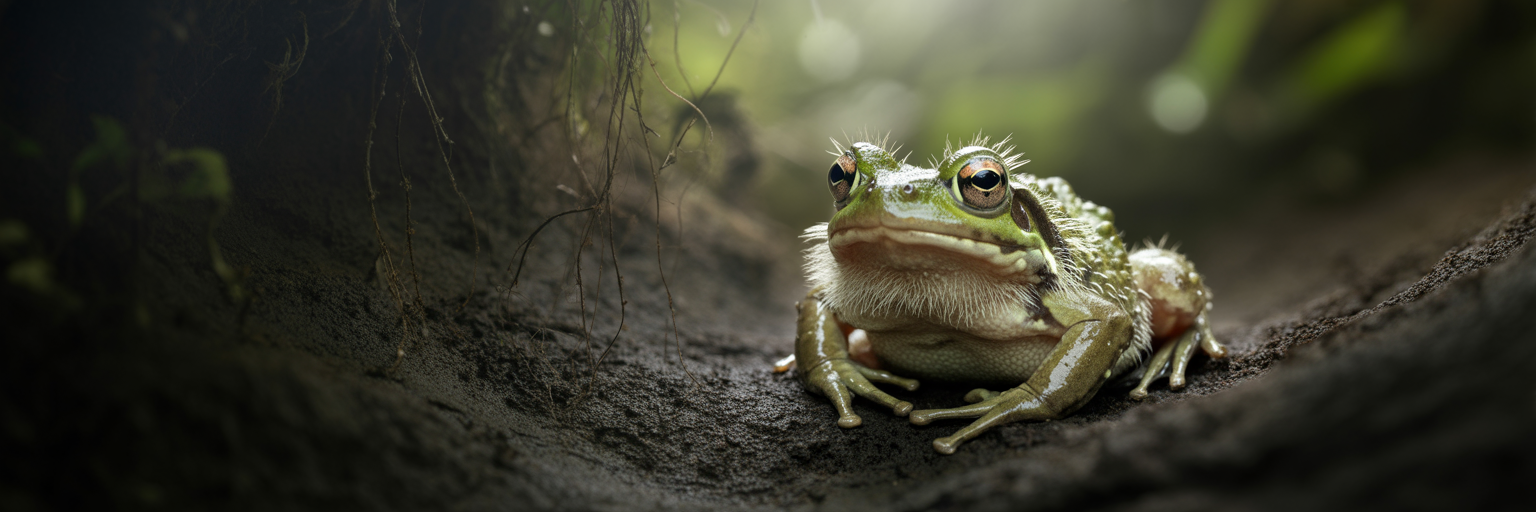
Most frogs rely on being slippery or poisonous to survive. Then there’s the one that decided Wolverine’s powers were a good evolutionary goal.
Meet Nature’s Most Brutal Brawler
Deep in the fast-flowing rivers of Central Africa lives the hairy frog (Trichobatrachus robustus), an amphibian that takes self-defense to a gruesome extreme. Forget toxins or camouflage. When this creature feels threatened, it doesn’t just fight back; it manufactures its own weapons through an act of violent self-mutilation. This isn’t a metaphor. The hairy frog intentionally shatters the bones in its own toes, forcing the sharp, jagged fragments to punch through its skin, creating a set of makeshift claws.
Imagine the sheer mechanics of it. A predator grabs the frog, and in a desperate, visceral response, the frog flexes its muscles with such force that its own skeleton snaps. The resulting bone shards become daggers, ready to gouge and tear at whatever is holding it. This isn’t a neat, clean process. It’s a messy, traumatic event that turns the frog’s feet into instruments of pain, both for its attacker and for itself. It’s the kind of biological feature you’d expect to read about in a comic book, not find in a rainforest stream.
This ability makes the hairy frog a true outlier in the animal kingdom. Most animals with claws, from house cats to grizzly bears, grow them from keratin, the same protein that makes up our hair and nails. These claws are external, renewable, and don’t require catastrophic injury to deploy. The hairy frog, on the other hand, opts for a strategy of controlled, catastrophic damage. It breaks its own body to save its life, a brutal trade-off that makes it one of nature’s most hardcore survivors.
Anatomy of an Amphibian Nightmare: The Hairy Frog
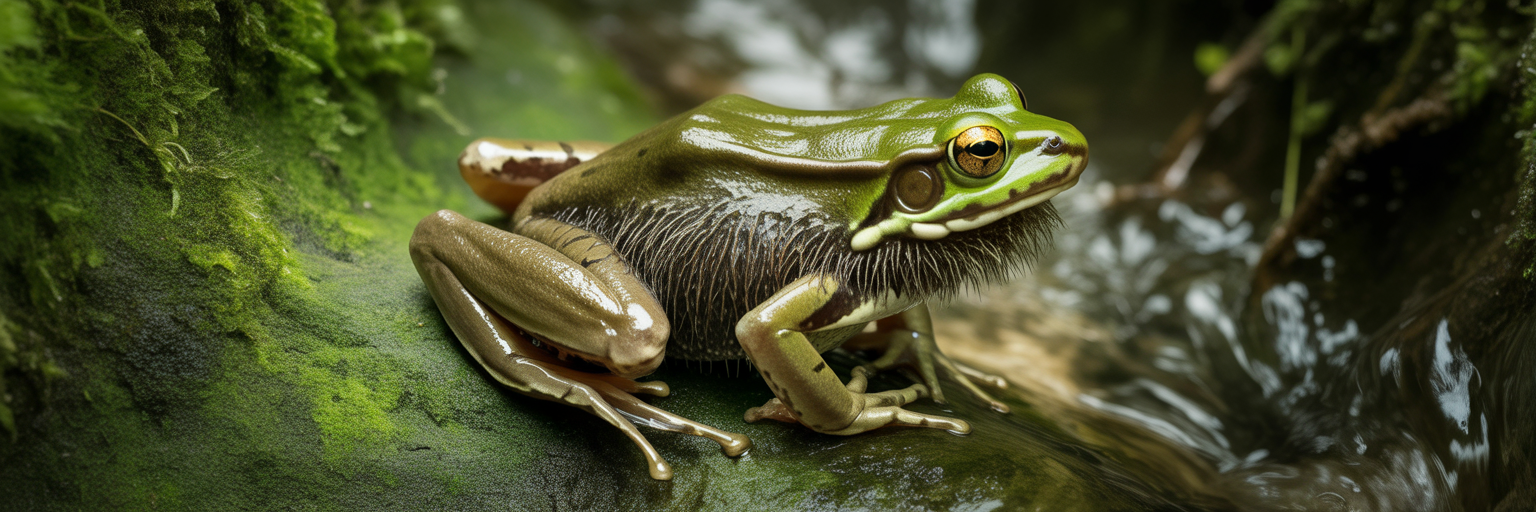
Before we get back to the bone-snapping horror, it helps to understand the creature behind the claws. The hairy frog is more than just its shocking defense mechanism. Its entire biology is a masterclass in adapting to a demanding environment, and its seemingly bizarre features all serve a purpose. Its daily life is a strange mix of the mundane and the extreme, creating a Jekyll-and-Hyde persona that makes its violent potential even more unsettling.
What’s With the ‘Hair’?
The first thing people notice, besides the bone claws, is the name. The “hair” isn’t hair at all. During the breeding season, male frogs develop a set of long, thin skin filaments along their flanks and thighs. These dermal papillae look like a shaggy coat, but they function more like an extra set of gills. They are rich in arteries and are thought to help the frog absorb more oxygen directly from the water. This is crucial for a creature that spends long periods underwater guarding eggs, an activity that demands a huge amount of energy and oxygen.
A Life in the Fast Lane
The hairy frog makes its home in the cool, turbulent, and highly oxygenated rivers of countries like Cameroon and Gabon. This isn’t a stagnant pond dweller. It thrives in a world of rushing water, which explains both its need for extra oxygen absorption and its powerful physique. Its muscular build isn’t just for breaking its own bones; it’s necessary for navigating strong currents and hunting the small crustaceans, insects, and slugs that make up its diet.
The Jekyll and Hyde of the Frog World
On a typical night, the hairy frog is just another nocturnal predator. It sits quietly, waiting for an unsuspecting insect to wander by. It’s a normal, almost boring existence for an amphibian. This placid behavior creates a stark contrast with the brutal capability lurking just beneath its skin. It’s a creature that spends most of its life in quiet ambush, only to transform into a self-mutilating brawler at a moment’s notice. This duality is what makes it so fascinating. It seems perfectly ordinary until it’s not, and when the switch flips, it becomes one of the most extreme defenders in the animal kingdom.
The Bone-Breaking Mechanism Step-by-Step
The process of deploying these bone claws is a feat of biological engineering, as precise as it is gruesome. It’s a sequence of events that turns the frog’s own skeleton into a weapon. Researchers have studied this incredible mechanism, and it unfolds in a few terrifying steps. This isn’t a passive defense; it’s an active, violent transformation.
- The Setup: The weapon is always ready, hidden inside the frog’s toe pads. The final bone in each toe, the terminal phalanx, is naturally pointed and sharp. It’s not connected to the preceding bone in a typical joint. Instead, it’s anchored at its base by a tough nodule of collagen. This unique anatomy keeps the sharp tip safely tucked away inside the fleshy part of the toe, a dagger waiting in its sheath.
- The Trigger: When a predator grabs the frog, a powerful flexor muscle attached to the sharp phalanx contracts with incredible force. This isn’t a gentle squeeze or a warning shot. It’s an all-or-nothing response to mortal danger, a biological panic button that initiates a chain reaction of self-destruction.
- The Snap: The muscle’s contraction is so violent that it pulls the base of the pointed bone against its collagen anchor. The force is too great for the anchor to withstand. It severs, and in the same motion, the bone itself is fractured away from its base. The frog has just snapped its own toe bone, creating a free-floating, razor-sharp shard of skeleton.
- The Puncture: Now detached, the sharp bone fragment is driven by the still-contracting muscle. It has nowhere to go but forward. It punches through the skin of the toe pad, emerging as a raw, jagged spike. This is the moment the bone breaking frog earns its name. What emerges is not a clean, retractable claw but a splinter of broken bone, ready to inflict damage.
- The Attack: With its toes now armed with bony spikes, the frog thrashes and kicks, using the claws to scratch and gouge its attacker. The goal is to cause enough pain and surprise to force the predator to let go. As documented in a 2008 Harvard Gazette article, researchers who first detailed this mechanism described them as “erectile claws,” a clinical term for one of nature’s most brutal defenses.
Why These Aren’t Your Cat’s Claws
It’s easy to hear “frog with claws” and picture a miniature tiger, but the reality is far stranger and more brutal. The weapons of the hairy frog are fundamentally different from the claws of a cat, lizard, or bear. A true claw is an external structure made of keratin, the same tough protein that forms our fingernails. It grows, can be sharpened, and often retracts into a protective sheath without causing any harm to the animal. The hairy frog’s bone daggers are none of these things.
This is a clear case of traumatic weaponry, not standard anatomy. The following table breaks down just how different these two types of “claws” are, highlighting why the hairy frog’s strategy is one of the most weird animal defenses ever documented.
| Feature | True Keratin Claw (e.g., Cat) | Hairy Frog’s Bone Dagger |
|---|---|---|
| Material | Keratin (same as hair and nails) | Bone (living skeletal tissue) |
| Location | External, grows out of the skin | Internal, until deployed by force |
| Deployment | Extends from a sheath, no injury | Requires breaking a bone and piercing the skin |
| Retraction | Retracts into sheath | Does not retract; tissue must heal around it |
| Maintenance | Grows continuously, can be sharpened | Single-use per break; brittle and un-sheathed |
The implications of these differences are profound. Lacking a keratin sheath, the bone shards are brittle and exposed. They are a true last-resort tool, not something used for climbing or casual scratching. No other known vertebrate intentionally breaks its own skeleton to create a weapon. This strategy is so bizarre it makes other strange survival tactics, like how a parrotfish sleeps inside a bubble of its own slime, seem almost normal by comparison. The hairy frog isn’t just using claws; it’s weaponizing its own broken body.
The Biological Price of Extreme Self-Defense
Survival always comes at a cost, but for the hairy frog, the price is immediate and severe. Deploying its bone claws is not a neat trick; it’s a desperate gamble that inflicts massive trauma on its own body. The frog may escape the predator, but it is left maimed, vulnerable, and fighting a new battle for its life against the consequences of its own defense.
A World of Hurt
While we can’t ask the frog how it feels, we can look at the biology. The act of fracturing multiple bones and punching them through skin would trigger a massive physiological stress response. In amphibians, this process, known as nociception, is the body’s way of reacting to damaging stimuli. The frog is essentially trading the certainty of being eaten for the certainty of intense, debilitating injury. It’s an act born of pure desperation.
The Risk of Rot
Perhaps the most immediate danger after the predator is gone is infection. The frog has just created several deep, open wounds on its feet. Its habitat, a wet, bacteria-filled river environment, is the worst possible place for such injuries. Without the protection of skin, the exposed tissue and bone are highly susceptible to bacteria and fungi. The frog’s immune system must work overtime to prevent a lethal infection from taking hold. It’s a race against time in a microscopic war.
A Sitting Duck
With broken toes and raw bone shards protruding from its feet, the frog’s mobility is severely compromised. Its ability to jump, swim effectively, and hunt for food is drastically reduced. It has escaped one threat only to become a sitting duck for another, less-deterred predator or to face the slow threat of starvation. The desperation of this act is reminiscent of other extreme survival strategies in nature, such as how some animals survive by shrinking their own organs to conserve energy. The hairy frog’s defense is the ultimate gamble, an admission that guaranteed injury is better than guaranteed death.
Amphibian Regeneration and Resetting the Weapon
If the hairy frog’s defense is its shocking superpower, its ability to heal is its quiet miracle. The brutal strategy of breaking its own bones would be a one-way ticket to infection and death if not for the remarkable regenerative abilities common among amphibians. This healing prowess is what makes the entire gruesome process viable, allowing the frog to recover from what should be a crippling injury.
Amphibians are masters of regeneration. We’ve all heard of a salamander regrowing a lost tail or even a full limb. This healing ability is a hallmark of many amphibians, a topic explored in depth by scientific publications like the journal Development, which, as reported by NCBI, details the cellular mechanisms of salamander limb regeneration. The hairy frog likely leverages a similar biological toolkit. After the claws are deployed, a rapid process of cell division begins, working to close the open wounds on its toe pads and repair the damaged tissue.
But what happens to the bone shards? How does the weapon “reset”? Researchers believe the process is passive, not active. The frog doesn’t retract the bones like a cat retracts its claws. Instead, a few things likely happen over time:
- The flexor tendon that pulled the bone through the skin relaxes, allowing the fragment to passively recede back into the toe pad.
- The torn skin and tissue then heal around the bone shard, slowly enclosing it once more.
- In some cases, the body may eventually reabsorb the broken bone fragment, a slow and energy-intensive process of recycling the skeletal material.
This healing is not instantaneous. It takes significant time and resources, reinforcing the high-cost nature of this defense. The frog must lay low, conserving energy and avoiding further threats while its body slowly puts itself back together. This incredible healing ability is as bizarre as the injury itself, rivaling other strange biological processes like the way the Suriname toad gives birth through holes in its back. It’s a testament to nature’s ability to find a solution for even the most extreme problems.
The Hairy Frog and Its Evolutionary Arms Race
Why would any creature evolve such a painful and costly defense mechanism? The answer lies in the intense pressures of its environment. The hairy frog didn’t develop its bone claws in a vacuum. It forged them in the crucible of an evolutionary arms race, where the stakes are life and death. Its Central African river habitat is filled with predators, including large snakes, birds of prey, and even humans, who are known to hunt the frogs for food, sometimes using spears to avoid being clawed.
In an environment with such formidable threats, simply being slippery or quick isn’t always enough. This is where extreme amphibian defense mechanisms come into play. A defense that inflicts a sharp, painful, and memorable wound can be a powerful deterrent. A predator that gets a mouthful of broken bone might think twice before trying to eat another hairy frog. It’s a lesson taught through pain.
This is a classic “last-ditch” defense. The frog likely doesn’t want to break its own bones. Its first instincts are probably to flee or hide. But when capture is imminent and all other options are exhausted, it unleashes its ultimate weapon. The high cost of injury becomes a worthwhile trade-off for a chance at survival. This makes the high cost a worthwhile trade-off, much like how the archerfish developed a highly specialized way to hunt. The bone-claw strategy is an extreme solution to an extreme problem, a brutal but successful adaptation for a life lived on the edge.
A Creature That Redefines Toughness
The story of the hairy frog sounds like something from a monster movie, but it’s a real-world example of nature’s brutal creativity. Thanks to researchers like David Blackburn, who first documented this phenomenon, we know that this swamp-dwelling Wolverine is not a myth. It’s a living, breathing creature that has pushed the boundaries of what we thought was possible for an amphibian.
The hairy frog is unforgettable for three reasons: the misleading “hairs” that are actually skin gills, the shocking act of breaking its own bones to create a frog with claws, and the incredible regeneration that allows it to heal from such self-inflicted trauma. It embodies a painful but effective form of survival, proving that toughness comes in the strangest and most gruesome packages.
This frog is a living testament to nature’s bizarre ingenuity. It reminds us that even the most delicate-looking systems require their own form of specialized protection, whether it’s an amphibian in a dangerous river or a phone in our pocket. The hairy frog simply chose a solution that was a little more… direct.