An Introduction to Indestructible Life
Imagine you find a strange, dried-up plant in your yard. It looks like a dead, brown tumbleweed, so you decide to get rid of it. You step on it, hearing a faint crackle. You leave it on the hot pavement for a week, forgotten. Then, a rainstorm passes through. The next morning, you find it sitting there, fully green, unfurled, and looking almost smug, as if your attempt to destroy it was a minor inconvenience. This isn’t a scene from a low-budget horror film; it’s a real encounter with one of nature’s most stubbornly resilient organisms.
This plant treats being crushed, desiccated, and left for dead as a spa day. Its durability isn’t a delicate, poetic resilience. It’s an arrogant defiance of what should be certain death. Most life on Earth is fragile, a complex machine that breaks when mishandled. This plant, however, seems to operate on a different set of rules, where total system failure is just a temporary state of rest. Its common name, the “resurrection plant,” feels like a dramatic understatement. It doesn’t just come back to life; it treats the entire concept of being alive as a casual, on-and-off switch.
Among the weirdest plants in the world, this one stands out for its sheer contempt for destruction. It has engineered itself to not just endure but to welcome conditions that would turn other organisms into dust. Formally known as Selaginella lepidophylla, it has perfected the art of playing dead so convincingly that it can fool time itself, waiting for years in a state of suspended animation before casually resuming its life as if nothing happened. It’s less a plant and more a biological paradox wrapped in a brittle, brown shell.
This raises some unsettling questions. How does a living thing survive forces that would obliterate it at a cellular level? What biological cheats does it use to laugh in the face of complete dehydration and physical trauma? The answers lie in an architecture so bizarre and a chemical strategy so precise that it feels less like evolution and more like a deliberate, almost alien design.
Meet the Desert’s Most Stubborn Resident
Moving beyond its almost supernatural reputation, Selaginella lepidophylla is a real organism with a specific home and identity. Its stubbornness is a product of its environment, a landscape that punishes anything that isn’t prepared for the absolute worst. This plant isn’t just tough; it’s a master of its brutal domain.
The Real Rose of Jericho
First, a point of clarification is needed. This plant is often sold as the “Rose of Jericho,” but that name is misleading. According to Wikipedia, this is a frequent point of misidentification. The “true” Rose of Jericho, Anastatica hierochuntica, is a completely different species from the Middle East. Our subject, Selaginella lepidophylla, is a type of spikemoss native to the Chihuahuan Desert, which spans parts of the American Southwest and Mexico. It’s a creature of the New World, shaped by the harsh sun and scarce water of North America.
A Life in Two Acts: Dormant and Alive
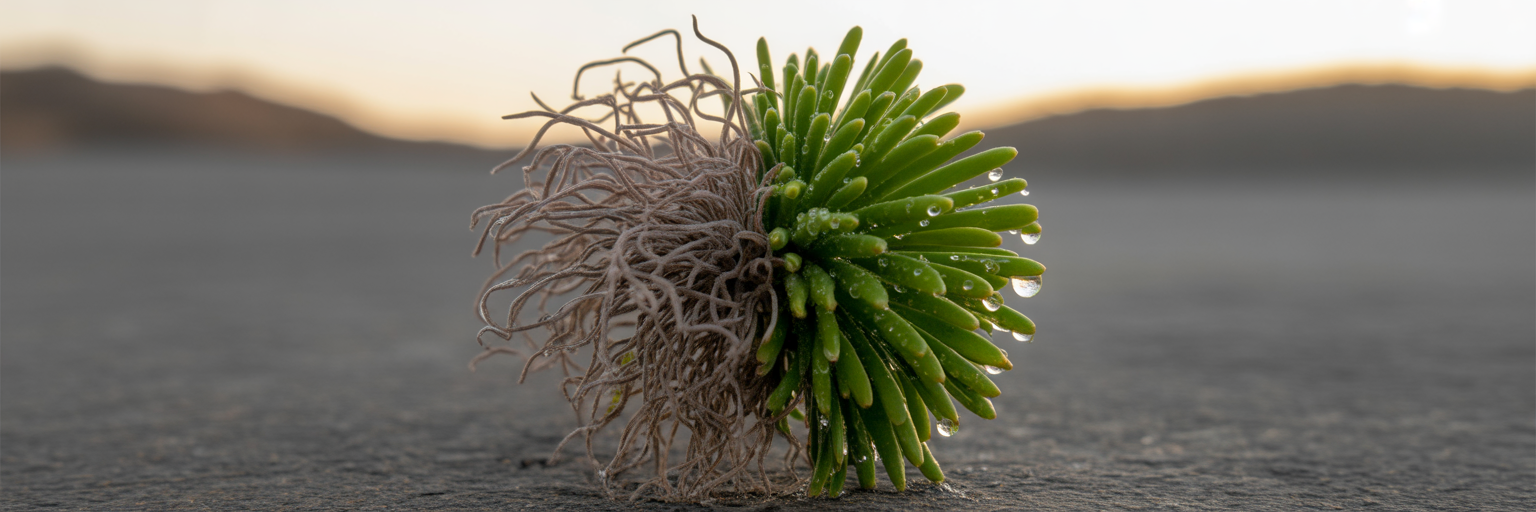
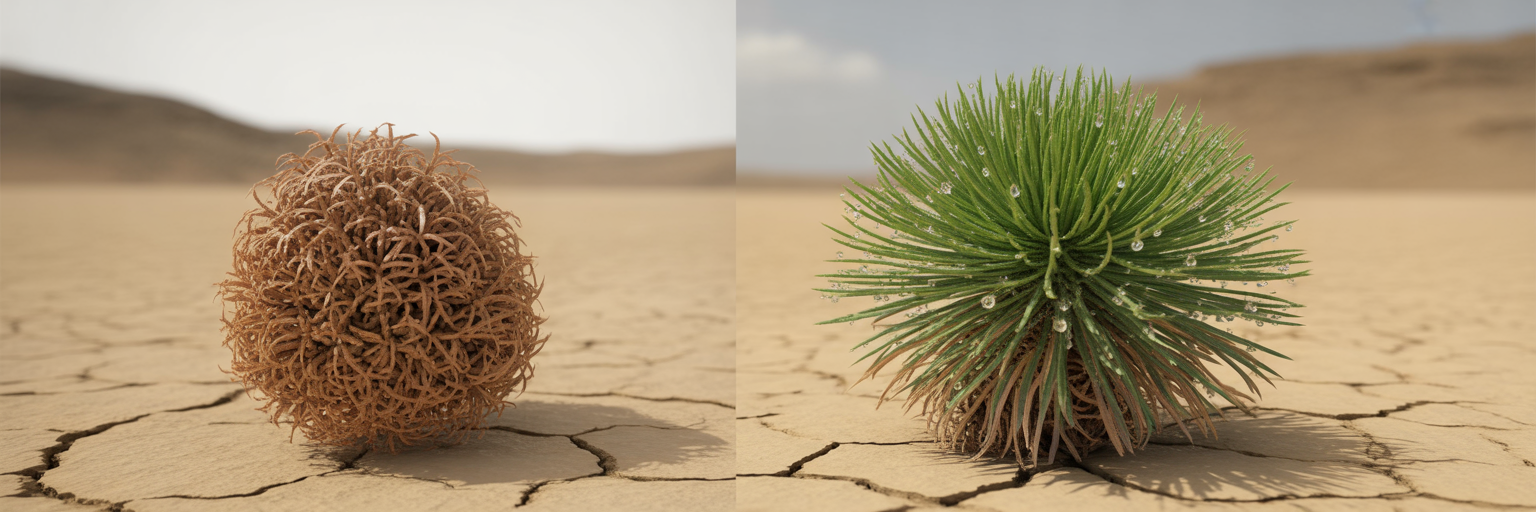
The plant exists in two dramatically different states. When water is available, it’s a lush, green, fern-like rosette that spreads out to a diameter of about a foot. It looks alive, vibrant, and almost ordinary. But when the water disappears, it begins a transformation. It curls inward, pulling its fronds tightly into a dense, brown ball. In this desiccated state, it looks like nothing more than a piece of dead organic debris. It’s brittle to the touch, light enough to be carried by the wind, and appears utterly lifeless.
The Tumbleweed Strategy
This transformation is not just a defensive posture; it’s a strategy for relocation. Once it becomes a dry, lightweight ball, the plant allows its shallow roots to break. The desert winds then pick it up and send it rolling across the landscape like a common tumbleweed. This isn’t a passive journey. The plant is actively searching for moisture. This ability to sense and seek out resources is a key feature of many desert plant adaptations, though few are as mobile as this one. It’s a behavior reminiscent of how some creatures have evolved unique sensory abilities, like the animal that can smell rain days before it falls. When the rolling ball finally settles in a damp spot, it unfurls, turns green, and begins to photosynthesize again, having successfully migrated to a better neighborhood.
The Architectural Secrets of Being Uncrushable
The fact that Selaginella lepidophylla can survive being completely dried out is strange enough. But its ability to withstand being physically crushed while in its dormant state is what makes it truly exceptional. This isn’t an accident; the plant is built like a piece of biomechanical armor, engineered from the cellular level up to treat physical force as a minor nuisance. This is the core of how a plant that survives being crushed actually works.
Engineered to Bend, Not Break
The secret to its structural integrity lies in how its cells are arranged. The stems contain specialized cells reinforced with lignin, a rigid polymer that acts like rebar in concrete. However, these lignified cells aren’t distributed uniformly. Instead, they are arranged in a “graded distribution,” with more rigid cells on the outer side of the stem and more flexible ones on the inner side. When the plant dries and curls inward, this design allows the stems to bend into a tight spiral without snapping. Think of a retractable metal measuring tape; it can coil tightly because it’s designed to be flexible in one direction and rigid in another. This architecture allows the entire plant to deform under pressure, distributing the force of an impact across its whole structure instead of letting it concentrate on one weak point.
The Glassy Secret Within
The real magic, however, happens inside the cells. As the plant desiccates, it floods its cells with a sugar called trehalose. This sugar has a remarkable property: at low water concentrations, it forms a viscous, glass-like substance. This process, known as vitrification, effectively turns the cytoplasm of each cell into a solid state. The delicate machinery of the cell, like proteins and membranes, becomes locked in place within this matrix of organic safety glass. When the plant is stepped on or crushed, the external force is met not by fragile, water-filled sacs but by a solid, glassy interior that prevents the internal components from being shattered. The plant literally turns its insides to glass to protect itself. It’s a strategy that is both brilliant and deeply unsettling.
| Feature | Hydrated State (Active) | Desiccated State (Dormant) |
|---|---|---|
| Water Content | ~95% of total mass | As low as 5% of total mass |
| Physical Form | Unfurled, green, flexible rosette | Curled, brown, brittle ball |
| Cellular Cytoplasm | Liquid, enabling metabolic activity | Vitrified (glass-like solid) |
| Trehalose Sugar | Low concentration, used for energy | High concentration, acts as a protectant |
| Metabolism | Active photosynthesis and growth | Suspended, near zero activity |
This table highlights the dramatic internal and external changes Selaginella lepidophylla undergoes. The data illustrates how the plant re-engineers itself at a cellular level to achieve a state of suspended animation and extreme durability.
A Masterclass in Playing Dead
The transition from a living, breathing organism to a vitrified, dormant ball isn’t a chaotic collapse. It’s a highly controlled, systematic shutdown, a process known as anhydrobiosis, or “life without water.” The plant doesn’t just dry out; it meticulously prepares itself for a state that borders on non-existence. Understanding this sequence is key to understanding how do resurrection plants work. It’s like watching an engineer carefully pack away sensitive equipment before a long journey, ensuring every component is protected and ready for a quick restart.
During this process, the plant can lose up to 95% of its water content and remain viable for decades. Its metabolism slows to an undetectable crawl, putting it into a profound state of suspended animation. This ability to enter a death-like state to conserve resources has parallels in the animal kingdom, such as the animal that survives by shrinking its own organs. For Selaginella lepidophylla, the shutdown is unnervingly precise and follows a clear sequence:
- Sensing Water Loss: The process begins the moment the plant detects a critical drop in moisture. This triggers a cascade of genetic signals that initiate the shutdown protocol.
- Production of Protectants: The plant ramps up production of trehalose sugar and a group of special proteins called Late Embryogenesis Abundant (LEA) proteins. These molecules work together to stabilize cell membranes and prevent proteins from denaturing or clumping together.
- Systematic Dismantling: Photosynthesis is a dangerous process to leave running without water, as it can produce damaging reactive oxygen species. The plant carefully dismantles its chlorophyll and other photosynthetic machinery, preventing cellular self-destruction. This is why it turns from green to brown.
- Physical Curling: As water leaves its cells, the graded flexibility of its stems causes it to curl inward. This motion is a physical consequence of its design, pulling its more delicate inner fronds into the center of the ball, protecting them from UV radiation and physical damage.
By the end of this sequence, the plant is no longer “alive” in any conventional sense. It is a perfectly preserved biological machine waiting for a single ingredient to reboot: water.
The Unsettling Science of Resurrection
The revival of the resurrection plant Selaginella lepidophylla is even more bizarre than its shutdown. What appears to be a dead object reanimates with an efficiency that challenges our definitions of life and death. The process is so rapid and complete that it feels less like healing and more like a switch being flipped.
Just Add Water
When water becomes available, the first stage of revival is purely physical. The dried, curled fronds begin to unfurl almost immediately. This initial expansion isn’t a biological process; it’s a mechanical one. The cells absorb water, causing the tissues to swell and forcing the plant to open up, much like a compressed sponge expanding in a sink. But there’s a creepy element to watching this happen to what was, just moments before, a brittle, dead-looking object. It’s a transformation so dramatic it’s reminiscent of other strange survival tactics in nature, like the animal that turns transparent just long enough to survive.
Waking the Machine
Once the plant is physically open, the biological machine reboots. The water dissolves the glassy trehalose matrix inside the cells, releasing the preserved cellular machinery. Within hours, the plant begins to repair any minor damage to its cell membranes and reassemble its photosynthetic apparatus. Chlorophyll is synthesized, and the plant turns from brown back to a vibrant green. Soon after, it resumes photosynthesis, often within 24 hours of its first contact with water. A plant that was biologically inert, physically crushed, and functionally dead is now making its own food again.
This ability has led some to call them “zombie plants.” The term isn’t just for effect; it captures the unsettling nature of their revival. As noted in a BBC Future article on the topic, these plants are of intense scientific interest precisely because they seem to come back from the dead. They exist in a gray area, forcing us to question whether they were ever truly dead at all.
Why Getting Stomped On Is Part of the Plan

After exploring its architecture and life cycle, a final, unsettling truth emerges: Selaginella lepidophylla isn’t just built to survive being crushed; its entire strategy depends on it. Being a hard, dense, vitrified ball isn’t just a side effect of dormancy. It’s a key feature of its plan for extreme plant survival. In the harsh desert, being stepped on by an animal or battered by debris in a flash flood isn’t a risk; it’s an inevitability.
The plant’s strategy is not to resist these forces with brute strength but to yield, deform, and absorb the impact without consequence. Its curled, low-profile shape presents a minimal target, while its flexible structure and vitrified cells ensure that any force is distributed and dissipated. It has engineered itself to treat a crushing blow as a trivial event, something to be weathered while it patiently waits for the next rain. This approach to surviving physical trauma is a testament to nature’s ingenuity, much like how tiny insects survive fungal artillery fire through their own unique defenses.
The advantages of its design are a perfect synthesis of all its bizarre traits:
- Force Distribution: The graded flexibility of its stems allows it to bend and deform, preventing the catastrophic failure that a rigid structure would suffer.
- Internal Protection: Vitrification turns its cells into shock-absorbent solids, protecting its delicate internal machinery from being shattered.
- Low-Profile Shape: By curling into a dense ball, it minimizes its exposure to physical threats and protects its most vital parts at its core.
So, the next time you see a dried-up resurrection plant, remember that you are looking at one of nature’s most insultingly durable creations. It doesn’t fear being crushed. It doesn’t fear being forgotten. It has a plan for everything, and that plan is to simply outlast whatever the world throws at it, waiting for the one thing it needs to casually come back to life.