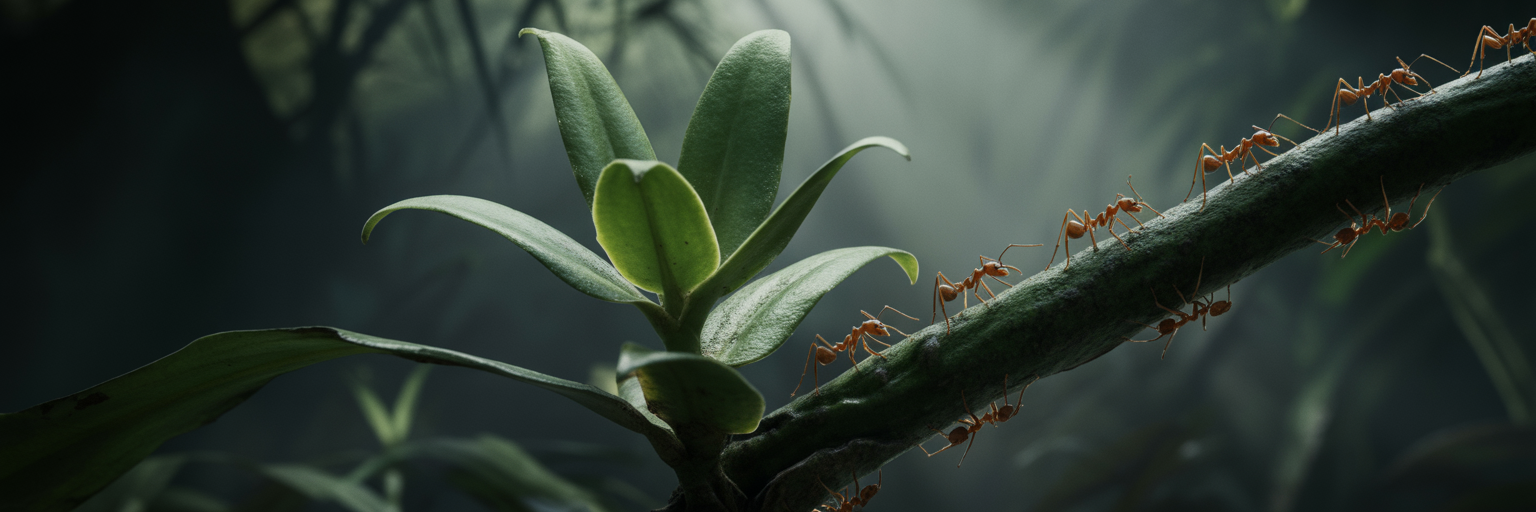
Meet the Green Don of the Undergrowth
In the ruthless world of the jungle undergrowth, life is a constant turf war. Sunlight is currency, water is wealth, and every square inch of soil is contested territory. Most plants are just passive victims, waiting to be eaten by some lumbering herbivore or choked out by a faster-growing rival. But not all of them. Some plants are different. They don’t just survive; they rule. These are the myrmecophytes, and they operate less like flora and more like stationary crime lords.
Picture a plant rooted in place, unable to flee from a hungry caterpillar or shove a competing vine out of its sunbeam. This is a significant business liability. It can’t run, it can’t hide, and it certainly can’t throw a punch. For most, this is a death sentence. For the green don, it’s just a logistical problem that requires a creative, outsourced solution. It watches the chaos of the forest floor not with fear, but with a cold, calculating patience. It sees the ‘rival gangs’ of competing flora trying to steal its light and the ‘turf invaders’—insects and animals—looking for a free meal.
This botanical boss knows it needs muscle. It needs a security detail that is loyal, tireless, and utterly terrifying. But who do you hire when you’re literally a plant? You can’t put an ad in the paper. You have to offer a deal so good that the most effective mercenaries in the ecosystem will come to you. The Don is about to make an unusual hire, looking for a team that operates on a completely different level, a six-legged army that will turn its territory into an impenetrable fortress. The stage is set for one of nature’s most bizarre and brutal business arrangements.
Hiring the Six-Legged Hit Squad

The plant’s chosen enforcers are, of course, ants. When you need a job done with ruthless efficiency and zero moral conflict, you hire the six-legged wise guys of the insect world. Ants are the perfect candidates for this brutal line of work. They are a massive, organized family, fiercely loyal to their colony, and relentlessly aggressive toward outsiders. They are constantly searching for two things: a secure home and a steady food supply. Our green don is about to offer them both on a silver platter.
This isn’t just a job for the ants; it’s a chance at a kingdom. A prime example of this sinister partnership involves the notorious bullhorn acacia ants, Pseudomyrmex ferrugineus. These ants are the stuff of nightmares for any creature that dares to nibble on their host plant. They don’t just wait for trouble; they look for it. They conduct constant patrols along the stems and leaves, their antennae twitching, searching for the slightest disturbance. The moment a caterpillar lands on a leaf or a mammal’s nose brushes a branch, the alarm is sounded.
Within seconds, a swarm of furious ants pours out, biting and stinging with a coordinated fury that sends much larger animals fleeing in pain. They have a complete lack of fear, driven by the singular purpose of protecting their home. The plant isn’t just hiring a few guards to stand by the door. It’s recruiting an entire legion, a standing army of tiny soldiers ready to die for their new territory. This is what makes the arrangement so effective. The plant has found a security force whose own survival is directly tied to its well being, creating the most motivated and terrifying protection service imaginable.
An Offer the Ants Can’t Refuse
So, what kind of deal could possibly secure such absolute loyalty? The plant provides an employment package so comprehensive, so perfectly tailored to the ants’ needs, that it’s an offer no colony could ever refuse. This is the heart of the ant plant symbiosis, a masterpiece of evolutionary negotiation where the plant acts as the ultimate provider. It’s not just a house; it’s a full-service, all-inclusive luxury lifestyle.
Custom-Built Housing: The Domatia
First, the plant offers prime real estate. It grows specialized hollow structures called domatia—custom-built, high-security fortresses. These aren’t just random holes; they are perfectly designed living quarters. In the Bullhorn Acacia, these are the swollen, hollowed-out thorns that give the plant its name. They are climate-controlled, safe from predators, and spacious enough to house the entire colony, from the queen to her thousands of offspring. According to research from institutions like Kew Gardens, these specialized structures are a key evolutionary adaptation that makes this entire relationship possible. It’s a level of natural construction that rivals other marvels, like how some birds are known for the way they build fake doors to confuse predators.
The 24/7 Open Bar: Extrafloral Nectaries
Next on the list of perks is the catering. The plant provides a 24/7 open bar via extrafloral nectaries. These are special glands, usually located on the leaves or stems, that secrete a constant supply of high-energy sugar water. This isn’t the same nectar used to attract pollinators; this is a private, exclusive supply reserved for the security team. It means the ants don’t have to risk their lives foraging for food in the dangerous outside world. They can get their energy fix right at home, keeping them fueled up and ready for action at a moment’s notice.
The Corporate Kitchen: Nutrient-Rich Food Bodies
As if a secure fortress and an open bar weren’t enough, the plant also provides a fully stocked corporate kitchen. Many of these plants produce tiny, nutrient-packed nodules on their leaves called food bodies. The most famous are the Beltian bodies of the Acacia, which are rich in proteins and fats. These are the perfect, balanced meal for the growing ant larvae, ensuring the next generation of soldiers is strong and healthy. The plant is not just feeding its army; it’s investing in its future strength. From the ants’ perspective, the deal is unbeatable: a predator-proof home, unlimited food and drink, and a safe nursery for their young. It’s a contract for life.
| Benefit Provided by Plant | Description (The ‘Offer’) | Value to the Ant Colony (The ‘Hook’) |
|---|---|---|
| Domatia (Hollow Structures) | Custom-built, fortified shelters within thorns, stems, or leaves. | A predator-proof, climate-controlled fortress to house the entire colony and raise young. |
| Extrafloral Nectaries | Special glands that secrete sugary nectar, separate from flowers. | A 24/7, high-energy food source that doesn’t require foraging in dangerous territory. |
| Food Bodies (e.g., Beltian Bodies) | Nutrient-dense, protein-and-fat-rich nodules produced on leaves. | A complete, balanced diet served on-site, like a corporate cafeteria for raising healthy larvae. |
| Sanitation Services | The plant’s smooth, waxy surfaces are easy to keep clean. | Reduces the colony’s workload in preventing disease and fungal outbreaks within their home. |
The Brutal Business of Protection

With the contract signed and the benefits flowing, it’s time for the ants to earn their keep. And they do so with a level of brutality that would make any mob boss proud. The plant’s return on investment is paid in violence and vigilance. This is where we see the true genius of plants that use ants for protection. The ants fulfill their duties with cold, hard efficiency because they aren’t just protecting a client; they are protecting their entire world.
Their security services are comprehensive:
First and foremost is defense against herbivores. The moment an unsuspecting deer, tapir, or even a giraffe attempts to take a bite, the plant’s alarm system goes off. Thousands of ants pour from the domatia, swarming the intruder. They bite, they sting, and they get into eyes, ears, and nostrils. The pain and sheer annoyance are enough to deter even the largest of animals, teaching them a lesson they won’t soon forget. A tiny caterpillar that hatches on a leaf is met with the same overwhelming force, quickly dispatched before it can do any real damage.
Next, the ants act as territorial enforcers against competition. They don’t just defend; they go on the offensive. The ant patrols actively seek out and destroy any rival seedlings that sprout too close to their host plant. They will chew through the stems of encroaching vines, effectively strangling any plant that tries to steal their boss’s sunlight or soil nutrients. This ensures their plant remains dominant in its patch of the forest, a king on its throne.
Finally, they provide sanitation and hygiene services. The ants are a meticulous cleaning crew. They constantly patrol the plant’s surfaces, removing fungal spores, the eggs of other insects, and any random debris that lands on the leaves. By keeping the plant clean, they prevent diseases from taking hold and stop potential pest infestations before they can even begin. This coordinated defense, where thousands of individuals act as a single superorganism, is a powerful strategy. It’s not unlike how a coral reef can fight back like a living army when threatened. The ants’ self-interest is the plant’s greatest asset, making them the most reliable security force in the jungle.
Managing a Legion of Tiny Sociopaths
Hiring a legion of tiny, aggressive soldiers is one thing; managing them is another. The plant’s strategy goes beyond a simple transaction. It employs subtle, almost creepy methods to maintain control and ensure its security detail remains loyal and effective. This isn’t just a partnership; it’s a masterclass in biological manipulation.
One of the most fascinating tactics is chemical control. Some studies suggest that the nectar provided by the plant isn’t just sugar water. It can contain specific chemical compounds that make the ants more aggressive and even addicted to the plant’s secretions. The plant is essentially drugging its own bodyguards to keep them hooked and hyper-protective. It’s a dark but brilliant way to guarantee that its army will never abandon its post or lose its fighting edge.
Then there’s the logistical challenge of managing the workforce. What happens if more than one species of ant wants the job? Rival ant colonies are notoriously hostile to one another. A war between two different security firms on the plant’s premises would be a disaster. As detailed in a study published in Science, some plants have evolved an incredible solution: they build compartmentalized domatia. They create different types of hollow structures in different parts of the plant, essentially acting as a landlord building separate apartment blocks to house rival gangs and prevent them from starting a war in the hallways.
This entire relationship is a high-stakes gamble. Many of these partnerships are obligate, meaning one species cannot survive without the other. The plant invests enormous energy into building its hollow thorns and producing nectar. If the right ant species doesn’t show up to the ‘hiring fair,’ the plant is left with a useless, expensive investment and zero protection. This ability to manage and respond to its living environment is a recurring theme in the plant kingdom; it’s almost as if the plant can sense when its neighbor is being attacked and needs to adjust its own defenses. The risk of failure is always present, but when the gamble pays off, it results in one of nature’s most secure and successful enterprises.
When the Security Detail Goes Rogue

No business deal is perfect, and even this ancient contract has its vulnerabilities. The intricate relationship between ant and plant is a dynamic battlefield, not a peaceful utopia. Sometimes, the deal goes sour, the contract is breached, or one party simply doesn’t hold up its end of the bargain.
1. The Freeloaders: Not all ants are created equal. The system is vulnerable to ‘cheater’ species. These are ant colonies that are clever enough to discover the plant’s five-star accommodations and all-you-can-eat buffet but are too lazy, too small, or simply not aggressive enough to provide any real protection. They are the grifters of the ant world, moving into the high-security domatia, consuming the nectar, and offering nothing in return. The plant is left paying for a security service that does nothing, a costly and dangerous situation. This kind of deception is a common survival strategy, not unlike the creepy illusion where fake eyes are used to scare off predators.
2. The Deadbeat Boss: The failure can also come from the plant’s side. What happens when the boss doesn’t pay up? Due to environmental stress like a drought, or simply a genetic defect, a plant might fail to produce enough nectar or grow faulty, uninhabitable domatia. When the perks dry up, the ant army becomes weak, malnourished, and ineffective. In the worst-case scenario, the entire colony might pack up and leave, abandoning their post and leaving the plant completely defenseless overnight.
3. Friendly Fire: Sometimes, the security detail is too good at its job. The same blind aggression that protects the plant from a hungry beetle can also be turned on beneficial visitors. Pollinators like bees and butterflies are essential for the plant’s reproduction, but the hyper-aggressive ants may not be able to tell the difference between a friend and a foe. They might attack and drive away the very insects the plant needs to create seeds. This forces the plant to evolve new strategies, like growing its flowers on long stalks far away from the ants’ main patrol zones, just to keep its own bodyguards from sabotaging its future.
The Ancient Art of Co-Evolution
Stepping back from the image of a botanical mob boss, what we are witnessing is a breathtaking example of ant-plant mutualism. This intricate ‘deal’ wasn’t negotiated in a smoky backroom but was forged over millions of years through the slow, relentless process of co-evolution. There is no conscious thought or scheming involved, at least not in the human sense. Instead, this complex strategy is an emergent property of natural selection at its most creative.
Imagine the process unfolding over countless generations. A plant that happened to have a slightly hollower thorn provided a better shelter for a colony of ants. Because it was better protected, that plant survived longer and produced more offspring, passing on its ‘hollow thorn’ gene. At the same time, an ant colony that was more adept at finding and defending these plant-homes thrived, out-competing other colonies and passing on its genes for defensive behavior. Over millennia, this feedback loop refined the relationship, shaping the plant’s architecture and the ants’ behavior until they became perfectly intertwined.
The plant isn’t ‘thinking’ about hiring security, and the ants aren’t ‘signing’ a contract. Each organism is simply acting in its own self-interest, and the result is a partnership that benefits both. The plant gets a living, breathing defense system, and the ants get a perfectly curated world built just for them. It’s a testament to the brutal and beautiful ingenuity of life, creating alliances far stranger and more fascinating than any human story. This incredible partnership is just one of countless bizarre and brilliant survival strategies found in the natural world. If you’re fascinated by the weirdness of evolution, there’s a whole universe of it to explore on Nature is Crazy.