An Introduction to the Ocean’s Most Obsessive Artist
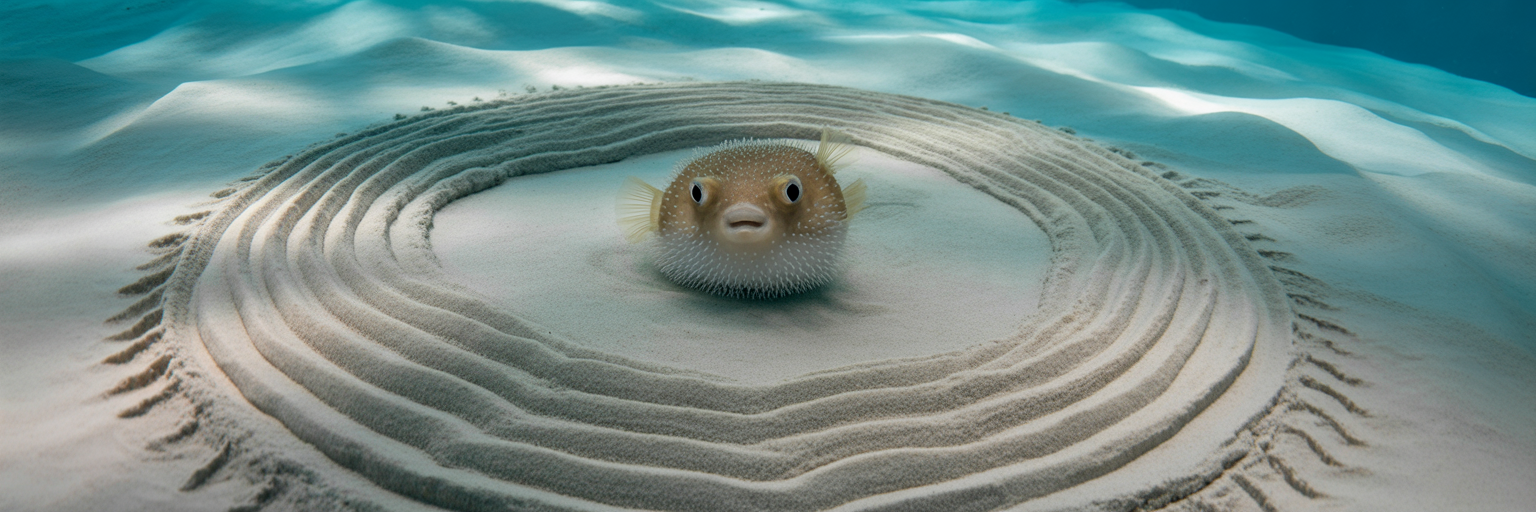
The pufferfish crop circle is not the work of seafloor aliens or a strange geological anomaly; it is the desperate, week-long creation of a very small fish trying to find a partner. Deep beneath the waves off the coast of Amami-Oshima Island, Japan, the sandy plains hide a secret. It is a place of quiet, crushing pressure and near-total darkness, an unlikely studio for one of nature’s most dedicated and frankly unhinged artists. This is the domain of the male white-spotted pufferfish, a member of the genus Torquigener.
At first glance, he is entirely unimpressive. Measuring only about five inches long, he is a tiny, unassuming creature who seems ill-equipped for any grand gesture. Yet this little fish is responsible for creating an ornate, seven-foot-wide geometric pattern on the ocean floor. This staggering mismatch between the artist and his creation is what makes the whole affair so bizarre. He is not a mighty whale or a fearsome shark. He is a tiny suitor with an enormous, all-consuming vision.
For seven days and seven nights, he enters a state of artistic frenzy. This is not a hobby. It is a biological imperative that borders on madness, a frantic, non-stop performance driven by the primal need to attract a female. He doesn’t eat. He doesn’t rest. He just works, tirelessly plowing sand with his fins, driven by an internal clock that screams for him to finish his masterpiece before it is too late. The resulting underwater sand art is a monument to his own desperation, a beautiful, intricate pattern born from pure, unfiltered anxiety. This is his one shot, and he pours every ounce of his being into this single, obsessive project.
The Anatomy of a Desperate Suitor
To understand the art, you must first understand the artist. The male white-spotted pufferfish is a study in contrasts. His body, barely 12 centimeters long, is tasked with moving tons of sand to create a structure more than 20 times his own size. This is not a creature built for brute force. Instead, his body is a collection of delicate, specialized tools honed for a single, obsessive craft. His pectoral and anal fins, usually used for steering, become tireless shovels and rakes, flapping with a precise, hypnotic rhythm to push and sculpt sediment. His mouth is not for fighting but for interior design, used to gather delicate shell fragments to decorate the final piece.
This week-long construction project is a form of devotion that pushes him to the brink. He forgoes food and sleep, his entire existence narrowed down to the repetitive motion of moving sand. This is the biological concept of a high-cost display in its most extreme form. The immense energy he pours into the circle is an honest, undeniable signal of his genetic fitness. It tells a potential mate, “Look at me. I just spent a week starving myself to build this ridiculous thing, and I’m still here.” Only the strongest, healthiest, and most resilient males can complete such a monumental task and still have the energy to be a viable partner.
Nature is full of incredible specialists that have evolved highly specialized traits for survival and mating. For instance, some animals have developed astonishing speed, like the star-nosed mole that eats faster than you can blink. The pufferfish, however, has specialized in architecture and endurance. His entire being is a testament to the idea that if you want to be chosen, you have to prove your worth in the most exhausting way imaginable.
A Step-by-Step Guide to Sculpting Seduction
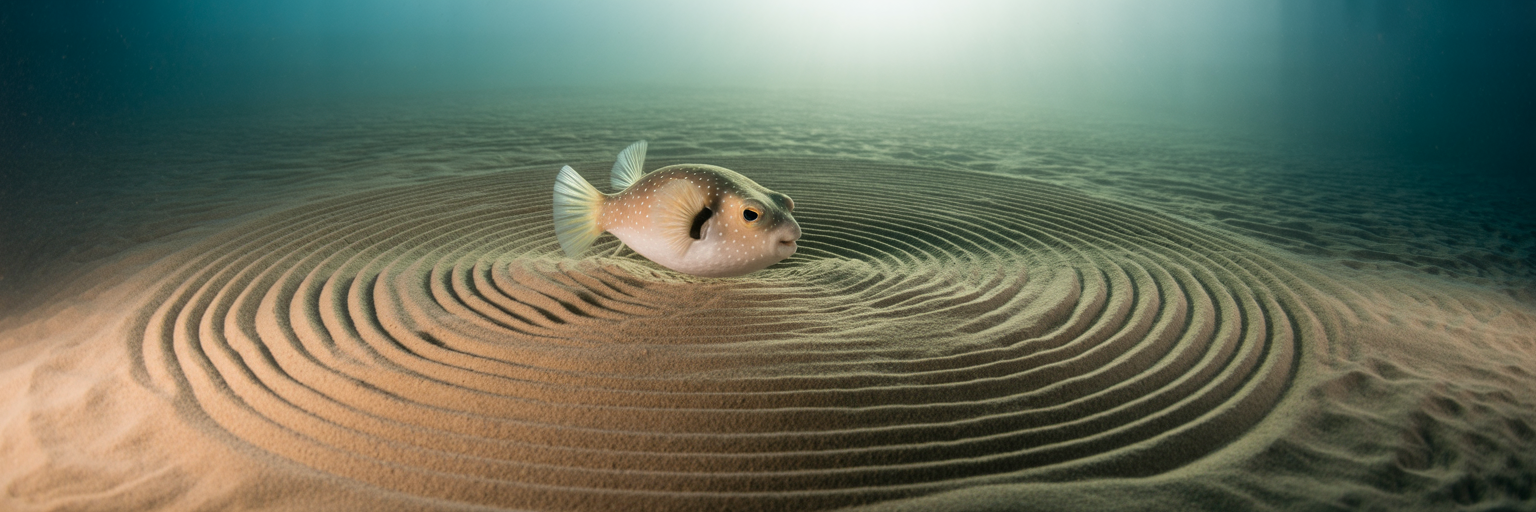
The creation of the pufferfish crop circle is not a random act but a methodical, painstaking process that unfolds over a week. It is a masterclass in persistence, a testament to what a single-minded fish can achieve with enough time and biological panic.
Phase 1: The Foundation
The process begins with the male carving out the basic shape. Using his fins and body, he tirelessly digs a large circular trench. This is the initial sketch, the foundational outline upon which the entire masterpiece will be built. He then begins plowing straight lines radiating out from the center, creating the initial valleys that will eventually become the iconic ridges of the design. This is grueling, repetitive work that continues day and night.
Phase 2: The Sculpting
Once the basic layout is established, the real artistry begins. The pufferfish swims back and forth along the valleys he created, using his fins to push sand from the troughs up onto the sides, forming the intricate and symmetrical ridges. This is the most labor-intensive part of the pufferfish mating ritual. He moves with a hypnotic, almost robotic repetition, his small body a blur of motion against the sand. He is an artist lost in his work, obsessively refining each peak and valley to achieve geometric perfection.
Phase 3: The Finishing Touches
In the final days, the pufferfish becomes an interior decorator. He swims to the center of his creation and, using his fins, flutters away the coarser grains of sand, leaving behind a bed of the finest, softest particles. This will be the nursery for the eggs. Then, in a final flourish, he gathers small shells and coral fragments and meticulously places them along the crests of his sandy ridges. This is not just for show; it adds visual complexity and texture, the final highlights on his sculpted canvas. All the while, he must constantly fight against ocean currents, making repairs and adjustments to ensure his work remains flawless for the impending critique.
| Construction Phase | Primary Action | Functional Purpose | Artistic Analogy |
|---|---|---|---|
| Phase 1: Excavation (Days 1-3) | Digging the foundational circle and radiating valleys with fins. | Establishes the basic structure and overall diameter. | Sketching the initial outline on a canvas. |
| Phase 2: Sculpting (Days 2-7) | Pushing sand from valleys to form geometric ridges and peaks. | Creates the hydrodynamic system to control water flow. | Adding texture and dimension with a palette knife. |
| Phase 3: Decoration (Days 6-8) | Lining the central area with fine sand and placing shell fragments on ridges. | Creates a soft, safe nursery for eggs and adds visual complexity. | Applying the final highlights and flourishes to a masterpiece. |
| Phase 4: Maintenance (Ongoing) | Constantly repairing and refining the structure against currents. | Ensures the structure remains perfect for the female’s inspection. | The artist obsessively touching up their work before the gallery opening. |
The Genius Behind the Geometric Design
While the underwater sand art is visually stunning, it is far more than just a pretty pattern. It is a brilliant piece of functional engineering, a nursery designed to protect the next generation. The true genius of the design lies in its hydrodynamics. The intricate system of ridges and valleys is built to manipulate the flow of water across the seafloor. According to research highlighted by The Asahi Shimbun, these “crop circles” made by love-struck pufferfish are not just for show but are highly engineered nests.
The tall, decorated peaks on the outer edges of the circle act as a buffer, slowing down the surrounding ocean currents by as much as 25 percent. This creates a calm, protected zone in the center. Meanwhile, the valleys are angled in such a way that they funnel a gentle flow of water toward the middle. This serves two critical purposes. First, it channels the finest, softest sand particles into the central nesting area, creating a soft bed for the eggs. Second, it ensures that if eggs are laid, they receive a steady supply of oxygen-rich water while being shielded from disruptive currents.
The complexity and perfection of the structure are a direct advertisement of the male’s quality. A more intricate and well-built circle demonstrates his strength, stamina, and ability to provide a safe environment for his offspring. The art is a proxy for his parental fitness. The physiological toll of this effort is immense, and understanding the biological cost of such extreme exertion is crucial. In human biology, for example, managing the consequences of intense physical stress is a complex field, with research exploring everything from muscle recovery to using PEMF therapy for chronic pain relief. For the pufferfish, there is no recovery plan; there is only the completion of the task or failure.
Enter the Critic: The Female’s Inspection
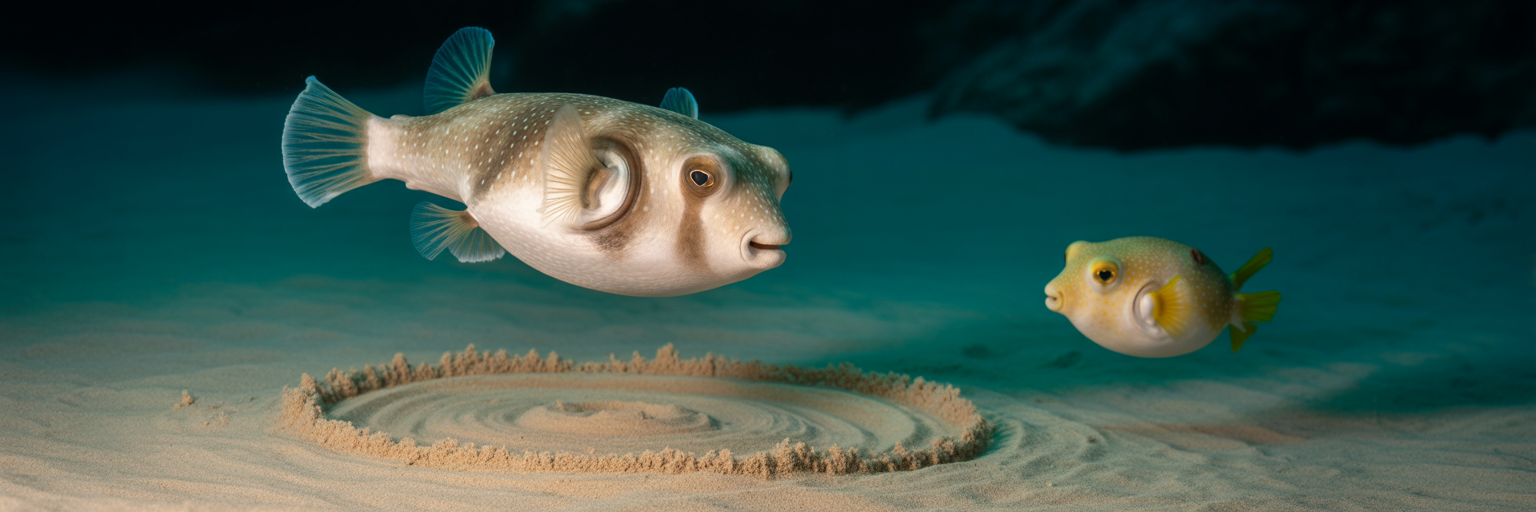
After a week of non-stop, obsessive labor, the moment of judgment arrives. The female pufferfish, the discerning art critic for whom this entire spectacle was created, finally appears. The male, exhausted but anxious, hovers nearby as she begins her inspection. This is not a romantic encounter. It is a cold, calculated evaluation of his work, and by extension, his genetic worth. She swims over the structure, her gaze taking in every detail.
She is assessing several key metrics. Is the circle large and impressive? Are the ridges symmetrical and the pattern complex? Is the sand in the central nest area sufficiently fine and soft? Each element of the design is an honest signal. Research suggests that larger, stronger males are able to build more elaborate and structurally sound nests. Her choice is based entirely on this tangible evidence of his health and vigor. The art is the resume, and she is the hiring manager.
There are only two possible outcomes. If she is impressed by his masterpiece, she will swim to the center and lay her eggs, allowing him to fertilize them. His week of torment will have been worth it. But if his work is deemed subpar, if a ridge is uneven or the sand too coarse, she will simply turn and swim away without a second glance. He is left alone with his rejected art, a week of his life wasted on a failed project. The stakes of this pufferfish mating ritual could not be higher. The animal kingdom is full of strange reproductive behaviors driven by these high stakes, such as the bizarre case of the Suriname toad that gives birth through holes in its back, but few are as artistically tragic as a rejected pufferfish.
Solving the Mystery of the Underwater Circles
For years, the origin of these intricate, geometric patterns was a complete mystery. Japanese divers first discovered the circles in the mid-1990s, and with no obvious creator in sight, speculation ran wild. The perfect symmetry and massive scale led some to dub them “underwater mystery circles,” fueling theories that ranged from unusual water currents to, inevitably, extraterrestrial activity. The truth, as it turned out, was far stranger and more charming.
The puzzle remained unsolved for over a decade until a team of scientists, led by photographer and researcher Yoji Okata, decided to get to the bottom of it. They set up underwater cameras aimed at a freshly made circle and waited. In 2011, their patience paid off. They finally captured the artist in the act: a tiny, five-inch male white-spotted pufferfish, tirelessly sculpting the sand with his fins. As reported by sources like The Times of India, the mystery of Japan’s underwater crop circles was officially solved, revealing a level of complex behavior in fish that was previously unknown.
This discovery was a major revelation in marine biology, providing fascinating Torquigener pufferfish facts and solving a long-standing enigma. Yet, there is a poignant final chapter to this story. After a female lays her eggs, the male guards them for about a week. Once they hatch, the nest is abandoned. The ocean currents, which the male fought so hard to control, quickly reclaim the structure. Within days, the intricate masterpiece is eroded, leaving no trace of the obsessive labor that went into its creation. It is a beautiful, tragic cycle of art for the sake of life, destined to be washed away.
The Evolutionary Logic of Obsessive Art

The pufferfish’s strange and beautiful behavior is a textbook example of sexual selection. This is the evolutionary theory that certain traits develop not because they aid in survival, but because they increase an individual’s success in securing a mate. The pufferfish’s sand circle is one of the most extreme examples of a “high-cost” courtship display, placing it in the same category as a peacock’s elaborate tail or a bowerbird’s decorated nest. This is the world of weird animal courtship, and the pufferfish is its underwater champion.
The core concept at play is “honest signaling.” The sand circle is such a reliable advertisement of good genes precisely because it is too energetically expensive and complex to fake. A weak or sickly male simply could not complete the task. By pouring all his energy into this non-essential, artistic endeavor, he is proving he has energy to spare. He is demonstrating his genetic superiority in the most tangible way possible. The female, by choosing the best artist, ensures she is also choosing the best genes for her offspring.
This pufferfish’s strategy is a form of elaborate persuasion, convincing a female of his worth through his art. Nature has other masters of deception, like the caterpillar that tricks ant colonies into raising it as their own, but the pufferfish’s display is one of honesty. He is not tricking her; he is proving himself. While science has uncovered the primary function of this incredible behavior, there is still much to learn. Are there subtle aesthetic preferences at play? Do different females prefer different styles? The full story of this obsessive, artistic fish is still being written, leaving us with a sense of wonder at the beautiful, bizarre, and often creepy lengths to which life will go to continue itself.