For most of us, a shadow is a harmless absence of light. It offers a brief respite from the sun or signals a cloud passing overhead. But in the natural world, for countless creatures, a sudden change in light is not a minor event. It is a direct and immediate threat to their existence. The first sign of a predator is not a sound, a smell, or even a clear visual. It is simply its approaching shadow, a patch of moving darkness that spells doom.
This is not speculation or a scene from a horror film. It is a documented scientific reality. The mechanism is known as the shadow escape response, and it is one of evolution’s most brutal and efficient shortcuts. For a prey animal, survival is a game of milliseconds. The time it takes to see a predator, process the image, identify it as a threat, and then command the body to flee is often too long. The shadow response bypasses this entire sequence of conscious thought. It trades perfect accuracy for life-saving speed.
This biological jump scare is not limited to a few skittish species. It is a fundamental survival tool found across the animal kingdom. From the frantic scuttling of an insect to the rapid withdrawal of a snail into its shell, the reaction to a passing shadow is a deeply ingrained reflex. Lizards basking on a rock and fish darting through a shallow stream share this same primal fear of a sudden darkness falling from above. This response is a testament to a simple, terrifying truth: for millions of years, being hunted from the sky has been such a common cause of death that the fear of it is now written directly into the nervous systems of its potential victims. It is a reflexive twitch born from an ancient and ongoing war between the hunter and the hunted.
The Neurological Shortcut That Cheats Death
The effectiveness of the shadow response lies in its neurological architecture. It is a system designed for one thing: speed. It achieves this by taking a path of least resistance through the nervous system, a route that deliberately avoids the brain’s slower, more bureaucratic processing centers.
The Reflex Arc: Bypassing the Brain’s Bureaucracy
The principle is the same as when you touch a hot stove. Your hand pulls back instantly, before your brain has even had a chance to register the sensation of pain. This is a reflex arc. The sensory information from your skin travels to your spinal cord, which immediately sends a command back to your muscles to contract. The brain is notified after the fact. The shadow escape response operates on a similar principle. The visual input of a sudden shadow triggers a direct motor output to flee, all without consulting the conscious mind. It is a hardwired, automatic reaction that prioritizes action over analysis. While some creatures have developed bizarre sensory systems, like the animal that can hear with its knees, the shadow response is a near-universal adaptation for raw survival.
Looming Stimulus: When Darkness Means Danger
Not just any shadow will trigger this panic. Nervous systems are specifically tuned to a particular type of visual threat known as the looming stimulus response. This is not the gentle dimming of a passing cloud. It is the perception of a dark shape that is rapidly expanding, a visual cue that the brain interprets as an object on a direct collision course. In many species, specialized nerve cells called giant interneurons act as a dedicated emergency hotline. These massive neurons can transmit a signal at incredible speeds, ensuring the escape command reaches the muscles almost instantaneously. These remarkable visual reflexes in prey are the difference between life and a swift, violent death.
The High Cost of a False Alarm
This system, for all its speed, is not intelligent. It is prone to false positives. A falling leaf, a bird flying harmlessly overhead, or even a thrown ball can trigger the same panicked escape as a diving hawk. This might seem like a design flaw, but it is a grim evolutionary calculation. The energy wasted fleeing from a hundred harmless shadows is a small price to pay to avoid being eaten by the one real predator. It is better to be paranoid and alive than confident and dead. The table below breaks down this fundamental trade-off.
| Factor | Conscious Threat Processing (e.g., Seeing a Wolf) | Reflex Arc (e.g., Shadow Response) |
|---|---|---|
| Response Time | Hundreds of milliseconds to seconds | As little as a few milliseconds |
| Neurological Pathway | Eyes -> Visual Cortex -> Amygdala -> Frontal Lobe -> Motor Cortex | Sensory Receptor -> Spinal Cord/Interneuron -> Motor Neuron |
| Decision Making | Complex evaluation of threat level, context, and escape routes | None. Pre-programmed, automatic reaction. |
| Accuracy | High. Correctly identifies real threats. | Low. High rate of false positives (e.g., a falling leaf). |
| Evolutionary Logic | Allows for strategic, planned survival behaviors. | It’s better to be paranoid and alive than confident and dead. |
Invertebrate Paranoia: Cockroaches and Snails
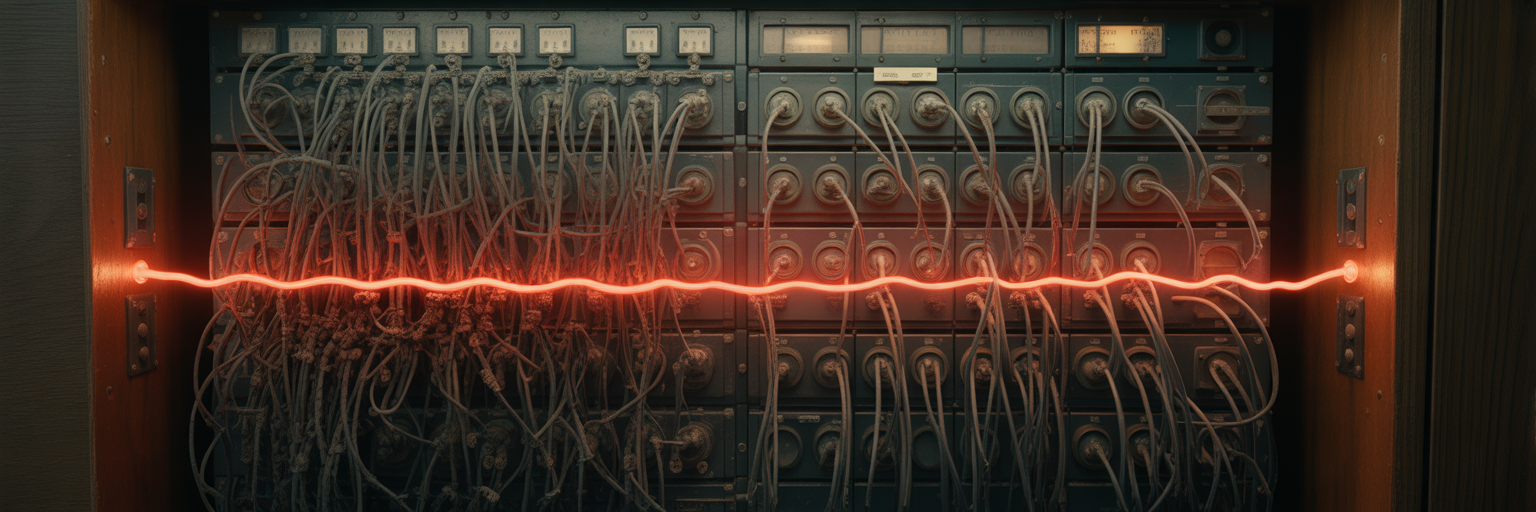
The abstract mechanics of the shadow response become tangible and deeply unsettling when observed in the invertebrate world. Here, in creatures often dismissed as simple, the fear of a moving shadow drives some of the most effective survival strategies on the planet.
The Cockroach’s Hair-Trigger Escape
The American cockroach is a master of the shadow escape. Its survival is not due to intelligence but to a nervous system perfected for paranoia. At the rear of its abdomen, it has two small, hair-covered appendages called cerci. These hairs are exquisitely sensitive, capable of detecting both the faint air currents stirred by an approaching predator and the sudden darkness of its shadow. When a threat is detected, this sensory data does not travel to the brain for careful consideration. Instead, it is fired through giant interneurons directly to the cockroach’s legs. This is the infamous cockroach shadow reaction. The insect is already sprinting for cover before its brain is even fully aware of what is happening. It is a pure, unthinking reflex.
The Snail’s Body-Wide Eyeball
The pond snail demonstrates an even stranger adaptation. Many snails lack complex, image-forming eyes, yet they react to shadows with startling speed. How? Their entire body is an eyeball. As research published in the Journal of Experimental Biology has detailed, their skin is embedded with dermal photoreceptors, which are light-sensitive cells spread across their body. A shadow falling over any part of the snail triggers an immediate, powerful withdrawal into the safety of its shell. A centralized brain or a sophisticated visual system is not even required for this trick. The snail’s body itself makes the decision. While this passive withdrawal is effective, other invertebrates have developed more active defenses, such as the insect that can turn a leaf into a nursery, fortress, and food supply all at once. The snail’s strategy, however, highlights a fundamental truth: in the game of survival, any system that works, no matter how bizarre, is a valid one.
Vertebrate Vigilance: Lizards and Rodents on High Alert
The fear of shadows is not exclusive to the world of invertebrates. As we move to animals with more complex brains, the response remains, albeit with greater sophistication. In vertebrates, the same primal fear is processed by more advanced neural structures, but the outcome is just as swift and decisive.
Lizards Watching the Skies
For a lizard basking on a sun-drenched rock, the greatest threat often comes from above. Species like the Jacky dragon are constantly vigilant, their eyes scanning for the tell-tale shadow of an aerial predator like a hawk or kestrel. When a looming stimulus is detected, their response is more than a simple twitch. It is a calculated evasive maneuver, a rapid reorientation and a dash for the nearest cover. These are innate defensive behaviors, hardwired into the lizard’s brain from birth. Lab-raised animals, with no prior experience of predators, will exhibit the exact same panicked escape when shown a dark shape moving overhead. The fear does not need to be learned; it is an inheritance.
The Universal Fear in Mammals
This deep-seated instinct is not lost in mammals. As a 2024 study published in Scientific Reports confirmed, looming shadows reliably induce defensive responses in rats. This is a critical finding, as it proves the fear of shadows is a deeply embedded survival instinct across the vertebrate line, from reptiles to mammals. In the vertebrate brain, structures like the superior colliculus and the amygdala manage these responses. They act as a more sophisticated version of the invertebrate’s simple reflex arc, processing the visual threat and initiating a fear response with incredible speed. This entire system of animal predator detection is further enhanced by a simple anatomical feature: eye placement. Prey animals like rabbits, deer, and rodents often have eyes placed on the sides of their heads. This gives them a panoramic field of view, making them exquisitely sensitive to the sudden darkness of a predator’s shadow entering their vision from almost any angle. While some animals rely on startling visual patterns to survive, like those in our piece on nature’s creepiest illusion, for many, survival depends on seeing the threat before it’s fully visible.
The Unforgiving Logic of a Killer Shadow
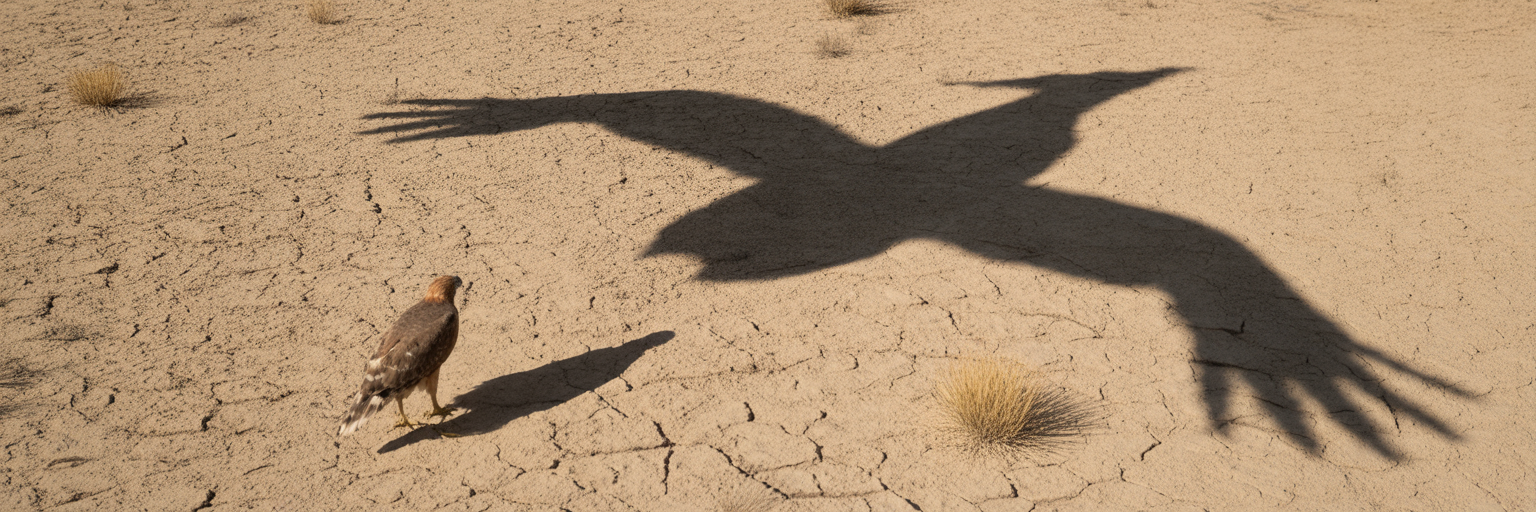
The shadow escape response is not a strange quirk of a few nervous animals. It is the logical and inevitable outcome of the physical laws that govern our world. Its effectiveness is rooted in simple physics and refined by millions of years of evolutionary pressure.
First, consider the physics. A shadow is an object blocking a light source. A shadow that appears suddenly and grows rapidly can only mean one thing: an object is getting closer, fast. When that shadow comes from above, the probability that it belongs to an aerial predator is alarmingly high. The nervous systems of prey animals have evolved to make this exact calculation in an instant. They are not just seeing a shadow; they are interpreting a trajectory.
This system is also remarkably precise in how it distinguishes between different types of light changes. An animal’s nervous system can tell the difference between a harmless environmental shift and a direct threat:
- Ambient Change: The slow, uniform dimming of light at sunset is ignored. It is a predictable, non-threatening pattern.
- Passing Cloud: A large, slow-moving shadow might cause a moment of alertness, but its speed and diffuse edges often mark it as non-threatening.
- Predator’s Shadow: The sharp, rapid, and accelerating occlusion of light by a nearby object is the specific trigger. This is the signal that activates the escape reflex.
This constant threat creates what ecologists call a “landscape of fear.” For these animals, the world is overlaid with an invisible map of risk. Open, sunlit areas are dangerous because they make an animal visible to predators. Yet, these same open areas make an approaching predator’s shadow easier to detect. This creates a constant, high-stakes trade-off between hiding and being able to see danger coming.
Ultimately, the shadow response was an evolutionary inevitability. In a world where death frequently falls from the sky, any genetic mutation that led to a faster reaction to a looming shadow would have provided a powerful survival advantage. Over countless generations, this relentless pressure fine-tuned the innate defensive behavior into the brutally efficient, hair-trigger system we see today. It is not a choice or a sign of anxiety. It is a law of survival, written in darkness and light.