
A Sniper Hiding in Plain Sight
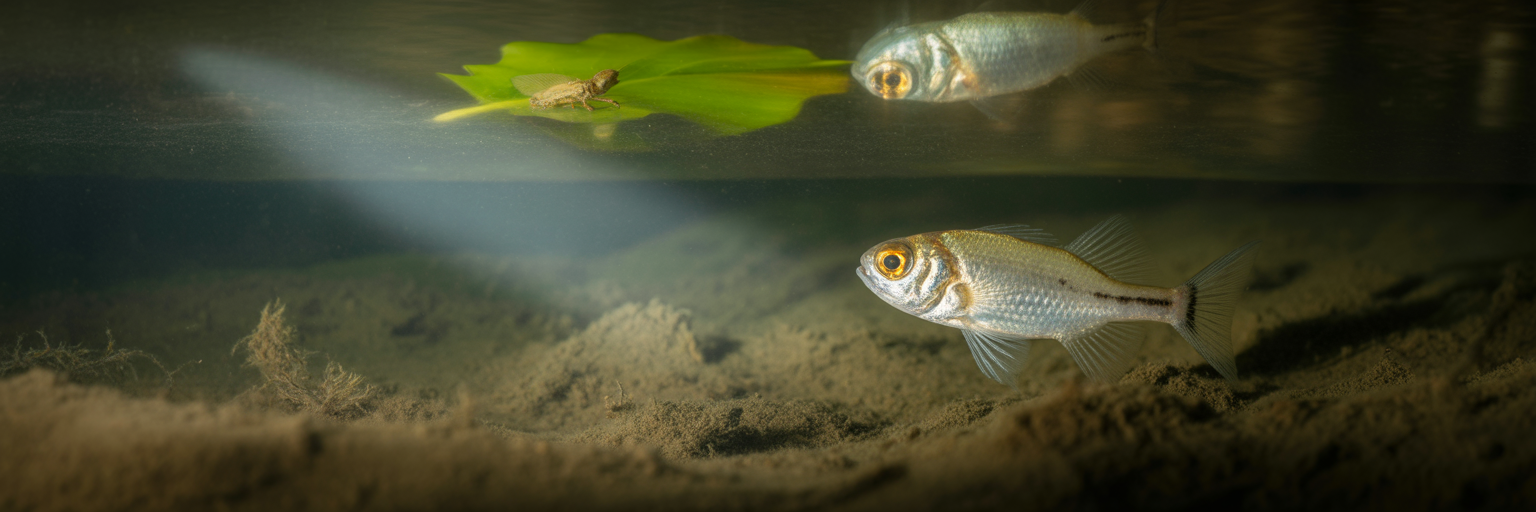
An ant rests on a mangrove leaf, inches above the still, murky water. It is oblivious, preoccupied with its own world. Below the surface, something is watching. It is not just a fish. It is a patient, calculating hunter, and its eyes are locked on the target. Without a sound, it aligns its body, takes aim, and fires. A perfectly controlled jet of water erupts from the surface, striking the ant with enough force to send it tumbling into the predator’s waiting mouth. This is not a chance event. It is a precision kill.
This aquatic sharpshooter is the archerfish, a name given to several species in the genus Toxotes. The most well known, Toxotes jaculatrix, patrols the brackish estuaries and mangrove swamps of Southeast Asia and Australia. These serene environments, with their tangled roots and shimmering surfaces, hide a constant, methodical hunt. The archerfish has turned its own mouth into a biological water cannon, a weapon it uses to access a food source completely out of reach for its aquatic neighbors: terrestrial insects.
The idea of a fish shooting down prey with a spitball of water sounds like something from a cartoon. We can all picture that moment of disbelief when first hearing about it. Yet, this behavior is a documented scientific fact, a stunning example of evolutionary adaptation. The archerfish does not just splash randomly. It performs a feat of ballistics that requires it to account for physics, anatomy, and learned skill. It is a living testament to the bizarre and unsettling realities that exist just beneath the surface of the natural world.
But how does it accomplish this? How can a fish possess the anatomical tools to create a high pressure water jet? More importantly, how does it solve the complex problem of light distorting its view of the world above? Understanding the archerfish means looking at the anatomy of a living weapon, the physics of a distorted world, and the mind of a surprisingly sophisticated predator.
Anatomy of a Living Water Pistol
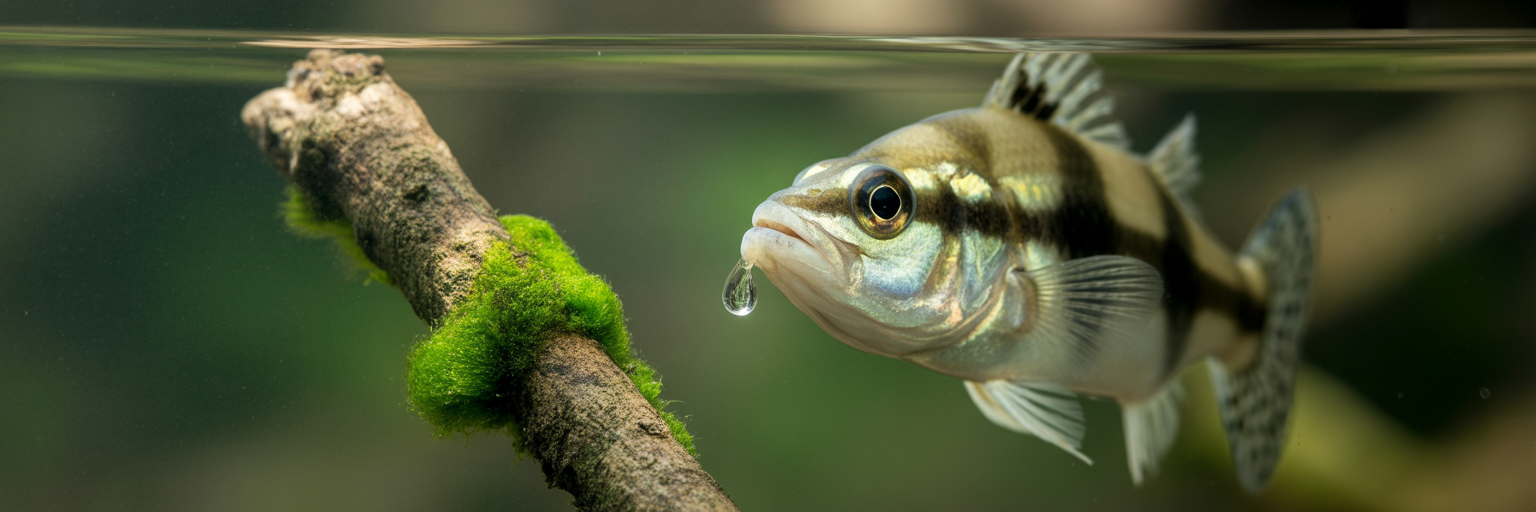
The archerfish’s ability to shoot is not magic. It is a product of highly specialized anatomy, a set of biological tools that work together to turn its mouth into a powerful and accurate projectile weapon. This is not a simple act of spitting. It is a mechanically complex process that the fish controls with remarkable precision. The entire system can be broken down into the components of a weapon: the barrel, the trigger, and the force that powers the shot.
The Barrel and the Trigger
The secret to the archerfish’s weapon lies in a unique feature inside its mouth. Along the roof of its mouth runs a narrow groove. When the fish is ready to fire, it presses its tongue firmly against this groove, forming a tight tube that functions exactly like the barrel of a rifle. This channel directs the flow of water into a focused, coherent stream rather than a useless, wide spray. The tip of the tongue acts as a valve or trigger. By controlling its position, the fish can hold the pressurized water and then release it in a sudden, powerful burst.
Generating the Force
Creating a jet of water powerful enough to knock an insect from a branch requires significant force. The archerfish generates this pressure not with its lungs, but with its gills. To fire, it rapidly and forcefully compresses its gill covers. This action squeezes the water held in its mouth, sending it rocketing through the tube formed by its tongue and palate. The entire motion is a sudden, muscular contraction, a biological hydraulic pump that transforms a mouthful of water into a projectile. This is a deliberate, controlled action, not a passive release.
Customizing the Ammunition
Not all targets are the same, and the archerfish can adjust its “ammunition” accordingly. By slightly changing the size of its mouth opening and the speed of its gill compression, it can alter the velocity and volume of the water jet. This allows it to fire smaller, faster jets for lightweight prey or larger, more powerful streams for heavier insects at a greater distance. This ability to customize each shot demonstrates a level of control that goes far beyond a simple reflex. The sequence is a masterpiece of biological engineering:
- The fish takes a precise amount of water into its mouth.
- It presses its tongue against the grooved palate, forming the barrel.
- It carefully aims its head, positioning the tip of its mouth just below the surface.
- It forcefully contracts its gill covers, pressurizing the water.
- The tongue acts as a valve, releasing the jet with pinpoint accuracy.
This weaponization of its own anatomy is a surprising adaptation, but nature is full of such solutions. For instance, some species have learned to use bubbles as tools for hunting, a similarly unexpected use of their environment that we have documented in other animals.
Solving the Problem of Light Refraction
Having a water pistol for a mouth is impressive, but it would be useless without the ability to aim. The single greatest challenge the archerfish faces is a fundamental law of physics: light refraction. This principle is what makes a straw in a glass of water appear bent at the surface. For the archerfish, this is not a curious illusion. It is a life or death obstacle, because it means the bug it sees is not actually where it appears to be. The water’s surface distorts the fish’s view of the world, creating a critical aiming problem that it must solve with every single shot.
The Physics of a Distorted World
When light passes from one medium to another, like from air to water, it changes speed and bends. This is refraction. From the archerfish’s perspective below the surface, the insect perched on a leaf appears to be higher and closer than its true position. If the fish were to aim directly at the image it sees, its water jet would miss every time. To succeed, it must somehow calculate the true location of its prey and adjust its aim to compensate for this visual distortion. The question of how archerfish hunt successfully comes down to how they overcome this complex optical challenge.
Two Strategies for a Perfect Shot
Scientists have discovered that the archerfish employs two primary strategies to correct for refraction. The first is a cognitive solution: motor adaptation. Through trial and error, the fish learns to adjust its aim. It internalizes the physics of refraction, developing an instinct for how much to correct its shot based on the angle and distance of the target. As a recent preprint on eLife suggests, this points to a sophisticated neural ability to correct for visual distortion. It is a learned skill, not a simple instinct, which is why juvenile archerfish are often clumsy and inaccurate with their first attempts.
The second strategy is a clever physical workaround. To minimize the effects of refraction, the archerfish will often maneuver itself to a position directly underneath its prey. By shooting straight up, at an angle close to 90 degrees, the bending of light is almost completely eliminated. This simplifies the shot dramatically, as the perceived location of the target is very close to its actual location. In many cases, the fish uses a combination of both strategies, getting as close to the ideal position as possible and then using its learned motor skills to fine tune the final shot.
| Strategy | Method | Key Advantage | Limitation |
|---|---|---|---|
| Motor Adaptation (Learned Correction) | The fish learns to adjust its aim, firing at a calculated spot different from the perceived target location. | Allows for successful shots from a wide variety of angles and positions. | Requires significant practice and cognitive processing; juveniles are less accurate. |
| Positional Correction (Minimizing Distortion) | The fish physically moves to a position almost directly beneath the prey (near a 90-degree angle). | Simplifies the shot by nearly eliminating the effect of refraction, making aiming easier. | The fish may not always be able to maneuver into the ideal position due to obstacles or water depth. |
| Combined Approach | The fish uses a combination, getting as close to the ideal position as possible and then using learned adaptation to fine-tune the shot. | Maximizes accuracy by leveraging both physical positioning and cognitive correction. | Represents the most complex and resource-intensive strategy. |
The Ballistics of a Water Jet

Once the archerfish fires, the projectile itself becomes a marvel of fluid dynamics. The act of archerfish shooting water is not just about pressure. It is about creating a projectile that is stable, powerful, and effective over a distance. The water jet is a dynamic weapon that changes in mid air to maximize its impact. Its power is startling, with an effective range of up to two meters, or over six feet. The force is more than enough to dislodge even well anchored insects from their perches.
The most remarkable aspect of the water jet is how it is engineered to deliver a concentrated blow. The fish does not shoot a simple, continuous stream. Instead, it modulates the speed of the water as it leaves its mouth, with the water at the back of the jet traveling faster than the water at the front. This causes the stream to bunch up and coalesce in mid air, forming a single, heavy droplet that arrives at the target. This concentration of mass delivers a much harder punch than a fine spray, transferring maximum kinetic energy to the prey.
This is not a static, one size fits all process. The archerfish actively calibrates its shot. As research published in the Journal of Experimental Biology details, the fish adjusts the duration and power of the jet for targets at different distances, ensuring the droplet forms at the precise moment of impact. This ability to weaponize its environment is an incredible survival strategy. It is not the only creature with such extreme solutions; for example, some animals have evolved to survive venom by breaking it down during an attack. For the archerfish, this ballistic skill gives it access to a rich food source that is completely unavailable to most other fish, providing a significant ecological advantage.
Inside the Mind of the Archerfish
The archerfish’s hunting ability is more than just a physical reflex. It is compelling evidence of sophisticated neural processing and cognitive abilities that challenge our assumptions about “simple” fish. The entire act, from spotting the prey to firing the shot, requires a seamless link between what the fish sees and the complex motor commands needed to aim and fire. This is known as sensorimotor integration, and the archerfish is a master of it.
Perhaps the most compelling evidence of its cognitive depth is its capacity for learning. Juvenile archerfish are notoriously clumsy. Their initial attempts are often wild and inaccurate. However, they improve dramatically with practice. More fascinating still, they appear to learn by observing more experienced adults, a form of social learning rarely attributed to fish. This proves the skill is not purely innate but is refined over a lifetime, a collection of Toxotes jaculatrix facts that points to a complex mind.
The most unsettling cognitive feat, however, is prediction. Archerfish have been observed leading moving targets. This means they are not just shooting at a static point in space. They are calculating the target’s trajectory and firing at its anticipated future position. This suggests the fish is running a predictive model in its brain, a mental simulation of where the insect will be in the fraction of a second it takes for the water jet to travel. These cognitive abilities are truly remarkable:
- Advanced Sensorimotor Integration: Seamlessly linking visual input with complex motor commands.
- Demonstrable Learning and Skill Refinement: Improving accuracy through trial and error over time.
- Social Learning through Observation: Acquiring skills by watching more experienced hunters.
- Predictive Aiming and Target Leading: Calculating a moving target’s future position.
The archerfish is not just a biological curiosity. It is a calculating hunter that learns, refines, and perfects its killing technique. This cognitive sophistication is echoed elsewhere in nature, such as in the Venus flytrap, a plant that can count before it decides to consume its prey. For the archerfish, this intelligence elevates it from a simple animal to a truly formidable predator.
A Versatile and Social Hunter
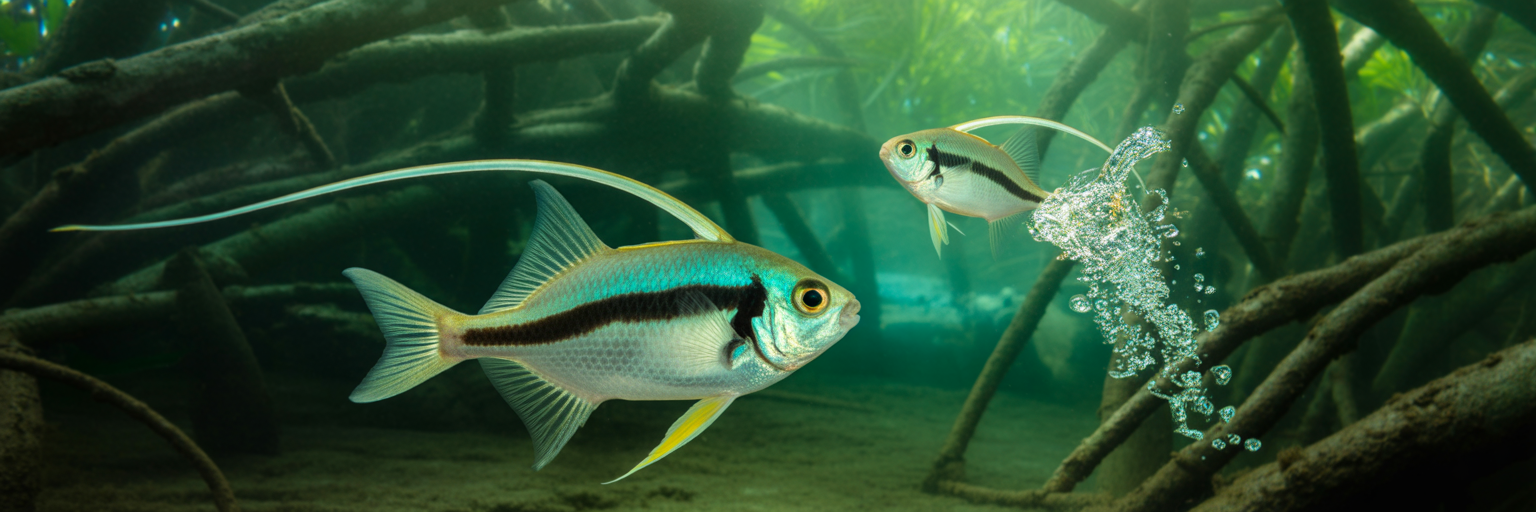
The famous spitting behavior is what defines the archerfish, but it is not a one trick pony. This remarkable creature is a versatile and adaptable predator with a surprising social life. Its famous water jet is just one of several animal hunting strategies it employs to survive. When an insect is too close to the water’s surface for a shot to be practical, the archerfish is more than capable of leaping directly out of the water to snatch its prey from a leaf or branch. This versatility ensures it can capitalize on any opportunity.
Furthermore, archerfish are not solitary hunters. They often live and hunt in groups, which introduces a layer of social complexity and competition. It is common for one fish to perform the difficult work of shooting down an insect, only for a quicker rival to dart in and steal the meal. This competitive environment likely drives the fish to become faster and more accurate. There is also evidence of social learning, where younger, inexperienced fish are seen watching their skilled elders, seemingly learning the technique through observation. This transmission of a complex skill through a social group is a fascinating behavior.
To aid its dual world hunting style, the archerfish has also evolved unique eyes adapted for bifocal vision. This allows it to see clearly both below and above the water simultaneously, giving it a distinct advantage in spotting prey on overhanging vegetation while also remaining aware of threats in its own aquatic environment. The complex social dynamics and hunting strategies of the archerfish are fascinating, but they are not the only animals with elaborate behaviors to outsmart others. For instance, some birds have been observed building fake doors to confuse predators. For the archerfish, its famous spitting is just one tool in a sophisticated arsenal that makes it a highly successful and adaptable predator.
An Evolutionary Masterpiece of Predation
The archerfish represents a perfect convergence of specialized anatomy, advanced neural processing, and learned behavior. Its entire strategy is an evolutionary marvel, a high risk, high reward solution that gave it exclusive access to an untapped food source. By manipulating a jet of water as a projectile, the archerfish has effectively developed a tool. This places it in a very small club of animals that demonstrate proto-tool use, fundamentally challenging our ideas about where to draw the line between instinct and ingenuity.
Let’s return to that quiet mangrove swamp. In the calm waters, a fish that spits water has mastered physics, ballistics, and predictive modeling to become an aquatic sniper. It is a creature that learns from its elders, calculates the trajectory of moving targets, and engineers its ammunition in mid air. It is a living, breathing refutation of the notion that “simple” life forms are incapable of complex behaviors.
The archerfish is a stark reminder that the natural world is filled with hidden, bizarre, and deeply sophisticated realities. It proves that unbelievable truths are often happening all around us, just beneath the surface, waiting to be discovered. The world is far stranger than we imagine, and the archerfish is its perfect, unsettling proof.