
For every animal on Earth, there are at least four species of parasite, each with a survival plan more elaborate than your average blockbuster movie. These tiny terrors have mastered the art of freeloading, and their methods are as brilliant as they are disgusting.
Understanding Gross Parasitic Life Cycles
Think your daily routine is complicated? Try being a parasite that needs to convince a snail to get eaten by a bird just so you can lay eggs. That’s the kind of high stakes project management we are talking about here. To get a handle on their bizarre careers, we first need to understand their incredibly complex parasitic life cycles.
So, what is a parasite host? Imagine you are a house. A parasite is the uninvited guest who moves into your spare room, eats all your food, never pays rent, and then invites a million of its relatives over for a party that never ends. The host is the unwilling landlord and all you can eat buffet rolled into one. The parasite is nature’s ultimate freeloader, a master manipulator that has evolved over millions of years to exploit its host for everything it is worth.
A parasite’s life cycle is its grand, often horrifying, game plan. It is the series of stages it must complete to grow up, reproduce, and find a new victim to call home. This is not a random series of events. It is a precise, evolutionary blueprint for survival, honed to perfection. Some parasites keep it simple with a one stop shop approach, while others embark on a multi stop tour that would make a world famous rock band jealous. Let’s take a tour of nature’s most devious survival schemes.
The One-Stop-Shop Direct Cycle

Let’s start with parasitism on easy mode: the direct life cycle. This strategy involves just one host from start to finish. It is the freeloader who moves into your apartment and never, ever leaves, content to live out its entire existence in one long suffering host. This approach is simple, efficient, and horrifyingly common. It is all about getting from one host to another of the same species without any complicated detours.
The Poop-to-Mouth Business Model: Giardia lamblia
One of the most successful practitioners of the direct cycle is Giardia lamblia, a tiny monster responsible for the infamous ‘beaver fever’. It is the reason your camping guide nervously tells you not to trust that pristine looking mountain stream. Its cycle is a masterclass in gross simplicity. An infected animal passes durable cysts in its faeces. These cysts contaminate water or food and wait patiently to be swallowed by a new host. Once inside, they transform, multiply, and cause all sorts of digestive chaos. It is a brutally effective poop to mouth business model. Simple, gross, and highly profitable for Giardia. This is one of the classic examples of parasitic infections that relies on nothing more than a lapse in hygiene.
The Scenic Route Specialist: Ascaris lumbricoides
Not all direct cycles are quite so straightforward. Meet Ascaris lumbricoides, the giant roundworm, which proves that even a one host parasite can enjoy a bit of travel. After its eggs are ingested, the larvae hatch in the intestine. But instead of settling down, they get adventurous. They burrow out of the gut, catch a ride in the bloodstream for a road trip to the lungs, and then crawl up the windpipe to get coughed up and swallowed again. Only then do they finally mature in the intestine. It is like leaving your house only to circle the block, climb onto your own roof, and then come back in through the chimney to watch TV. It is a bizarre, scenic detour within a single host.
The direct cycle is fast and requires only one type of victim. But its success is a numbers game. It relies heavily on environmental contamination and poor hygiene, forcing the parasite to produce millions of eggs with the hope that someone, somewhere, forgets to wash their hands.
The Inter-Host Uber Service: Indirect Cycle
If the direct cycle is a simple commute, the indirect cycle is an epic quest involving multiple modes of transport and a cast of unwilling characters. This is where parasitism gets wonderfully weird, requiring two or more different host species to complete the journey. The direct vs indirect life cycle debate for parasites is all about strategy. Why settle for one host when you can conquer two or three?
The Definitive Host vs. The Intermediate Host
To understand this complex journey, you need to know the key players. The definitive vs intermediate host distinction is crucial. The definitive host is the finish line party. It is the host where the parasite becomes a sexually mature adult and reproduces. Think of it as the headliner’s sold out stadium show. The intermediate host, on the other hand, is the unwilling taxi, nursery, or waiting room where the parasite develops through its larval stages. It is the opening act nobody came to see but has to sit through.
The World’s Worst Uber Driver: Plasmodium and Malaria
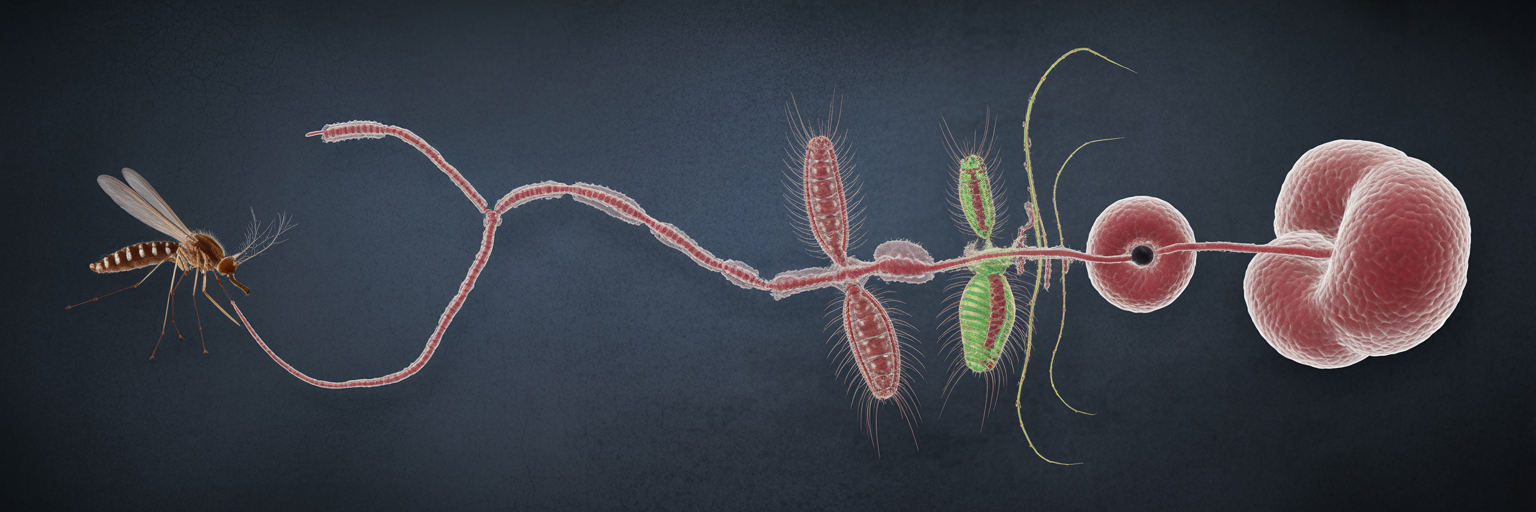
The classic example of an indirect cycle is Plasmodium, the parasite that causes malaria. Its life depends on a twisted relationship between a mosquito and a human. The Anopheles mosquito acts as the definitive host, where the parasite has its fun. When the mosquito bites a human, it is not just a needle prick. It is a chauffeured limo service delivering the parasite into the human, its intermediate host. Once inside, Plasmodium goes on a tour of the liver and red blood cells, multiplying until the mosquito returns for another blood meal, picking up the parasites to continue the cycle. As experts at Britannica point out, understanding these multi host journeys is fundamental to grasping how parasites conquer ecosystems.
A Freshwater Romance Gone Wrong: Schistosoma
Then there is the blood fluke, Schistosoma, which orchestrates a disturbing aquatic drama. An infected human, the definitive host, passes eggs into freshwater. These eggs hatch and infect a specific type of snail, the intermediate host. Inside the snail, the parasite multiplies into thousands of tiny, swimming larvae. These are then released back into the water, where they seek out and burrow into the skin of the next human they find. It is a summer fling between a parasite and a snail with a terrible, infectious ending for any human who happens to be in the wrong pond at the wrong time.
| Feature | Direct Life Cycle (The Freeloader) | Indirect Life Cycle (The Globetrotter) |
|---|---|---|
| Number of Hosts | One single, unlucky host | Two or more different species |
| Key Players | Just the host and the parasite | Definitive host (the party spot) and intermediate host(s) (the taxi) |
| Complexity | Simple and straightforward | Complex, multi-stage journey |
| Transmission Strategy | Usually fecal-oral route, direct contact | Vectors (like mosquitoes), being eaten by the next host |
| Example Parasite | Giardia, Roundworms (Ascaris) | Plasmodium (Malaria), Flukes (Schistosoma) |
Mind Control and Host Hijinks
Completing a life cycle is hard work, especially when it involves convincing your ride to drive straight into the mouth of a predator. So, what is a clever parasite to do? Simple. Grab the wheel. Some parasites have evolved the astonishing ability to manipulate their host’s behaviour, turning them into mindless zombies that do their bidding. These are some of the most spectacular examples of parasitic infections out there.
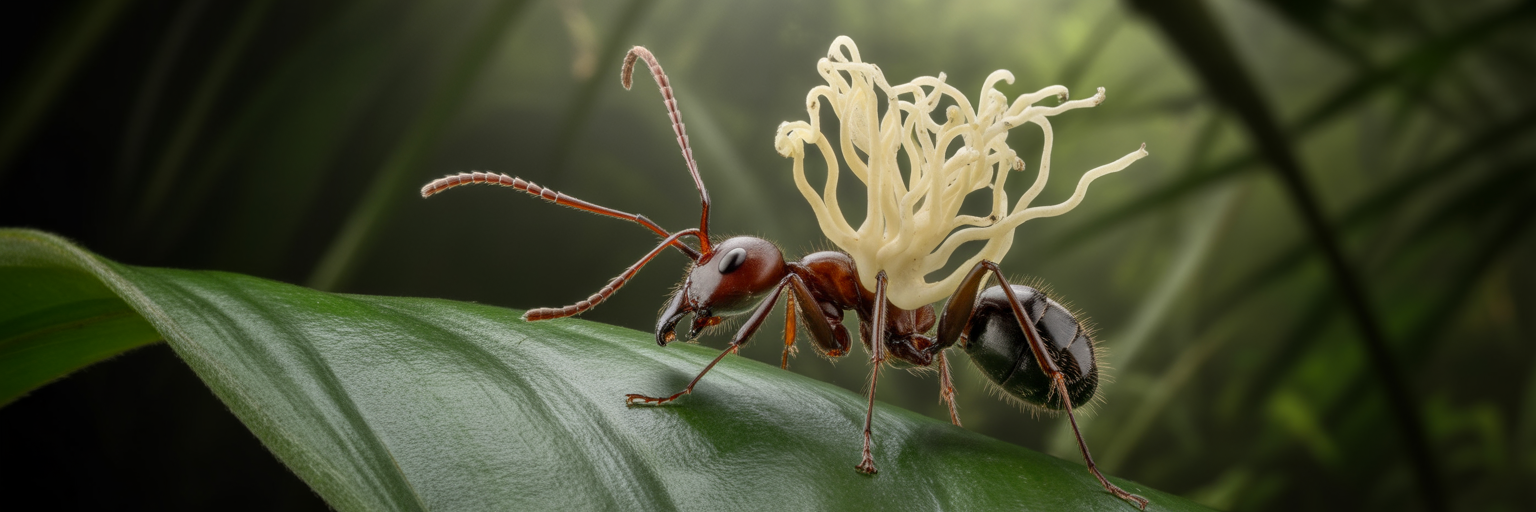
- The Zombie Ant Fungus (Ophiocordyceps unilateralis): This is a true sci-fi horror story. The fungus infects an ant and hijacks its central nervous system. It forces the ant to abandon its colony, climb a plant to a specific height and humidity, and perform a ‘death grip’ on the underside of a leaf. Once the ant is locked in place, the fungus sprouts a stalk from the ant’s head, raining spores down on the unsuspecting colony below.
- The Cat-Lover Maker (Toxoplasma gondii): This parasite has a brilliant, evil plan. It needs to get from its intermediate host, a mouse, to its definitive host, a cat. Its solution? Hack the mouse’s brain to make it lose its innate fear of cats. In fact, infected mice can become attracted to the smell of cat urine, making them easy prey. It is nature’s first self delivering pizza.
- The Tongue-Eating Louse (Cymothoa exigua): If you thought things couldn’t get weirder, meet this absolute nightmare. This crustacean enters a fish through its gills and latches onto its tongue. It then drains the blood from the tongue until the organ withers and falls off. But the louse is not done. It attaches itself to the tongue stub and becomes the new, fully functional tongue for the fish. It is the only freeloader that becomes a functional piece of furniture. Horrifying, yet weirdly practical.
The Parasite’s Transportation Network
So, how do parasites spread with such terrifying efficiency? They have developed a sophisticated logistics network that would make any delivery company envious. These transportation methods are the key to bridging the gap between hosts and ensuring the life cycle continues.
- Vectors: The Blood-Sucking Couriers. A vector is a living organism that acts as a delivery driver, transmitting a parasite from one host to another. The usual suspects are mosquitoes, ticks, and fleas. These unwitting, blood sucking couriers of the parasite world pick up infectious agents from one host and inject them into another, often without getting sick themselves.
- Trophic Transmission: The Food Chain Express. This strategy is all about getting from one host to the next by being eaten. It is the entire principle behind Toxoplasma making mice brave or other parasites making their hosts sluggish and easy prey. The parasite essentially weaponizes the phrase ‘you are what you eat’ to climb the food chain and reach its final destination.
- Paratenic Hosts: The Unplanned Layover. Sometimes a parasite ends up in the wrong host, one where it cannot develop further. Instead of dying, it enters a state of suspended animation inside a ‘paratenic host’. Think of it as a temporary storage unit or a safe house. The parasite just waits there until this transport host gets eaten by the correct definitive host. It is a clever evolutionary workaround to bridge a gap in the food chain and increase the odds of success.
Serving an Eviction Notice

After learning about their evil plans, you are probably wondering how we can possibly fight back. The good news is that understanding their intricate parasitic life cycles is the most powerful weapon we have. By identifying a weak link in the chain, we can break the cycle and serve these freeloaders an eviction notice.
If we know a parasite needs a specific snail to develop, like Schistosoma, we can focus on managing the snail population. If a parasite is spread by mosquitoes, like the one causing malaria, we can use bed nets and insect repellent to block the transmission. Every control strategy, from public health campaigns to agricultural practices, is built on exploiting a vulnerability in the parasite’s life plan.
Of course, we also have modern medicine on our side. Anthelminthic and antiprotozoal drugs are the chemical warfare we deploy once a parasite is already inside. These drugs are designed to attack a specific, vulnerable part of the parasite’s metabolism, stopping it from feeding, reproducing, or just plain living. So wash your hands, cook your meat thoroughly, and maybe think twice before taking a sip from that ‘crystal clear’ stream. You never know whose complex life plan you might be interrupting.