
Understanding Awful Parasite Life Cycles
Ever feel like you’re just a vehicle for someone else’s drama? Well, for some tiny creatures, you literally are. And their drama is messy. Welcome, friend, to the wonderfully horrifying world of Parasite Life Cycles. A parasite is the universe’s ultimate freeloader. It’s that roommate who never pays rent, eats your food from the inside, and redecorates your intestines without asking. Their “life cycle” is just a fancy term for their ridiculously elaborate game plan to survive, reproduce, and find their next unsuspecting host. It’s a masterclass in freeloading.
Let’s meet the main characters in this biological horror show. First, you have the Protozoa. These are the microscopic, single-celled party animals that, once inside you, multiply at a truly alarming rate. Think of them as a rave that starts in your gut and never, ever ends. Then there are the Helminths. These are the big, dramatic worms, the A-listers of the parasite world. Having them is like hosting an entire soap opera cast in your digestive tract, complete with love triangles and dramatic exits.
Finally, we have the Ectoparasites. These are the clingy surface-dwellers like ticks and fleas who treat your skin as both a five-star hotel and an all-you-can-eat buffet. They’re the ones who believe personal space is just a suggestion. So why are we talking about this? Because to defeat the enemy, you have to know their playbook. Think of this as a spy mission. We’re going to learn their master plan so we can laugh at its absurdity while also knowing how to avoid becoming the next stop on their world tour.
The Unappetizing Journey of Giardia
Let’s start with a classic, Giardia lamblia. This little guy is the poster child for why you should think twice before drinking from that “pristine” mountain stream. It’s the cause of “beaver fever,” a decidedly un-groovy experience that turns your insides into a disaster zone. Its life cycle is a simple but disgusting tale of fecal-oral transmission. Basically, what comes out of one animal’s rear end finds its way into another’s mouth. Nature is beautiful, isn’t it?
Giardia exists in two forms. First, there’s the tough, dormant cyst, which we can call its “interstellar travel pod.” This little tank can survive for weeks in cold water, just waiting for some thirsty hiker to come along. Once you swallow it, your stomach acid and gut juices trigger its transformation. Out hatches the trophozoite, the “party animal” stage. This pear-shaped critter with creepy, staring “eyes” and whipping flagella attaches to your intestinal wall and starts multiplying. It’s a full-on gut invasion.
This brings us to the delightful Giardia infection symptoms. Your body, quite reasonably, is not happy about this. The result is explosive diarrhea, stomach cramps, bloating, and gas that could peel paint off a wall. Your intestines are throwing a protest rally, and everyone is getting sprayed. To avoid this nightmare, the advice is simple. Filter or boil water from natural sources. Wash your hands like you just touched something sticky and mysterious. And be deeply suspicious of any water a beaver might have looked at funny. The moral of the story? Not all-natural spring water is a health drink. Sometimes, it’s a ticket to a very bad time.
Toxoplasma, The Cat’s Mind-Control Agent

If Giardia made you wary of water, Toxoplasma gondii will make you look at your fluffy cat with a newfound sense of suspicion. This parasite is a master manipulator with a bizarre, almost romantic obsession with felines. The cat is its one true love, its “final boss,” the only place where it can sexually reproduce. Every other warm-blooded animal, including us, is just an intermediate stop on its quest to get into a cat. We’re just part of the elaborate dating game.
The truly wild part of the Toxoplasma gondii life cycle is its mind-control party trick. When it infects a mouse or a rat, it doesn’t just hang out. It heads for the brain and starts messing with the wiring. It makes the rodent lose its natural fear of cats. In fact, it can make the rat actively attracted to the smell of cat urine. It’s like a tiny evil genius sitting in the rat’s brain, whispering, “Go on, cuddle the fluffy predator! What could possibly go wrong?” This brilliant, horrifying strategy ensures its host gets eaten, allowing the parasite to complete its journey back to its beloved cat.
So, how are parasites transmitted to humans in this case? We can get it from eating undercooked meat from an infected animal or from the infamous cat litter box. For most people, it’s a mild, flu-like illness or they don’t notice it at all. But it poses a serious risk for pregnant individuals and those with weakened immune systems. As a comprehensive review in the journal Parasites & Vectors highlights, the behavioral effects are well-documented in rodents. Whether it subtly influences human behavior is still a hot topic of debate, which just adds another layer of creepy fascination to this tiny puppet master.
Strongyloides, The Worm That Never Leaves
If you thought the cat parasite was weird, allow me to introduce Strongyloides stercoralis, the ultimate stage-five clinger of the parasite world. If this worm had a social media profile, its relationship status would be “In a lifelong, complicated situationship with your intestines… and it’s not planning on leaving.” This parasite’s claim to fame is its terrifying ability to create a self-sustaining infection that can last for your entire life.
Its standard life cycle is horrifying enough. The larvae live in contaminated soil, and when an unsuspecting person walks by barefoot, they burrow right through the skin. From there, they take a grand tour of your body, traveling through the bloodstream to the lungs. Then, in a truly gross twist, they get coughed up, swallowed, and finally settle in the small intestine to mature and lay eggs. Most of these eggs pass out of your body to continue the cycle. But Strongyloides has a unique trick up its sleeve: autoinfection.
Unlike most worms whose offspring need to leave the body to become infectious, some Strongyloides larvae can mature right there in your gut. They don’t even need to leave the building. They just burrow back into the intestinal wall or the skin around the anus and start the whole infection over again. This creates the potential for chronic human parasitic infections that can persist for decades. For most healthy people, it’s a quiet, lifelong freeloader. But if your body’s security system goes offline, like in people with weakened immune systems, the freeloaders can throw a full-blown riot that takes over the whole building, leading to a deadly condition called hyperinfection.
When Your Skin Becomes a Nursery
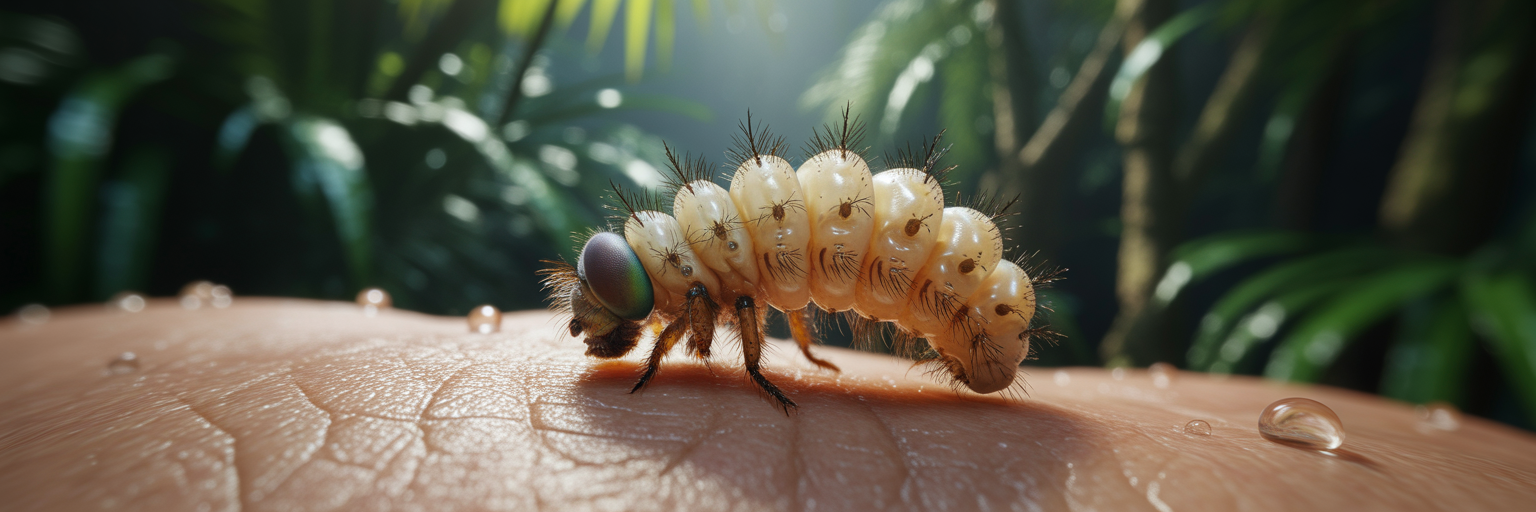
Let’s move on from the internal drama to the parasites that get uncomfortably personal on the outside. Meet the human botfly, the star of nature’s most horrifying parenting show. Some animals build cozy nests for their young. The botfly, on the other hand, decides your bicep looks like a great spot to raise its kid. It’s a real estate choice that is, to put it mildly, invasive.
The botfly’s life cycle is brilliantly evil. The large, fuzzy adult fly is too slow and obvious to land on you directly. So, it doesn’t. Instead, it performs a mid-air tackle on a mosquito, holds it down, and glues a few eggs to the mosquito’s belly before letting it go. The mosquito, completely unaware it’s now a delivery vehicle for a tiny monster, flies off to find its next meal. When it lands on you and starts to bite, your body heat triggers the botfly eggs to hatch instantly. The tiny larva drops onto your skin and burrows into the bite wound.
What follows is the stuff of nightmares. The larva sets up shop under your skin, creating a little breathing hole to the surface. It grows there for weeks, feeding on your tissues and occasionally wiggling. It’s the worst roommate imaginable, and eviction involves a doctor, not just a strongly worded text. And this isn’t a one-off phenomenon. Scabies mites are microscopic arachnids that complete their entire life cycle—mating, laying eggs, and dying—all within the top layers of your skin. Your epidermis is their entire universe. Try not to think about that next time you have an itch.
How to Evict These Unwanted Tenants
Okay, take a deep breath. You are probably not a walking, talking ecosystem for tiny monsters. Probably. But just in case, here’s how to post an eviction notice. The best defense is a good offense, and understanding these awful Parasite Life Cycles gives us the intel we need to stay safe.
It mostly comes down to common sense. To avoid Giardia, wash your hands and purify water from the wild. To dodge Strongyloides, wear shoes when you’re walking on soil in tropical areas. Worried about the botfly? Use insect repellent. The goal is to break the chain of transmission by not giving them an easy way in. And for those who do get infected, don’t panic. Modern medicine is on our side. Scientists have developed some very satisfyingly effective anti-parasitic drugs to tell these freeloaders that the party is officially over.
For travelers or the extra cautious, official resources can provide more detailed advice. For example, the U.S. Centers for Disease Control and Prevention (CDC) offers comprehensive guidelines on how to avoid these unwanted souvenirs. Knowledge is your best defense.
| Parasite | How It Gets In (Transmission) | How to Keep It Out (Prevention) |
|---|---|---|
| Giardia | Swallowing cysts from contaminated water or food (fecal-oral) | Filter/boil water from natural sources; wash hands thoroughly. |
| Toxoplasma gondii | Eating undercooked meat; contact with cat feces. | Cook meat to a safe temperature; wash hands after gardening or cleaning a litter box. |
| Strongyloides | Larvae in soil burrowing through bare skin. | Wear shoes when walking on soil, especially in tropical areas. |
| Human Botfly | Larva transferred from a mosquito bite. | Use insect repellent and wear protective clothing in endemic regions. |
| Scabies Mites | Prolonged skin-to-skin contact with an infected person. | Avoid direct, prolonged contact with infested individuals and their belongings. |
This table summarizes the transmission routes and key prevention strategies for the parasites discussed. It’s a quick reference guide based on understanding each parasite’s unique life cycle.
Why We Should Respect These Tiny Monsters

After all that, you might be ready to lock yourself in a sterile bubble. But here’s the thing: while parasites are undeniably gross, their life cycles are masterpieces of evolutionary engineering. They aren’t “evil.” They’re just ruthlessly, brilliantly good at surviving in a world that’s constantly trying to kill them. They have solved biological problems we can’t even imagine, all in the name of getting to their next meal and making more of themselves.
The scientists who dedicate their lives to mapping these bizarre pathways are the real heroes. Their work reveals the exact points where we can break the chain of infection, protecting not just individuals but entire communities from disease. By understanding how a worm travels from the soil to our lungs or how a protozoan survives in a mountain stream, we can develop strategies to keep ourselves healthy.
It’s a reminder that the natural world is a web of complex, strange, and often unsettling relationships that we are still just beginning to understand. Parasites are a fundamental, if creepy, part of that web. So, the next time you’re washing your vegetables or putting on shoes to take out the trash, give a little nod to the incredible, horrifying world of parasites. You’re outsmarting millions of years of evolution with a bar of soap. Now go wash your hands again. You know, just to be safe.