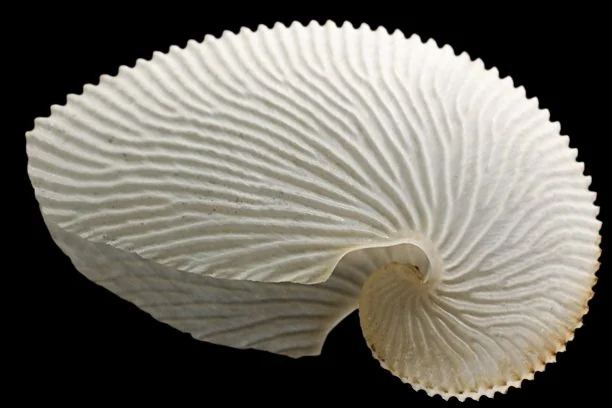
A female argonaut can lift her delicate, shell-like eggcase to the sea surface, capture air, and carry the bubble underwater. The result is a living submarine built around an octopus. Unlike giant larvaceans' disposable mucus houses, this structure combines a place for developing eggs with a way to manage the animal's position in open water.
Argonauts are sometimes called paper nautiluses, but that familiar name is misleading. They are octopuses, not true nautiluses, and the female's thin eggcase is not a chambered nautilus shell. Its spiral appearance invites the comparison. The way the animal obtains and manages gas inside it is an entirely different biological invention.
An eggcase that also changes buoyancy
An animal floating in seawater experiences an upward buoyant force associated with the water it displaces. Whether it rises, sinks, or remains at a depth depends on the balance between that upward force and its weight. An air pocket can make a substantial difference because a volume filled with gas weighs much less than the same volume filled with water.
That creates both an opportunity and a complication. A large bubble can pull an animal toward the surface when it wants to descend. But pressure increases with depth and compresses the gas. The argonaut's strategy uses that change: enough air captured at the surface can become a smaller, useful pocket at depth, where the animal reaches a more favorable balance.
How researchers watched an octopus collect air
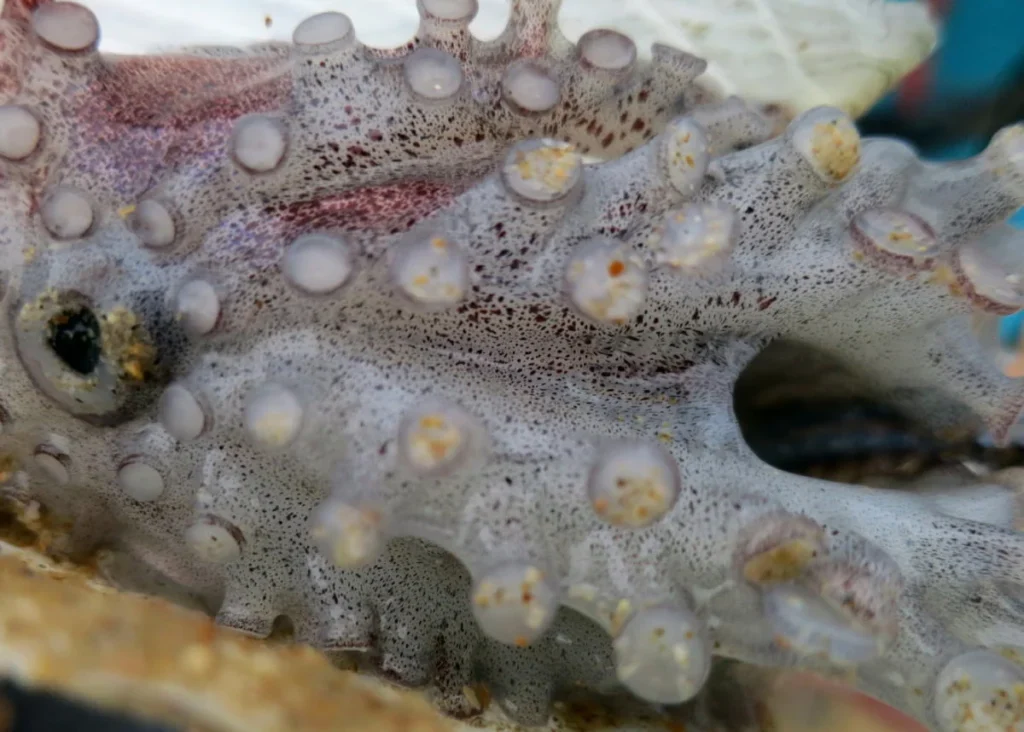
The field study of gas-mediated buoyancy control followed female Argonauta argo in the wild and manipulated their trapped air. The observations showed that air inside the eggcase was not merely an accidental inconvenience. Females actively acquired it from the surface, retained it using their arms, and then dived.
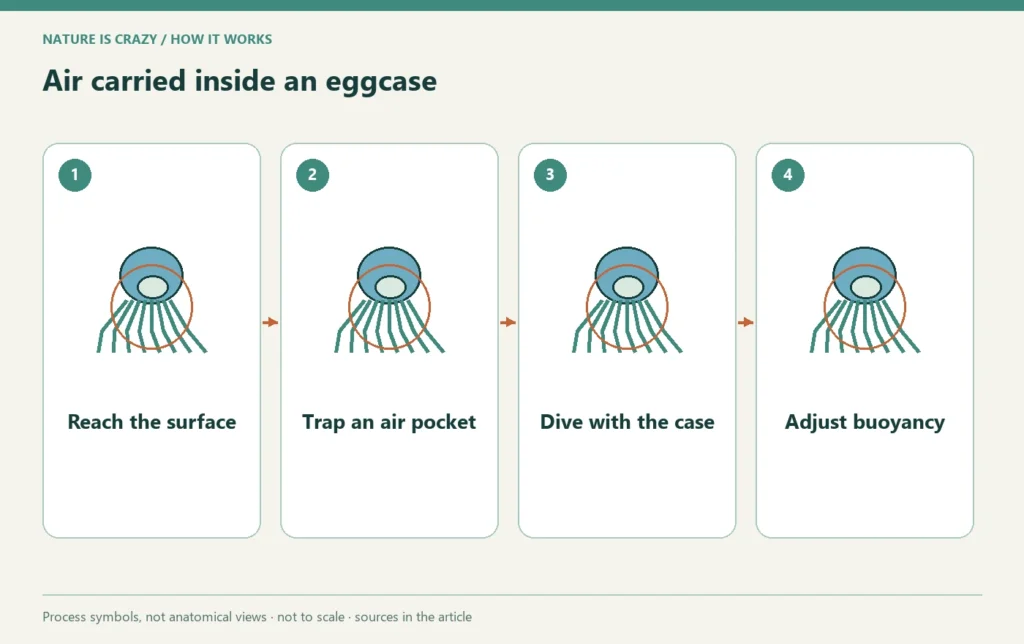
The researchers described a sequence of positioning the eggcase at the surface and moving it to take in air. The octopus then kept the collected gas in place while swimming downward. This behavioral control is the important point. A bubble found inside a captured specimen would not, by itself, reveal whether the animal had obtained it deliberately or whether it was useful.
Captivity can obscure the explanation. An aquarium that is too shallow may not let an air-carrying argonaut reach a depth where the bubble compresses enough. A behavior that works in a deep water column can therefore look awkward in a small tank. The field observations helped connect the anatomy to the physical setting in which it normally operates.
Why a nautilus comparison only goes so far
A true nautilus has a shell divided into internal chambers and uses a different physiological arrangement to regulate the contents of those spaces. The argonaut does not simply fill a series of closed chambers with gas. It carries a captured air pocket in an open shell-like structure, managing that pocket through posture, arms, swimming, and depth.
This is a useful contrast with bacteria's protein-walled gas vesicles. Both examples concern buoyancy, but the structures, scales, and sources of gas differ. Similar physical challenges do not require organisms to use the same biological machinery. “Floating with gas” is a broad outcome, rather than evidence of identical anatomy.
Genetic evidence also places argonauts among octopuses. A mitochondrial-genome study of the greater argonaut examined its evolutionary relationships and supported its place among those relatives. The shell-like appearance should not outweigh the rest of the animal's biology when deciding what it is. An octopus can evolve a spiral eggcase without becoming a nautilus.
Females carry the conspicuous structure
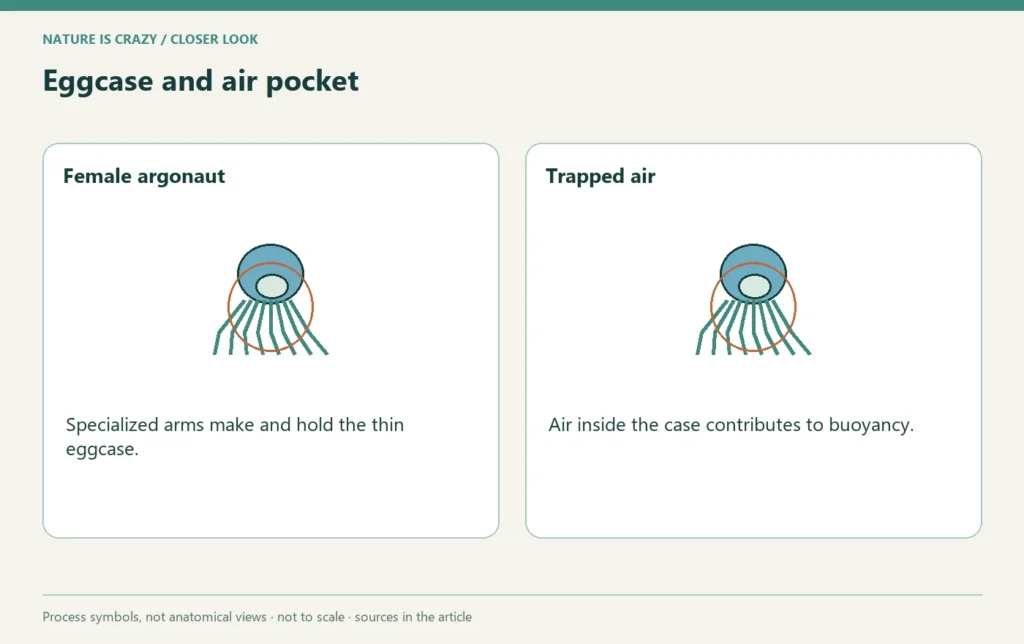
The large, delicate eggcase belongs to the female's reproductive biology. It supports developing eggs, and carrying those eggs changes the load the animal must manage. Buoyancy control therefore matters alongside brooding. A structure associated with reproduction can contribute to locomotion and stability, rather than serving only as a container.
Males do not carry an equivalent large eggcase. It is therefore inaccurate to picture every argonaut as an octopus permanently enclosed in a paper shell. Sex differences are central to the natural history of these animals. A photograph of a female in her eggcase represents a particular form and life stage, rather than the universal appearance of the group.
Nor is the eggcase literally paper. It is a thin, mineralized biological structure. “Paper” describes its fragile appearance, not its chemical composition. The distinction becomes useful when discussing how an animal assembles material outside its body: its structure is more like a carefully built biological composite than a scrap of folded plant fiber.
An evolutionary return to external protection
Researchers have also investigated the argonaut genome and the evolution of its shell-like eggcase. Such comparisons ask how genetic toolkits can be recruited into a distinctive structure. Finding related genes in other mollusks does not mean those animals all produce the same structure, or that a gene's presence alone tells us exactly where minerals are deposited.
This is a case in which evolution and engineering meet without conscious planning. Selection can retain a structure because of the opportunities it offers, and later modifications can change how it functions. The physical behavior of air and water supplies constraints that any resulting anatomy must satisfy. An eggcase that helps an animal occupy open water is an especially striking outcome.
The best part of the argonaut story is observable: an octopus goes to the surface, acquires a bubble, and takes it down. Compare that with barreleyes adjusting their eyes while changing position. In both animals, watching behavior explains why the anatomy looks so odd. The argonaut's apparent ornament becomes functional diving equipment, and the open ocean becomes a place an egg-carrying octopus can inhabit without simply sinking to the bottom.
Featured image credit: Thin white eggcase made by a female Argonauta argo. Image: Emőke Dénes; Wikimedia Commons source; CC BY-SA 4.0. Resized and converted to WebP.
Featured image credit: Thin white eggcase made by a female Argonauta argo. Image: Emőke Dénes; Wikimedia Commons source; CC BY-SA 4.0. Resized and converted to WebP.