
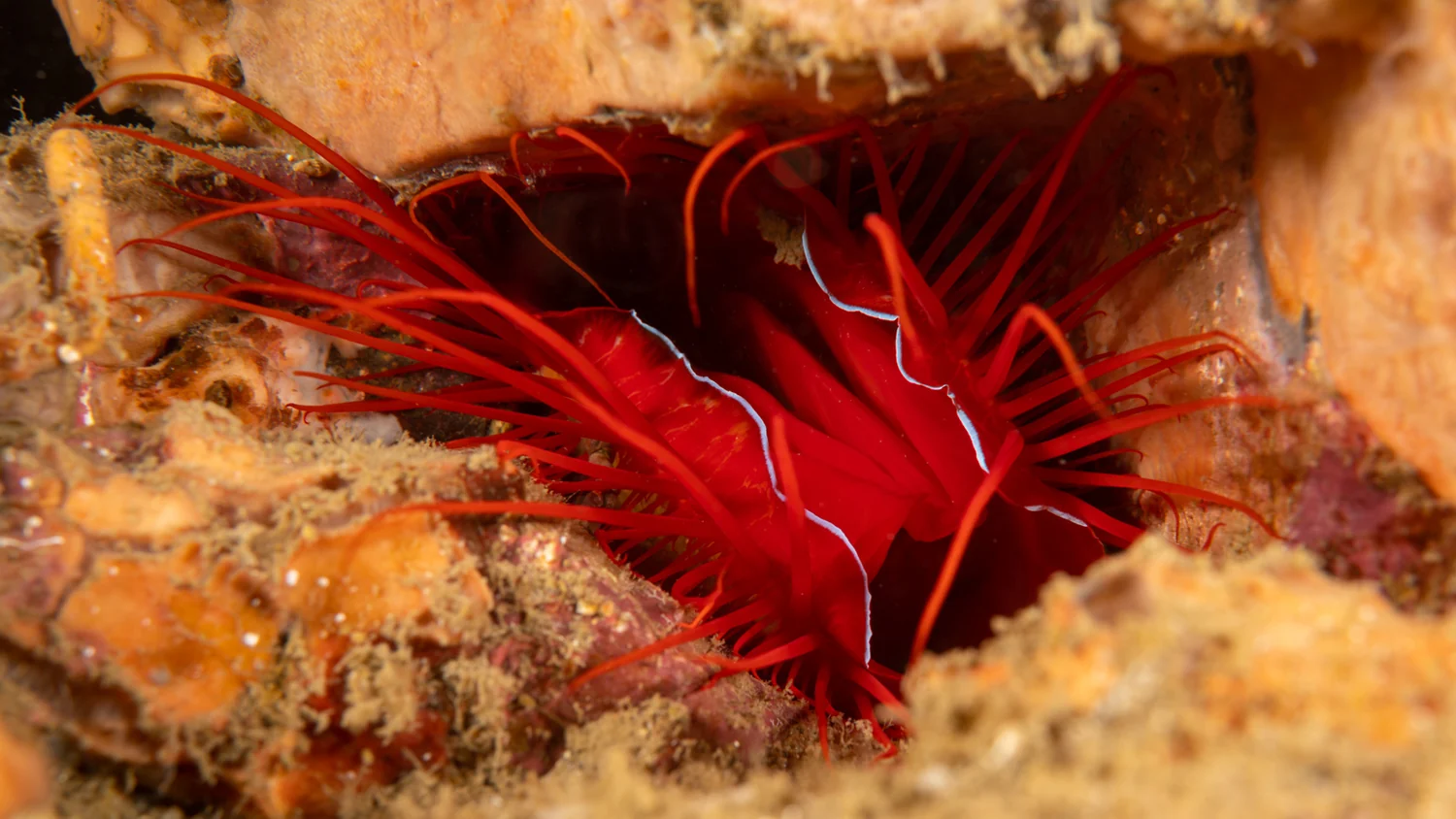
Inside a reef crevice, a disco clam appears to run a strip of flickering electricity along its body. The bright line opens and closes beside long tentacles, producing a display that looks far more technological than a clam should manage. Like the structural shine of metallic blue Pollia berries, however, its brilliance begins with how a surface handles incoming light. Distinguishing reflection from animal biofluorescence helps explain what kind of optical effect this clam actually produces.
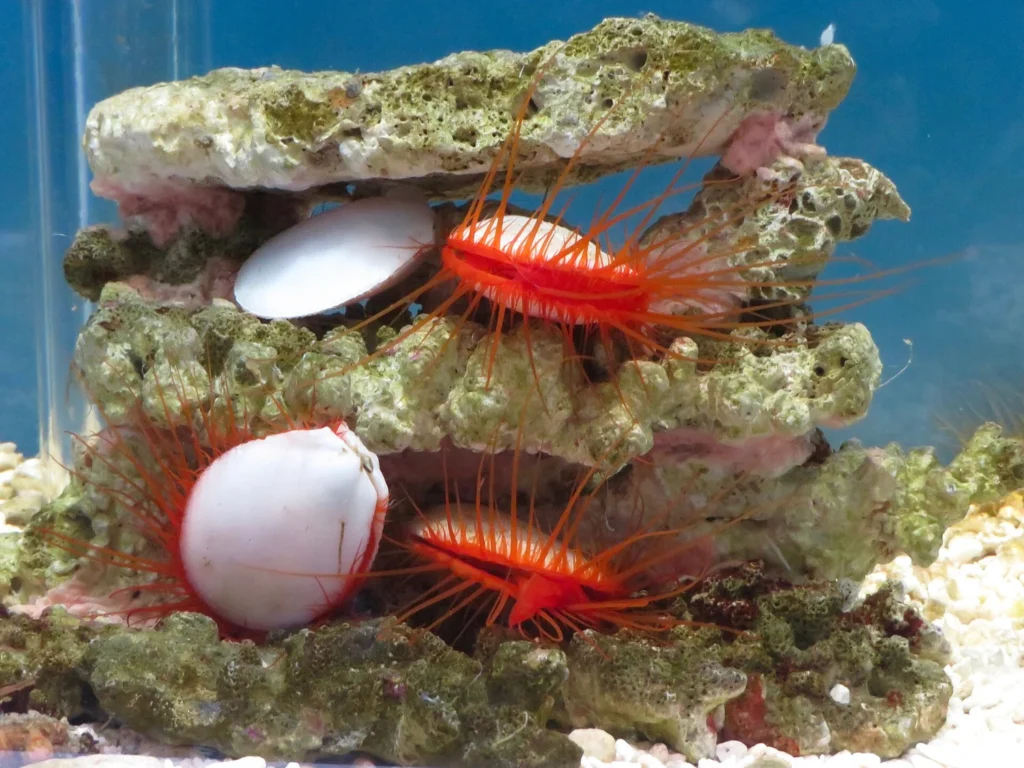
The animal is Ctenoides ales. Its flashes are reflections, rather than light made through a bioluminescent chemical reaction. Microscopic silica spheres provide the reflective material, and a rolling movement of tissue repeatedly exposes and conceals it. The effect resembles a blinking light because the animal alternates a bright face with a much darker one.
A flashing edge with two different faces
The relevant tissue lies along the mantle, the soft body region associated with the shell. Its edge has two optically different sides. One contains dense collections of tiny silica spheres and scatters light strongly. The other is much less reflective. As the edge curls and uncurls, an observer sees rapid changes in the amount of returned light.
Think of turning a small reflective strip toward a lamp and then away from it. The strip does not need a battery to appear to switch on and off. The clam performs a comparable optical trick using living, moving tissue. The difference between the two surfaces makes that movement visually dramatic, even though the underlying structure is extremely small.
The reflector is built from silica spheres
In the study that characterized the broadband reflector, researchers combined microscopy, measurements of reflected light, chemical analysis, and optical modeling. The spheres were roughly three-tenths of a micrometer across. At that scale, their size and arrangement influence how visible light scatters through the material.
Silica is familiar as a major component of glass, but the clam is not carrying tiny manufactured glass beads. It makes a biological structure whose composition and geometry produce a useful optical effect. This is a good example of why a material's appearance depends on arrangement as well as chemistry. Identical ingredients can behave differently when assembled at different scales.
The broader optical result is especially relevant to the blue-green light available underwater. A reflector suited to the wavelengths reaching an animal's habitat can remain conspicuous where other colors are relatively weak. That does not mean the clam is choosing a favorite color. Its anatomy operates within the physical conditions of the water around it.
Why the display is not bioluminescence
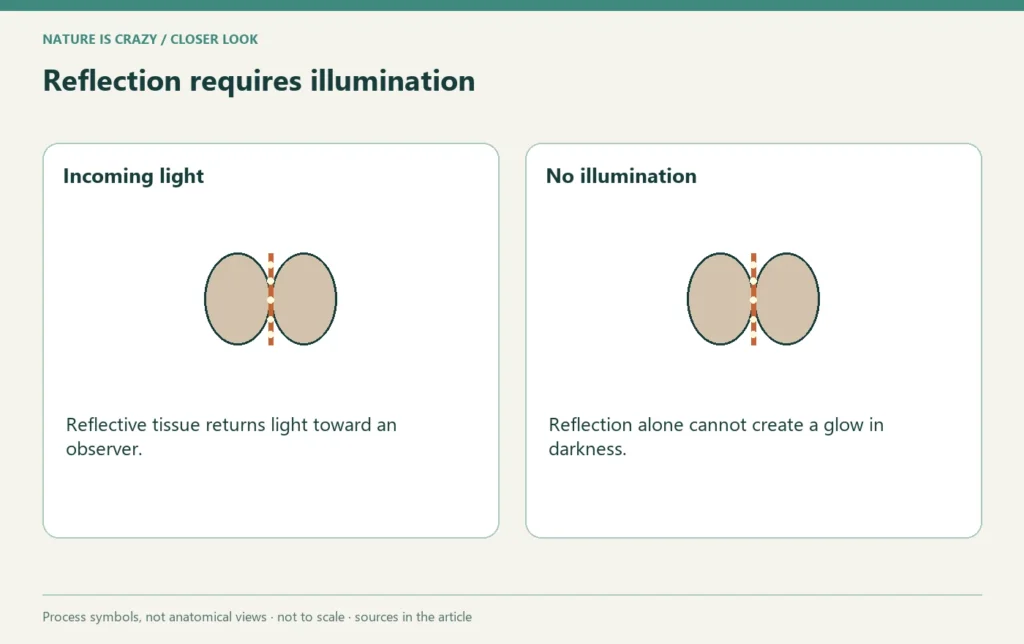
Bioluminescent organisms produce light through chemical processes. Reflection requires light from elsewhere. The distinction is easy to miss in underwater videos, where a camera's illumination can make the flashing edge look brilliantly self-lit against a dark background. A dramatic recording therefore shows the behavior, but the recording alone does not identify its energy source.
The comparison with yellow-light-producing Tomopteris worms is useful. Those worms present a problem in light production; the disco clam presents a problem in light scattering and movement. Treating both as simply “glowing animals” hides the most interesting biological difference between them.
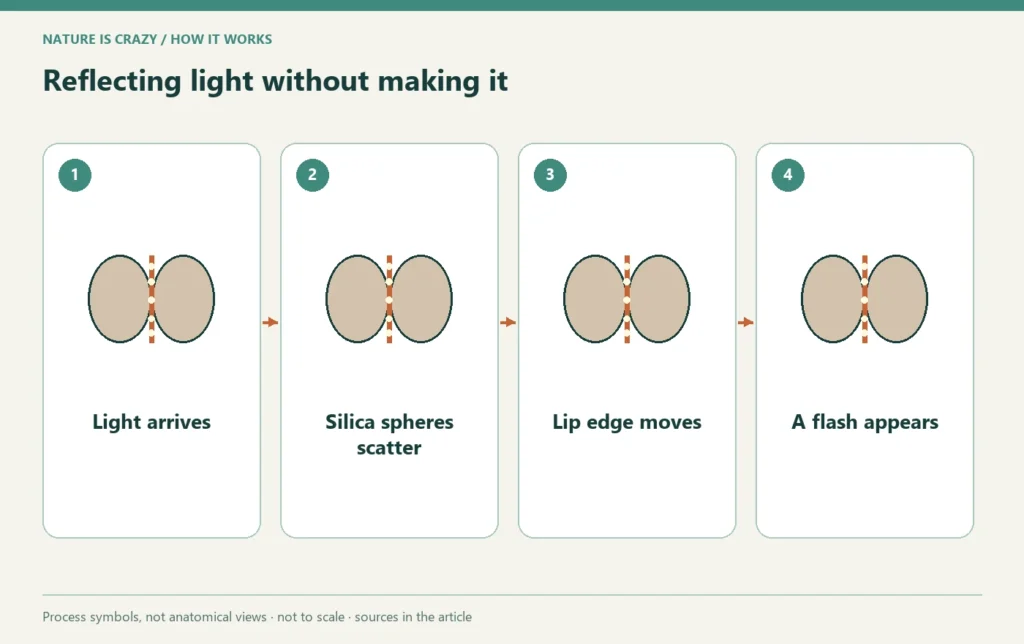
High-speed recordings helped connect the visible flicker to movement of the mantle edge. Microscopy then supplied a mechanism for the contrast between its two faces. Those independent lines of evidence are stronger than identifying the phenomenon by its nickname. “Electric clam” is a memorable label, but it is not an account of how the display works.
Can another disco clam see the flashing?
One obvious possibility is that the flashes communicate with other disco clams. Testing that idea requires more than observing several animals together. A signal must be detectable by the proposed receiver. Investigators therefore examined the eyes and light responses of these clams, rather than assuming that producing a striking display automatically implies sharp vision.
The study of disco-clam visual capabilities found eye structures consistent with coarse light detection rather than detailed image resolution. The authors concluded that the clams were unlikely to resolve the flashes of nearby members of their own species in the way a human camera records them. That result weakened a simple clam-to-clam visual signaling explanation.
The animals did respond to changes in illumination and approaching stimuli. Detecting an approaching object or a shadow is a different task from resolving another animal's rapidly changing mantle edge. An eye can be useful without forming a detailed picture. This is why the quality of a receiver's sensory system belongs in any explanation of a display.
The purpose remains more uncertain than the mechanism
Changes in flash rate during experimental approaches are compatible with a defensive role, but a response to a stimulus does not prove every detail of predator deterrence in the wild. Researchers have considered several functions over time. The clearest established result is the optical mechanism; the full ecological effect requires additional observations and experiments.
A chromosome-level genome study provides another kind of resource for examining this unusual bivalve. Genomic information can help scientists compare sensory systems across related animals. Sequencing an animal, however, does not by itself tell us what every flash means to a predator approaching a crevice.
That combination of certainty and open questions makes the disco clam more interesting. We can explain how a soft tissue edge becomes a moving reflector while still investigating why the animal benefits from using it. For another way tiny structures change appearance, explore peacock spiders' unusually dark patches. A clam can make a light show, and a spider can make a light trap: both depend on the structure of a surface rather than a supernatural color.
Featured image credit: Disco clam with red tentacles and a bright reflective mantle edge. Image: Stefan Brending ( 2eight ); Wikimedia Commons source; CC BY-SA 3.0 de. Resized and converted to WebP.
Featured image credit: Disco clam with red tentacles and a bright reflective mantle edge. Image: Stefan Brending ( 2eight ); Wikimedia Commons source; CC BY-SA 3.0 de. Resized and converted to WebP.